

Essay
Happy Hour
On Ryusuke Hamaguchi’s international breakthrough film.
Share:
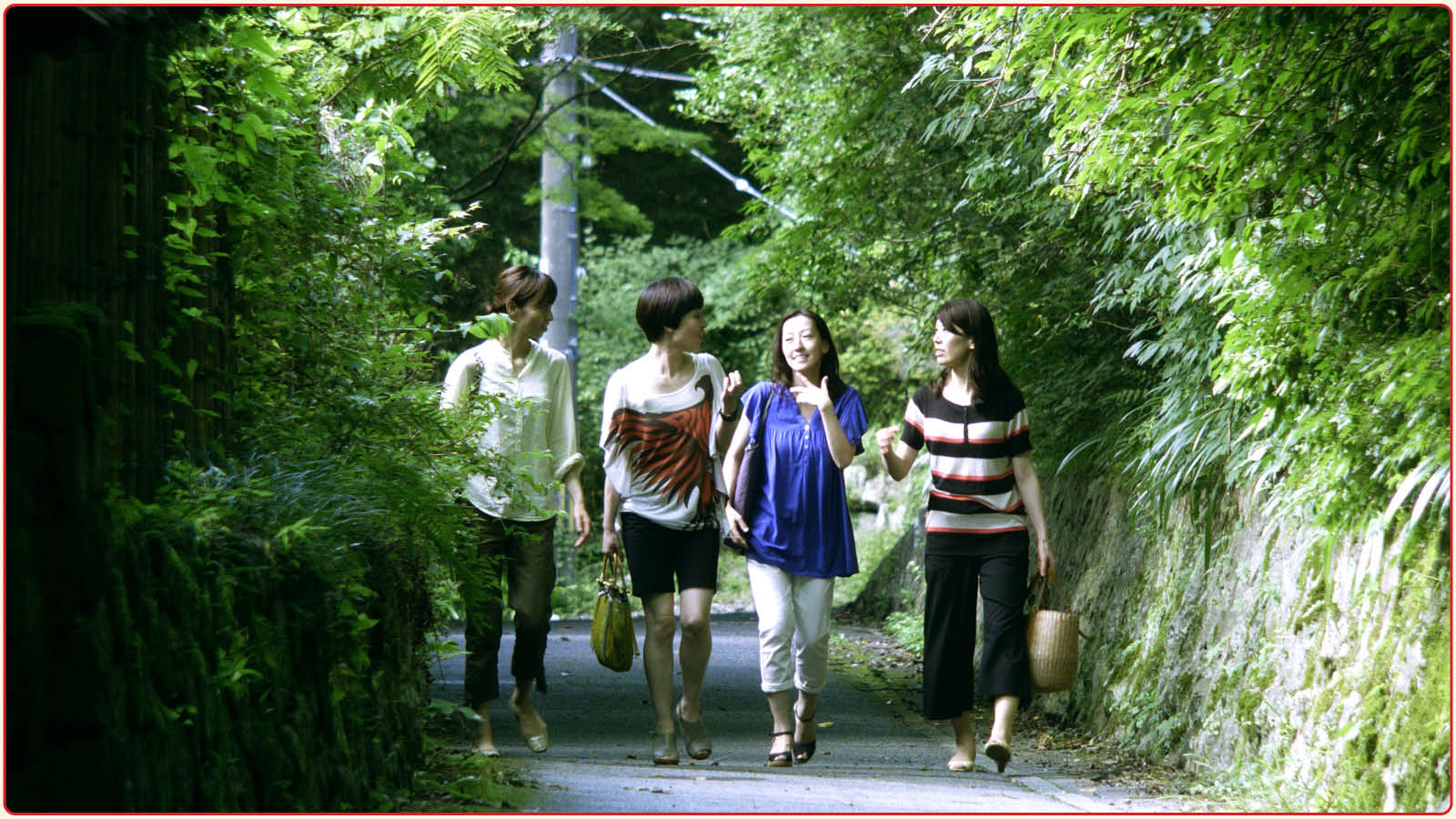
It’s a relatively common joke to point out that the five-and-a-half-hour epic Happy Hour (2015), Ryūsuke Hamaguchi’s breakthrough film, has been affixed with a title denoting a substantially shorter time span. It is true that at least three scenes take place at bars, izakaya, or clubs, and involve drinking, but there is no single, delineated length of time where, in the most literal sense of the term, the four women at the center of the feature—divorced nurse Akari (Sachie Tanaka), frustrated housewife Sakurako (Hazuki Kikuchi), married artistic events planner Fumi (Maiko Mihara), and the enigmatic Jun (Rira Kawamura)—can be said to experience unbridled bliss.
Perhaps the closest moment is the opening scene: a funicular excursion to the top of a mountain adjacent to Kobe, the port city where they all live, cross paths, break apart, and come together again. Heavy fog shrouds the cityscape, and Jun comments that the overwhelming gray resembles the future of this quartet of late-thirties women: a wry but light-hearted comment that, even as they turn their attention towards their shared lunches and plans for the next outing, will be tested and challenged. Every encounter they have afterwards will force them to examine their preconceptions about the precise nature of their relationships and the right ways to approach the difficulties of living. Hamaguchi’s exquisitely patient approach encourages the viewer to undertake this process in kind, forging a connection with the characters fostered by the intimacy of his filmmaking.
Happy Hour (2015)
The film was born from a 2013 improvisational workshop, organized by Hamaguchi during his artist-in-residency at KIITO Design and Creative Center Kobe (where Fumi works and some of the film’s scenes are shot). At this workshop, he discovered the non-professional actresses who would occupy the key four roles; none of them had prior cinematic acting experience, and for all of them this remains one of, at most, two film appearances to date (Kikuchi’s two credits include her recent turn in Hamaguchi’s 2023 film Evil Does Not Exist). While almost every scene takes place from one or more of the women’s perspectives, care is given to allow each of the characters time to shine.
Happy Hour is generally couched in an extended contemplative register, utilizing a mostly reserved emotional tenor as the protagonists slowly navigate quotidian events on the border between realism and melodrama: most notably Jun’s secretive divorce proceedings which comes close to tearing the previously close group of four apart. But Hamaguchi’s film is exceptional for how its duration is used to cement its firm rootedness in the present and the relationships that develop over the span of about half a year. The effect of sitting with these sprawling narratives for such a lengthy period of time is inviting (rather than punishing): the odd momentum that Hamaguchi’s style generates—alternating short, ordinary moments of these women about their everyday duties with elongated sequences of unexpected encounters—is necessary to depict the full extent of his characters’ experiences.
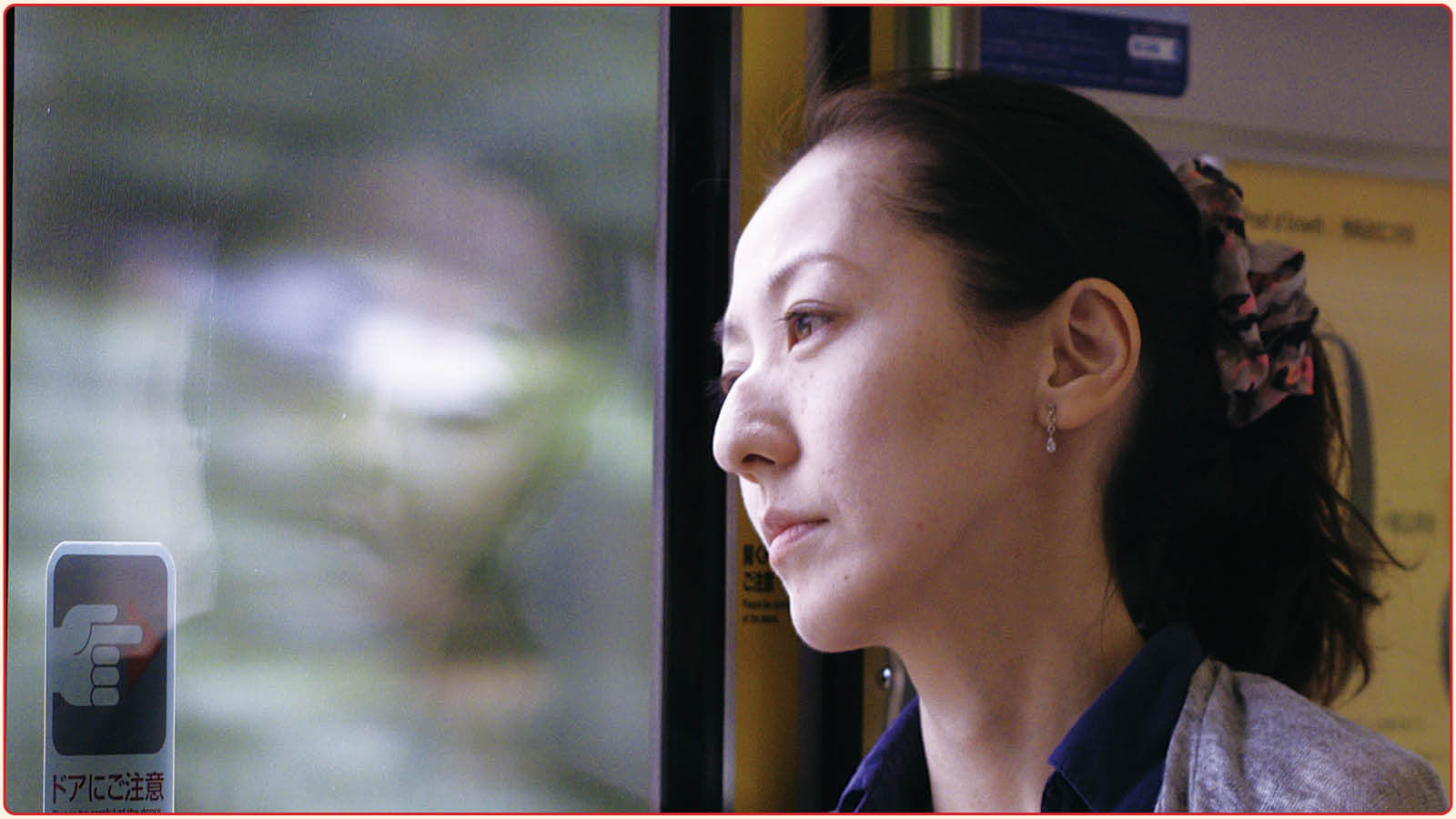
Happy Hour opts for linearity within each given narrative perspective, creating a coherent sense of experience. On multiple occasions, a character gives a long monologue about their past ordeals: the viewer experiences their emotions in “real time,” observing their intonations and expressions and the reactions on the listeners’ faces. In such moments, Hamaguchi and his co-writers Tadashi Nohara and Tomoyuki Takahashi (under the collective name Hatano Koubou) reveal an uncommon patience and a dedication to the beauty of the spoken word. These protracted scenes of dialogue contain discrete recollections that feed into the film’s separate narrative strands. In one scene, for example, Akari and new acquaintance Kazama (Hajime Sakasho) discuss their respective marital separations, which will ultimately influence Sakurako’s tentative romantic interest in the latter and Jun’s own plans to leave her husband.
Happy Hour (2015)
In Happy Hour’s centerpiece 30-minute sequence, beginning less than half an hour in, the artist’s workshop hosted by Ukai (Shuhei Shibata) launches the film into a series of modules on the possibilities of non-verbal communication. Attendees practice familiar and not so familiar “trust” exercises, such as two people standing up by using their backs to support each other, touching foreheads to transmit a thought, or aligning their center lines and moving circularly in tandem. One of Hamaguchi’s most frequent formal gambits is a shot of a character looking directly into the camera, and it first appears in this film when Ukai and his partner are completely aligned, a match cut from the back of Ukai’s head to his partner’s face. The effect is to place the viewer in, if not a specific character’s place, then a state of complete communion with the subject, used for both the main women and the many other characters that come into their orbit.
The immersion of this sequence finds its unanticipated complement in a similarly elongated series of scenes immediately after Jun takes her leave from the film: young author Kozue (Reina Shiihashi) gives a timid reading of her short story, before Jun’s emotionally manipulative biologist husband Kohei (Yoshitaka Zahana) is enlisted to fill in as Q&A moderator. It is true that, through much of Kozue’s recitation, her prose seems tepid, underscored by a few choice shots of bored attendees, but Hamaguchi’s insistence on dwelling here—and then providing a full-length, positive dissection from Kohei—transforms it into an indelible experience. Hamaguchi’s lengthy approach draws parallels between this weak text and Ukai’s more obviously compelling workshop, challenging the viewer to find the positive qualities in this particular manifestation of personal expression. In turn, these moments are interwoven with Fumi’s attempts to manage the event and Jun’s dalliance at a club with Ukai, a realignment of the viewer’s expectations that occurs at the same time as the women’s own reassessment of themselves and their quasi-adversaries.
As is the case with so much of Happy Hour, the everyday is not so much elevated as revealed, a constant process of finding dignity in the little moments and the strength to grasp onto any opportunity to better one’s own position. If the ending finds the quartet fractured and in an uncertain state, the film still faces the future with a renewed capacity for hope: the sun shines bright.

Happy Hour (2015)
Share:
About the Contributor
Recommended
- Juliette Binoche
 On the eloquent hunger of the iconic French actress.
 - I’m Not Everything I Want to Be
 On Libuše Jarcovjáková, the queer photographer drawn to the social fringes of Soviet Prague.
 - Letters to His Wife
 Translated into English for the first time, a selection of the esteemed Soviet filmmaker’s devastatingly honest and bittersweet letters.