
Essay
A Girl is a Gun
On Luc Moullet’s beautifully perverse and eternally shapeshifting Western.
A Girl Is a Gun opens at Metrograph on Friday, December 19.
Share:
A Girl is a Gun (1971)
Luc Moullet’s A Girl is a Gun (1971) is a Western like no other, shot in France’s Southern Alps (the Alpes-de-Haute-Provence), caught literally between a rock and hard place, propelled by wild swings and random bursts of energy. Moullet created a work of chaos on- and off-screen, a film of calculated offhandedness nonchalance and idiosyncratic specificity. The natural world feels overpowering at times; it is almost as if characters, narrative twists, even editing decisions, are in thrallto the spectacle of landscape. This newly restored version does justice to the film’s striking settings, and reinstates the original French-language audio—a welcome relief after the clunky English dub that circulated in the past. Its rampant oddness and disconcerting absurdity remain undiminished, even enhanced.
A Girl is a Gun was born from a mixture of opportunism and conviction. Moullet’s original title, Une aventure de Billy le Kid, was a peg on which to hang a sales pitch. With the addition of a New Wave star, Jean-Pierre Léaud, it sold in more than 40 territories worldwide, although it wasn’t picked up in France. But the project also had its personal aspects. Moullet drew on two key elements: the physical environment, particularly the mountainous terrain of his childhood; and the movies he devoured as a young filmgoer and aspiring critic.
He was born in Paris in 1937, to a family from the Southern Alps, a location that he has returned to frequently in his life and his art. It has been a setting, a subject and a reference point for many of his films. He has a particular fondness for an area known as “les roubines”, or “the badlands,” a bleak, steep, sparsely vegetated part of France, remote and inaccessible. His first feature, Brigitte et Brigitte (1966), is set in Paris, but the young women of the title discover they both hail from the mountains: one from the Pyrenees, the other from a tiny village in the Alps without roads or electricity. This is Miraud, where Moullet’s grandmother came from, and it is the location for a dramatic scene towards the end of A Girl is a Gun. In his second feature, The Smugglers (1968), he takes his characters to the Alps, in a tale of contraband, adventure, a love triangle and a smugglers’ union.
His interest in landscape, location and mountains was not simply aesthetic or personal; he had a very specific, almost nerdy fascination with detail. “I have always been passionate about places,” he says in Notre alpin quotidien, a short book of interviews. “I was programmed to be a geography teacher. I went straight from the feeding bottle to the Michelin map. I was attracted by everything I saw; at three or four years old, I could already read maps. I try to sense a place by looking at the map. It’s quite important in cinema. All I have to do is look at a survey map to determine camera angle.”
The austere way of life in the Southern Alps was part of his inheritance. It is one of the reasons why, he suggests, he became known as the shoestring specialist, working with impossibly low budgets in the shortest amount of time and with a minimum number of takes. In a 2011 documentary short, The Cinema According to Luc (2011), he recalls, “I’ve always had a fascination with the degree zero, and with the village some of my family members come from … the smallest village in France. So I place a higher bid on the zero, the pleasure of showing as little as possible and of having the barest territory possible. It is a love of nothingness and of the deletion of all elements.”

A Girl is a Gun (1971)
This does not apply to the kinds of films he admired and enjoyed, however. Moullet was passionate about films and movie publications from an early age. He remembers, as a nine-year-old, being impressed by Carl Dreyer’s Day of Wrath (1943) and poring over a lavishly illustrated issue of a magazine called L’écran français. A film club in Paris’s Latin Quarter allowed him to explore his passion more widely. At the age of 18, he published his first review in Cahiers du Cinéma, on director Edgar G. Ulmer, and went on to write regularly. One of his books makes a brief appearance in Jean-Luc Godard’s Contempt (1963); Brigitte Bardot is shown sitting in the bath reading Moullet’s work on Fritz Lang. Godard was a supporter of his criticism and his filmmaking from the earliest days.
Although Moullet emerged alongside the filmmakers of the New Wave, he has established himself separately, following his own path. Still active and engaged, he has made and produced an array of narrative films and documentaries, shorts and features, and written numerous reviews, articles and books. He remains proudly parsimonious and a passionate advocate for under-appreciated or overlooked filmmakers past and present. His film projects are distinctively, austerely his own, but cover an audacious, eclectic range of subjects and possibilities.
Over the years, he has told various origin stories about A Girl is a Gun. One of his cinematic heroes, Howard Hawks, was a master of genre, he says, making “the best comedy, the best crime film, the best Western. So I decided to follow in his footsteps,” he told documentary-maker Gérard Courant.When it came to the character of Billy the Kid, it wasn’t the historical figure that interested him; it was the name that he found appealing. In any case, there is nothing in the movie, except the original title, to suggest that the hapless central character is Billy. He is never identified. In casting Léaud, he has always acknowledged that it was a deliberately perverse choice; in a recent introduction to a screening of A Girl is a Gun, Moullet called the actor “the quintessential young man from Paris, ill at ease in his own body.”
Léaud brought other qualities to the central character. One of them, undoubtedly, was his reputation as “the child of the New Wave” that began with his remarkable performance as 12-year-old Antoine Doinel in Truffaut’s The 400 Blows (1959). By the time Léaud made A Girl is a Gun, he had played the character of Doinel in later life and appeared in some of Godard’s most significant films of the 1960s. He had also taken the opportunity to work with directors outside France who were making political cinema. This included Pier Paolo Pasolini, for whom he made Pigsty (1969) in which he plays a wealthy industrialist’s son with a bizarre obsession. For Glauber Rocha he went to the Republic of Congo to play a ranting preacher in The Lion has Seven Heads (1970), and for Carlos Diegues he travelled to Brazil to appear in The Inheritors (1970), the saga of a family and the struggle for power.

Luc Moullet, courtesy Cinema Guild
For A Girl is a Gun, Léaud brought every aspect of his singularity as an actor. He is a performer of commitment, and the film makes the most of his distinctive repertoire of gestures, his air of unpredictability, his gift for physical comedy; in a work that has little interest in dialogue, it even indulges his declamatory side. And in a way, there was a method to the madness of the casting choice. Notions of masculinity are at play in the film. Whatever else it might be, A Girl is a Gun is a film about a relationship: it is framed by a glimpse of a disheveled, damaged couple, a man and a woman, crouching together in what looks like a stable. Not until the end do we understand the context of this scene, and there remains a degree of mystery about it, an open, inconclusive conclusion.
In between it is a work in perpetual motion, an endless chase sequence of fits and starts, false steps and wrong moves. The characters are often slipping, sliding, struggling to keep their feet, falling over or down. And it is hard to work out where they are going and where they have been. As the outlaw is pursued by a sheriff and his deputy as well as a bounty hunter, Moullet plots a zigzag, vertiginous, occasionally leisurely course through terrain that shifts from jagged cliffs to stretches of desert. It’s an errant path that almost seems ridiculous, taking in steep slopes, gorges, lakes, forests, magnificent striated rock formations, and flat outcrops crisscrossed with lines and full of crevasses. The colors change, the landscape shifts, and so does the tone. The spectator is forced to wonder if this is a Western, a drama, a comedy, a tragedy, a burlesque, a satire, a psychological study, a willful exercise in misdirection, a tale of awkward amour fou or everything all at once?
But to begin with, the codes of the Western are deployed in an ostentatiously economical fashion. A stagecoach hold-up has just taken place; a vehicle lies upside down, and several bodies are scattered about the place. Léaud appears, a figure of insouciance and incongruity. He is brandishing two guns and sporting a black hat, a black bandana mask, a white collarless shirt and striped pants that make him look like the lead singer of a 1960s pop band. He makes off with several bags of gold coins: the first of many instances of objects that look like cut-price theatre props. One of the dead bodies, it turns out, is still alive, and Léaud pursues him with comic, bumbling zeal, firing at random. This incompetent gunplay continues throughout the film. Léaud’s character is the worst but not the sole offender. Moullet’s gunslinger is not only an inept shooter, he is also a cowboy without a horse. He travels on foot, with a donkey by his side. He has no sentimental attachment to the creature, we soon discover; the relationship does not last long.
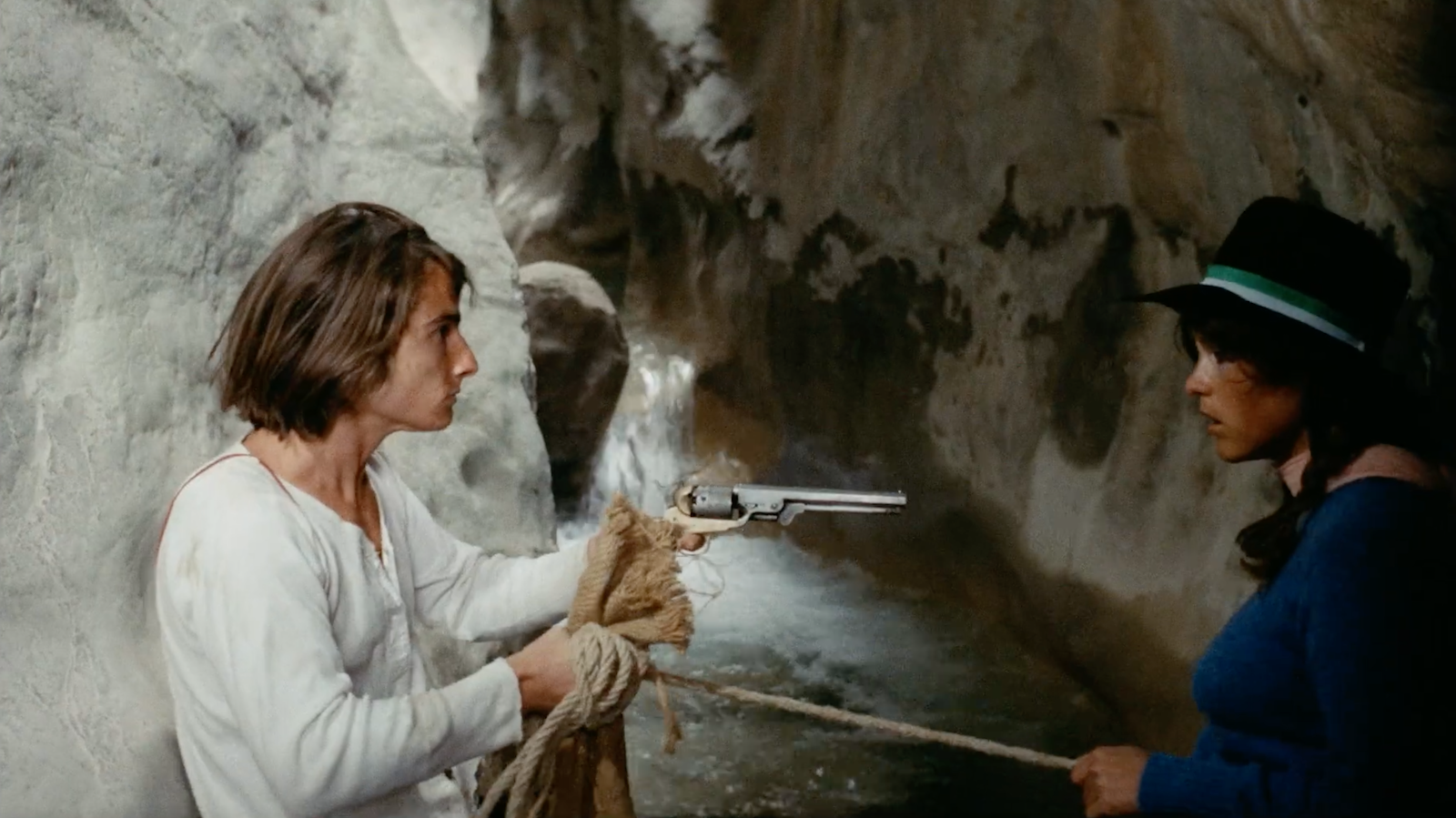
The transformational moment takes place when Billy, now on the run, comes across a young woman in what can only be described as bizarre circumstances. She is lying on the ground, covered in sand and emerges in an almost mythic or animal fashion. He takes her prisoner, rather awkwardly, ties her up, and for a while pulls her behind him on a rope, alongside the donkey. It’s not exactly an assertive, macho display. The dynamic between them is constantly in flux, but he never seems to be a match for her physically. Together, they seek to evade the forces of the law who are on their trail, or so it seems. Yet there is something tougher and more forceful about her character, even when she is Billy’s prisoner. You have the feeling she could overpower him at any time.
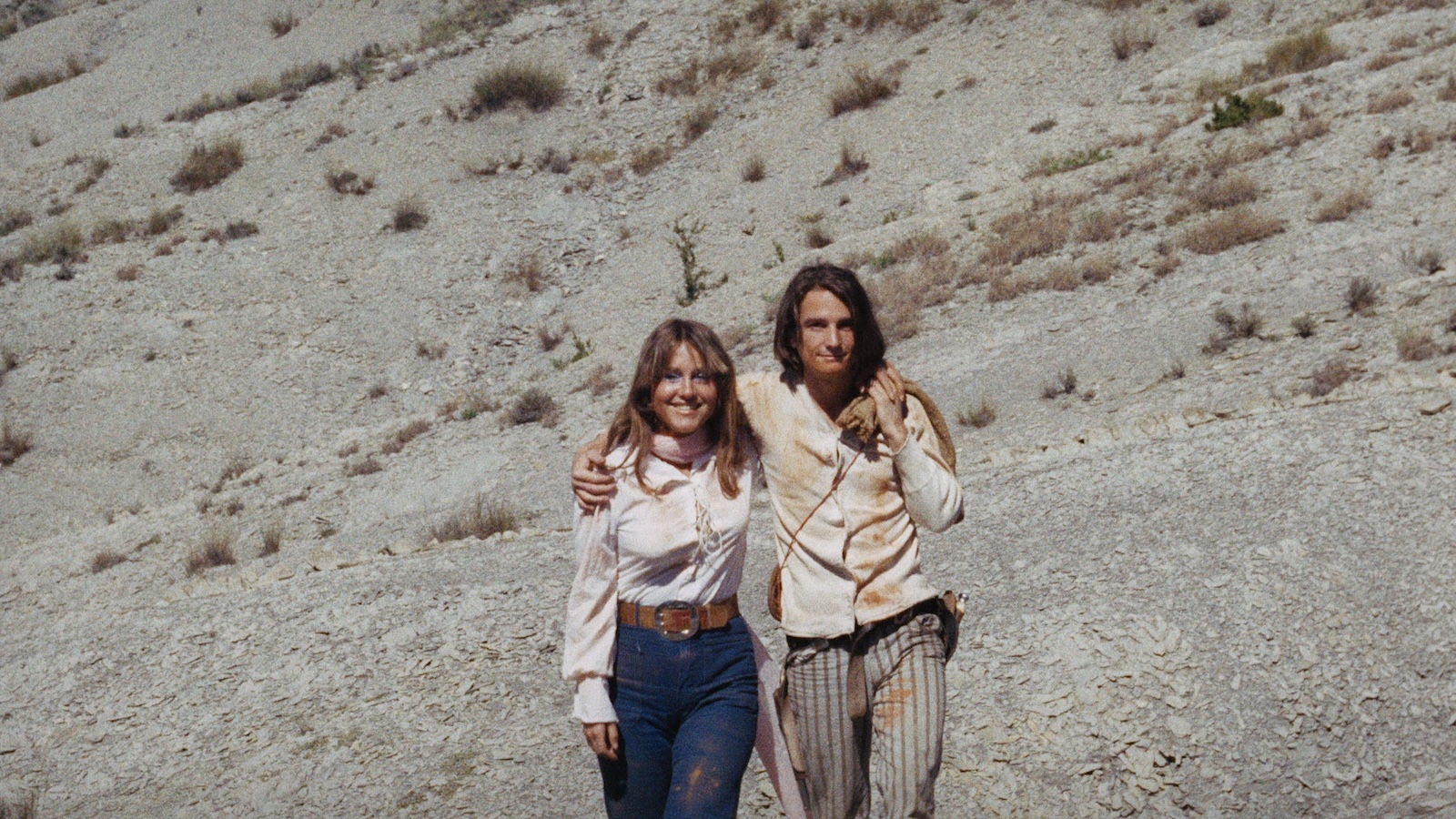
She is played by Marie-Christine Questerbert (credited in the film as Rachel Kesterber), making her acting debut. She was a philosophy student who was also interested in cinema and had a short film project that received Moullet’s support. Like Léaud, she has a ’60s vibe; she wears a blue sweater and a long, gauzy pink scarf, and her eyes are ringed with baby-blue eyeshadow. The minor characters in the film are outfitted with a Western-coded quasi-theatrical wardrobe; the leads look more like time-travelers. Their performance styles are very different. Questerbert plays the absurdity straight; Léaud embraces it.
A Girl is a Gun (1971)
Moullet’s alternative title, A Girl is a Gun, refers to a phrase Moullet says he borrowed from D.W. Griffith. It was an idea in circulation amongst the writers and filmmakers of the New Wave; its best-known iteration is probably Godard’s much-cited formula “all you need for making a movie is a girl and a gun,” which he also attributed to Griffith. In Moullet’s case, the new title shifts the focus from Billy the Kid to his female counterpart. It is also a phrase repeated over and over again in a song that can be heard twice in the film, half chanted, half sung by Questerbert. The lyrics, which are in English, represent two very different facets of “a girl”: abject the first time, powerful the next, echoing the course that the character takes. The song was written by Moullet’s younger brother, Patrice (later of the band Alpes), who composed the music for the movie. His score reflects the tonal shifts of the film, ranging from classic western harmonica to threatening drum beats to tinkling piano to psychedelic meltdown.
Perhaps inevitably, A Girl is a Gun’s Western tropes include Native American characters. One of the first things Questerbert’s character alludes to is an encounter with “Cherokees.” For much of the film, they make brief appearances on the edge of the frame, a source of anxiety, referenced or glimpsed. Their aim is true: in the world of A Girl is a Gun a bow and arrow is a far more accurate and deadly weapon than a rifle or a revolver. Towards the end, there is a shift: Native American characters are drawn into the drama of the couple, the tug-of-war between Léaud’s character and Questerbert’s. It is a clumsy development, although it does recall a strange moment, earlier in the film, when Léaud’s Billy tells a tale of woe about his isolated upbringing and the complete absence of women in his life. At this point, he seems like a kind of Lost Boy, a Peter Pan looking for his Wendy. It is almost as if the clunky Native American stereotypes are akin to those in J.M. Barrie’s Neverland.
The locations of A Girl is a Gun—in various parts of the Southern Alps—took their toll on the makers of the film as well as its characters. It was shot on 35mm, in extremely demanding conditions. Many locations were inaccessible by road; cast and crew travelled on foot, lugging equipment, supplies and food. It was an endurance test for all concerned. Questerbert was badly injured shooting a scene in which it was meant to look as if her character had fallen off a cliff. She fell more than 40 meters and fractured her lumbar vertebrae. Production was halted for a month while she recovered. Undeterred, however, Questerbert worked again with Moullet after A Girl is a Gun. She appears in his next feature, Anatomy of a Relationship (1975), a film poised between documentary and fiction about a couple in sexual crisis, made by Moullet and his partner, Antonietta Pizzorno, who had been a crew member on A Girl is a Gun. (He plays a version of himself; Questerbert, under the name Christine Hébert, takes the Pizzorno role.)
Moullet continues to re-examine and reflect on previous work, in films, essays and books. A good deal of his writing remains untranslated, but there are recent efforts to get more into circulation, notably in informal versions on the Seventh Art website. One of his latest books is his 2021 autobiography, Mémoires d’un savonnette indocile (Memoirs of a slippery piece of soap), a disarming account of his life through films, with an emphasis on budgets, locations and stories of misadventure. He’s a wry self-mythologist, self-deprecating and playful, and there’s a fascinating tell-all chapter on A Girl is a Gun that dishes the dirt on much that went on during the shoot. It also includes a remarkable roll call of films that influenced or inspired the work or that are referenced in it, everything from King Vidor’s Duel in the Sun (1946) to Sternberg’s The Shanghai Gesture (1941) to Benjamin Christensen’s The Devil’s Circus (1926). There is no mention, however, of any cinematic backstory for one of the film’s oddest odd moments: the occasion when the bounty hunter, mid-chase, settles down to a lunch of sandwich au jambon, deploying a knife, a fork, a plate, and a starched white napkin.
Share:
Recommended
- Orangey, Revisited
 A video essay ode to the inimitable feline screen star.
 - Green Snake
 On Tsui Hark’s subversive reimagining of an immortal Chinese folk tale, starring Maggie Cheung as a serpent demon.
 - Travel Companions: Bahram Beyzaie & Amir Naderi
 On two defining Iranian filmmakers, and two of their most enduring works.