
Columns
Cracked Actor: Carmen Maura
On the dynamic performances of the actress who shaped Pedro Almodóvar’s cinematic world.
Volver a Carmen opens at Metrograph Friday, May 30.

Share:
Women on the Verge of a Nervous Breakdown (1988). All About My Mother (1999). Talk To Her (2002). Right away, Pedro Almodóvar’s films announce his interest in women and femininity. The Almodóvarian woman is determined and dignified, beautiful, often sexually confident or promiscuous; there is sorrow in her, which she usually offsets with a salty humour. She is frequently a single mother and tends to have fraught relationships with men. She is modern.
From their first collaboration in Almodóvar’s feature debut Pepi, Luci, Bom and Other Girls Like Mom (1980), Carmen Maura reveals herself as the originator of this essence. It’s easy to see how his future female characters—as played by Cecilia Roth, Marisa Paredes, or Penelope Cruz—would build on the foundations laid by Maura across the six films she made with the director in the ’80s, culminating in her Best Actress win at the European Film Awards for Women on the Verge of a Nervous Breakdown. Afterward, a rift with Almodóvar would take her away from his work for nearly 20 years, before she returned to his universe in 2006 with Volver.
Little wonder that Almodóvar sensed an affinity with Maura, given her background. Born four years before the filmmaker, she grew up in Franco’s Spain, a scion of a wealthy and conservative family who turned their backs on her when she became an actor. Her husband left her, too, taking their young children with him. In 2004, Maura spoke to The Guardian about those years: “My decision [to become an actor] caused a catastrophe in my life. When the disaster came I had only one thing clear in my mind, that acting was my only happiness, my only support.” Throughout the ’70s, she worked various small-time jobs and performed in local plays, rubbing shoulders with queer creatives, punks, and a new generation of emancipated Spanish women. The domestic independence she found—the way she cast off the shackles of class and sex—these elements of the “new feminine” would recur again and again in Almodóvar’s work. By the time she came to work with Almodóvar on the films that turned her into an international icon, she was already established in Spain, appearing in Carlos Saura’s Blindfolded Eyes (1978) and working twice with Fernando Colomo on Paper Tigers (1977) and What’s A Girl Like You Doing in a Place Like This? (1978).

Pepi, Luci, Bom and Other Girls Like Mom (1980)
Maura’s personal experience lends an uncanny metatextual quality to Almodóvar’s early filmography, which is largely focused on pricking at the bourgeoisie and exploring the lives of bold, striving women, albeit often confined to abusive relationships. In Pepi, Luci, Bom and Other Girls Like Mom, Maura plays the determined young Pepi, who is sexually assaulted by a police officer (Félix Rotaeta) in the film’s opening scenes (far from Almodóvar’s last dubious staging of a rape); Luci (Eva Siva) is the policeman’s housewife, who leaves her older husband and falls in with a bunch of cheerfully inclusive freaks and homos, not least Bom (played by then 16-year-old singer Alaska), a lesbian in a punk-rock band whose exuberant performance with her band is lovingly filmed here.
A vibrant Maura, brisk and impish, functions as a guiding spirit here, leading Luci and audiences into this anarchic new world. In an attempt to gain revenge on her attacker, Pepi befriends his wife, and when she discovers Luci’s attraction to sadomasochism, invites Bom to urinate on her: this is the instigating act that brings Luci out of her constricting marriage and into the fold. Soon, she is cheerfully fellating the winner of a “General Erection” party hosted by Pepi and—in a cameo—by Almodóvar himself. John Waters is clearly his primary influence here, and while it’s fun to see him set out to shock the old world, it’s Maura who runs away with the film: she presents a fully embodied character, lending texture and depth. This is visible in her general aura—straight-backed, luminous, professional—which contrasts with the more amateur performances around her. In the General Erection scene (basically, a dick-measuring contest, subverting Spain’s recent general elections) she seems to oversee proceedings by the same token as Almodóvar himself; there is a sense that, like him, she is a fellow progenitor of the project, not just one of his creations.
Almodóvar gives her more to do as he becomes more ambitious: Dark Habits (1983) is an entertaining curio from a director still indulging in provocation, but doesn’t use the actress a great deal. But by the time of What Have I Done to Deserve This? (1984)—still a little scrappy from a formal point of view, and occasionally marred by flippancy—Maura gets a satisfyingly meaty character. Loosely based on Roald Dahl’s short story “Lamb to the Slaughter,” the film depicts the life of a downtrodden housewife—surrounded by a boorish husband and misbehaving children—who ultimately resorts to extreme measures to free herself. As Gloria, Maura is given a more dowdy aspect than usual: Far from the fluorescent colors and sequins she donned in Pepi, Luci, Bom, here Maura is weighed down by heavy cotton cardigans and aprons in muted tones. In this, his fourth film, Almodóvar has still not attained his more expansive style: opulent and lavish, with a keen eye for design and costume that echo his taste for heightened emotionality. What Have I Done to Deserve This instead evokes the subversive chamberpieces of Fassbinder (another post-war queer European director with a sympathetic eye for complex women and a fascination with bold actresses).
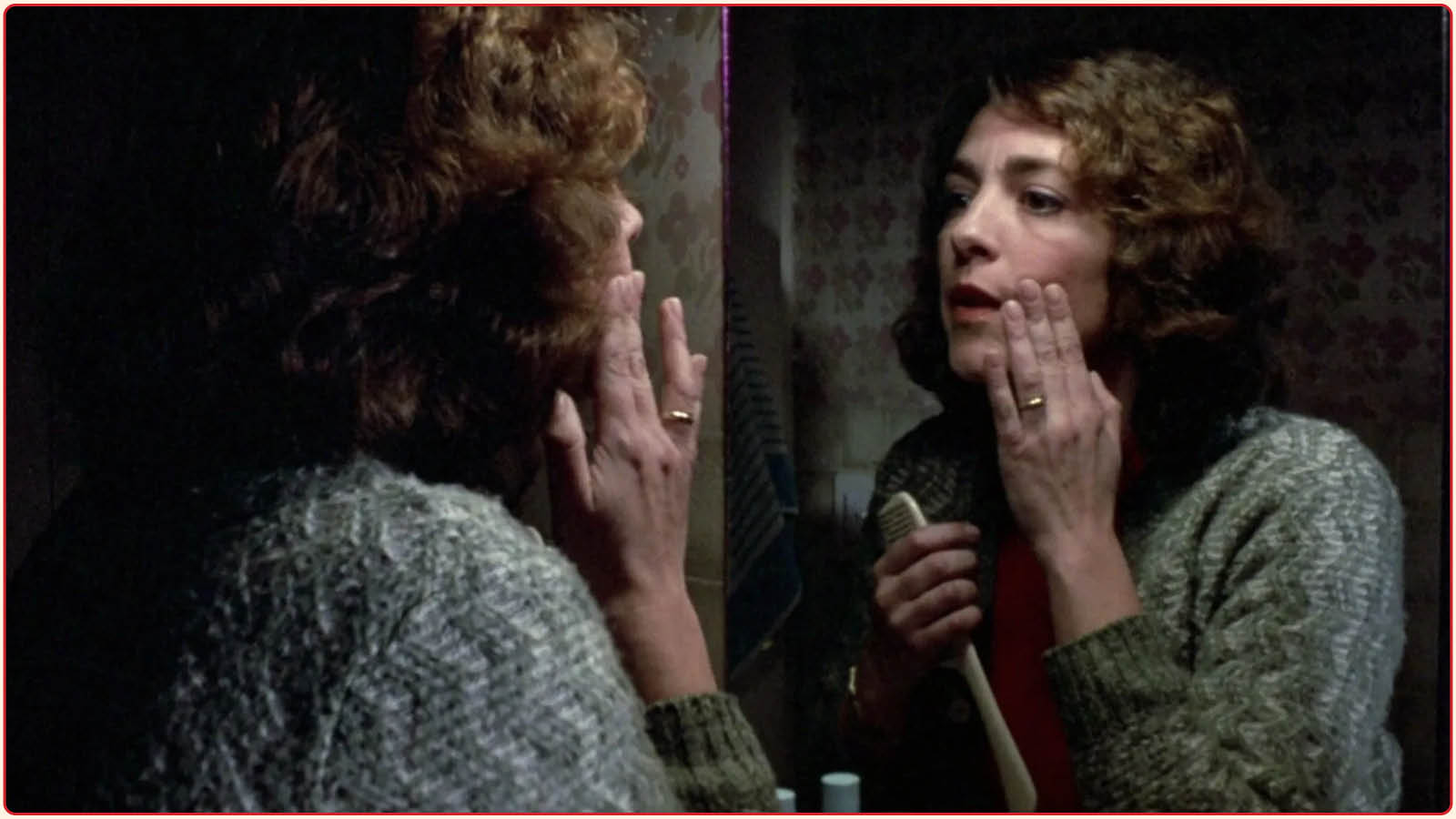
What Have I Done To Deserve This? (1984)
Once again, Maura anchors the film with her presence, playing a straight-man to the greater eccentricities of other characters; and there is a new sensitivity here, particularly in a warm, more hushed sensibility which emerges in Gloria’s interactions with her children. In Maura’s hands, a final goodbye between this mother and her son feels truly lived in, taking the film away from some of its gonzo touches: notably when Almodovar’s camera stays with her in closeup after the farewell, her eyes watering. She is restrained as she wipes away her tears, returning to her empty home; we sense how broken by her life this woman has become.
Maura returns to a more breezy register in perhaps her best known role for Almodóvar, as Pepa in Women on the Verge of a Nervous Breakdown (1988). A comparison with Pepi, Luci, Bom is salutary, because it shows the progression in Almodóvar’s means and artistry since his debut: in formal terms, most of the rough-and-ready punk affect of his previous films has been shifted into the movie’s actual story and dialogue. The film’s content is still heady and subversive, but here, we see the director leaning much more towards heavily stylized melodrama. Maura is once again key to that project. Pepa is an actor, whose job partly involves dubbing films into Spanish. An early scene shows her providing a voiceover for Joan Crawford in Nicholas Ray’s Johnny Guitar (1954). Maura takes the mannered intensity of Crawford as her cue in this film, wedding some of those Old Hollywood stylings to her trademark earthiness and ebullience, and in so doing co-designs what we now tend to think of as the Almodóvarian woman. Maura’s work is in the eyes, large and expressive, and in nostrils flared just so: this is overacting pitched exactly right, which underlines the melodrama around her and somehow seems to pick up on Almodóvar’s Fauvist colours, all the hot bright reds of rotary phones and gazpacho that signify a twisted kind of unreality.
This is a remarkable, although organic evolution from the early days of his and Maura’s partnership, as it finds a more convincing mode of expression for the director’s queer perspective. We’re now revelling in aesthetic pleasures, with a screenplay that melds queer trashiness with something more heartfelt, and more fleshed out characters whose connections feel more complex and authentic. Maura is key to this, because she can hit all these different registers, and can synthesize them into a type.

Women on the Verge of a Nervous Breakdown (1988)
These performance elements are also there in perhaps Maura’s most surprising role for Almodóvar: playing Tina Quintero, a trans woman, in The Law of Desire (1987). The film centers on a gay film director, Pablo (Eusebio Poncela), who embarks on an imprudent affair with a younger man (Antonio Banderas, another Almodóvar favorite) whose jealousy turns murderous. As Tina—Pablo’s sister—Maura upends ideas of gender and theatricality. That is visible in mannerisms which are, if anything, more clearly “feminine” than we see in their other films together: little touches of the nape, a more conscious roll of her hips. Maura isn’t aping femininity; her performance does not condescend towards her character’s gender expression. Instead she highlights her particularity of being, her character, which come through in these dramatic flourishes. The portrayal is necessarily limited because Maura is cis, yet it feels sincere. One beautiful scene features Tina impulsively bathing in a jet of water late at night, gorging on her own sensuality, and seems to echo La Dolce Vita (1960). The character is troubled and somewhat wayward—witness a scene of her feasting on drugs in a bathroom with her brother—but fundamentally caring, displayed most in her nurturing role towards her brother and her child. Most importantly, Almodóvar affords her dignity, especially in a long monologue delivered by Maura, filmed in riveting close-up. Surely the actress must have drawn, here, on her own checkered family history and stolen motherhood. She gives a performance of enormous depth, allowing her character’s pain to come to the fore in waves of tears, without being entirely overcome by it: Tina wears her vulnerability openly, but is resilient above all.
Some of these elements of performance would be passed on to other actors—particularly Penelope Cruz in her later work with Almodóvar. In Volver (2006), for example, the archetype of a courageous mother who has endured trauma but still finds it within her to continue, is present in Cruz’s briny performance. And Maura’s repatriation to the cinema of Almodóvar finds a doubly touching personal resonance. Playing the returning mother, Maura is also coming back to this world that she birthed.
In Maura’s films with Almodóvar, one gets the thrilling sense of a language being gradually created: at first abrasive and riotous, this vernacular becomes richer, finds new inflections, more complex constructions to describe the lives of women; to describe, too, their newfound freedom with its attendant compromises. Maura embodies that very particular sort of post-Franco freedom: her women are resolute, preoccupied, but able to draw on inner resources, sensitive but not sentimental. Around her, the world feels crazed at times, and she must somehow find a way forward in a landscape where men are treacherous and powerful. What does freedom look like, what shape does it have, when it is still being born? Carmen Maura shows that it consists of the bond that ties us to others.

Volver (2006)
Share:
About the Contributor
Recommended
- Futures and Pasts: Éric Rohmer’s Élisabeth
 On the French New Wave legend’s life before cinema, and his newly translated first and only novel.
 - When Carolco Was King
 On the maverick indie studio who ruled the multiplex for a golden decade.
 - Arnold Schwarzenegger
 How the heavyweight star became America’s favorite father figure.