

The Company’s in Love (1932)
Essay
The Company’s in Love
On Max Ophuls’s first feature and the signature tragedies it set in motion.
Max Ophuls: Motion Within Motion plays at Metrograph from January 24.
Share:
DESPITE MAX OPHULS’S REPUTATION AS one of the great directors, his films have suffered interference, tinkering, and neglect. The butchering of Lola Montès (1955) is well-known: against Ophuls’s wishes, producers reedited the film repeatedly, shortened the running time, resequenced events, and excised the frame story. The original version was only partially restored in 1968, and completely in 2008, though Ophuls, who died in 1957, did not live to see it. A Man Has Been Stolen, released in 1934, has been lost entirely. And though Ophuls’s first feature, The Company’s in Love (1932), was restored in 2023, the film is incomplete, with noticeably missing frames and gaps in sound.
Even in this unfortunate state, The Company is marked by Ophuls’s signature fascinations: tragic heroines, doomed romances, waltzes, staircases, train rides, and the opulence of Belle Epoque Europe, which he depicted in meticulously crafted mises-en-scènes. Ophuls also had special affinity for the performing arts, and many of his most memorable heroines were singers and actors: Christine (Magda Schneider), the opera singer in Liebelei (1932), the starlet Gaby (Isa Miranda) in La signora di tutti (1934), the titular stage actress (Simone Berriau) in Divine (1935), and the infamous Lola Montès (Martine Carol) herself, once a mistress to powerful men, and now a circus performer reenacting her most sordid affairs.
Accordingly, The Company centers on a young postal clerk named Gretl (Lien Deyers) who charms a film crew shooting on location in the mountains. The lead actress has walked off the film, and to them, Gretl seems like the perfect replacement. This delights Gretl, who longs for stardom. “An actress must be as the public wants her, full of sunshine, youth,” declares a character in La signora di tutti, and Gretl, all smiles and bouncy curls, readily embodies these qualities. But Loring (Gustav Fröhlich) the studio boss, who is as smitten with Gretl as the rest of his crew, offers the other Ophulsian choice: a life of domesticity. Never mind the unhappy housewives and chilly marriages of The Earrings of Madame de… (1953), The Reckless Moment (1949), Caught (1949), Le plaisir (1952), and La ronde (1950). In this moment, Loring envisions a happy home, with ruddy-cheeked children and schnitzel expertly made by his little Bavarian wife. Gretl is less convinced. “I’d so loved to have become famous,” she says wistfully. “What a pity,” he responds gently, then adds, “Let’s see how things work out.” The choice between fame and family is deferred.
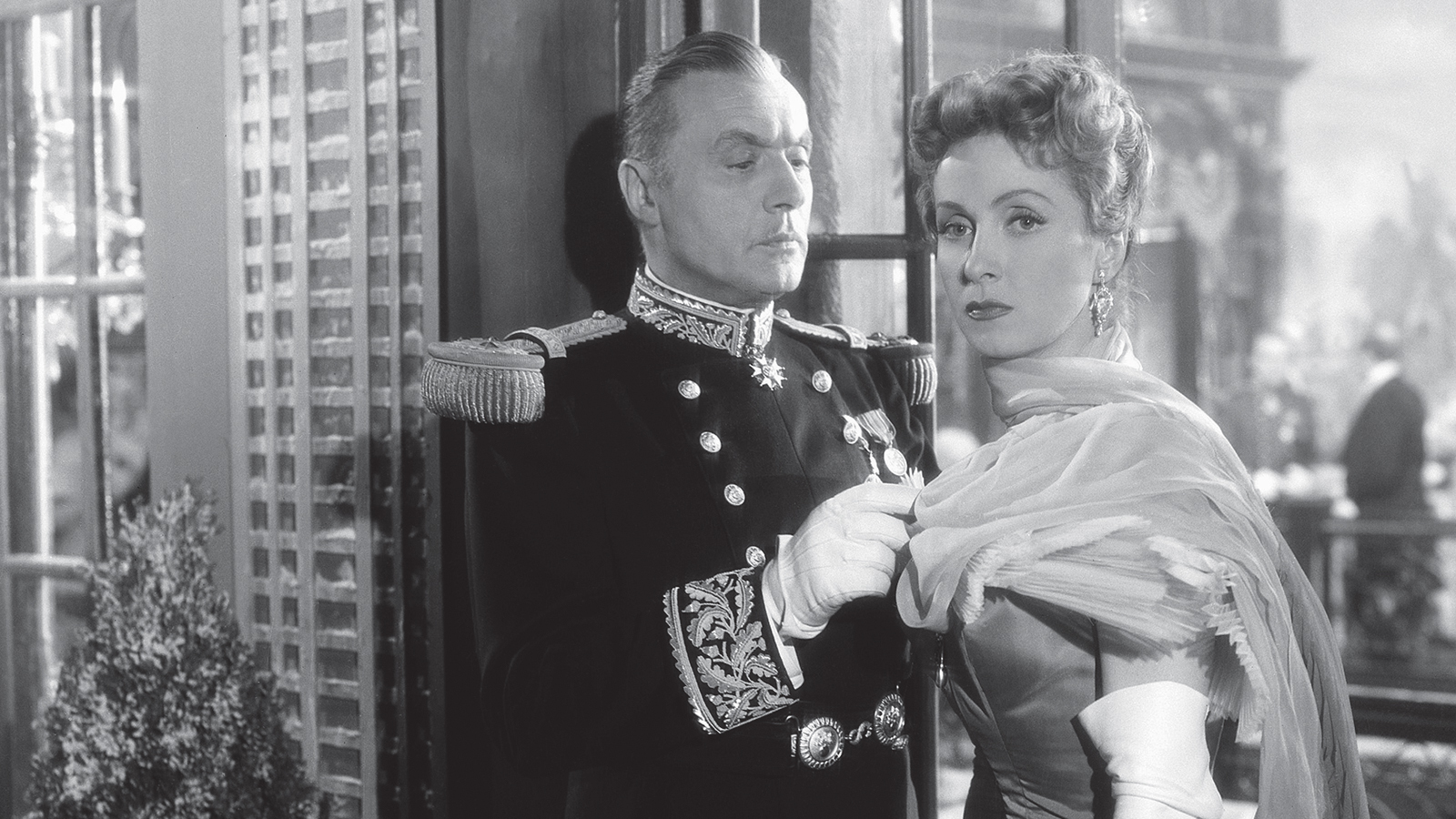
The Earrings of Madame de… (1953)
The most prominent feature of an Ophuls film are the extended tracking shots that glide alongside his beautiful, tragic, often dancing heroines. Critics have long argued over their meaning and function. For Andrew Sarris, writing in 1971 for Film Comment, “[t]he moving camera of Ophuls… does not so much comment on life as constitute it,” while more recently Daniel Morgan has argued the opposite, that the camera, for all its weightless access, cannot meaningfully intervene into the affairs of Ophuls’s characters. “[T]he camera can only do so much,” he writes, with a touch of wistfulness in “Max Ophuls and the Limits of Virtuosity.” What are we, then, to make of the relative absence of such camera movements in The Company?
We could point to the technical limitations of the early 1930s, especially for a production that was so invested in the use of heavy sound equipment. Yet the camerawork in Liebelei, released just a year later in 1933, is significantly more fluid. The camera sometimes does move in The Company, often to enter and exit scenes, like when the camera pulls away from a close-up of a plate of buns offered to the crew during a production meeting. And there are a couple of elaborate tracking shots that highlight narrow spaces, in one case a corridor teeming with backstage activity, and in another, shot from a departing train window, a platform full of villagers waving hankies at their beloved Gretl. But overall, the camera movement is modest.
Character movement, meanwhile, is abundant. In other Ophuls films, women waltz; here they ski. Gretl upends the film production by literally skiing into its stars, Leo and Peggy, who perform the song “I’d So Like to Be in Love” astride a snowy slope. “I lost my balance!” Gretl explains breathlessly. Before continuing down the slope, she inadvertently ruins another take with her emphatic singing. Chasing after her, the assistant director trips and tumbles down the mountain.
In another remarkable sequence, Gretl is passed among the members of the production team. From one end of the frame to the other, each takes a turn escorting her across a room, a gesture that is tracked or panned by the camera. First the director, then the composer, the screenwriter, the cinematographer, and the assistant director: each repeats a variation of the same line:, “Wwe must meet up in one day in Berlin, so that I get to know you.” Gretl starts to catch on to their less-than-professional meaning and abruptly breaks off their overtures with a polite handshake. In form, the sequence is like the continuously cut waltz between Louise and Donati in The Earrings of Madame de…, a montage of multiple evenings in which the pair rehearse the same formalities and empty pleasantries, all while falling in love. Through repetition and unbroken movement, a transformation subtly takes place: for Louise, it is the shift from flirtation to romance, while Gretl starts to understand that the fame she seeks is attended by sexual predation and calculated manipulation.
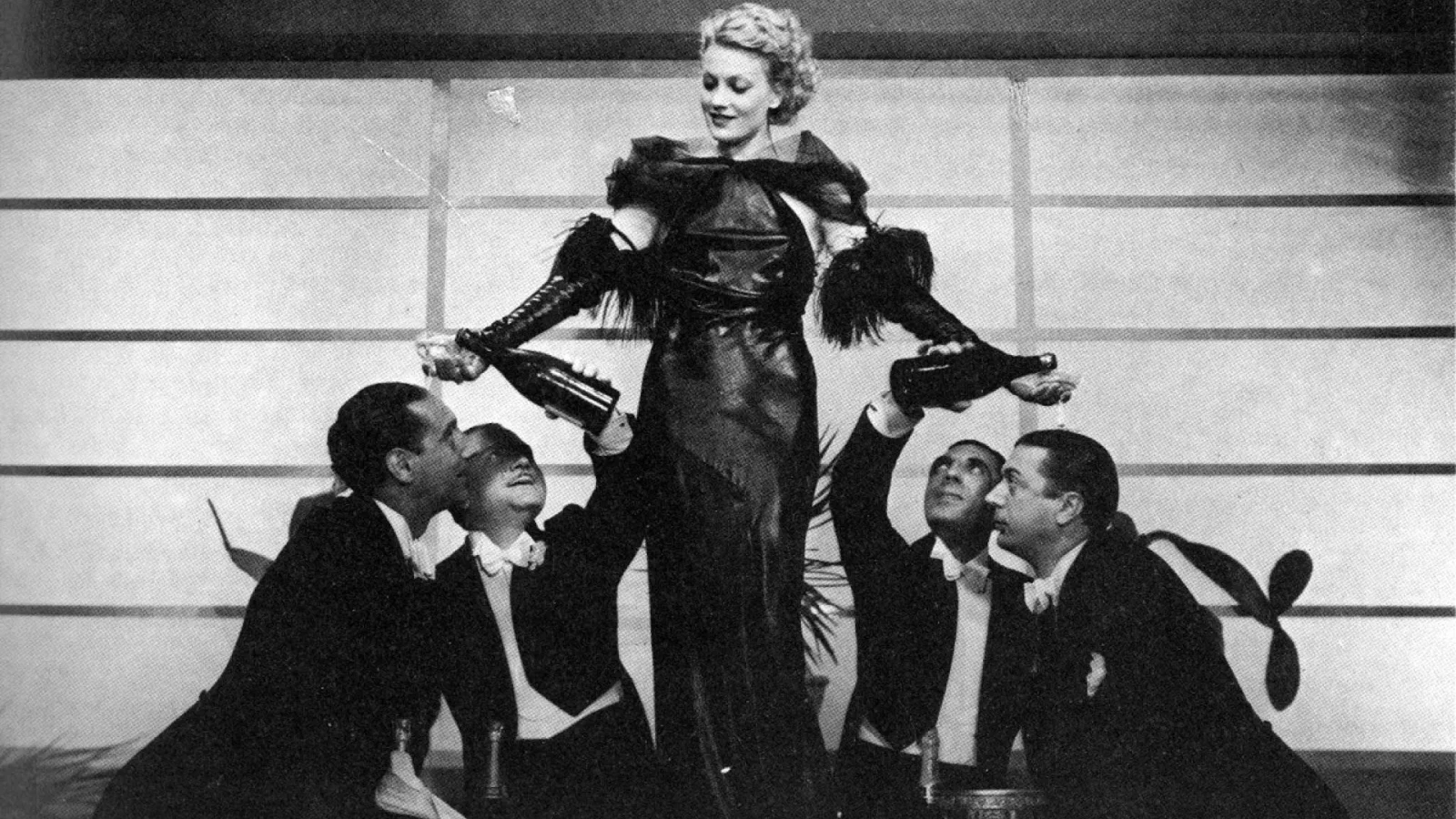
La signora di tutti (1934)
It is startling to see Gretl, previously the lithe skier who bowled over the crew like an avalanche, become akin to a baton in a relay race (or a dippy Bachelorette on the night of the first rose ceremony). Whatever the reason for the restrained camera movement in The Company, the movements of Gretl’s character function similarly to that of the roving camera in his later films. Just as Sarris and Morgan debated the camera’s ability to affect the world of the film, so too is it unclear how much Gretl really controls of her own life.
The Company’s tone may be light but the implications about the costs of stardom, and the autonomy of women, are anything but. In Ophuls, there is ambiguity as to the source of the woman’s motivation. Is it the passion in her heart, or something else—the diamond earrings that keep returning to Louise, the unexpected encounters between Lisa and Stefan in Letter from an Unknown Woman (1948), the rotations of the carousel in La ronde? What explains the ruinous effect that La signora di tutti’s Gaby has on all who love her, which is, by the film’s title, everyone? Even the most powerful seductress, Lola, seems overwhelmed by her exploits, as if she had been moved by some other, inexorable force. For Gretl, the only thing that is clear is that the events of her life have been set in unstoppable motion. She may well become, like Lola, a woman who “never stays, [who] rests nowhere.”
The choice between fame and family may turn out to be a false one. If Ophuls’s other films are any indication, his characters are largely powerless as they are churned up in the gears of fate. The only relief is temporary, and it comes from artifice:, from opera, theater, and above all, film. In The Company, the song “I’d So Like to Be in Love” repeats several times in different settings. Its refrain—“If your heart’s still solo, to Venice it should go”—plays first over the snow-covered mountains, then a fake Venice produced for a movie set (complete with silly sailor suit costumes). In one scene, the crew discusses the importance of the Venice song. “Venice must be a dream!” says the composer. “A fairy tale… romantic… it must be visual and it must be acoustic,” others add. “It can’t be too expensive!” declares the director. Venice, in other words, is like a film.
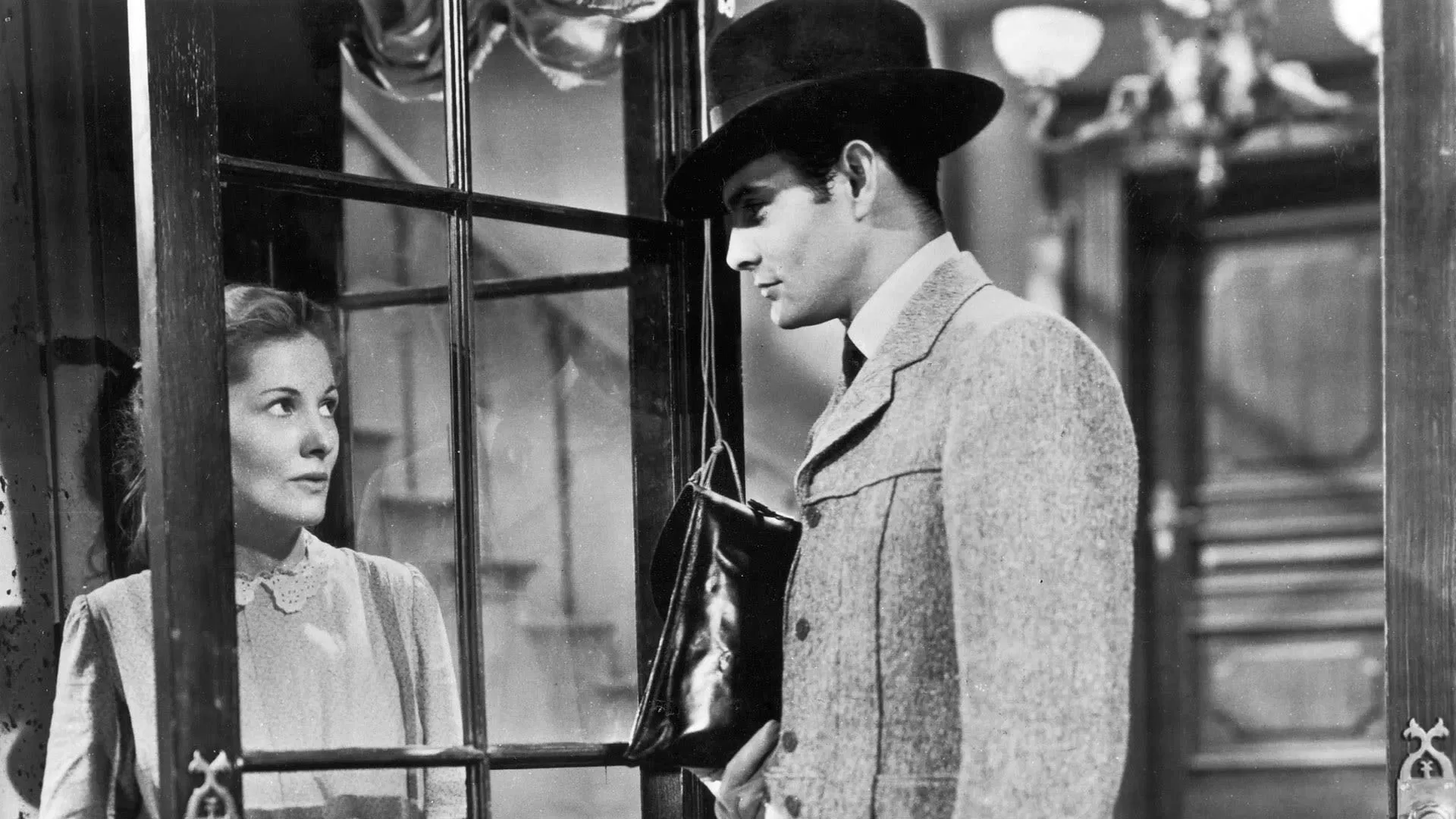
Letter from an Unknown Woman (1948)
Sadly, for Gretl, Venice is only a dream. She has come to Berlin to work on the film, but it turns out she is terrible at acting, and she leaves the production humiliated. Riding the train back home, she sobs into her coat. But this being an Ophuls film, we can predict that good things may come of the train setting. The most famous example of this is the diorama ride in Letter from an Unknown Woman, perhaps the happiest that Lisa (Joan Fontaine) and Stefan (Louis Jourdan) ever are, secluded in their compartment as a facsimile world passes in the window. A more poignant but lesser-known example comes from De Meyerling à Sarajevo (1940), about the love affair between Countess Sophie Chotek (Edwidge Feuillère) and Archduke Francis Ferdinand (John Lodge). As the couple arrives in Sarajevo, in what the audience knows to be the archduke’s final hours, they enjoy a moment of happiness on the train. For now, they are private, unguarded, and free.
Soon enough, at a transfer, Loring appears. He enters Gretl’s compartment with a wide grin and two tickets, both with destination Venice! The film ends on a closeup of the tickets, leaving open the question of the future. Will Venice live up to its fantastical promise? Will Gretl become Loring’s hausfrau? Perhaps Ophuls is sparing them the tragedy that awaits, like that of Lisa and Stefan, or the countess and the archduke. If we take Robin Wood’s axiom that “[i]t is central to the Ophulsian view of human existence that there are no happy endings in his films,” then this may be the happiest possible ending that he can offer: a direction, a promise, cut off before events are allowed to play out.
Consider Liebelei, the last film Ophuls made before leaving Germany. Fritz (Wolfgang Liebeneiner), a young lieutenant, breaks off his affair with a baroness because he has since fallen in love with Christine (Magda Schneider). When the baron learns of the affair, he challenges Fritz to a duel. Because Fritz is in the military—this always spells trouble in Ophuls’s films—he must accept. Christine learns of this, and its terrible outcome, only after the fact. But it is as if she already knows. In a heartbreaking scene, she sings at her audition for an opera. She begins Brahms’s “Little Sister,” from Volksleider, at a rousing tempo. The film cuts to close-up, and she slows with the second verse. Her voice thins, then falters. “Little sister, little sister,” she sings quietly, “why are you so pale?”
At the time of The Company’s release, there is an optimism that doesn’t seem possible in later works like Liebelei. Perhaps this is because his debut film was made before Ophuls, a German Jew, was forced to flee Nazi persecution in 1933. The restless movement ascribed to his heroines was something he experienced in his own life, working across Europe and the United States, and making films in German, Italian, English, and French. In The Company, we see an Ophuls who imagines that a future in Europe is still possible.
Share:
Recommended
- Juliette Binoche
 An interview with the icon of French cinema, La Binoche.
 - Olivier Assayas
 The titan of contemporary French cinema visits Metrograph.
 - The Maiku Hama Trilogy
 On the retro riffs and magnetic lead of Kaizo Hayashi’s newly restored cult trilogy.