

Land of the Dead (2005)
Interview
Let the Dead Bury the Dead: A. S. Hamrah in Conversation
On the so-called “death” of theatrical moviegoing, the boondoggle of AI, the greatness of George Romero’s oft overlooked Land of the Dead, and a whole lot more.
A. S. Hamrah joins Metrograph on Friday, January 31 for n+1 Presents an A. S. Hamrah Double Bill, signing copies of his two new books Algorithm of the Night and Last Week in End Times Cinema following the screening of Ace in the Hole (1951), and then introducing Land of the Dead (2005).
Share:
ONE OF THE MANY PERSPICACIOUS, serious-minded, and seriously entertaining pieces contained in the new collection of A. S. Hamrah’s work, Algorithm of the Night: Film Writing, 2019-2025, titled “All-Consuming Horror,” is a freewheeling analysis of “a group of American horror and sci-films that began to emerge after George A. Romero’s Night of the Living Dead came out in 1968,” examining several works that, in their individual ways, each convey the sense that, per Hamrah, “there is no space outside of consumerism.” (Romero’s ghouls, banqueting on steaming, glistening viscera, give new meaning to the phrase “conspicuous consumption.”)
The fourth entry in Romero’s Dead series, Land of the Dead (2005), released after the director had taken a 20-year hiatus from zombie pictures, is not discussed therein, an oversight that will be made up for when Hamrah visits Metrograph on January 31st to screen Romero’s “late style” cri de couer, in which the beleaguered Americans who’ve survived the initial carnage that came with mass reanimation and contamination, now some years removed from the apocalypse, have adapted themselves to enduring a greatly reduced freedom of movement, the indignities of a brutally stratified caste system enforced with paramilitary thuggery, and the omnipresent threat of violence. None of which, of course, should sound familiar at all. —Nick Pinkerton
NICK PINKERTON: You’ve written eloquently on Romero’s trenchant analysis of American consumerism in Dawn of the Dead (1978); how do you think that Romero, in Land of the Dead (2005), coming almost 30 years later, brings this analysis up-to-date, or expands it?
A. S. HAMRAH: Land of the Dead is a step further removed from the world of consumerism than Dawn of the Dead. It’s a post-capitalist, or a feudal structure, like we live in now. The mall in Dawn of the Dead is just a regular mall in Pennsylvania—by the way, it’s now owned by Walmart, they bought it last year. Whereas Fiddler’s Green, the commercial space of Land of the Dead, is more of an upscale condominium.
NP: What you’d call a mixed-use space.
AH: Yes. It’s not exactly a mall, yet in a way it is, because the survivors have to go out into the world, steal packaged goods, and bring them back so that the rich people who live in this space can consume them. It is more like something you’d see in Las Vegas. It has this quality of being upscale, referring to a neoclassical past, and being exclusively for the use of the wealthy.
NP: It’s an amalgam of, as you say, a Vegas hotel-slash-shopping mall and, oddly, the University of Pittsburgh’s Cathedral of Learning skyscraper, which it seems to have been modeled after.
AH: One striking thing about the film, as is true of other Romeros, is how prescient it is. It came out in June of 2005; two months later, Hurricane Katrina happened in New Orleans, and it feels like a predictor of that tragedy—with the zombies walking through water to get to the city, for example. It’s a film about the coming to consciousness of the working class that I don’t think many people cared about or paid attention to in 2005, and it was mostly forgotten by the end of that summer.

Land of the Dead (2005)
NP: The idea was one that Romero had been, I know, shopping around for a while, and there are certain then-contemporary models he might have had in mind: São Paulo millionaires who travel from high-rise helipad to high-rise helipad, having developed this totally immured lifestyle where they never have to set foot on the street or rub shoulders with the hoi polloi. Today, though, it suggests modern “urban living” for the well-to-do white-collar elite in much of the developed world: you can DoorDash every meal, Uber yourself any place you need to go, and all the while remain above the fray.
AH: I mean, it largely takes place in this tower, which is run by Dennis Hopper. And a tower is, you know, looming over the city, or here, what’s left of it. It’s surrounded by essentially a lawless encampment for the homeless and semi-homeless, fueled by drugs, alcohol, prostitution, and so on, which is not yet gentrified.
NP: I feel like the film belongs to that moment when the monied classes started rediscovering the appeal of urban living. Certainly, in New York City it was already well underway.
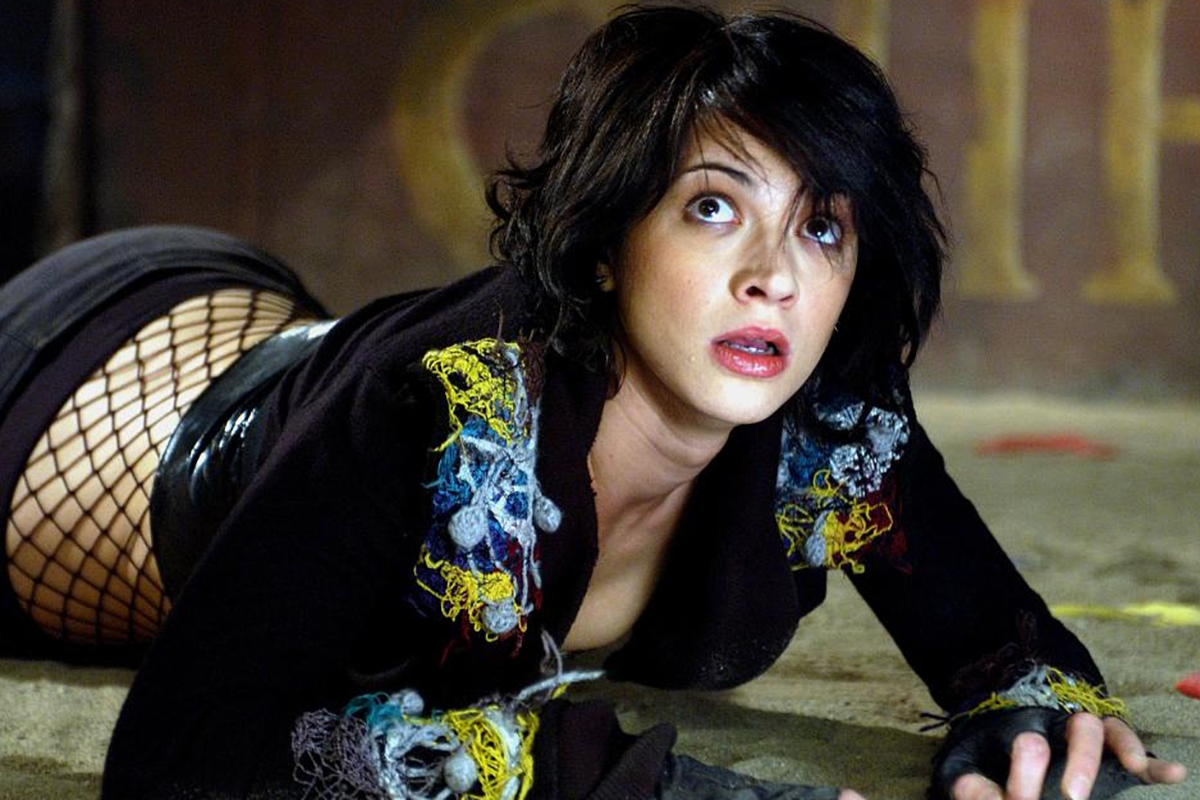
AH: This is part of the film’s prescience, because it takes place before 2008 and the economic collapse, before Occupy Wall Street, all that. It’s predictive of different kinds of violence and economic disruption in American life but not in quite the same way as in other Romero films. It’s more classical; it’s very [Howard] Hawks-ian, I’m sure you noticed. In fact, there’s a reference to Sergeant York (1941) in Charlie, the Robert Joy character, who’s a kind of Walter Brennan-ish presence, licking his thumb and rubbing it on the barrel of his rifle to “catch the light.” Land of the Dead is not only more classily constructed than other Romero films, but it also has Hollywood stars, of a sort: Simon Baker, Asia Argento. I mean, Simon Baker was not really a big star.
NP: Later to delight us as The Mentalist.
AH: Yeah, exactly. He reminds me of someone who would’ve been in a late Allan Dwan film, you know? He rises to the level of like a Ron Randell in Most Dangerous Man Alive (1961).
NP: And Asia is at the peak of her considerable powers.
AH: It’s one of her best roles. Everyone is good… Robert Joy, in a part that could have just been too broad. John Leguizamo is great, Hopper is in good form…
NP: I like his little cocaine booger moment.
AH: And it’s not like a lot of latter-day horror movies that are marred by funny cameos and things—even though Edgar Wright does have a silent cameo in it. But I think their performances show Romero as a great director of actors, who could have been more mainstream, if he’d wanted.
NP: I’m glad you bring up Hawks, because I think the received wisdom on Romero—that he’s the granddaddy of “horror as metaphor,” that he’s principally interested in genre as a Trojan Horse for social commentary—misses something else essential to his personality. Of course, there is that aspect to his films; certainly, Land of the Dead is not on the side of Hopper’s tycoon and the yuppies. But it’s significant, I think, that Simon Baker doesn’t stay to join the new, theoretically more egalitarian community that’s to be set up with the fall of Fiddler’s Green.
AH: Right, he moves on. With Asia, Robert Joy, and a couple of others.
NP: Knightriders (1981) is to my mind a key movie for unlocking Romero; there is definitely an interest in community and what it means to belong to a community, the responsibilities and the compromises and the comforts that come with that… But the community he deals with is never that big; it’s a troupe, it’s the size of a small film crew…
AH: Yes, it’s a Hawksian-style community of a small group of people in a particular setting at a particular time. You know, I showed John Carpenter’s Ghosts of Mars (2001) at Metrograph when my book The Earth Dies Streaming came out at the end of 2018. It shares this same theme: a small community in a desperate situation in a science fiction setting. Both films have this weird quality, landing between the director’s main body of work and then what are considered late films or final films. That’s part of what’s interesting about these two, they both seem like they were cut-off points.
NP: After the catastrophe that was his previous film, Bruiser (2000), Romero seems so revitalized in Land of the Dead. I’m sure part of that is having a halfway decent budget for the first time in a while, after spending some wilderness years….
AH: Land of the Dead is actually quite a beautiful film. There’s the fireworks, which they call “sky flowers.” But also built into the film is an interesting criticism of spectacle that isn’t so present in his others, which are each more focused on the news media, consumerism, things like that.
In Night of the Living Dead, it’s the violence of American life. When I think ofthat film, I always think about the Black militant Rap Brown: “Violence is as American as cherry pie.” I love that he chose cherry pie instead of apple pie. Because it’s red, you know?
NP: Viscous.
AH: Exactly. Gooey.
Land of the Dead (2005)
NP: Another thing that isn’t, perhaps, discussed enough about Romero is what a great editor he is when he’s really cooking. As director-editors go, I’d put him up there with Sam Peckinpah and Don Siegel.
AH: He is like Siegel. There’s nothing extra in it.
NP: I think part of it comes out of his apprenticeship in industrial films, his having had to operate at times almost as a one-man band, really leaving his fingerprints on everything…
AH: The first reel of Land of the Dead is fantastic because it establishes everything so invisibly. There is that slight preamble, the prologue with the old radio broadcast, but then we meet the characters, their personalities are established, we understand the relationships, and it’s all done in a 20-minute action scene.
NP: You can say that about all the first four Dead movies; you get this propulsive energy right out of the gate, the incredible savagery of the SWAT tactical assault on the housing projects in Dawn of the Dead…
AH: This one’s even more Hawksian, though, because there’s no news media involved. There are no incursions like there are in Dawn of the Dead. The zombie epidemic is so far along that there’s no longer any news coverage. There’s a stripped-down quality to Land of the Dead.
NP: It gives you a closed world and doesn’t clutter it with anything extraneous. We don’t need to see Hopper’s character, say, getting on the phone to Philadelphia.
AH: Or Washington.
NP: There are no pauses for world-building rigamarole, very little in the way of “In our last episode…” recapping, a bare minimum of expositional scaffolding before getting down to business. It’s funny how many films dealing with shopworn genre archetypes still feel obligated to do this, to trot out truckloads of lore… When in fact this should expedite matters.
AH: Land of the Dead also has a very analog feel—a very practical, hand-made quality.
NP: There’s some CGI haze accompanying the (many) headshots but, yes, in the main the kills at close quarters are very juicy. Something I found quite charming is the way that, as always in the Dead movies but even more so here, you can identify the zombies’ former occupations by the clothes they wear, by their uniforms. There’s something that belongs to another era, something almost Norman Rockwellian, in these clearly delineated small-town American types. Like: okay, here’s the gas station attendant…
AH: Here’s the cheerleader…
NP: Here’s the butcher with his meat cleaver and his smock…
AH: And of course, in this movie made in 2005, when we were starting to understand that in the 21st century it was no longer going to be an analog world, there’s this emphasis on tools. When the zombies are coming to consciousness, they start to understand they can use the tools in their hands to, say, smash the glass to break into Fiddler’s Green.
NP: And of course, the zombies show much greater capacity for acting in concert, as a disciplined mass, than the living do. Which goes back to what we were talking about earlier, the sense that Romero, even if he has some faith in humans as small, mobile units, doesn’t seem to have the highest opinion of the human race as social beings willing or capable of cooperating towards the shared good.
AH: For Day of the Dead (1985),that’s especially true. That’s one of the bleakest horror films.
NP: It’s a cul-de-sac. Survivors scuttling around underground like starving rats, gnawing away at one another.
AH: Conducting horrible experiments on each other. Yeah. That one’s hard to watch.
NP: The Crazies (1973), to take another example, is a film very concerned with failures of communication, failures of coordination. It’s all about missed phone calls, orders that don’t arrive when they need to, nobody being in the right place at the right time, chains-of-command breaking down, human error escalating the very situation that it’s trying to ameliorate.
AH: Yeah, Dawn of the Dead,too. And Night of the Living Dead, in which the mean couple in the film turns out to be right, in a way. Even though they’re complete assholes, and racists. Their prescription for what to do…
NP: Is dead bang on the money! [Laughs]
AH: …would’ve saved the Duane Jones character’s life.

Land of the Dead (2005)
NP: Talking of societal breakdown… Your introduction to your new collection, Algorithm of the Night, discusses a phenomenon that I’ve observed myself but rarely seen articulated so well: the degree to which the discourse over the “death” of theatrical moviegoing is particularly driven by representatives of a certain generation who, in spite of advancing age, tend to be some of the most wide-eyed, naïve, gee-whiz technophiles out there. I’m sure you saw George Miller being quoted recently concerning AI; Paul Schrader has issued his own hosannas on the subject. One can’t help but notice that the artists who seem to be the least skeptical of this technology are already fucking rich, approaching the tail end of their working lives, and face absolutely no threat, existential or otherwise, to their livelihoods.
AH: Beyond auteurists, there are also people like the centibillionare Larry Ellison, who are convinced they’re going to live forever. He’s eightysomething years old but looks much younger because of all the various processes he’s having done to himself, and he talks as if he’s never going to die. But, yes, we’re increasingly witness to this embrace of technology that filmmakers oftentimes don’t even seem capable of accurately describing. Sometimes when David Cronenberg is talking about AI, he seems to just be talking about CGI. He’ll say, “Oh, I’ve been using that for years!” It hasn’t existed for years! Their embrace of it is just so… They want to be the last generation of cinema, they’re obsessed with being the last generation.
NP: “Après moi, le déluge,” etc.
AH: Yes, right, and not passing it on to anyone else, taking it with them. It’s not across the board, of course, but it’s something one notices. And it’s not just that these filmmakers are convinced certain technologies are for the good—or inevitable, which is the worst way to think about it—but they’re actually proud of having this attitude. Which then trickles down to people you meet who say things like, “Oh, we never go to the movies. Not only do we never go to the movies, nobody goes to the movies.” The way they say it speaks of this kind of amour propre. They’re so happy with themselves that they don’t go to the movies anymore, that they impose it on everyone else.
NP: It’s often combined, I’ve found, with generalizations offloading some of that same technophilia onto younger generations. For example, how often have you heard: “Oh, these kids today, they can’t stay off their phones!” And yet the vast majority of times I’ve been in a movie theater where somebody’s causing a disruption with their smartphone, it’s been an octogenarian who’s pathologically incapable of going five minutes without caressing their device. And I guarantee it isn’t Zoomers who are logging on Facebook and racking up likes of some AI slop picture of a grandfather celebrating his 137th birthday or whatever other nightmare images the algorithm is gushing into the feed.
AH: I just refer to them now as people in their early hundreds.
NP: The centenarians. The New Centenarians.
AH: Exactly. There should be a sequel to that now. Last Week in End Times Cinema includes a mention of a guy in a UK movie theater who ordered DoorDash and had it delivered to him while he was watching the movie, a revival screening of Pulp Fiction (1994).
NP: I’ll eschew the “Royale with Cheese” joke.
AH: The obvious joke, which I made in the book.
NP: I mean, I think that’s a brutal example of how—and I mean I’ve definitely tried, at least at times, to be a writer on the contemporary—but something I find daunting about what you do as a critic is, and particularly in Last Week in End Times Cinema, to stare directly and fixedly into the hellmouth. I’ve gotten to the point where I have to focus on things I can find something to admire about, because otherwise… It can all get incredibly dispiriting.
AH: It’s funny, because the Last Week in End Times Cinema newsletter started in an odd way, as a JPEG on Instagram; I could put four or five items in the space of an Instagram story. People liked it and said I should email it to them, so I started doing that instead. I knew I was only going to do it for a year because, yes, it does get depressing. But for probably the first nine or so months I did enjoy it, partly because I basically live alone in the woods now.
NP: You’re out at your own little private Walden Pond, contemplating?
AH: Yeah, exactly. Then I go look at a pine marten. I read the news every morning and so all I had to do was spend an extra half hour reading and noting these things down. Which I did with a great deal of joy, actually, and mirth! However, then came the Los Angeles wildfires, and the death of David Lynch; when things started to get that tragic, it changed the way I felt about it. Because it was so grim. It’s one thing to make fun of David Zaslav or Bob Iger or stupid actors like Josh Gad—it’s easy to do that, and it’s revealing too, which is the point. But it’s not like people losing their homes, it’s not like a great director is dying because he had to be moved during the fires. The death of Gene Hackman. Those things came in a row. I never could have predicted how dire it would get.
NP: Yeah, precisely. It’s the confluence of the tech world not only denigrating all human creative endeavor, but in the process, managing to cook the environment…
AH: Or burn down your house.
NP: Grok making the air in Black neighborhoods in South Memphis unbreathable…
AH: And of course, the AI thing—which just seemed silly when I started this project—the amount of news about it grew so exponentially. At points, it seemed like every bit of film industry news I’d read in a week was about AI.
NP: I can’t remember another product that’s been marketed by its proselytizers with such a threatening tone. There’s this recurrent, “It’s coming! Whether you like it or not!”
AH: There’s nothing you can do about it. You can’t avoid it. Whether you want it or not, it’s going to happen to you. They sell it like it’s Covid.
NP: You just have to let it wash through your system. But there’s a tinge of desperation which makes it terribly unconvincing. Because if I was introducing something to market that could actually improve people’s day-to-day lives, I’d have a product people wanted, that I didn’t have to ram down their throats. I mean, that’s classic supply-side economics!
AH: They would buy it from you! They would pay money for it!
NP: Instead, it feels like you’re being shaken down for protection by some looming, surly George Raft type; “Nice piece of writin’ you got there… Be a shame if something happened to it.” Which, I’m sorry, doesn’t make me feel these vendors are terribly confident in what they’re selling.
AH: Then, if you have the temerity to suggest that maybe you don’t like, it they feel wounded. They feel very hurt you don’t understand how it’s going to improve your life in ways you can’t even understand yet. They get very whiny and sad.
NP: Which suggests something chimerical about the whole enterprise.
AH: Obviously, it’s a boondoggle. And everyone knows. And I mean, Romero doesn’t exactly speak to this, but because AI is based solely on things from the past that are fed into it, this is the dead talking to the dead, the dead burying the dead, in a zombified loop of decay.
Share:
Recommended
- Letters to His Wife
 Translated into English for the first time, a selection of the esteemed Soviet filmmaker’s devastatingly honest and bittersweet letters.
 - Anocha Suwichakornpong
 The two filmmakers discuss exile, the shock of political awakening, and the filmmaking ecosystem of Southeast Asia.
 - The Holy Girl
 On Lucrecia Martel’s transfixing portrait of adolescent fervor.