
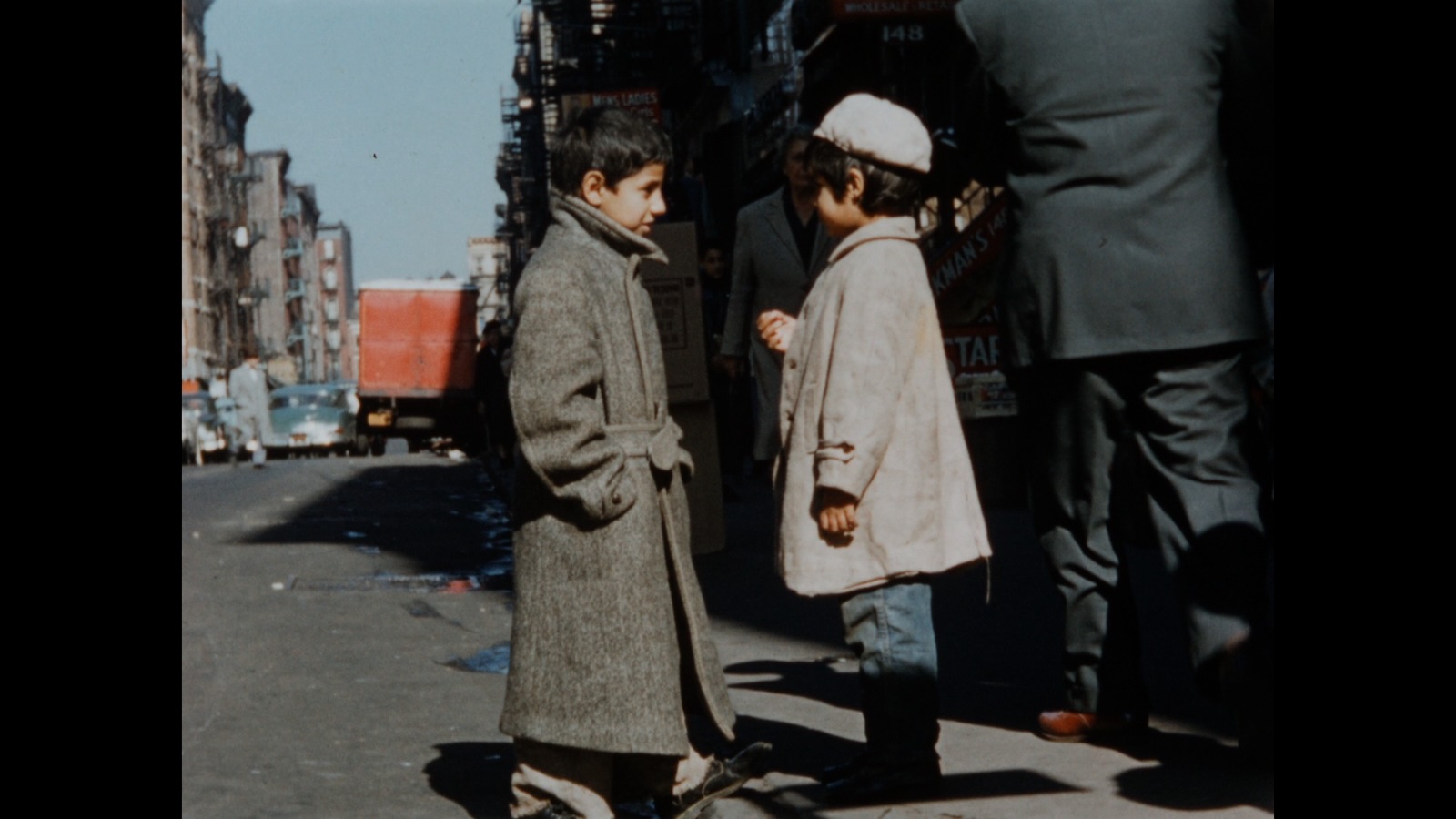
Orchard Street (1955)
Essay
The Given Word
This essay is excerpted from the newly released Ken Jacobs: I Walked Into My Shortcomings (The Visible Press), the first book to gather the writings, teachings and interviews of Ken Jacobs (1933–2025), a towering and singular figure in American art and experimental film.
Ken Jacobs’s Lower East Side: A Tribute takes place at Metrograph on Saturday, April 11.
Share:
IN THE EARLY 1960S THERE was a middle-aged bohemian fellow I would sometimes chance to meet. Possibly a Jew like myself, but if so Jewishness was something long subsumed into his character; he was another art-minded intellectual at odds with capitalism and capitalist culture. I recognized this but had little patience for him, holding against him his determination to be interesting. Now I think how he had to have come up through the 1930s and 1940s, tough times, while I only had to endure rotten times, and how I could’ve been a bit more forbearing. He was a failure in my eyes because he was not so exceptional as to not need other people’s approval. He urged me to see a storefront he was renting that he proclaimed “sold nothing”—that was good—though it might eventually shape up as a coffee shop (flash! East Village begins invasion of Lower East Side). He was paying neighborhood kids to bring him used coffee grounds—50 cents for a one-pound can, pretty good money in those days—which he’d immediately pour out onto the floor of his no-merchandise store, there to dry and lighten in color. There was already a thick brown loam of grounds covering the floor, actually quite beautiful. It was of course an early dismissed-from-history earthwork, and I’m not proud of myself for not valuing it more when seeing it then.
I was standing with my face in my reading on a crowded bus but I could see him working his way towards me. Facing each other, but not speaking, we stood shaking and lurching together to the irregular movements. Then, just before stepping off, he leaned towards me and whispered (I see his dopey smug face now), “The word is … ineffable.” I had a reaction of disdain, it was so arty a gesture. And yet there was no preventing it from sinking in and there’s been no thinking of the word since then without thinking of him, and—curses—it’s a word that someone in my line has to consider often. I’d been making Baud’larian Capers [1963], determined to allude to, and to not say things, and the ineffable was already much on my mind. What’s called the Holocaust was still recent and many of us were still working at grasping its scope and reality. I wished only to indicate—only that was adequately respectful of what had happened—or conversely to lie big-time (another fool [Harry Fainlight] had suggested I film “the revenge of Anne Frankenstein” and after the shock wore off I decided to go with it [The Sky Socialist, 1968]) with the understanding that my blatant lie would be seen through and the unspeakable reality would surface to mind. This, I was thinking, is where art comes in, as a way to evoke or to pay homage to the unutterable, even by way of purposeful bad taste. Art is not expression but repression of emotion. The nerve then of this affected guy to position himself as angelic agent of something so crucial!
Comprendez Vous Yiddish?
Flo and I often went to what had become the Village Theatre before it further succumbed to the changes time had wrought upon the Lower East Side and became the Fillmore East. Management had dared to revive Yiddish vaudeville, alternating Yiddish-language movies with variety acts starring old-timers who had known the theatre from when the clientele were just off the boat like themselves. There were also some young performers refreshingly disobliged from adherence to the Hebrew persuasion. The old movies only sometimes had subtitles so I would often be whispering rough and sketchy translations into Flo’s ear, limited to a seven-year-old’s vocabulary. My early years were in a Yiddish speaking household in Williamsburg, where my grandfather took me by the hand to the Marcy on Sundays to see a Yiddish weepie double billed with a Hopalong Cassidy. Though I’d often be playing under the seats, some of the features had left impressions, mysterious disembodied cine-ghosts that I longed to meet with again. (A man has returned from prison to find the tenement that housed his family gone. He sits on the curb, head buried in his arms. Kids sit on curbs, not grown men. I learn this scene is from Without a Home [1939] and later, reading Hoberman’s Bridge of Light, that it was the last Yiddish film out of Poland.) The benumbed Lower East Side streets had begun flaming back to life. The 1960s had just turned on (decades distinguish themselves when almost halfway through) and the streets were filling with young people dressed in thrift shop outfits as their everyday party clothes. The dress-up in-your-face street theatre Jack and I had fooled with (see Star Spangled To Death [2004]) was taking hold. I churlishly commented about how “things spread and sink” but lovely girls were everywhere, without bras, who directly met your gaze, while in the 1950s I’d walked night after night through a sexual desert. This was better and do we miss it now, this widespread yen to achieve distinctiveness (if not personality, something reserved for genius). Second Avenue and 8th Street was a hub, with every sort of junk spread out for sale on Second both day and night. I’d meet Jack’s creation, Francis Francine (Frank Di Giovani, who had thrilled Jack with the anatomical trickery that had allowed him to pass sideshow inspection). Frank was selling his mother’s old crap, having finally—in his fifties—broken the buck-and-a-quarter limit to his hourly earnings. Flaming Creatures [1963] had made him an underground celebrity and he was in his element, excitedly bad-mouthing Jack about not seeing a penny from the film, hawking shmattas [Yiddish word for ‘shabby’] and imbecile knick-knacks from a cloth spread flat on the pavement.
Things quieted quickly moving south to 6th and away from the lights. People aged even more quickly, growing smaller and speaking quaintly. You could hear in their voices stickball Brooklyn during the Great Depression, Mayor La Guardia, the famous war against fascism (had we only seen Bush-Cheney coming we could’ve surrendered then). A full house every time and it was a big theatre. I may have been mature on 8th Street at age 31 but we were both self-consciously young in this crowd, and exceptionally tall. English was spoken, murmured, but one could feel the hunger to again immerse in Yiddish. I knew these people, knew their ways; we had long rejected each other, at every bris (before I refused to attend), bar mitzvah, wedding, where we’d been stuck with each other after an exchange of maybe 20 words. I also recognised them each and every one from waiting tables upstate in the Catskills, with me returning to the city each time certifiably nuts. Flo would have to massage my neck and shoulders, talk me down from shouting. These were the people who thought art was fine but not something you did for a living. Now we were sharing a theatre, but a slight shift in time and space and we’d be interred together as per Hermann Goering’s pronouncement, “I decide who is a Jew.” That would’ve made me sulk but now they were okay, I had to admit, now that they weren’t asking for more prunes.
1964 to 2007: They’re gone now, too, but at least from “natural causes.”
We loved the vivacity of the old performers, doing their stage acts from when the Lower East Side had been a Jewish world complete unto itself. Back on their own stage boards from when they’d been all piss and vinegar, they had to have known this was their last outing from the throwaway bin they’d been consigned to. Their sturdy routines still supported them. Jacob Jacobs in his seventies (it was announced) buck and winging—sort of—across the stage, arms flapping to busy the eyes so it wouldn’t be noticed this was no dance at all. Leo Fuchs, still lean and dapper, our Yiddisha Fred Astaire (in his mind and the minds of a few doting old ladies). Miriam Kressyn was a regular at these shows with her truly beautiful voice. One imagined them performing one step in advance of their final heart seizures, plopping into offstage chairs to breathe, breathe… a little longer. They gave us all they had, wonderful mad egotists. Who could ask for anything more?
There was also The Fibich Dancers, also regulars. Flo and I watched fascinated and appalled as each week these hopelessly sincere and maladapted young dreamers of a wonderfully ecumenical mix, some swishy, some black, did their enthusiastic versions of European folk dances. Camp beyond camp, because unintended.
Many in the audience left when the old movies came on. Too bad for them. Every one of the cheaply made and mostly awkward films was precious and revealing to us. After all, I was the champion of Oscar Micheaux, cine-blunderer par excellence, writing and directing his witless masterpieces under the tutelage of Sigmund Freud. Outstanding of course was Green Fields [1937] directed by Edgar Ulmer, The Dybbuk [1937] and Tevye [1939]. A surprise was His Wife’s Lover [1931], the first Yiddish talkie, a musical shot in 1931 right there on Second Avenue starring brilliant comedian Ludwig Satz and classic “Jewess” Lucy [Levine] with her strong operetta voice. And with Isidore [Cashier] as a sort of Mephistopheles, “the man with no faith in women.” Five years later, with my first paycheck from Binghamton University, I purchased a 16mm print of it. (Joseph Seiden wanted me to buy one of his own directorial efforts. Addled by the recent loss of his wife, he’d already lost the storage ticket to another Satz movie and he scrapped the negative to this one after printing my copy.)
Allow me to explain my fascination with things Jewish: I despise, then as now, every manifestation of religion along with every other rigid ideology. When I chance upon some screwball or thug pushing religion on the radio or TV I hear pathology. But Jews are a lot more than religion. I was shocked to learn about this minority thing after growing up among Jews in Williamsburg, spill-off of the Lower East Side to just across the East River; I thought they were people. They were nice. Berry and South 10th was crime free, kids went out to play on their own as soon as they understood not to cross the street unsupervised. I saw my first cop at age five, a red-faced man from Mars, all in blue. The synagogue was pleasant (though God went out of my life with the Easter bunny), the young rabbi concerned with real issues. A story he told probably decided my entire direction in life and I’ll repeat it here. A man notices a boy with a mirror standing in the street every day at the same time. Curious, he finally asks the boy why he’s doing this. The boy points out that the street, alongside a hospital, is narrow. His brother is a patient in the hospital. They are poor and the room he’s in is always dark. But at this time each day he can reflect sunlight into his brother’s room.
Around 1945 or 1946 I found my grandmother tearful (but she was always tearful then). She’d gotten a photo from a cousin in Europe she was helping with money and packages. The photo was of a man and his young daughter, dressed neatly, staring ahead fearfully. They were living skeletons seated in front of a photographer’s painted backdrop of swans in a lake.
Flo’s Jewishness had in fact been a hurdle. Her too familiar ways, problems, her parents, feh! I’d mostly gone with Italian girls, close enough to Jews to be understood yet at the same time coming from a whole other set of crazy-making strictures.
Religious study offers one significant historical fact: the theological recipe of the Jews, a conglomerate of near Eastern lore plus monotheism, was grabbed up by Christians and later by Muslims with Jews being punished for not recognizing their saviour in Jesus, as if that makes any sense. Jews remain a key to the understanding of the debacle of Western history at the same time that the minutiae of belief is a dead end, a morbid study (Freud got it right on this one) of hysteria, neurotic compulsion and murderous defensiveness. So for a long time, even as I was learning something of the mechanics of art and my mind was on abstract developments, Jews would enter into the work under cover of my subconscious. My first short was Orchard Street [1955], when the outdoor market still had some of its cardboard signs handwritten in Yiddish. As late as 1986 I shot the material for The Alps and the Jews, a film I put aside when a European friend convinced me its message could make problems for people outside safe (for us) New York. But that’s it, I neither seek out or avoid Jews for friends, don’t put it on our kids to “remain loyal” in choosing mates, and the state of Israel—America’s Igor—repulses me. As do most states but I’m as disappointed with Israel as with USA. Amy Goodman makes me feel good, the neo-cons lousy, meaning connection still exists. Jews are people which other people want to draw a line around, and they’re counter fucked-up enough to again make the line a physical wall.
Exposure to the old performers got to me. If His Wife’s Lover was the first Yiddish movie, I’d better be hurrying to make The Last Yiddish Movie. Jacob Jacobs was going to buck and wing right off the stage to his demise (only a few years later we did read of his dying). I’d film in 16mm, in-sync and non-sync, catch the old people on and off stage, visit Miami where they could still get gigs in the nursing homes, catch them on film in and out of their personas. Study the animals in their habitat and go—cinematically—where chance/actuality led, juggling it all into shape on the editing table. But this was the last moment, while they still could be impossible people, not docile, not yet beaten.
Money. Underground filmmakers were getting some attention via Jonas Mekas’s column in the Village Voice but Flo and I were still handsome and oddly well-spoken paupers. I thought that, as irregular as the film I was groping towards might be, it would be heavy with truth and there was an audience out there that needed nothing less. I decided to go to the office of the Jewish Actors’ Union, where comparatively young Seymour Rexite was president. He was on the radio then, WEBD (“The station that speaks your language”), daily I think, with wife Miriam Kressyn. He had to have been involved in arranging the revivals at the theatre. He was an energetic ‘macher,’ [Yiddish word for an important or influential person; often used ironically] someone who made things happen, with his entire life in theater (he could be seen as a chubby distressed boy in the old movies where he was required, again and again, to emotionally spill his guts). The small office was—mmm—unprepossessing. There was one other person there who never spoke but looked at me fish-eyed. Neatly suited Rexite was being quick with me but I got out a description of the film I had (burning!) in mind. Then he asked—the only thing he asked—what was my source of backing? I explained that was why I was seeing him—that with his backing I was sure money could be raised. He snapped, “Come back when you have money.” He turned his attention to fish-eye and I understood I was dismissed. Short shrift. Another nut case he had to deal with. Couldn’t he see something of my passion, that I was an artist? That there was a crying need for this documentation and it was now or never?
I began filming The Sky Socialist on 8mm Kodachrome with Flo playing Anne Frank, now that the obligation to preserve something of the past, or concern about any future for myself, no longer interfered.
“The Given Word” was written by Ken Jacobs in 2008, and first published in Jews: A People’s History of the Lower East Side, Vol. 3 (Clayton Books). It is reproduced here, from Ken Jacobs: I Walked Into My Shortcomings (The Visible Press)—a compendium that brings together for the first time Jacobs’s writings, teachings and interviews, edited by William Rose—with the permission of Azazel Jacobs.,
Share:
Recommended
- Five Films About Football
 The Georgian director picks five of his favorites.
 - Listen Up! Light of Day
 Metrograph’s Listen Up! column continues with a look at Paul Schrader’s love letter to Cleveland, family, and rock ’n’ roll.
 - Orian Barki & Meriem Bennani
 The multi-hyphenate collaborators discuss their anthropomorphized, experimental, animated feature debut.