
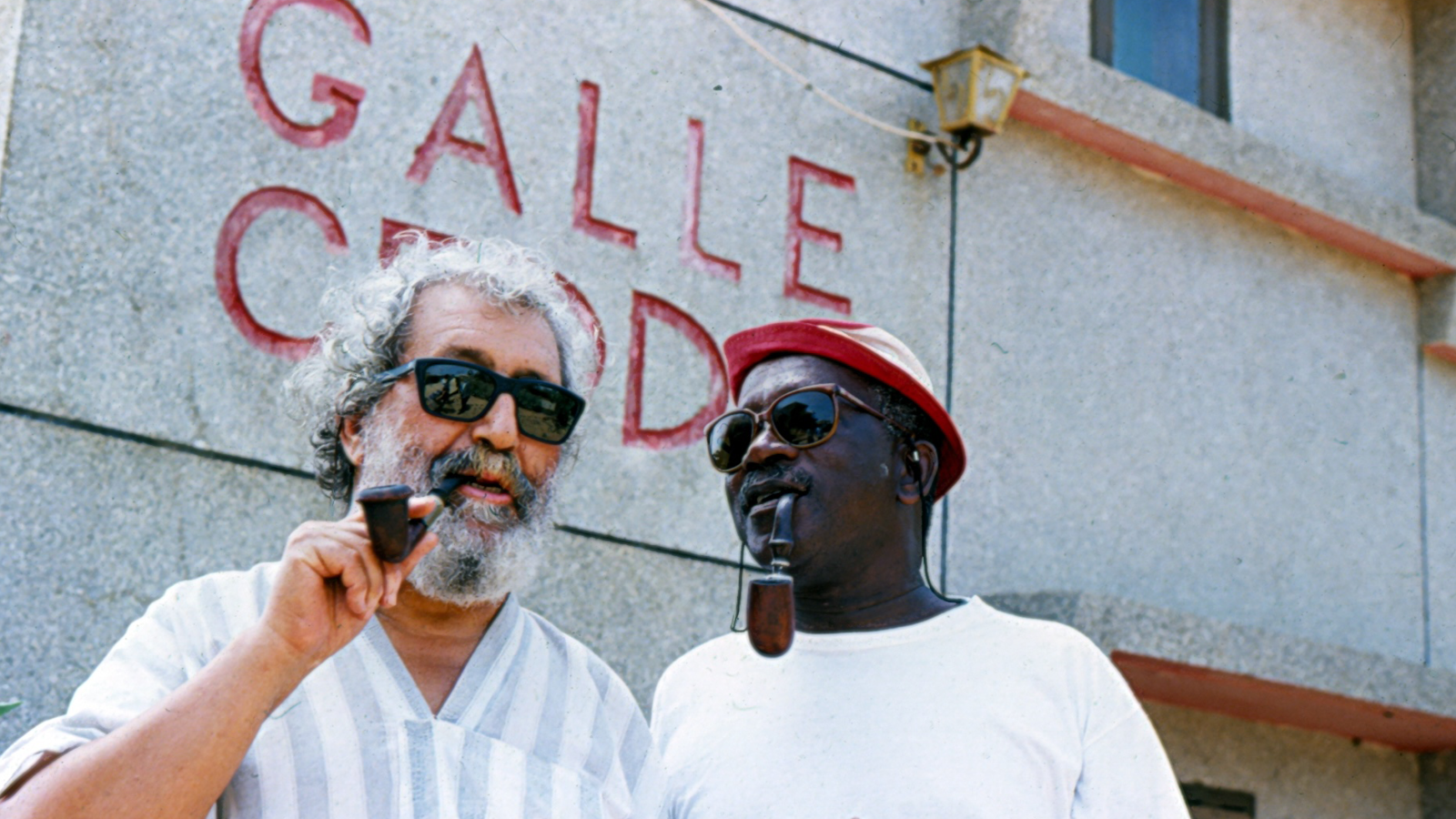
Cheriaa and Sembène in front of the Calle Ceddo, Sembène’s home, in 1994. Photo by Mohamed Challouf.
Essay
Father Figure: Tahar Cheriaa
On the era-defining champion of Afro-Arab cinema.
Tahar Cheriaa: Chronicles of a Pan-African Pioneer opens at Metrograph on Friday, April 3.
Share:
PATRIARCHS SUFFOCATE. THEIR INFLUENCE CASTS a long shadow over their descendants. The father of a movement becomes wedded to both its ideals and blunders. National cinemas, like national literatures, can be surveyed through the lives and career trajectories of renowned pioneers. Official records rhapsodize. “Fathers” are natural geniuses. It’s easy to lose sight of path-breaking as a group effort, or culture as something we make and unmake together. Visionaries emerge somewhere in between, shaped by the strange and wondrous alchemy of personality and historical opportunity. They seem inevitable, because you can’t imagine the present landscape without them.
Tahar Cheriaa was a foundational figure in the most literal sense. A lauded father of Pan-African cinema, he encouraged a generation of filmmakers and cultural workers. The struggle for cultural autonomy preoccupied him. It was at the thudding heart of Afro-Arab cinema, caught between the constraints of censorious post-independence governments and the demands of European financiers. Cinema, as Cheriaa saw it, was a smoldering battleground. Self-determination had to be won at the level of production and distribution. To him, film was a “cultural necessity” that couldn’t be neglected. As the founder of the Carthage Film Festival, or Journées Cinématographiques de Carthage (JCC) as it’s commonly known, he inaugurated Africa’s first and oldest film festival, launched in 1966. Cheriaa, a coastal Tunisian born under French colonial rule, donned several hats in his lifetime. Teacher, organizer, juror, critic and mentor; these roles allowed him to mobilize institutional clout and resources in the service of indigenous cinema. A position within the Tunisian Ministry of Culture gave him a vital launchpad, and Carthage was only the beginning. Cheriaa helped establish FESPACO (the Panafrican Film and Television Festival) in 1969, the premier cultural event held in Ouagadougou, turning Burkina Faso’s capital into a regional film hub. That same year, he was a founding member of FEPACI, an association of African filmmakers committed to developing the infrastructure of African cinema, encouraging governments to invest in technical training and education. Soon after, Cheriaa was appointed as the Director of Culture at the International Organisation of La Francophonie. There’s nothing like the right person in the right job, and Cheriaa was quickly galvanized by the pressures of leadership.
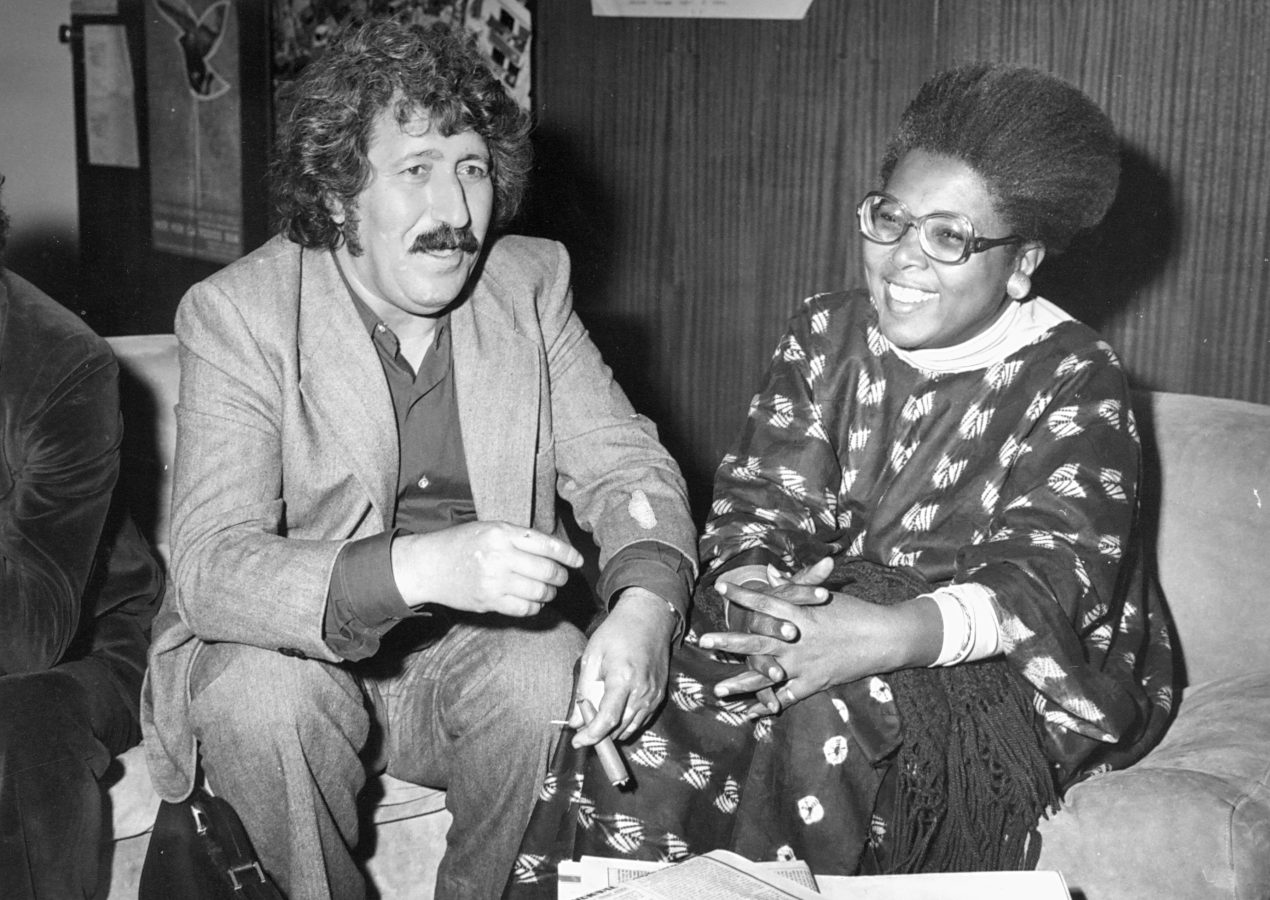
Cheriaa with Annette Mbaye d’Erneville, director of Rencontres Cinématographiques de Dakar (RECIDAK).
The velvet darkness of the auditorium lifts, and lives are changed. When you consider the evolution of Tunisian cinema, this is hardly a hyperbole. In the 1940s and 1950s, Tunisia boasted more cinema clubs than any other African country. Run by amateurs and cinephiles, these were lively spaces of assembly. From Sousse to Kairouan, the ciné-club movement inspired public debates and personal milestones. (Selma Baccar was a member of the Hammam-Lif club, where she showed her first short film L’Eveil in 1967). Cheriaa, a young schoolteacher in Sfax, was an especially active member of the city’s ciné-club, eventually heading The Tunisian Federation of Film Clubs, while still finding time to start Nawadi Cinéma, a film magazine. Community was fostered in these clubs, where filmmakers cut their teeth and screened early experiments.
For those relegated to the fringes, Cheriaa’s interventions transformed the odds. Often, his support was personal. Tewfik Saleh’s The Rebels (1968) was banned in the director’s native Egypt. Depicting class struggle in a remote sanatorium, the film is a richly allegorical portrayal of a thwarted uprising. At Carthage, Saleh was a guest of honour, whisked away by an excitable Cheriaa from city to city, where The Rebels was shown at various ciné-clubs. In Mohamed Challouf’s 2014 documentary Tahar Cheriaa: Under the Shadow of the Baobab, Saleh recalls this life-changing trip. He had never seen anything like the enthusiasm of those initial audiences. Cheriaa, he notes, brought people together. He had a knack for identifying new talent, championing the likes of Souleymane Cissé, Heiny Srour, Med Hondo, Michel Khelifi, and Sarah Maldoror. (As the Angolan War of Independence bitterly raged on, 1972’s Sambizanga won Maldoror the Tanit D’Or at Carthage). Works that had faced censorship at home were screened in jam-packed Tunis theaters, granting even celebrated auteurs like Youssef Chahine a platform to share their more contentious films.
Resisting the monopoly of Hollywood companies over national screens made Cheriaa unpopular with Western film distribution heavyweights and certain political parties. At one point, he was accused of “clandestine political subversion” and thrown in Habib Bourguiba’s prisons for six months, only released after an international appeal led by African filmmakers including Safi Faye and Mohammed Lakhdar-Hamina.

Challouf and Cheriaa at the grave of Burkina Faso President Thomas Sankara.
Back at his Paris desk, he continued his work, pulling strings at the Organisation internationale de la Francophonie (OIF), creating wriggle room for outsiders and lifelines for floundering projects. Screens of Abundance or Liberation Cinema in Africa, his landmark critical work, was published in 1978, reckoning with the politics of film distribution across Africa and the Arab world. Theory reveals a strident Cheriaa, though his increasing authority meant walking a tightrope between militancy and the compromises demanded of state-sponsored institutions. He could skirt the edges, but the center was where he was most useful.
The archive ripples with conviviality. Cheriaa sits with peers, protégés, friends. In one snapshot, he beams at the Egyptian documentarian Attyat El Abnoudy. In another, he drags on a pipe outside Galle Ceddo, shouldering Ousmane Sembène. (Cheriaa was enamoured with Sembène, whose 1966 film Black Girl won the inaugural Tanit d’Or at the first-ever Carthage Film Festival). At galas and gatherings, beside hotel pools and at communal tables, there is Cheriaa, breaking bread and forging connections. Flanked by Lionel Ngakane and Timit Bassori. Paying his respects at Thomas Sankara’s grave. Walking along the sloping beach. Tunisian filmmaker and historian Férid Boughedir wove poetry out of these scenes, describing Cheriaa as someone who “made Fanon’s dream come true under the shade of the baobab tree.”
When I lived in Tunis, I often attended Le Rio, a historic venue that’s been in operation since the 1920s. It was my favorite cinema downtown, distinguished by its Rococo-style arches and peeling posters. During festival season, it became a regular haunt. Youth crowded the entrance, and locals would intermingle with visitors in Le Rio’s quaint lobby. I saw films I had always been curious about, postcolonial deep cuts I had only ever encountered in reference books and circulated screencaps. Many had been backed by Cheriaa, who once wrote that the principal character of African cinema was the group, “the collectivity” he spent his life nurturing. He understood the Sahara as a porous membrane. Stepping into the cool night after a screening, I felt like a participant in his unfinished story, an inheritor of a borderless legacy.
Share:
Recommended
- Anja Breien
 On the late Norwegian filmmaker, master chronicler of feminine ennui.
 - Mississippi Mermaid
 On Yves Saint Laurent’s striking costumes in François Truffaut’s subversive neo-noir.
 - Lady in the Water
 On the death of the critic in M. Night Shyamalan’s watery fairy tale.