
With Hasan in Gaza (2025)
Essay
With Hasan in Gaza
On the temporal collapse promised by the archive.
With Hasan in Gaza opens at Metrograph on Friday, May 29.
Share:
FOR A TIME, INTIMACY WAS HOUSED in tiny cassettes. What Super8 was to previous generations, miniDV, Hi8, and VHS were to mine. Because it was cheap, ubiquitous, and easy to manage, a magnetic coat on a plastic strip became memory’s substrate. If you were young in the ’90s, and if you can see yourself in motion as a child, what you see is, more likely than not, tape. Home movies are archives in the mundane sense, but the footage operates the same way, too. It is rarely the construction of the images themselves that matter as much as the ties to their subjects and the distance between the recording and the viewing. A kid bounces at the edge of the pool, seeking attention before leaping in. It is the life that unfurls later that makes that joy and innocence meaningful. In documentary, it is all the ensuing history that demands we scrutinize the frame as if for clues of what will come to pass. Whatever its evidentiary value, it is what the archive cannot bear witness to, yet still implies, that produces its own importance.
In this way, Kamal Aljafari’s 2025 film With Hasan in Gaza is an archive made into a monument, a film rendered into a temporally dislocated cenotaph. It was made from footage shot over two November days in 2001 as the filmmaker traveled through Gaza trying to find a friend he had met in an Israeli prison 12 years earlier. This framing device is largely expressed through periodic on screen text and, in the end, only glancingly describes Aljafari’s project. The first snatch of dialogue in the movie is like an introduction to a travelogue. “To your left is Beit Lahia. To your right is Beit Hanoun,” the driver says. All throughout the journey the toponyms are tossed off nonchalantly. But they begin to feel like a litany. Whatever they would have meant in a documentary in the early 2000s, they cannot mean the same thing now. Beit Lahia, Beit Hanoun, Gaza City, Jabalia, Nuseirat, Deir al Balah, Khan Younis. There are names that become inseparable from the great crimes committed there.
With Hasan in Gaza (2025)
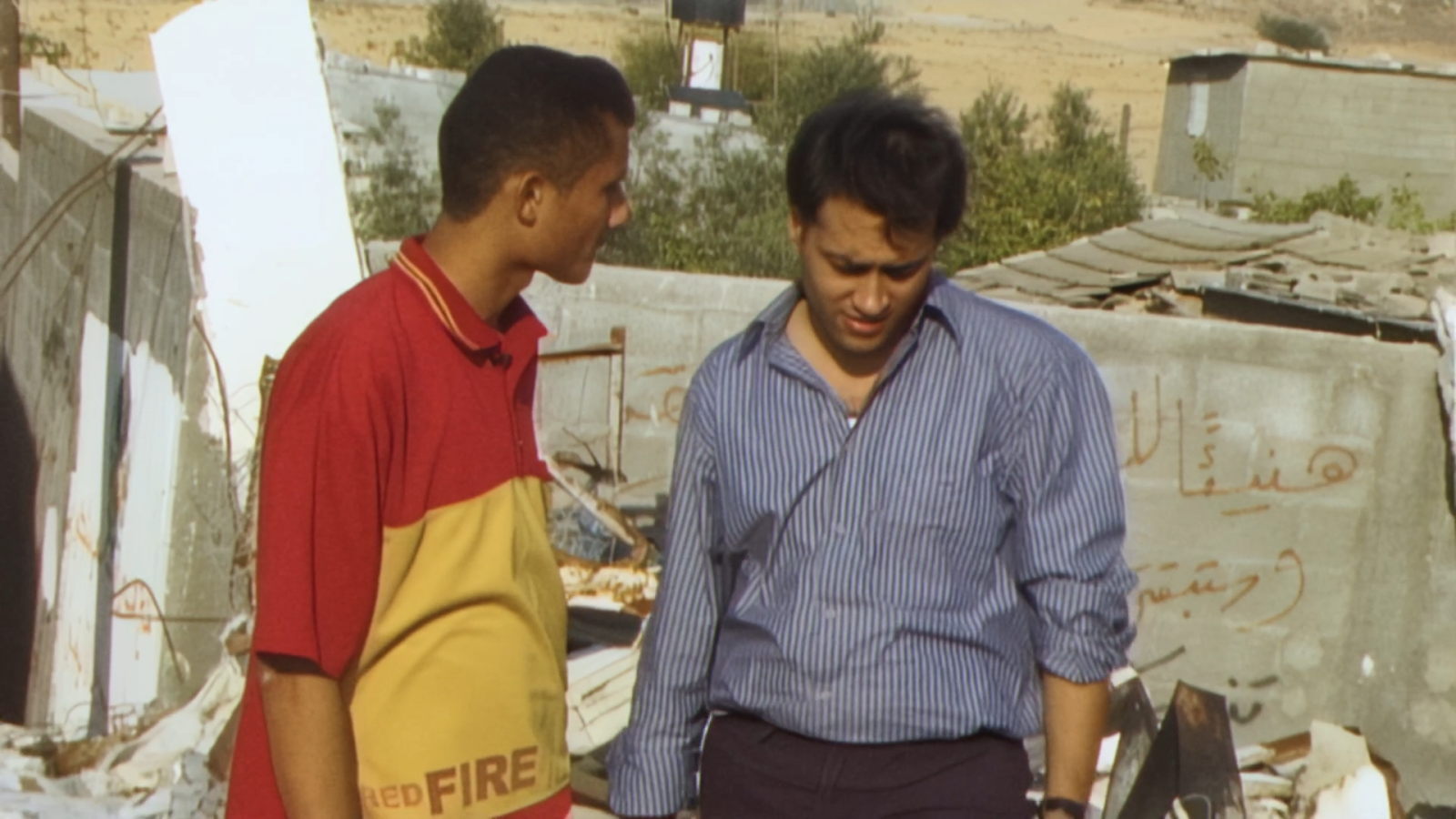
Much of the footage is shot from a moving car as the crew is forced to take detours to get anywhere they want to go. “It’s all to protect the settlements,” a driver explains. (The footage precedes Israel’s 2005 “disengagement,” which resulted in the withdrawal of the settlements from the Gaza Strip). When we finally see one, it is at a great distance. Two men walk through the ruins of a home recently bombed by the IDF. While they talk, the camera zooms past them until they disappear from the frame. The image is jittery at this distance. When it resolves, there, in the hills, an Israeli flag flaps in the wind.
Long stretches pass without a cut: trees on the side of the road, a university (the camera holds as long as the car it is in idles in traffic), a woman testifies to the destruction brought by Israeli bombardment and enclosure, the night is punctured by the thuds and cracks of mortars and bullets. What is normally left out remains: the camera is readjusted, sometimes holding on the ground while a conversation takes place; its autofocus struggles in low light, resembling for a moment the bleary gaze of a sentry keeping watch. It is not for the sake of duration alone, but to make solid what will prove fleeting. In other films, these might be termed establishing shots or B-roll, merely intended to cover up a cut. Here, they are close to the line from poet Robert Lowell’s Life Studies, “life changed to landscape.” A colony, a settlement, is always trying to separate the two. “These are the new buildings,” one of the guides says early on in the film. It is impossible to hear this line now, to see the construction, and not call to mind the expanse of leveled cities that have been beamed around the world for the last two and a half years.

With Hasan in Gaza (2025)
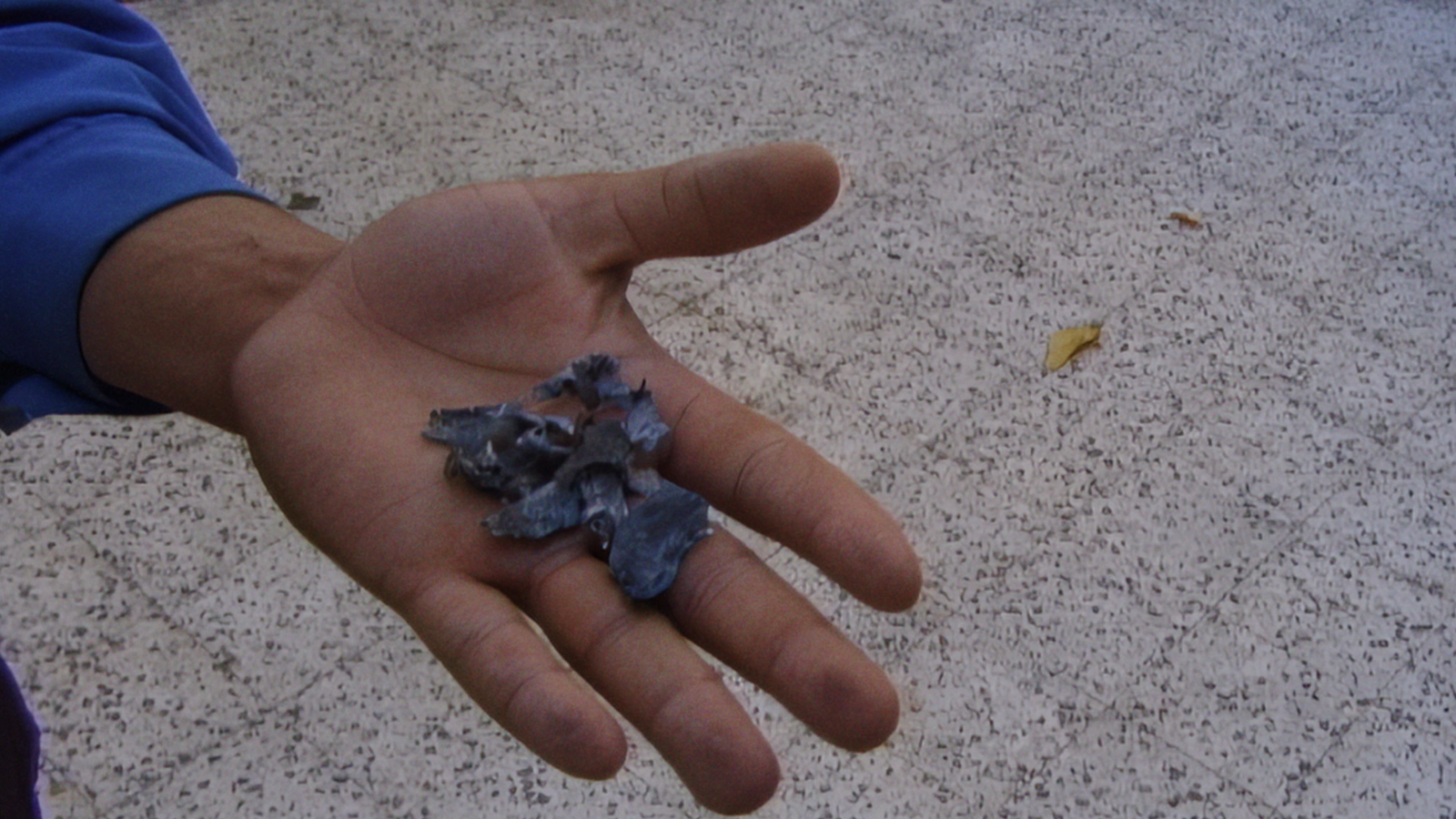
There is a type of literature, and cinema, that derives its tension from a sort of manufactured historical premonition. Everything is laden with the future. The violence and domination of the pre-World War I small town in Michael Haneke’s The White Ribbon (2009) does not stand for itself. It is a kernel yet to germinate. We know what will bloom in the German soil. The disaster, which is always just beyond the work’s horizon, colors every scene. Works in this genre, a friend recently said to me, might very well be coauthored with history. With Hasan is in and to the side of this tradition. Aljafari promises an interlocutor that he filmed “the tank” and “the settlement” and “the flag and the sea.” It could be said that these images—the university, the tents amidst the rubble, the checkpoints—are premonitions of a genocide. But when a young man holds out his hand to the camera to show the shrapnel scattered throughout his home while a little girl looks on, that is no presentiment. It is evidence. A near-century long project does not partake in augury, but déjà vu. A tank is not an omen; it is a weapon here and now.
In the night, when the sounds of war resume, Aljafari’s hosts promise him he does not need to fear for his safety. There were so many funerals that day, he explains, “They’re afraid of launching a missile and killing 100 people.” This is the gap between when the conversation was recorded and the film was made, between the archive and history. On the dust jacket of Lowell’s book, Elizabeth Bishop wrote in recommendation that “in the middle of our worst century so far, we have produced a magnificent poet.” It is the so far that haunts. This century, and its disasters, had only just begun when an artist picked up a camera and pointed it towards the city, the road, the sea. Light was recorded, magnetized, scanned, and later digitized. The archive offers an imperfect permanence, just as an eternal flame really means a tended one. A caretaker provides fuel, an artist provides definition in the way of structure and distinction. One shot after another can create meaning; so, too, can one shot unfurling. Life is changed into landscape. Two men stand atop what was once a home. A flag flaps in the breeze. The continuity of the image adds “because.”
Share:
Recommended
- With Hasan in Gaza
 On the temporal collapse promised by the archive.
 - Futures and Pasts: Pirosmani
 On Giorgi Shengelaia’s tender and altogether sublime biopic of the Georgian painter.
 - Alien 3
 David Fincher gets under the skin in his feature debut.