

Column
[wpbb post:title]
Wardrobe Dept. is a regular Metrograph column in which writers take a front row look at fashion in film, paying close attention to iconic and outlandish costumes, star players, and those pulling strings behind the scenes.
In our latest entry, Hillary Weston salutes the five-decade career of legendary Italian costume designer Milena Canonero, tracing her work for Stanley Kubrick through to Sofia Coppola.
First and Last, showcasing Kubrick’s first and last features, opens at 7 Ludlow from Friday, September 22.

Milena Canonero winning her fourth Oscar in 2015.
“Milena, you start with the head.” This was one of the first lessons that costume designer Milena Canonero learned from Stanley Kubrick, her self-described “great master.” I picture Kubrick, hands squared, framing her face to illustrate his point that it’s in the close-up that cinema begins and that you build outward from. It conjures the overture of A Clockwork Orange (1971), an utter jolt of cinematic bliss that begins with an onslaught of mise en scène.
Our ears prick up to Wendy Carlos’s title music for the film (a “switched-on” reworking of Purcell’s “Music For The Funeral Of Queen Mary”) as Malcolm McDowell’s Alex DeLarge leers at the camera-one eye done up with false eyelashes, and a bowler hat perched upon his overgrown moptop. As the camera glacially pulls back, we see him drinking a glass of milk with his fellow drugged-out Droogs, clad in various mutations of their gang uniform: a perversion of cricket whites paired with a codpiece, black boots, white suspenders, and unique to Alex, a pair of bloody eyeballs clamped onto each wrist like oversized cufflinks.
It’s not only one of the most provocative openings in all of cinema, but also the first appearance of Canonero’s vision onscreen. Less than two minutes in, and her premiere outing as a costume designer instantly solidified her place in film history. A half century later, she’s now one of the most illustrious of her profession-a four-time Oscar-winner who has also collaborated with fashion houses like Gucci and Prada, designed costumes for some of the world’s greatest opera houses, and, to this day, remains an ever-evolving artist. The only real connective tissue between her 40 feature films is an almost fetishistic attention to fabric, texture, and historical detail, which has allowed her to indulge her vast range and versatility. With an enduring interest not only in fashion but in fashioning fully realized characters, Canonero has said that, for her, the most important thing is to be part of the greater creative team of a film, forming the “visual memory of a movie.” I can’t think of another designer who has achieved just this-who has captured attention and established herself so firmly as a singular artist, while remaining ever committed to serving the vision of a filmmaker.
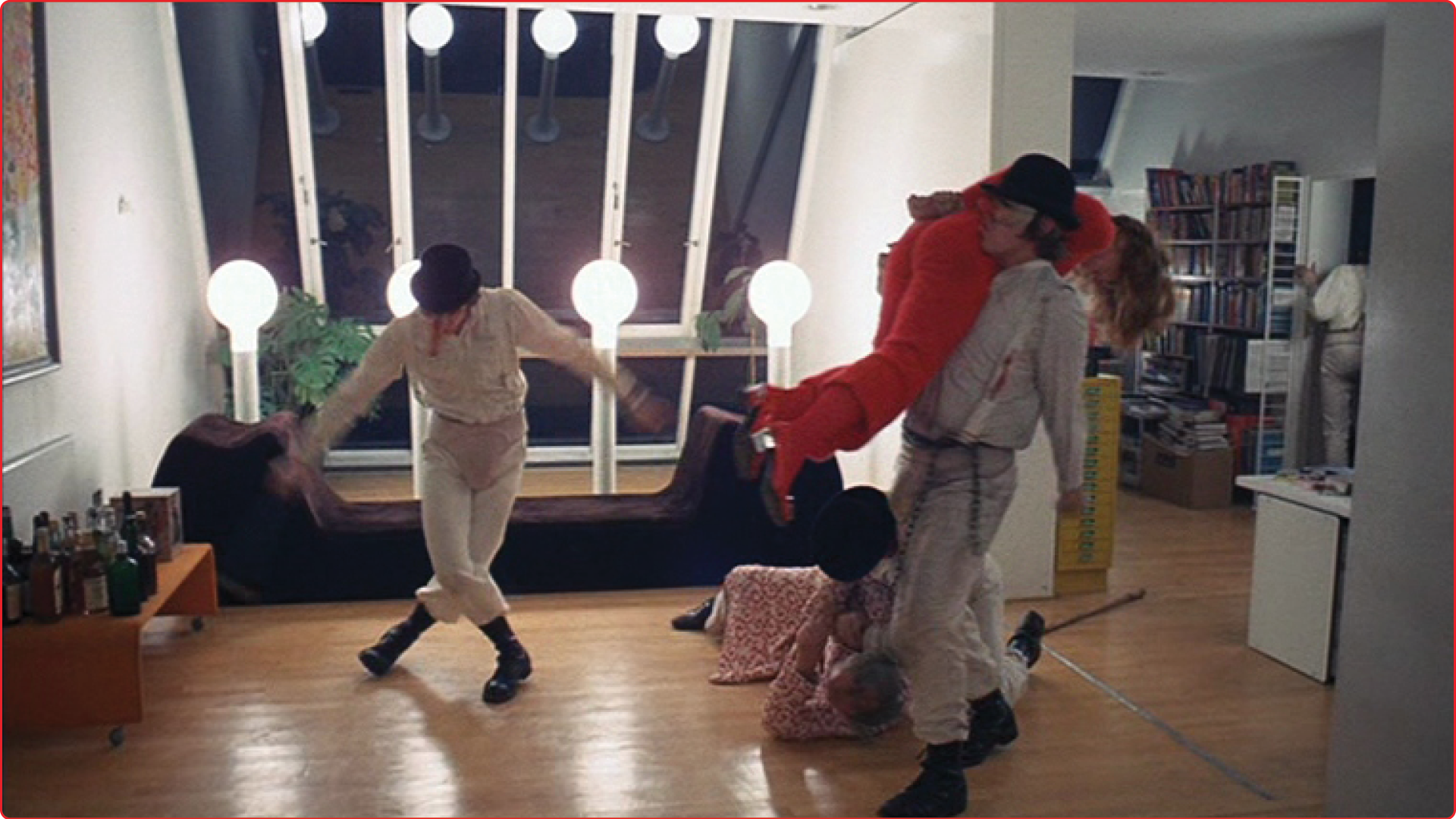
A Clockwork Orange (1971)
Canonero was born in Turin, Italy, in 1946, and studied art history and fashion design, before moving to London, where she started out in advertising and theater. A lover of cinema, she hoped to find her way into the film industry-and she did, meeting Kubrick for the first time on the set of 2001: A Space Odyssey (1968), and shortly thereafter, being asked to design the costumes for his next feature, A Clockwork Orange.
It was through him that she first understood the importance of a holistic approach to worldbuilding, that every aspect of the visual storytelling must be in harmony, from costumes and production design to cinematography and lighting. Rather than begin her exploration of A Clockwork Orange by sketching or doing research, Kubrick taught Canonero how to use a wide-angle Nikon and a light meter, and had her assist production designer John Barry on location scouts throughout London. By the time she began conceiving of the wardrobe, she’d already spent months thinking about these characters and their environments, and crafted an array of looks that would fit amongst Kubrick’s vividly stylized vision of the near future.
Given this “start with the head” dogma, Canonero has always stressed the importance of having the hair and make-up department be intimately involved in the creation of a character’s aesthetic identity. A Clockwork Orange was her first collaboration with the legendary make-up artist Barbara Daly and hairdresser Leonard (known in the early ’60s for styling the signature cuts Twiggy and the Beatles). The three would become something of a team. Together, they not only crafted the iconic look of the Droogs, from the tops of their bowler hats to the tips of their paratrooper boots, but envisioned a distinct style for everyone in the cast, too. Consider the wardrobe of Alex’s mother, a personal fascination of mine: a middle-aged factory worker, she was dressed by Canonero like a young mod on Carnaby Street, in a Mary Quant-esque fire engine red PVC raincoat or brightly colored knee-highs paired with a leather minidress-and that is to say nothing of her purple coiffure.
Like Kubrick, Canonero is a meticulous and endlessly curious researcher who delights in a detective-like inquiry into each new film. “I like to steep myself in an era,” as she once put it. For their next collaboration, Barry Lyndon (1975), Kubrick’s baroque, powder-perfect adaptation of William Makepeace Thackeray’s 18th-century picaresque tale of decadence and moral decay, her research took her all over Europe, visiting museums and libraries to find references that would allow her and costume co-designer Ulla-Britt Söderlund to bring to life the exactitude of Kubrick’s painterly vision and the opulence of the 18th-century court.
To achieve this, she and Söderlund sourced fabrics, laces, and clothing from auction houses and private collections-one can only fantasize about visiting the archive of garments, books, and other materials Canonero has amassed over the years. Given that much of Barry Lyndon was photographed in low, flickering candlelight, the costumes needed to visibly stand out in terms of both shape and texture. (By contrast, the bright white light that bathes Sofia Coppola’s delicious petit four of a film, 2006’s Marie Antoinette, for which Canonero re-used several pieces from her archive, allows every small, bejeweled or fragrant floral detail to overwhelm the senses.) For their original costumes, Canonero and Söderlund-and their team of tailors, cutters, and dressmakers-dyed and boiled fabrics to give them a lovingly worn quality that did away with the artificial stuffiness inherent to the period drama genre. In doing so, they created a radical evocation of both rarified beauty and lived-in naturalism onscreen-and for their supreme work, they won the Academy Award for Best Costume Design in 1977. Söderlund accepted the award on their behalf in full Barry Lyndon garb-tricorn hat, velvet tailcoat, and all.
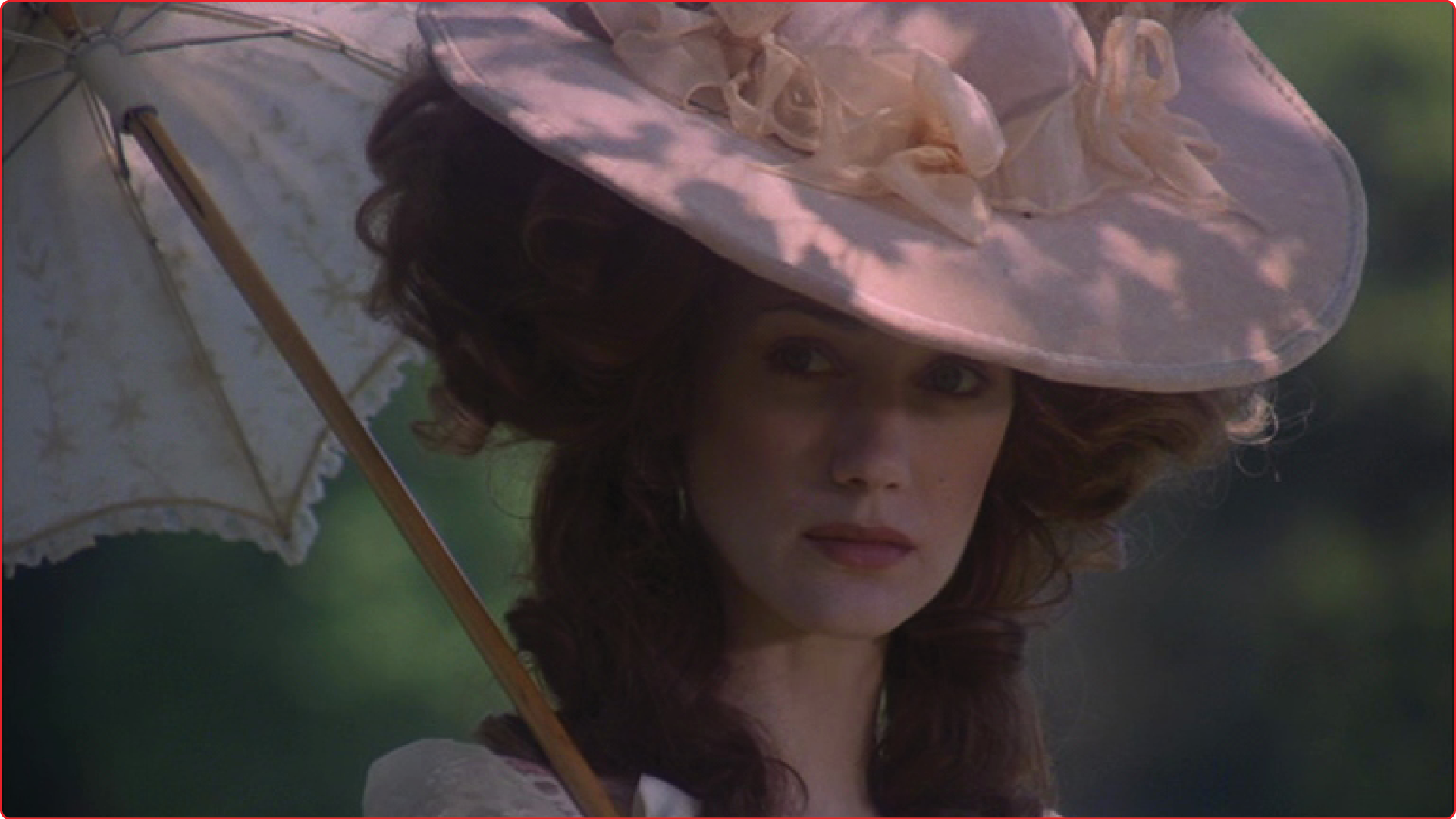
Barry Lyndon (1975)
Francis Ford Coppola would prove to be another one of Canonero’s closest collaborators, partnering on The Cotton Club (1984), Tucker: The Man and His Dream (1998), The Godfather Part III (1990), and, most recently, his forthcoming, long-awaited sci-fi Megalopolis. Despite being a notoriously fraught production, The Cotton Club was a fond experience for Canonero. Part Prohibition-era crime caper, part musical, part erotic melodrama, the film centers on the legendary Harlem jazz club from which it takes its name, renowned for hosting some of the greatest Black performers of its day. Canonero dresses the cast-including Gregory Hines, Richard Gere, Diane Lane, Lonette McKee, and Bob Hoskins-with the roaring pomp and panache of the times.
She came onto the project after production designer Richard Sylbert (who she’d re-team with in 1990 on Warren Beatty’s Dick Tracy) recommended her to producer Bob Evans. When Coppola came onboard, Milena had already begun her extensive research process, familiarizing herself with the history of New York City, and particularly Harlem, in the early 20th century, and sourcing period-precise dresses, suits, and everything in between, each tailored to accentuate a certain character’s personality. (Sofia Coppola, when she was 12 years old, liked to visit The Cotton Club‘s wardrobe department after school and see Milena’s work.) Perhaps most memorable are the ensembles worn during the musical numbers, designed by Canonero and her team. There’s Hines, dancing on stage in a gorgeous double-breasted satin tuxedo jacket and pinstripe trousers or donning a more casual get-up in a Houndstooth sport jacket, suspenders, and bow tie-always with wingtip black-and-white tap shoes. There’s McKee, in one of the many show-stopping sartorial moments, wearing a delicate, lightly beaded teal silk gown; it hugs her body as she belts out a song, the intense emotion seemingly coming right from the bottom of her soul.
As the moll of legendary kingpin Dutch Schultz, Lane beams with youthful beauty in sequined drop-waist dresses, silk gowns, and my personal favorite, an exquisite beaded black-and-gold head cap. With her platinum finger-wave, she anticipates the way Canonero would dress Madonna in Dick Tracy-a fellow Dietrich-blonde creature of the night, a gangster’s girl aching for the good guy. Both women are seen in their respective final ensembles onscreen: a luxe, black coat with a high-neck leotard print trim. Not one of these outfits look out of fashion today.
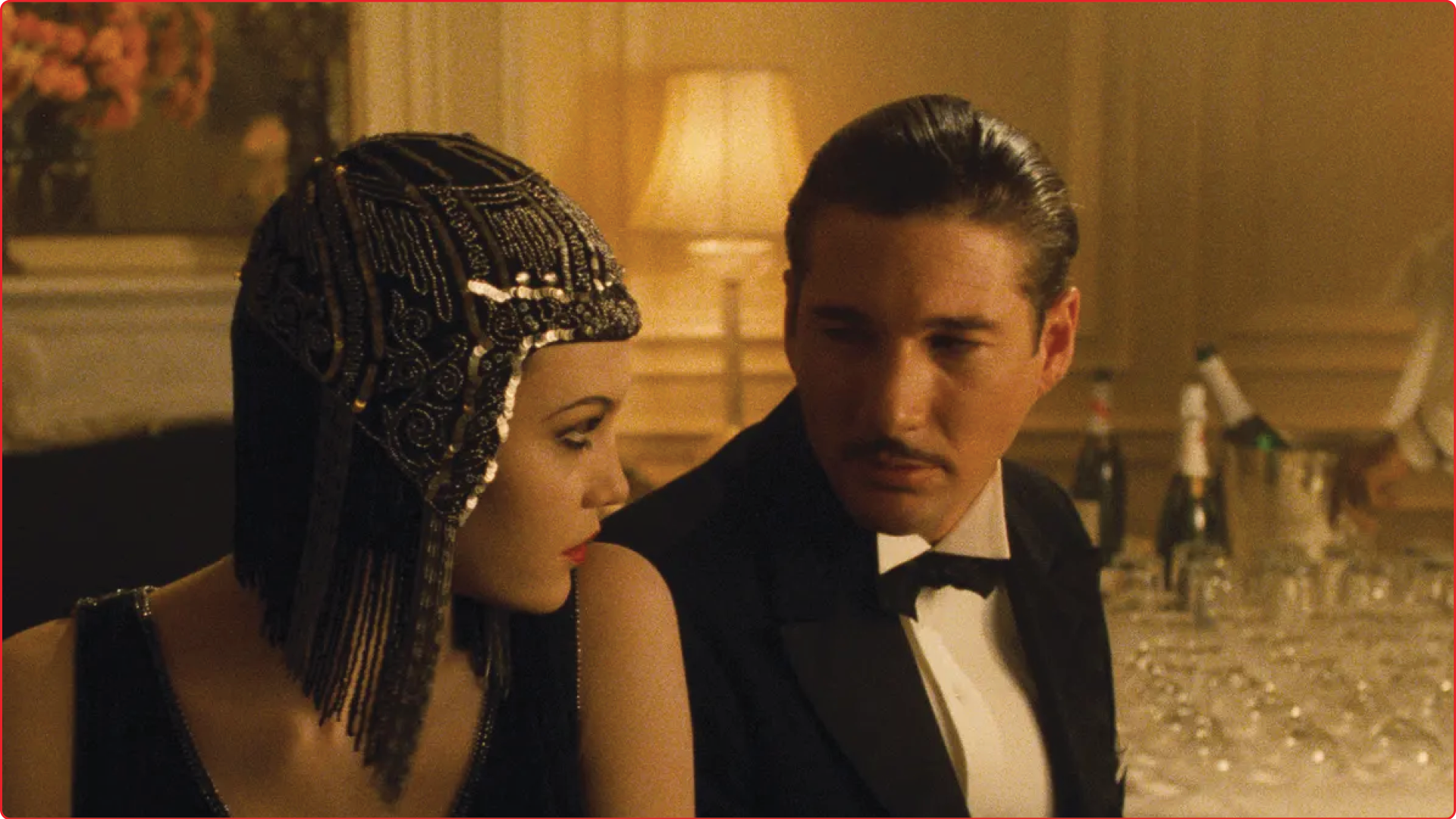
The Cotton Club (1984)
Many of Canonero’s closest collaborators are those often described as “director’s directors.” In that vein, one could say Canonero is a true “designer’s designer”-a prolific artist and craftsperson whose sustained fervor has never wavered. She understands the importance of every suture, absorbs herself in the social and sartorial world of the characters she’s dressing… and is someone who can fashion a tricorn hat in 10 minutes with just some cardboard and fabric, as designer Joanna Johnston observed while visiting the set of Barry Lyndon as a young woman, an experience she recounts in Deborah Nadoolman Landis’s book Hollywood Costume. “Watching her work on a batch of silk flowers was a highlight of my life,” Sofia Coppola told Vogue, discussing the production of Marie Antoinette.
Through her work, Canonero hasn’t so much inspired fashion movements as become synonymous with seismic shifts in the industry. It’s evident in the legacy of her work with Kubrick-but especially from the runaway success of Hugh Hudson’s historical sports drama Chariots of Fire (1981), which catapulted her into a larger cultural conversation. Set mainly in England and Scotland in the 1920s, the film was lauded for its interpretation of classic Oxbridge style menswear: sumptuous tweed jackets and suits, crisp button-downs, chunky cable-knit tennis sweaters, and pleat front wool trousers. Canonero told the LA Times that she enjoyed designing for the early 1900s because the clothes weren’t “costumey,” they could be work with what was already in one’s closet. In favoring historical precision over theatrical costuming, Canonero made the film’s wardrobe feel aspirational but accessible.
Chariots of Fire played at the Cannes Film Festival in May 1981, and by the time the film was released in the US the following April, the New York Times was writing trend pieces on recent period dramas and their influence on menswear that year. They reported, “The first clue that Milena Canonero’s efforts would have an impact on the fashion industry surfaced at the European collections last fall when several ready-to-wear houses played the composer Vangelis’s soundtrack behind their fashion shows. Weeks later, in New York City, at the shows of a number of Seventh Avenue designers, the soundtrack was heard again.”
This nostalgic style soon became de rigueur for the preppie Ivy League set shopping at high-end retailers and department stores like Bloomingdales (who even based a 1982 ad campaign on the film featuring one of its stars, Ben Cross). The look was also echoed by American sportswear designers like Perry Ellis, whose collections were infused with a formal Englishman’s sensibility, as well as Ralph Lauren, one of Canonero’s great champions. His Polo line has drawn from the Chariots of Fire ethos for several capsule collections-as recently as last year, a line of sportswear harkened back to the “vintage athletic style,” with promotional photography and videos that paid homage to the film’s famed sequence of young men running in slow-motion along the beach.
Five years after Chariots of Fire’s release, a New York Times profile of Canonero begins with the writer overhearing a young woman in the theater lobby say, after seeing Sydney Pollack’s Out of Africa (1985): “If they had a concession stand selling the clothes in this movie, I’d buy a whole new wardrobe.” And she wasn’t alone. Canonero’s fastidiously researched and recreated designs for the romantic drama set off another nostalgic trend (this time, more balanced between men’s and women’s wear), creating a demand for colonial turn-of-the-20th-century fashion reimagined through a late 20th-century lens, channeling the crème-colored linens, safari shirts and jackets, leather boots, and bevy of expertly-crafted hats worn by Meryl Streep and Robert Redford in the film. By that time, Lauren had already presented his famed Safari collection, but again, Canonero’s costumes not only echoed the zeitgeist but tripled its volume. “It was as though the fashion world was ready for the styles of the film,” she told the LA Times. “The costumes just caught something that was in the air.”
Her designs evoke a certain ineffable desire to be worn. I find sometimes it’s not even the garments themselves as much as it is how people move in them, a certain confidence and ease, a sophistication and sexiness that is inherently cinematic. That’s how I feel watching The Godfather Part III, in which Canonero’s creations-a rich tapestry of colors and textures, a palette of jewel tones: deep scarlets, midnight black velvets, iridescent ambers inspired by 16th-century painters like Titian, Caravaggio, and Rembrandt-play in perfect harmony with Gordon Willis’s cinematography and Dean Tavoularis’s production design.
I love the specificity of the fact that, despite the story taking place in 1979, Canonero chose fabrics like silk taffeta, velvet, and leather that lean closer to fashion of the late 1980s. It imbues the film with an anachronistic quality that elevates it from the tenor of traditional drama into the operatic register of Shakespearean tragedy that Coppola so desired. Everyone in the cast looks exquisite. There’s a fiery and dashingly handsome Andy Garcia in a parade of slick leather jackets that lengthen and become increasingly sophisticated (from a double-breasted sport coat to a broad-shouldered trench) as he rises up the family ranks. There’s a prematurely aged Al Pacino in an array of dark suits worn with pin-collared shirts and patterned ties (the paisley is a favorite of mine) and Talia Shire, whose slicked-back hair gives a stage to the layers of shimmering jewelry adorning her neck, wrists, and ears with casual opulence. Then there’s Sofia. So perfect in her two-piece black velvet suit dress and matching beret as she struts out of her red convertible, off to prove that she’s a woman. And then there’s her grand finale opera dress, an off-the-shoulder sparkling gold tulle gown that, when eventually drenched in blood, brings to mind religious iconography of bleeding hearts.
To create the suits for the film, Canonero worked with Milan-based fashion house, Verri, which allowed for one of my favorite credits: “Men’s Costumes by Milena Canonero / Expressly realized by Verri.” She has since continued to collaborate with major designers: Yves Saint Laurent dressed Catherine Deneuve alongside Canonero’s wardrobe for Tony Scott’s lethally stylish vampire ménage à trois The Hunger (1983), Manolo Blahnik whipped up the decadent, macaron-hued satin heels paraded in Marie Antoinette, and Marc Jacobs created the classically handsome gray suits and one-of-a-kind luggage (together with Louis Vuitton) toted by the leading men in Wes Anderson’s The Darjeeling Limited (2007).
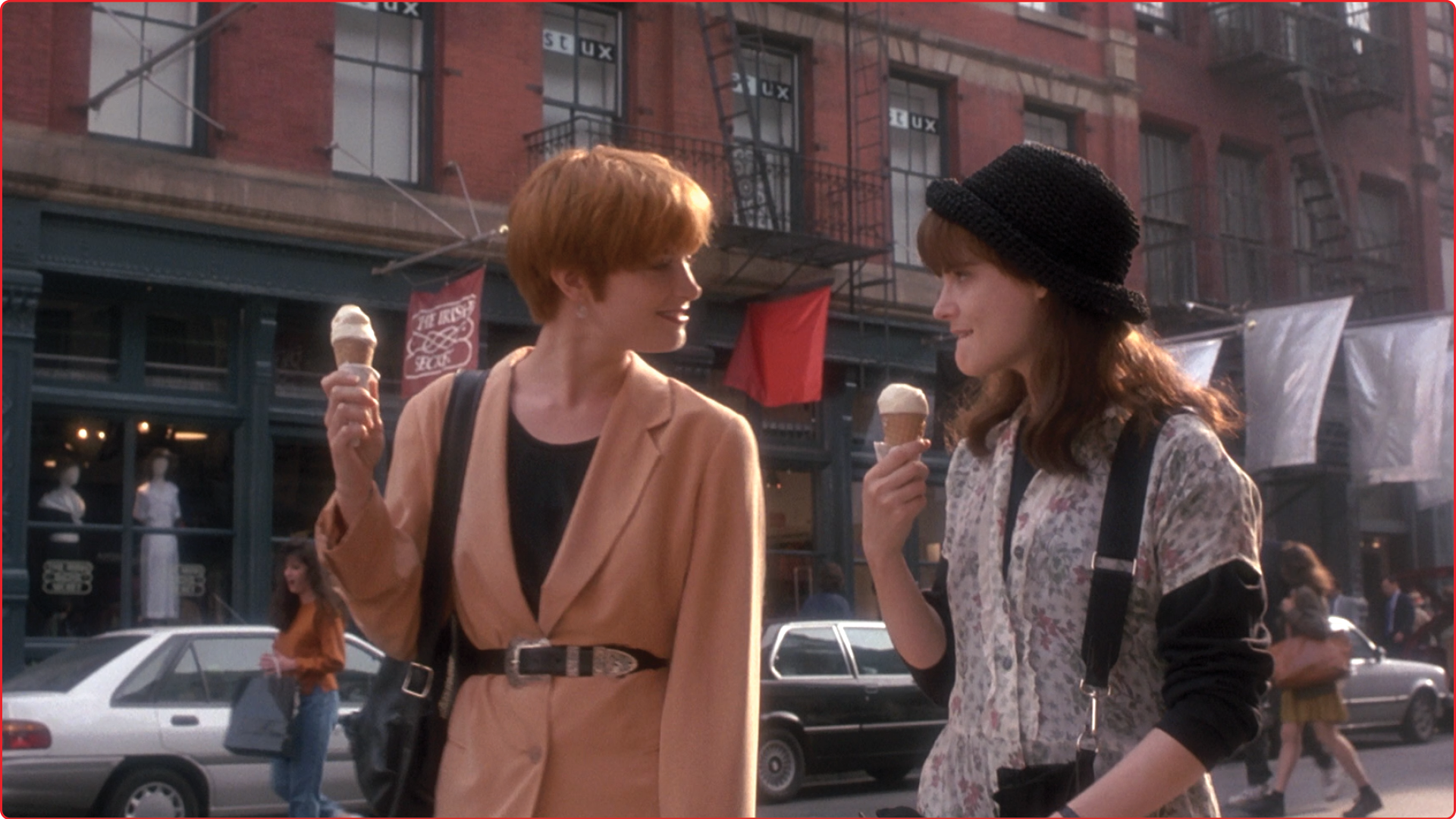
Single White Female (1992)
With Barbet Schroder’s 1992 erotic thriller Single White Female, Canonero was able to fully envelop a film in the richness of her artistic tastes by taking on the role of both costume and production designer for the first time (she’s reprised this double billing only once since). In her New York Times review of the film, Janet Maslin wrote that Canonero’s production design was of “such ravaged urban beauty that it suggests Last Tango in Paris on the Upper West Side.” Taking place in and around the Ansonia, a beautiful Beaux-Arts style building near Central Park, the film concerns a freshly single fashion designer (Bridget Fonda) who finds herself caught in the disturbing and obsessive snare of her new roommate (Jennifer Jason Leigh).
A Working Girl meets proto-Sex and the City professional New York woman aesthetic pervades the interior décor and wardrobe of the film. The fantastically spacious apartment is sparse but in a chic early-’90s Manhattan loft-meets-Parisian Haussmann-style way: a chaise lounge in the center of the room, coromandel screen by the bed, paint artfully peeling off the wall, some tulips lazing over their vase. It’s sophisticated and sexy but without frills, like Fonda’s closet of angular jackets belted with power miniskirts, sheer black tights, a pivotal silver mid-length trench, and pumps and smart flats that seem comfortable enough to get you to Zabar’s and back.
I could continue on and on about Canonero, about the endless surprises of an eclectic and singular career that has taken her through nearly every genre and period onscreen-how, between all of her cinematic accomplishments in the 1980s, she also managed to work on the costumes for 24 episodes of the moody cop drama Miami Vice; how the cleverness and sex appeal of her costumes give a tactile sense of personality to Steven Soderbergh’s Solaris (2002) and Ocean’s 12 (2004); and how entwined her costumes have become with Anderson’s output over the last two decades and five films together, including The Life Aquatic With Steve Zissou (2004), The Grand Budapest Hotel (2014), and most recently, Asteroid City (2023). Together they’ve conjured new trends of their own, like the instantly recognizable Steve Zissou red wool beanie hats (“start with the head“) inspired by those worn by oceanographer Jacques Cousteau. And in a beautifully full-circle moment, Canonero styled Jason Schwartzman’s Asteroid City character after a particular look from Kubrick’s early days as a photographer, when he was always sporting one of his beloved cameras like a well-worn accessory.
With each passing decade, Canonero’s costumes collapse the past, present, and future to create a style and feeling that’s eternally elegant and always stimulating. Her designs don’t age. “I hate time,” she told the New York Times in 1986. “There is never enough time to do something properly. There is never enough time to live all the lives you want to live.” Reflecting back on these words nearly 40 years on, it’s safe to say she’s lived, and will continue to live, far more lives than most.
Hillary Weston is the director of social media for the Criterion Collection, as well as a staff writer for their online publication. Her work has appeared in Film Quarterly, BOMB, Interview, The Brooklyn Rail, SSENSE, and more.

Asteroid City (2023)