[wpbb post:terms_list taxonomy=’category’ html_list=’no’ separator=’, ‘ linked=’yes’]
[wpbb post:title]
By [wpbb archive:acf type=’text’ name=’byline_author’]
An examination of the newly rediscovered proto-Afrofuturist psychodrama. Top of The Heap screens at Metrograph from September 16 as part of the series Welcome to Metrograph: A to Z.D.C. policeman George Lattimer swaggers around his beat with more authority than he has. Brushing off the orders of his Captain, the cocksure officer rebuffs, “I can do any goddamn thing I want”-as if he wasn’t just passed over for promotion for the umpteenth time. He repeats this maxim throughout Top of the Heap (1972), a proto-Afrofuturist avant-garde psychodrama-comedy often mispackaged as Blaxploitation, and the feature debut of writer-director-producer Christopher St. John, who also stars as Lattimer: outwardly tall, handsome in a uniform; inwardly distracted and increasingly disturbed.
After premiering at the 1972 Berlinale, Top of the Heap was invited to Cannes. But its financier, Fanfare Films, known for their exploitation pictures, pulled it in fear of it being labelled as arthouse fare rather than a more lucrative genre piece, before the distribution was ultimately shuttered over a writing credits dispute. With the rights issue left unresolved, the much-mythologized film barely played again until 2013, over 40 years later, when Chicago-based programmer Floyd Webb rescued it from neglect. Then, just this year, Shout! Factory and AGFA restored the film. We can only imagine the body of work St. John, whose career never really recovered, might have directed, had the film found its audience earlier.
Before St. John broke into the movies as an actor in the late 1960s and early 1970s, starting off with a string of roles in softcore pornos, he was training under Lee Strasberg at the Acting Studio, working at a fabric and rug store in New York City, and accumulating theater experience (including Charles Gordone’s Pulitzer Prize-winning “No Place to Be Somebody”). Eventually, he even founded his own theater space on 42nd Street. Working onscreen, moment to moment his performance in Top of the Heap feels uniquely inside out. St. John plays Lattimer as tightly wound, sardonic, and solipsistic, with mysterious calculations crackling behind his eyes. His long limbs stiffen or loosen according to Lattimer’s sense of authority in any given scene-the officer is loosest when at his most powerful.
Like Lattimer, St. John wasn’t afraid to walk out on authority-he initially left the audition for what would become his most famous role, the militant leader Ben Buford in Shaft (1971), when he learned that he wouldn’t be auditioning for the lead like he’d first been told. Later, he dropped a producer from Top of the Heap who’d recommended Lattimer’s character be rewritten, to make him a baseball player. By contrast, the director mocks such racial stereotypes, having Lattimer at one point imagine himself succeeding as a man wearing a Harvard letterman jacket and an impossibly rictused smile.
Like Lattimer, St. John wasn’t afraid to walk out on authority
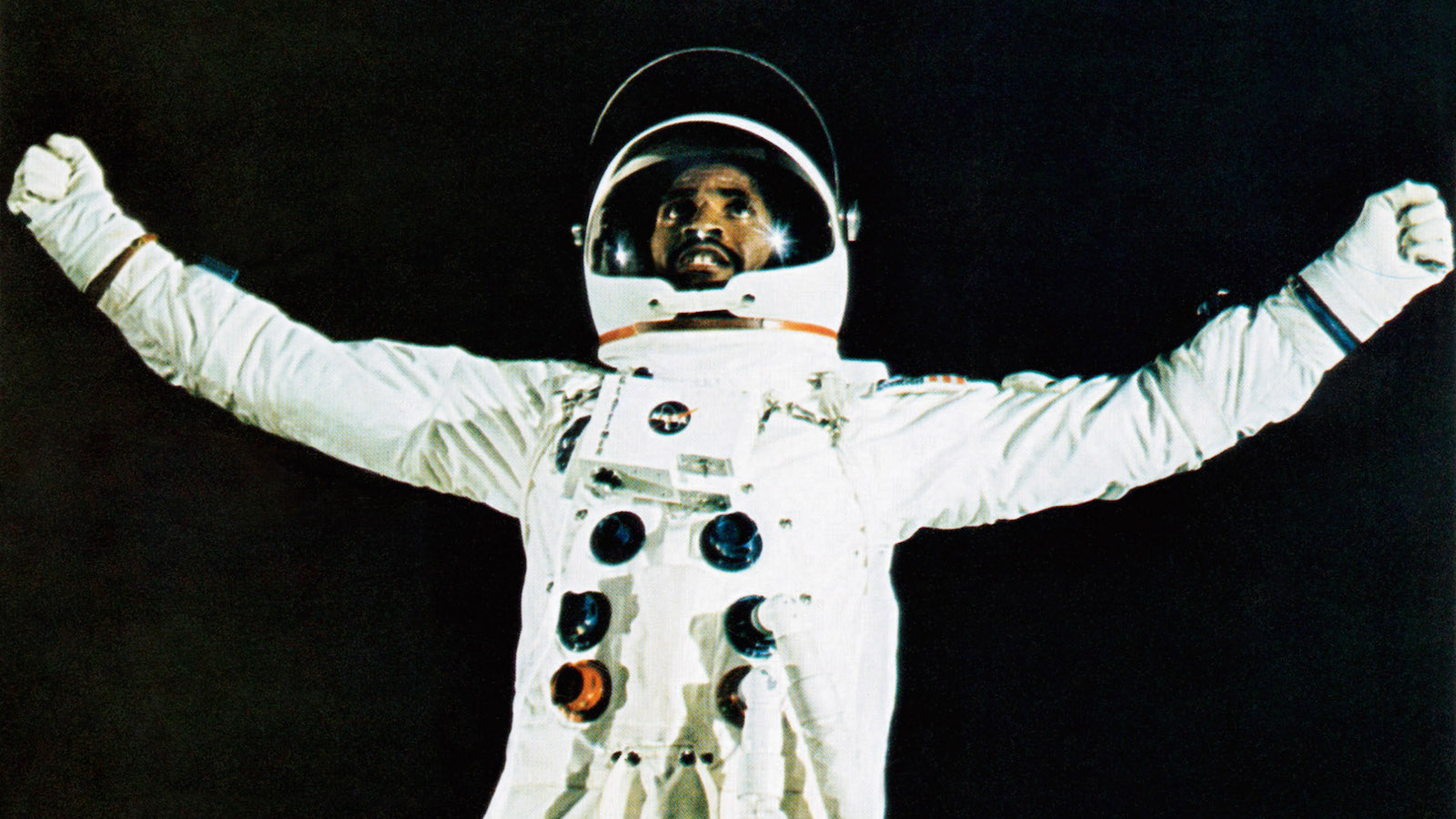
To his credit, though, Lattimer doesn’t measure his worth by recognition, and he knows that the only reason he hasn’t already made sergeant (on paper, he should have years ago) is that, after more than a decade on the force, he’s the only Black cop in the precinct, and he won’t fete any so-called authority to move rank. Instead, he wanders off on his path, hoping the world will eventually catch up. While he waits, Lattimer daydreams of living at the “top of the heap,” in particular, as the first Black man to walk on the moon. In one such sequence, astronaut-Lattimer trips and nearly impales himself on the pointy end of an upside down American flag on the moon. A director, played by Lattimer’s police captain, calls cut; movie lights come up, revealing the once-convincing surface of the moon as just a set, Lattimer as just an actor. Then the scene resets, playing again in real time, confusing any easy distinctions between dreams, movies, and reality.
Rather than just present this story as one man lashing out against an unjust system, the film widens its purview. As Lattimer busies himself fantasizing about ways that he might come to be regarded as exceptional, his wife and kids pay the price-they could use a little more money, and a husband and father a little less self-absorbed.
St. John’s film language feels tethered to the character-the camerawork is tight and static during Lattimer’s most repressed scenes, and handheld when he is at his least restrained. Copious lens flares spike and cloud the lens, blurring the line between Lattimer’s recollections, present, and Americana-filled daydreams-guns, NASA paraphernalia, hot dogs… Meanwhile, the women in his life seem to merely symbolize stages of his own personal crises-his wife Viola (Florence St. Peter) represents responsibility and subjection, his unnamed mistress (musician Paula Kelly) dereliction and freedom-and he runs to and from them accordingly. When Viola expresses her material and emotional needs, Lattimer is quick to retreat back into his head, busying himself with his fantasies.
Sometimes, St. John shows us the same action twice, played differently. When, on duty, Lattimer waylays the perpetrator of a stabbing, we see two versions of the confrontation: one where the culprit doesn’t resist arrest, and another where he calls Lattimer racial slurs and stabs him. The film often feels like it’s taking place anywhere but on the ground upon which Lattimer stands. And when it is there, it’s hard to determine how much of what we’re seeing is reliable. Such devices indicate Lattimer’s most tragic quality: a total lack of presence.
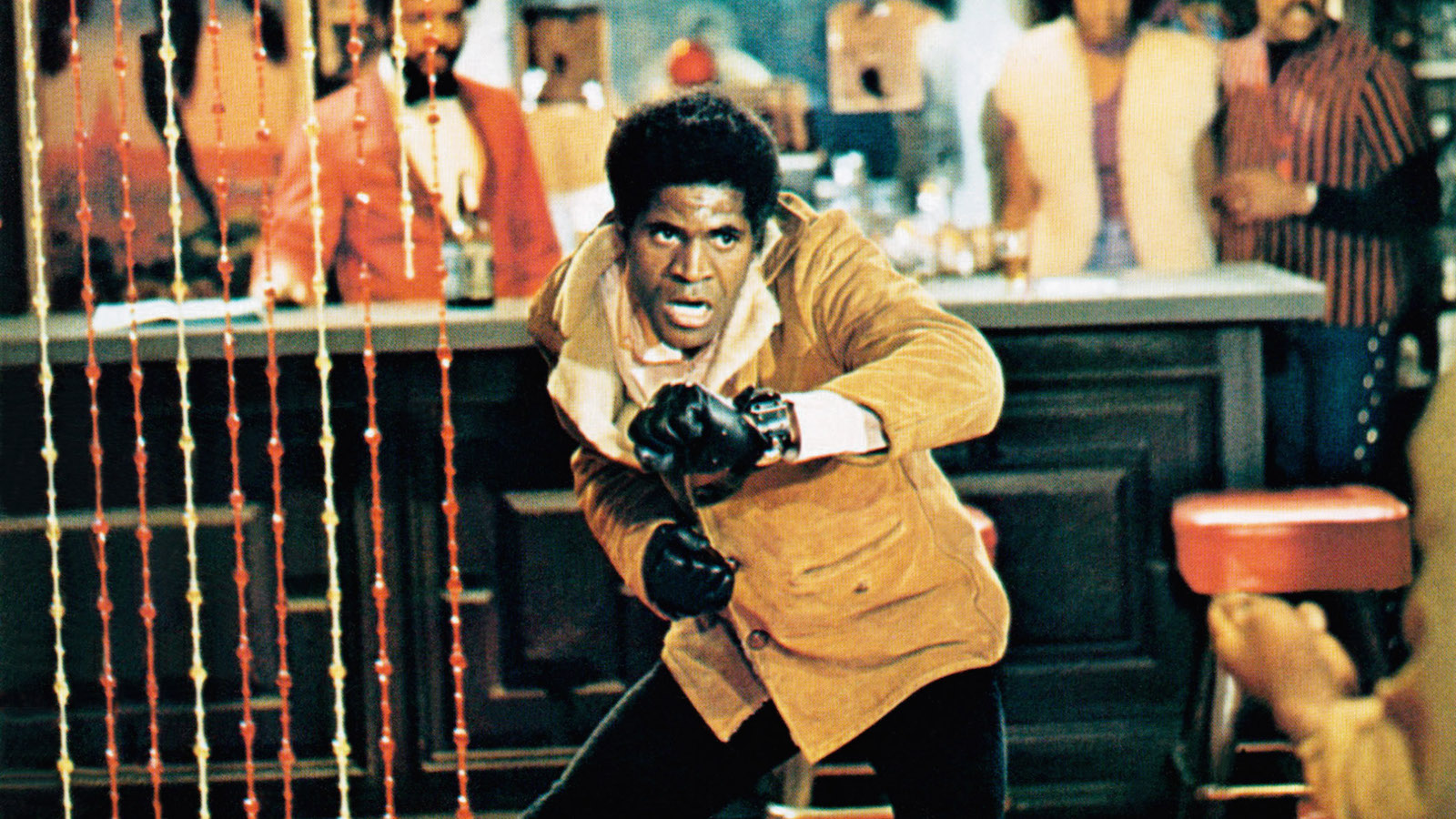
St. John has more formal tricks up his sleeve. At decisive points throughout the film, he and editor Michael Pozen jump cut a small measure forward. In one moment, Lattimer’s police partner Bobby (Leonard Kuras) might be talking about his wife’s meatball sandwiches, but in another, after a cut that is barely discernible, be asking Lattimer about his recently deceased mother from Alabama. The technique is always blindsiding. Removing the natural pauses between dialogue, St. John makes even regular conversations feel like jarring, back-to-back series of rebuttals: it’s the lonely Lattimer against the world. Most conversations with him feel like a contest.
When visiting his mistress, Lattimer has to break the chain lock on the door because she’s too high to let him in. He’s especially upset by this because it inadvertently puts him back into the role he fears most: the intruder. But he feels unwelcome almost everywhere, in both the white DC police force and Black neighborhoods when sporting the badge. As part of this repeated pattern in the film of emphasized doors and questions of access, the entrance to Lattimer’s apartment is shown to be sealed shut by three separate locks. One night after night patrol, he comes home to find the front door ajar and, panicking, finds not an intruder but his daughter Valerie (Almeria Quinn), sluggish on drugs, in her first and only appearance in the film. Lattimer takes off her coat and boots, and tucks her into bed, as she strings together her first and only coherent sentence: “You don’t care what I do anyway.”
Given her limited screen time, you may think St. John doesn’t care either. But it’s difficult to say what Top of the Heap might have looked like if one of its producers, Joe Solomon (the founder of Fanfare Films, who got his start luring audiences into four-walled theaters with the real birthing sequence in 1945’s Mom & Dad) didn’t demand cuts to make the film he wanted rather than the formally and politically boundary pushing drama St. John had in mind. “[Solomon] was making an exploitation movie… and I was not,” St. John told the L.A. Times earlier this year. The producer cut out all of the scenes that featured Lattimer’s son, who is now only referenced in dialogue, dangling the expectation for a character who then never appears. We can only imagine what Top of the Heap could have been if St. John completely had his way.
Lattimer, though, cannot even conceive of success for himself in the terms of the American dream. He tries it on as an astronaut, a Wallstreet tycoon, and an Ivy League athlete, but even in his fantasies, not a single person in his hometown of Watersville, Alabama, shows up to his arrival ceremony to congratulate his landing on the moon. In another reverie, he rides in the backseat of a car as the star being publicly honored in a ticker-tape parade. He’s finally made it! But then a sniper assassin cuts his dream short.
Perhaps even more tragic: Lattimer becomes convinced of his country’s capacity to destroy anything, even objects as far out as UFOs. “What about laser beams, underwater soldiers?” his partner contests, killing time in the patrol car. Lattimer broadcasts a warning to any UFO who might be listening in, “Don’t come down here, we got Richard Nixon! We got Agnew the golfing giant!” And with that, he heads out for a stroll. Alternately dragging his feet and tapdancing across the pavement, the jaded patrolman begins to sing Clyde McPhatter’s “I Can’t Stand Up Alone.” There are two layers to the tragedy here. Professionally isolated and belittled, with his career arc thwarted, Lattimer is so caught up in his own fantasies of heroic self-aggrandizement that he’s unable to tend to the routine duties of domestic life, and the everyday needs of the people back on earth who need him.
A.E. Hunt is the Vice President of Dedza Films, a freelance programmer, cameraperson, and writer with words in Criterion, Filmmaker, American Cinematographer, GQ, Rappler, and others.