

Essay
The Legend of Suram Fortress
On the chimerical Transcaucasian adaptation of a Georgian folktale.
Share:
Jubilantly outlandish and artisanally magical, The Legend of Suram Fortress (1984) is a late work by the Soviet Georgian master mythmaker Sergei Parajanov. Boldly mixing fairy-tale elements with sincere spirituality, the film portrays characters who, while archetypal, are unpredictable and convincingly soulful. This episodic fable takes us on dual quests, following a pair of lovers: a would-be hero who seeks freedom and material riches, and a heroine who clings to love until it escapes her. Made at a time when the Soviet Union suppressed the distinct national identities of its vast territories, the story is spurred on by perpetually brewing border trouble, with the ruling empire on the brink of ruin: a geopolitical metaphor embodied by the crumbling fortress walls that are central to the plot.
Playing out in a temporally ambiguous world, Legend is adjacent to the ethnically soupy and homoerotically-coded Medieval universe of Parajanov’s internationally praised and best-known work, The Color of Pomegranates (shot in Armenia and Azerbaijan in 1969). Where Pomegranates is taut and marked with allegorical melancholy, Legend has an uninhibited and flamboyant quality, projecting a sense of defiance in the wake of the unjust persecution Parajanov had recently endured. (His crimes included making films outside the sanctioned Soviet Realist style, being a formalist, a Ukrainian nationalist, and “a bourgeois mystic,” among other Soviet-demarcated sins, including homosexuality.) Parajanov’s prison term had been reduced to four years in response to an international petition of protest, but in 1982 he was arrested again, locked in a flooded cement hut where he came down with pneumonia. (After 11 months, the court found him innocent.) One cannot help but notice how a pervasive sense of being cursed finds its way into this film, made after 15 years of blacklisted silence. (Parajanov officially shares his director credit with actor David “Dodo” Abashidze, an arrangement made to bolster support from officials, though the two were friends who went on to make a final movie together, 1988’s Ashik Kerib.)

The Legend of Suram Fortress (1985)
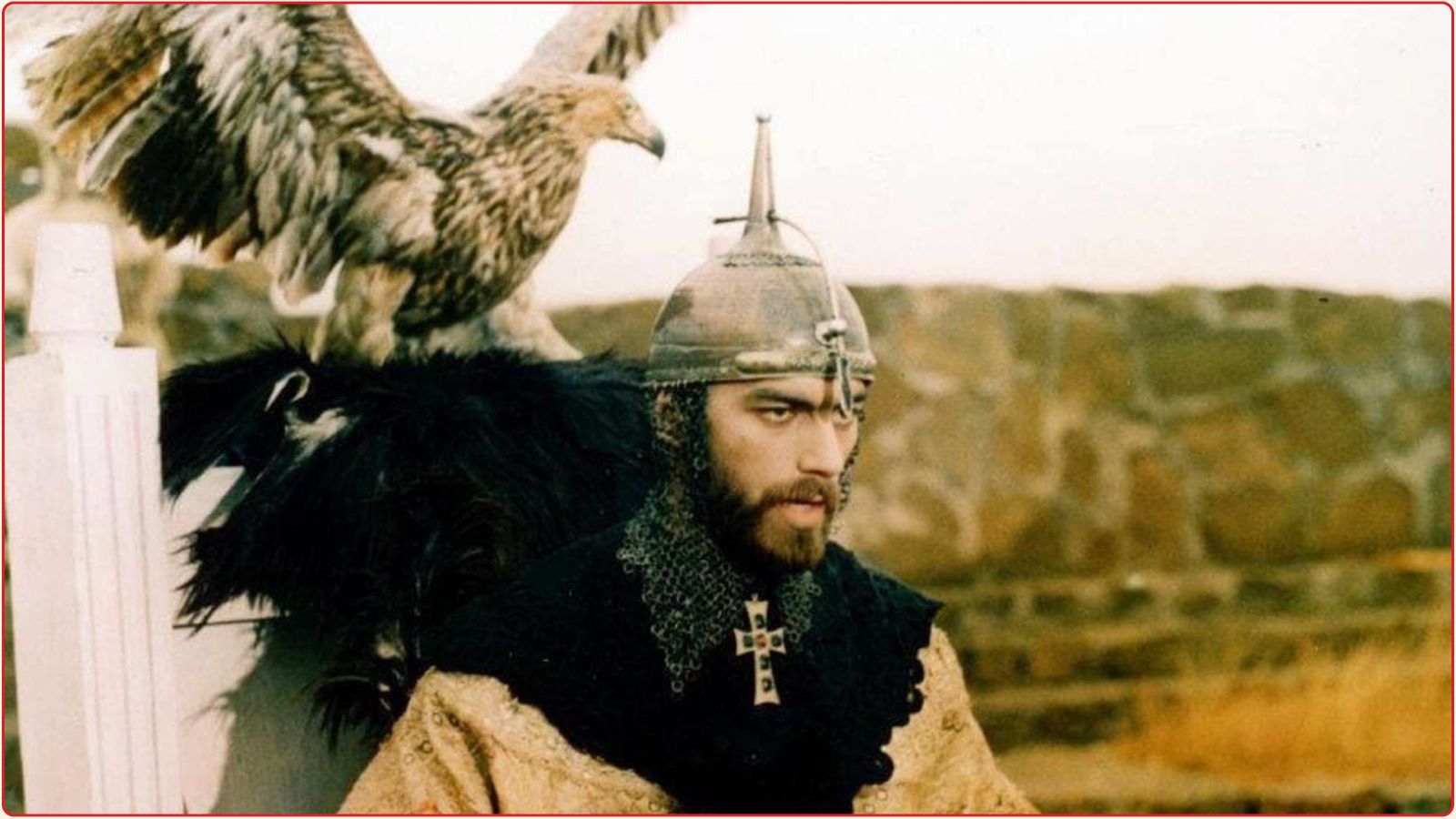
Legend declares at the outset that the story was inspired by a novella, Suramis tsikhe, and that it is being told in honor of all Georgian warriors. The film begins with an image of a detached tusk atop a rock face followed by an open rural landscape: fields of luminous, dry, yellow grass, and a mountainous background—an expanse that radiates a sense of nature’s independence from battles raging elsewhere. Veiled women scurry along in urgency, loading eggs they’ve collected onto a cart plodding up a hillside. A dashing young czar appears in a ceremonial robe with pearls strung around his neck, posed against a leopard skin backdrop, declaring himself an equal among his people while blessing the construction of the Suram fortress and presenting a blueprint (well, a gold print) depicting an aerial view of the structure. From there, we’re given a wide shot of serfs wielding pickaxes, laboring away in a circle, underlining class divisions and a contradiction at the core of the czar’s proclamation. Between the opening credits, we see semi-static black and white footage of the fortress (a nod to a 1922 film adaptation of the same novella), culminating in shrapnel penetrating the picture frame, partially shattering a mirror image of the fortress—an unsubtle announcement of the directors’ fracturing of convention.
The actors are rarely filmed in close-up, reinforcing a sense of folkloric stateliness, somehow without short-circuiting the transmission of emotion. (It’s a big component of the film’s enchanted quality.) For all that, Legend also has a cheekiness absent in Pomegranates and Parajanov’s earlier work. Amidst the action of the opening sequence, we see two guards on duty goofing around at an entryway, playing a hasty game of dice as they keep a darting watch from under their shaggy papakhas. In another comically absurd moment, the Doomed Lovers are introduced: Durmishkhan (Zurab Kipshidze) calls out to his beloved Vardo (Leila Alibegashvilli), summoned from a shallow cave, her apparent place of residence. She is oddly petulant, resisting her beloved’s insistence that they dance for the czar (and dance they eventually do, though her yielding to the request doesn’t overturn her foreboding prediction that her man is going to abandon her).
Durmishkhan rides off on a stolen horse, journeying to a village where Muslims are gathered in prayer. He meets Osman-Agha (played by Abashidze), a merchant who embraced Islam to avoid persecution. Abashidze also plays Simon the Piper, a fairy godfather figure to Durmishkhan’s future son. This doubling of supporting roles, a common convention on stage, feeds into Legend’s pronounced theatricality, accentuated by the frontal orientation of performers to the viewer. Osman confesses his conversion story and, as if transplanted from Parajanov’s earlier film, a pile of pomegranates appear, embedded in his memories of torment. The fruit is sliced midair by the sabers of his master, who mocks him, seeds spewing confetti-like in a spectacle of humiliation. Such flashbacks aside, the narrative lurches forward in restless and jolting leaps, with elaborate tableaux and musical interludes. Static shots flaunt peacocks, horses, llamas, and camels posed against vibrant tapestries and rugs. Llamas, like camels and peacocks, are not native to Georgia, but that doesn’t stop Parajanov from inserting them into his eclectic fantasyland.
The Legend of Suram Fortress (1985)
When the story circles back to Durmishkhan, he has married a giggling bride (who is not, alas, poor Vardo) in an Orthodox ceremony, and a son named Zarub promptly arrives, symbolically linked, by way of a jump cut, to a lamb. Here, and in scenes that follow, images of Christian iconography and pageantry give the film an ecstatic energy, even as they foretell ruptures to come. Meanwhile, Piper Simon is giving young Zurab an al fresco lesson among taxidermied leopards and dangling puppets. The figure of Saint Nino looms prominently as a symbol of Georgia’s Christianization. Mirrors and flames and a haunting score taunt Osman as he is seized by the Turkish brotherhood to which he once belonged. He’s shown wedged in the floor, looking rather beheaded and wide-eyed, as he is transported to a candidly artificial afterlife. Swathes of undulating sky-blue cloth rhapsodically represent the sea while a tightrope walker bounces along overhead, a tableau that’s been meticulously plagiarized in a music video by Tarsem Singh, while also serving as a source of inspiration for other artists drawn to Parajanov’s surrealist inventiveness, from Fellini to Derek Jarman.
In the chapter titled “Prayer,” we see Vardo in profile gazing up at the sky, veiling and unveiling herself in profile against a backdrop of majestic mountains, turning to face the camera. This action is repeated three times, heightening our sense of Vardo’s longing—a somber rehearsal before she embarks on a futile search for her long-lost love. Doomed love provides a recurring theme for Parajanov, and Legend is naturally no exception. Vardo is the heart of the story, even though it is a dark heart, capable of exacting revenge. Bewildered at the loss of her lover, she seeks solace from an old fortune teller, who soon passes on, and a swindler swoops in for the deceased’s paltry earthly belongings, advising Vardo to take the vacant mantle while dispensing an off-hand maxim: “Tell fortunes. Deceive people. People like to be deceived… Nothing hurts like the truth, but a lie is always welcome.” (And oh, how this resonates.) Vardo grows older (transitioning from youth to maturity by way of a pendulum sway between the two actresses playing the heroine) and revered as the village clairvoyant.
The now desperate czar sends his men to Vardo for advice on how to stop the walls from crumbling. She nominates Durmishkhan’s now adult son Zurab (Levan Uchaneishvili) to be the necessary human ingredient to fortify the walls of the beleaguered fortress. Zurab silently accepts his sacrificial immurement as an honor, and we see his profile in a close-up dramatically backlit and haloed; then he rotates his head to face the camera, allowing us to examine his perfectly proportioned features and blue-gray eyes, his wavy hair slicked back, his expression serene before breaking into a smile. Parajanov cuts to a white horse, also in close-up, tilting its head to the camera. Funeral organ music plays over these parallel shots.
Zurab’s Jesus-tinged stoicism crystallizes the tale’s tragedy. The young man builds himself into the wall brick by brick, making use of an egg tempera admixture seen being prepared in the opening scenes, an odd bonding substitute for cement. Icons from Zurab’s early education dangle above him, including Saint Nino. Piper Simon stands above, knighting the beautiful man with armor before pouring goopy earthy matter over his face. The hero is sealed and transformed into stone, rendered eerily abstract. A crowd of mourning women emerge at the news of the martyrdom, displeasing the czar, who is nevertheless convinced the fortress will finally hold together.
Any stern, didactic critique of the feudal system is blurred by the film’s pictorial splendor and elegiac mood. Parajanov completes the story with a sense of sorrow and a display of resilience. Serfs return to the fields—back to work, business as usual. The vast landscape absorbs and reflects a conclusive message: within this brutal yet wondrous world, the dead affirm the living. Survival is not to be taken for granted.

The Legend of Suram Fortress (1985)
Share:
About the Contributor
Recommended
- The Maiku Hama Trilogy
 On the retro riffs and magnetic lead of Kaizo Hayashi’s newly restored cult trilogy.
 - Juliette Binoche
 On the eloquent hunger of the iconic French actress.
 - I’m Not Everything I Want to Be
 On Libuše Jarcovjáková, the queer photographer drawn to the social fringes of Soviet Prague.