
Column
[wpbb post:title]

Drew Barrymore in 1994
Column
BY
[wpbb archive:acf type=’text’ name=’byline_author’]
Strange Pleasures is a regular Metrograph column in which writer Beatrice Loayza shares unconventional desires found across underground and mainstream cinema alike.
One of the things I like about Drew Barrymore is the way she glows-it’s the glow of someone who seems to have found salvation. Just this morning I happened upon a clip from her CBS talk show, The Drew Barrymore Show, in which she sits on the couch with her legs crisscrossed and bares her heart to fellow former child star Brooke Shields. Shields reciprocates, but she also looks somewhat startled that they’re going there. Barrymore’s approach is disarming (and it makes for very good television). Look at the way her plaintive eyes summon empathy; the way she’s positioned like a long-time girlfriend, squeezing her guest’s hands in solidarity. On air, Barrymore doesn’t shy away from discussing the turbulent events of her own life-her early years battling drug addiction, her fraught relationship with her mother. It’s the stuff of Hollywood legend and she knows it. Yet I find that moments similar to the ones she shares with Shields feel so convincingly raw and cathartic because Barrymore conveys something like gratitude that the past is behind her. It’s almost spiritual, this gratitude, as if haunted by a terrifying vision of how things could have been.
After being emancipated from her mother in 1989, age 14, Barrymore aggressively pursued mature parts that helped her distance herself from the cherubic persona she was attached to. She was nothing like Gertie, the snaggle-toothed little sister she had played in E.T. the Extra-Terrestrial (1982), whose image, in 2020, she conjured from the void, repurposing footage from a Tonight Show appearance that she had made at age seven, with the adult Barrymore seen to be interviewing her pig-tailed child-self for a promo launching her talk show, delightfully facing the past head on. By 15, Barrymore had already partied hard enough for two lifetimes; she’d gone to rehab for a cocaine addiction; relapsed and recovered, and written her first memoir, Little Girl Lost. “I didn’t want to play Barbies, I wanted to go out to a club and dance,” she said in one interview, recounting a childhood spent hanging out with twentysomething-year-olds at Studio 54.
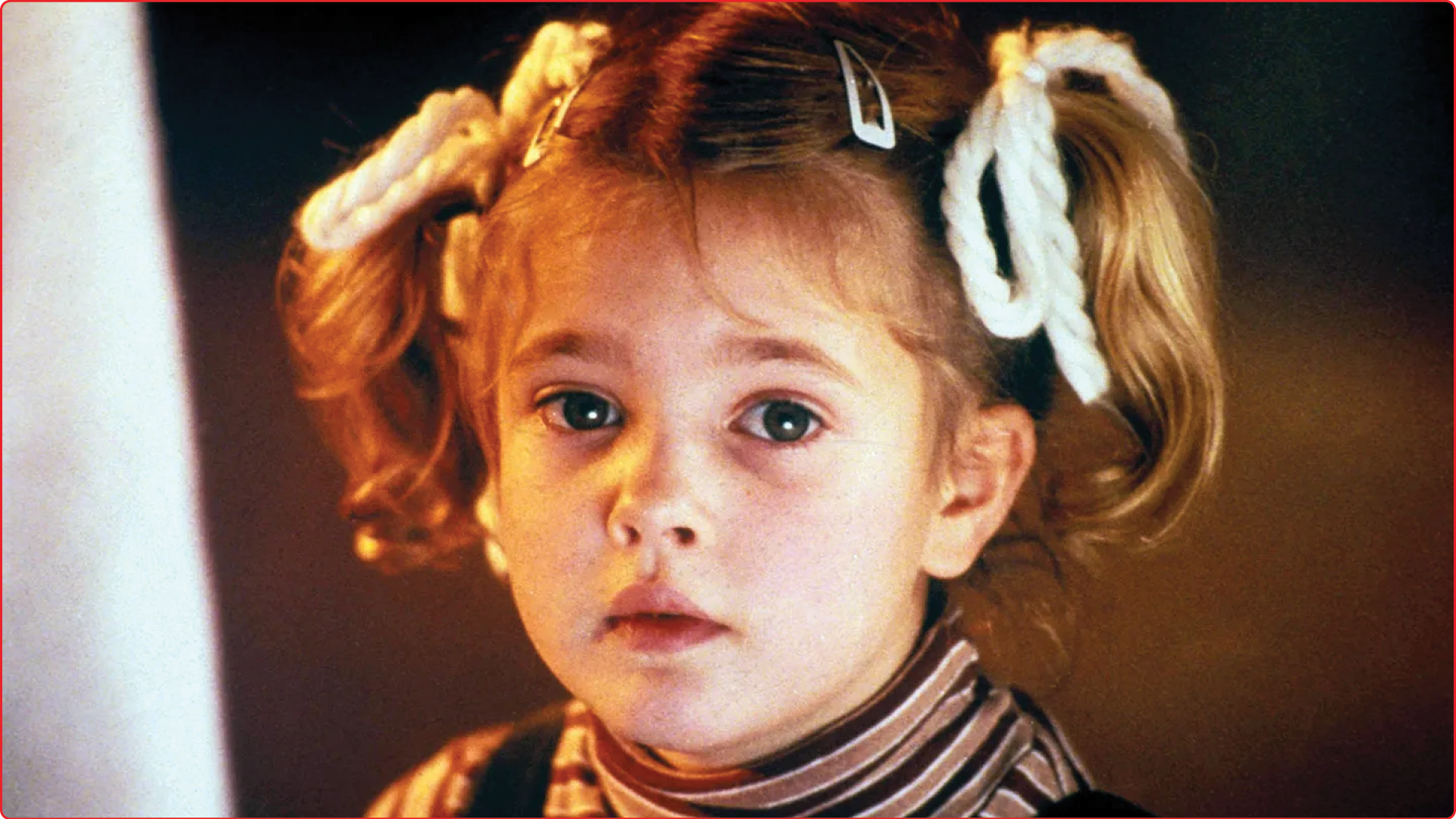
E.T. (1982)
The films that Drew would go on star in over the next five years spectacularize the idea of the actress as a girl who has skipped past her childhood. Throughout the early 90s, she consistently played sexually experienced teenagers, underage vamps, gun-toting thrill-seekers-all characters who corresponded to the actress’s bad-girl public image at the time. She was, as Sylvie (Sara Gilbert) the narrator of Poison Ivy (1992) says of Ivy, Barrymore’s pubescent homewrecker, someone “you envy and hate,” the kind of young woman you both “want to be in your wildest fantasies” and “could never dream of becoming.” I take this last part to mean that most girls would be too awkward in their still-blooming bodies and too nervous to perform as anyone other than themselves. Barrymore-desperate to come across as the adult woman she felt she already was-gleefully consented to her onscreen hyper-sexualization with roles that both romanticized her known recklessness and intensified its tragic origins; exulted her wild beauty and suffused it with danger. She’s a natural femme fatale in Poison Ivy, strutting around Sylvie’s home, all too aware that her friend’s weak-willed, sex-starved father (Tom Skerritt) is eyeing her from a distance.
That said, to be a teenage cool-girl at the start of the 90s likely meant preaching the sex-positive gospel of Madonna; Drew, in fact, cheekily integrated a sacrilege-lite accessory, a cross necklace, into her everyday wardrobe. By the time that Poison Ivy came out-the same year as Basic Instinct, and five years after Fatal Attraction (1987) had cinched the erotic thriller’s place in the cultural zeitgeist-it was far from the only film then banking on the appeal of a sultry nymphet figure. Making her feature debut at 15, Alicia Silverstone played one in The Crush (1993), while a 19-year-old Juliette Lewis took it to the extreme as a horny-and-homicidal maniac in Natural Born Killers (1994). When Amy Fisher, the “Long Island Lolita,” made the headlines, a trio of made-for-TV movies dramatized the scandal; naturally Barrymore starred in one, The Amy Fisher Story (1993), which details the 17-year-old Fisher’s seduction of a married man and the fatal fallout. In the supernatural psycho-thriller Doppelganger (1993), Barrymore plays Holly, an heiress with a split personality who flees to Los Angeles after being accused of killing her mother (played winkingly by Drew’s real mom, Jaid Barrymore, who comes and goes in the film’s bloody opening number). Holly’s new roommate (George Newbern) becomes immediately infatuated with her-she’s sweet, gorgeous, and seemingly proper-but his fascination grows as her dark side emerges, the side which dances provocatively at house parties and pins him down on the kitchen floor for a mid-thunderstorm quickie.
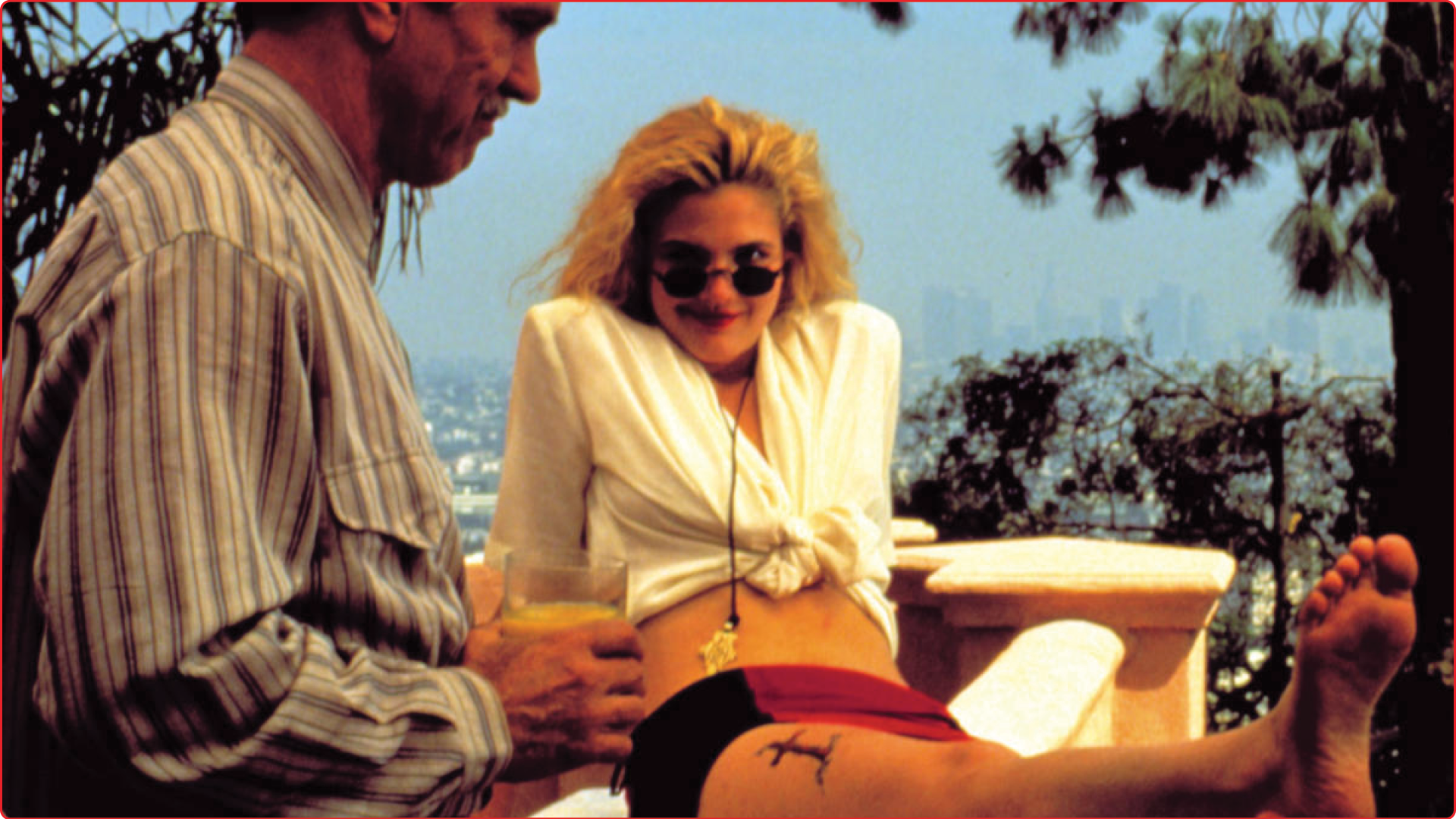
Poison Ivy (1992)
Drew worked as a murdering minor for a lot of reasons-that sly smile, her knowing pout-but there was also the sense that she was distinctly capable of killing because she had, despite her young age, lived through and seen things, which numbed her to the customary taboos. At the beginning of Poison Ivy, Sylvie and the neighborhood kids gather around a dog whose been hit by a vehicle. Its entrails are splayed across the road, but it is somehow still alive. Suddenly, Ivy whacks the poor beast in the head with a shovel. The scene portends homicidal intent, but it also reveals Ivy to be someone accustomed to the cruelties of everyday life.
Ivy, it turns out, is an orphan who lives with an aunt on welfare. In Doppelganger, Holly’s psychological disorder is attributed to her past of sexual abuse. In fact, rapists appear repeatedly throughout Barrymore’s early roles: midway through the 1994 Western Bad Girls, Drew’s character, the littlest gunslinger-cum-brothel-worker in the all-female posse, is kidnapped and presumably gang-raped offscreen. But essential to the early Barrymore brand is her lack of innocence-which is not to suggest that the punishments endured by these characters are justified by the films. Rather, it underscores her fearlessness, and makes her a force that bites back, often in rejection of her own victimhood.
Look at Guncrazy (1992), a remake of the classic Joseph H. Lewis film that sees Drew as a social outcast living in a trailer with her predatory stepdad. She eventually puts a revolver to her sleazy guardian’s head, emboldened by having found love in an ex-con and fellow firearm afficionado. Her love makes her stronger, yes, but it also makes her uninhibited, delusional, limitless-all too willing to graze death, as she does in all these early films. On the run from her domineering parents in Mad Love (1995), Casey places her hands over her boyfriend’s eyes as he drives their convertible along a winding mountain road. She entreats him to trust her as she whispers directions in his ear, revealing early on her morbid propensities well before the full scope of her mental illness becomes apparent-perhaps a nod to Barrymore’s teenage battle with depression and her suicide attempt at 14.
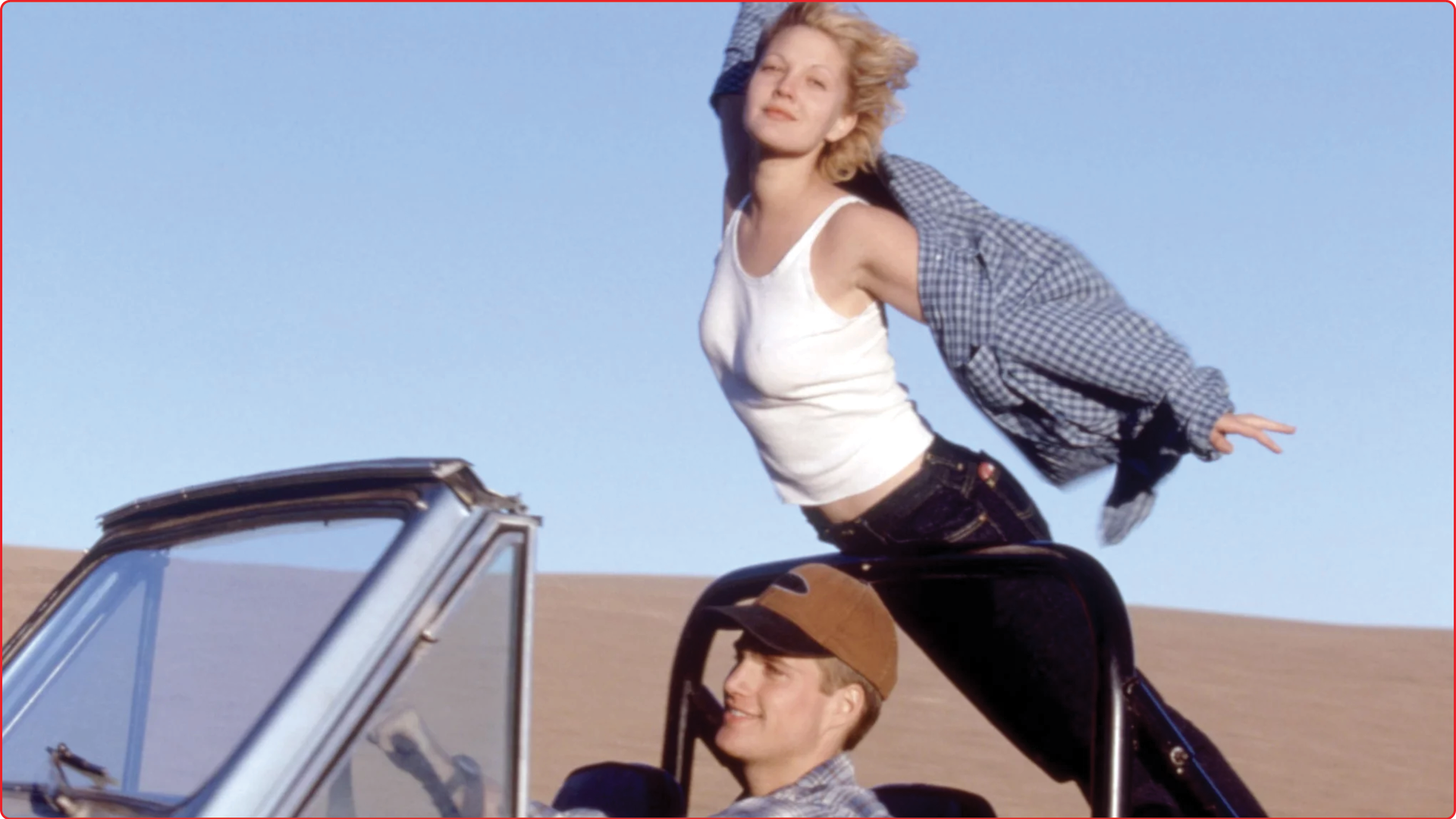
Mad Love (1995)
1995 was also the year that Barrymore began steering herself in a direction closer to the wholesome, nurturing one of today, opting for much lighter fare that turned away from these meta-macabre reckonings with her past. Retiring her unhinged persona must have felt like a rejection of that destructive impulse dramatized by Mad Love. In January of that year, she posed nude for Playboy. The following month, she turned 20. Then in April, she appeared on the David Letterman show where she leapt onto the bewildered host’s desk and flashed him. In her most recent memoir, Wildflower, she writes that this Letterman appearance-an embarrassment when she watched it back on tape shortly after it happened-sparked her reinvention: “I realized right then and there that this was the end of an era for me … I started my journey into no sex scenes in movies, modesty clauses in my contracts, and a total lack of nudity in any public forum from there on out.” So, even though she had starred in multiple films in which she washes someone else’s blood off her naked body in leering slow motion, Barrymore would go on to become an archetypal sweetheart-a vivacious Cinderella in Ever After (1998), a sexually stunted bookworm in Never Been Kissed (1999), a wannabe writer who becomes pregnant after losing her virginity in Riding in Cars with Boys (2001). The new Drew was still flirty and mischievous, but her sexuality was no longer an extension of her brokenness; her rebellious spirit an all-American quirk as opposed to merely indicative of a dark pathology or a hereditary curse.
Still, there’s a dimension to Barrymore’s sexpot films that complicate their doom and gloom. “The cross makes me think of death, the ivy of life,” says Ivy, running her fingers over her temporary tattoo. “It’s sort of the tragic and the hopeful, yeah?” The tragic and the hopeful-that seems to me to describe what makes these early Barrymore performances so compelling. She embodies the tragic nature of her own history without succumbing to a fatalistic worldview, refusing-despite her characters’ often grueling circumstances-to give up hope, this more idealistic sensibility coming through in scenes of gleeful abandon: licking her lips as she shoots tin cans beside her lover in Guncrazy; screaming her head off at a punk concert in Mad Love. When Casey and Matt (Chris O’Donnell) lie in naked postcoital embrace, he asks if their love will last forever. Casey says yes, tentatively. The look on her face is slightly blank, charged with the understanding that the chances are slim. Yet something in her expression refuses to say no.
Beatrice Loayza is a writer and editor who contributes regularly to The New York Times, the Criterion Collection, Artforum, 4Columns, and other publications.
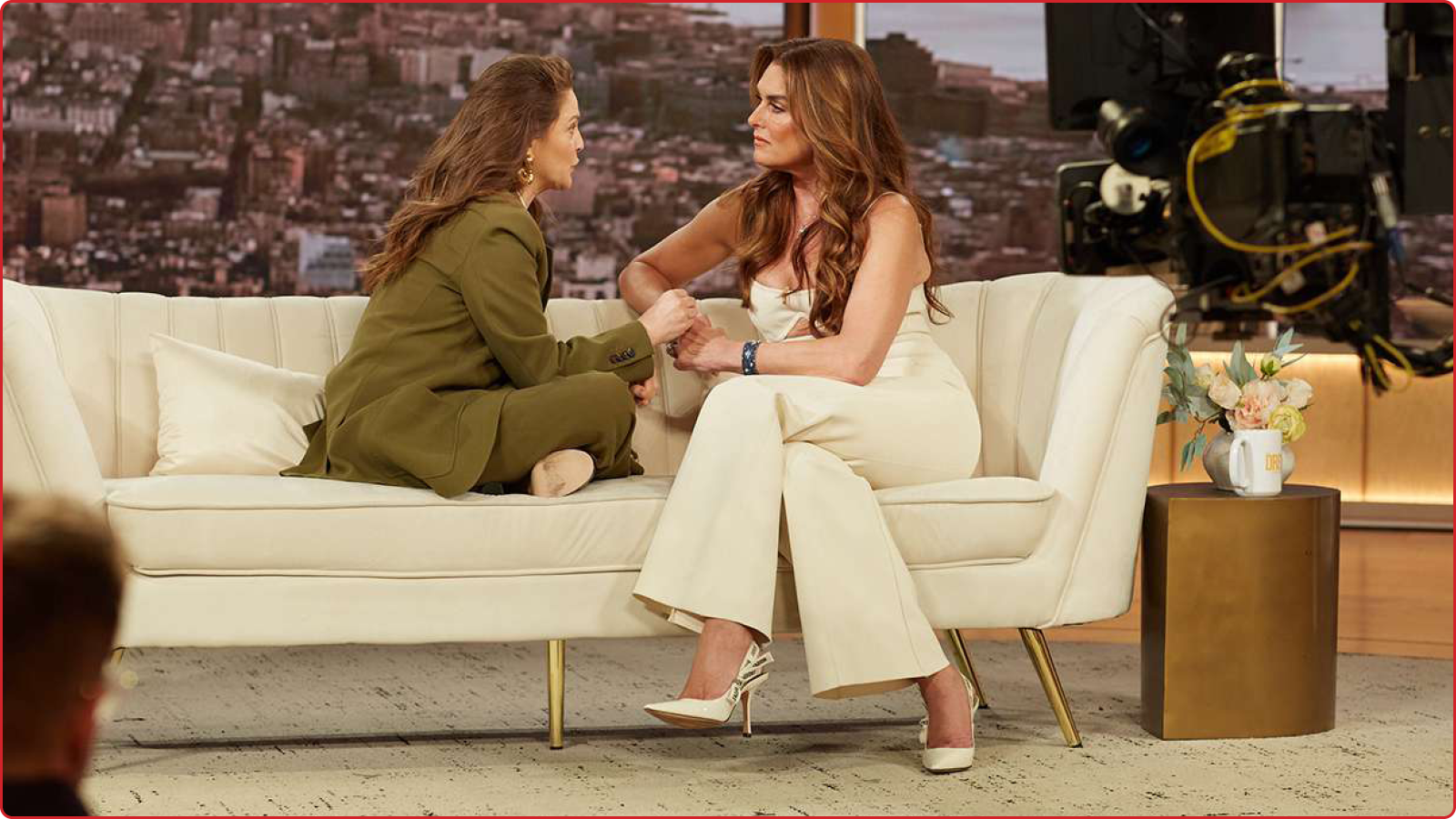
Drew Barrymore interviews Brooke Shields on The Drew Barrymore Show, 2023