
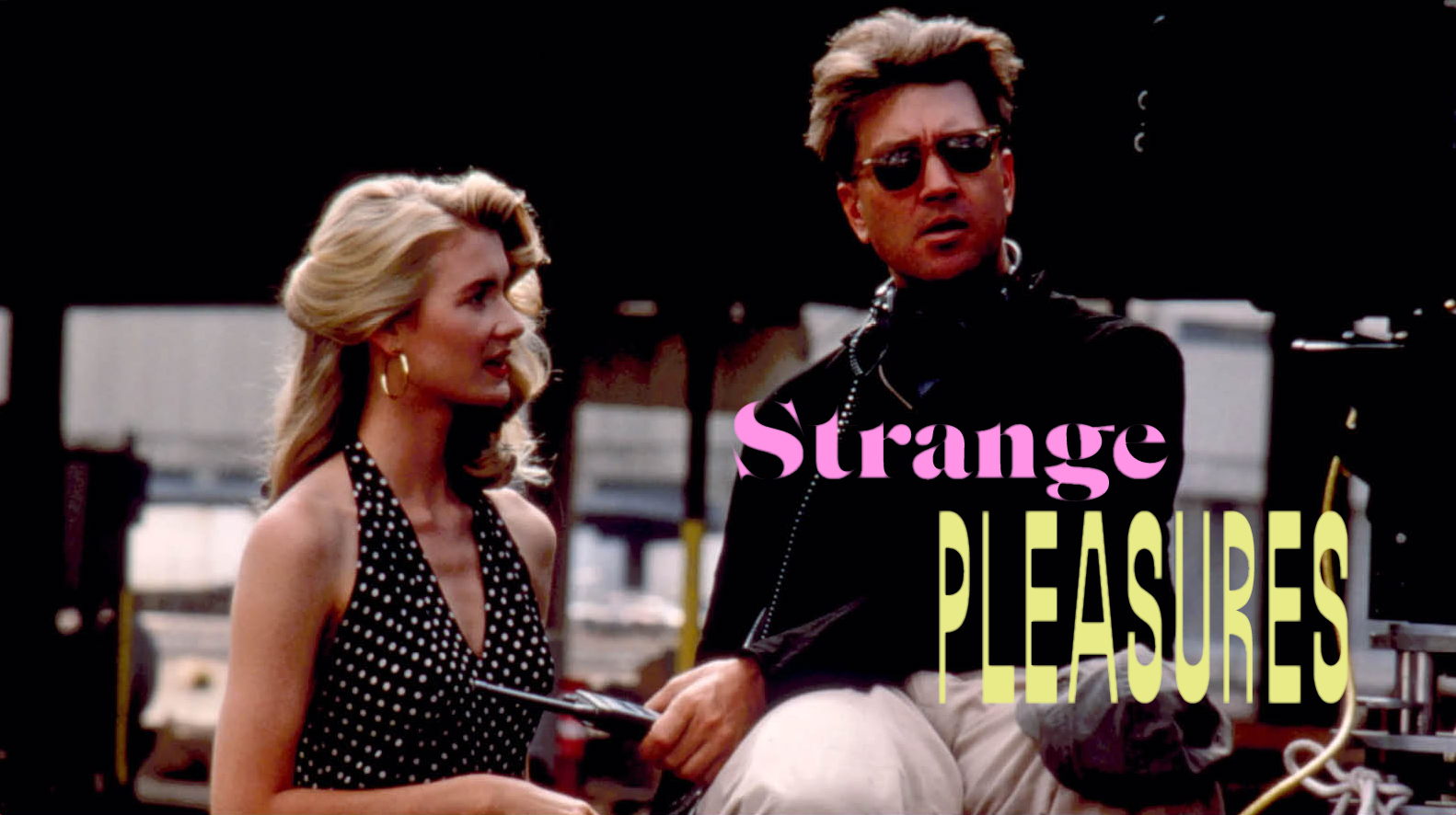
Strange Pleasures
Strange Pleasures: Laura Dern
How the actress’s multifaceted portraits of desire were harnessed by David Lynch.
Share:
When I think of Laura Dern, I think pink, pink, pink. Chalk it up to my first exposure to the actress: I was a teenager when I first encountered her in David Lynch’s Blue Velvet (1986), where she angelically emerges from the shadows wearing a retro striped pink collared dress. Look at her in her bubblegum-colored cardigan with a matching barrette nestled in her feathery yellow locks as she conspires after school with the film’s protagonist Jeffrey (Kyle Maclachlan); a cashmere pullover in rosé when they go on their first stakeout. Styled in the modest fits of a midcentury Betty, where pink conveys sweet romance and girl-next-door femininity, Dern’s Sandy is juxtaposed with Isabella Rossellini’s lonely lounge singer Dorothy Vallens, a dark-haired foreigner whom Jeffrey both fears and desires. Lynch died last Wednesday, leaving behind a singular body of work that delves into the noxious impulses that warp and corrupt our lives. In Blue Velvet, Lynch positions Sandy as the epitome of virtue, a force for good in his Manichean mystery, where (as in all of his films) darkness and light—a blonde and a brunette—are in constant struggle, locked in a perpetual pas de deux. Sandy was Dern’s major breakthrough role and the first of her three big screen collaborations with Lynch, who was pivotal in shaping her star persona. In Dern, he saw a beacon of innocence with a twist: Sandy, a whitebread young American, is meet-the-parents material; yet she is drawn by her own powerful curiosity into a lurid conspiracy involving murder and violent sex.
Lynch tends to play with these binaries, though he doesn’t treat them as mutually exclusive. A child of the ’50s, the director burst the bubbles of white-picket-fence suburbia, which he rendered as an idealized dream latent with terrible secrets. In many ways, Dern’s on-screen coming-of-age mirrored this relationship between naivete and trauma. At the end of Blue Velvet, a robin comes—as memorably prophesied by Sandy—symbolizing the triumph of good over evil, but the integrity of this victory feels compromised. The animatronic bird that appears outside of Jeffrey’s window at the end of the film is uncanny and artificial; and the squirming insect trapped in its beak is a grotesque reminder of the swarming creatures and severed ears yet undetected inside manicured lawns. Dern carries out a similar kind of subversion: blonde, wholesome, and pretty in pink, the actress straddles archetypal girlhood and its ruin, her vintage looks wielded (as so often in Lynch’s work) with a degree of irony that complicates the soft femininity and idealism she evokes at face-value. Neuroses simmer beneath her golden girl veneer such that it always seemed liable to crack and spill forth hidden wounds.
When Dern made her official screen debut at age 12 in Adrian Lyne’s Foxes (1980), she was a mere nepo baby: the daughter of Hollywood legends Bruce Dern and Diane Ladd. A year later she played Jessica, the bass player of a rebellious all-girl band, in Lou Adler’s Ladies and Gentlemen, the Fabulous Stains (1982). At 16, she became legally emancipated from her parents in order to work longer hours on set, a not uncommon move for young actors eager to jump the gun on their careers. Her early roles parallel her own precociousness: In Foxes, an LA-set tale of teen turmoil, Dern’s Debbie worms her way into a house party hosted by Jodie Foster’s Jeanie, and goes on—with the kind of faux-wisdom only a virgin desperate to seem otherwise could muster—about the superiority of birth control pills over diaphragms. Debbie, with her rosy cheeks and round bubble glasses, looks far greener than the partiers in her midst. Dern was actually a kid at the time whereas several of her costars (with the exception of 17-year-old Foster) were in their twenties and thirties, though her height (5’10”) would, here and in later films, give her the impression of an overgrown child; or perhaps a stunted woman.
If the ’80s and ’90s saw an uptick in teen sex comedies wherein girls were mere sexual conquests, Dern’s roles appeared to counter this trend. She spent much of her own adolescence playing starry-eyed girls with a taste for adventure and romance, a type complemented by the warmth in her voice; her gently raspy enunciations, inflected by nervous laughter, would suggest, at the time, her novice state. The contrast between Dern’s sweetheart vibe and her then-blooming sensuality allowed these early roles to articulate fraught coming-of-age narratives, ones that simultaneously paid credence to girls’ fantasy lives and the real life (and often nefarious) forces shaping their appetites.

Rambling Rose (1991)
In Rambling Rose (1991), Martha Coolidge’s Southern melodrama, Dern plays a 19-year-old ingenue rescued from forced sex work by a patrician family. Rose delights in playing the nymphet. She arrives to the Hillyer family’s country home, where she will work as a maid, looking like a sultry Bo Peep in a dropwaisted sundress with a corset-style bodice, again in pink. Sexually active from a young age, Rose’s love language is physical intimacy; it’s the way she shows affection toward the men in her life: be it the Hillyer patriarch, played by Robert Duvall, whom she tries and fails to seduce, or Lukas Haas’s 13-year-old narrator, the Hillyer’s eldest, whom she allows to experiment with her body one night. She’s equally elated to attract attention when she heads out on the town in a fern-green halter dress speckled with rose decals, yet the boldness in her stride, her gleeful, full-dentured cackle, conveys something purer than vampish intent. With Dern, innocence and experience don’t cancel each other out; they are intertwined, cutting through the virgin-whore dichotomy.
Rose’s strut through the streets is her “princess” moment, and though the men that turn their heads may not be thinking gallant thoughts, all she sees in their gazes is love. Moral judgments against promiscuity don’t hold much water when the need for validation is tangled up in the stuff of desire itself, which Mrs. Hillyer—played by Dern’s mom Ladd (making them the first mother-daughter duo to garner Oscar nominations for their work in the same film)—understands all too well in her sympathetic treatment of Rose.
A similar craving for adulthood runs through Joyce Chopra’s Smooth Talk (1985). Dern plays 15-year-old Connie, a teen who is “unformed and looking for something to happen in her life—something wonderful,” said Chopra in an interview. Immersed in the classical trappings of youth culture—malls and gossip rags—Connie is at the cusp of her sexual awakening. She comes to realize that her looks and body, no longer that of a little girl’s, might give her access to the life she dreams about. She practices her flirting skills in the bathroom mirror. Later, she luxuriates in the image of herself wearing a newly acquired halter top: cropped and satin white, with peepholes along the center where the garment’s laces fasten into a criss-cross pattern. The halter top brings to mind history’s bombshells, like Marilyn Monroe (who posed above a subway vent in a billowing white halter dress in Billy Wilder’s 1955 romcom The Seven Year Itch). In that way, wardrobe anchors Connie to a dreamy old-school romanticism—further evident in the many posters of James Dean on the walls of her bedroom. Connie’s glorious apparel also gestures at the decade’s consumerist values, which informed ideas around youth empowerment and individuality. In this top, Connie believes, she can finally become who she is meant to be.
Although Connie may be trapped in the bubble of her adolescent illusions, she’s not wrong to perceive someone different in her reflection: a new and sensual being. She wears the top every time she visits the diner where all the local teens hang out in the late hours, hoping to be approached by some Prince Charming—there’s the promise of freedom in the company of men—even if she’s not sure how to handle it. Connie talks about her hopes of getting out and “just travelling somewhere,” before canoodling with a boy in his convertible. But there’s also danger in taking his hand. When Arnold Friend (Treat Williams), a menacingly suave older man, shows up at Connie’s doorstep when her parents are away, the satisfaction of her open-road fantasies becomes more like a threat. The scene, which culminates in the suggestion of rape, presents a curdled coming-of-age, one that underscores the way women’s sexual awakenings can be corrupted by male prerogatives.
At the same time, Dern—with her thrill-seeking gaze, her elastic mouth always slightly open, —is a great force of desire herself. Lynch and Dern, who called each other by the same nickname, “Tidbit,” proved kindred spirits, leaving Wilmington for the open road for their second collaboration, Wild at Heart (1990). In a role written specifically for her, Dern again plays a classic dream girl, albeit one with her libido unleashed. In typical Lynchian fashion, the domestic realm is full of buried horrors: there, Lula lived with her deranged mother (Ladd again) and experienced an assault at the hands of a family friend. Dern could easily play Lolita roles, though these performances were always grounded by a certain guilelessness that others proved all too keen to take advantage of—and rape often recurs in the fictional lives of her youngest characters.
Lula’s mother is freakishly obsessed with preventing Lula and her beau Sailor (Nicolas Cage Dern’s then-boyfriend, in Elvis drag) from being together. Here, we’re rooting for the couple, their love so fiery and boundless as to make them outlaws, estranged from the rest of the world. In between run-ins with the crooks Lula’s mother has sent after them, Sailor and Lula dance and screw and drive like no one’s watching. Everything Dern seemed to be testing out as Connie—the lip-biting and coy poses—she brings to full-blown hyper-feminine expression as Lula, a sultry pin-up-style beauty who wears polka dot dresses, black bodycons, and pink (!) leotards. If her style is meant to please her dear Sailor, Lula also carries her clothes with a crazy-eyed confidence that suggests she’s, well, really feeling herself. She’s a passionate babe made fearless by love.
When Lula strikes a pose in her hot pink leotard, her chin facing skywards, her hands gripping the sides of her hips, she’s a cartoon diva: her femininity is a force larger-than-life, prefiguring the girlbosses and finger-snapping power players that Dern has grown into as she and her roles have matured, discarding her girlhood innocence for a more hardened outlook still coated in pink and its feminine theatricality. Dern’s Renata in the television series Big Little Lies comes to mind, as does Dern’s double role of actress Nikki Grace/Sue Blue in Lynch’s Inland Empire (2006), notably reclining in a grimy pink bathrobe inside a purgatorial mansion. Then there’s FBI employee Diane Evans in Twin Peaks: The Return (2017), whose love for agent Dale Cooper (MacLachlan) is corrupted during his years as the malevolent “Mr. C.” But it is in Noah Baumbach’s Marriage Story (2019), where she plays Nora, an intimidatingly sharp divorce lawyer, that Dern’s heightened womanhood fuels the film’s explicit gender rivalry.
Funny that after so many boy-crazy roles in her early years, Dern, as Nora, can seem to represent a metabolization of all those past lives and their corresponding relationships: when Nora counsels Scarlett Johannsen’s Nicole, she rouses her out of complacency and urges her to consider her desires in such a way that no longer privileges her husband. In the scope of Dern’s career, it’s also another instance of her flaunting her glamour as a power move. This time, however, she’s not trying to win a man’s affections; she’s asserting her dominance in the courtroom. With a wave of her manicured hand, she commands the spotlight, wielding her feminine gravitas with killer instinct: a wolf in the clothing of a girly girl.

Blue Velvet (1986)
Share:
About the Contributor
Recommended
- Somersault
 On Cate Shortland’s assured directorial debut on sexual awakening.
 - Can She Bake a Cherry Pie?
 On Henry Jaglom’s effervescent anti-rom-com.
 - Re-Wind
 On the AV dreams and celluloid nightmares of Hisayasu Satô’s Re-Wind.