
Column
[wpbb post:title]
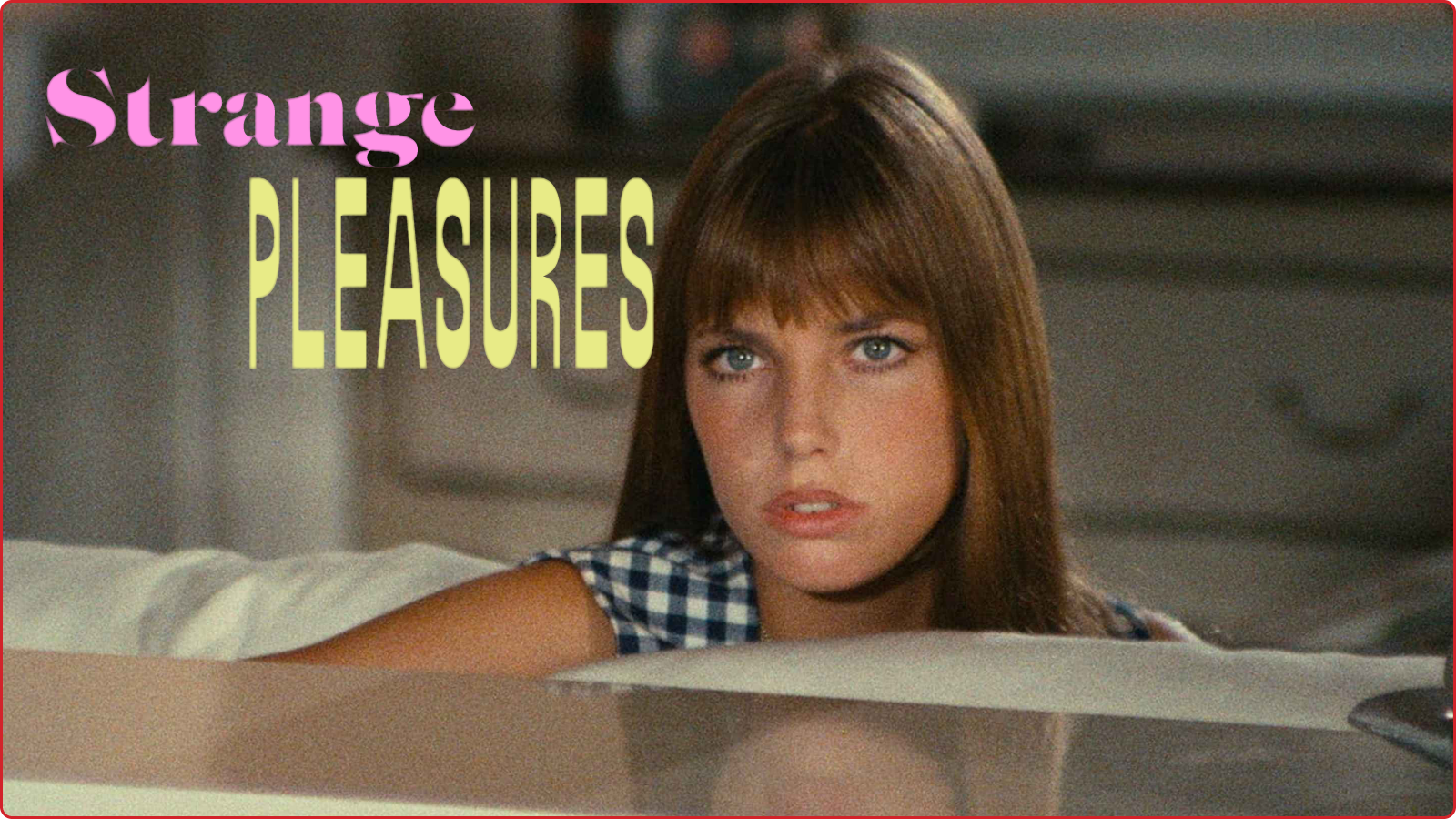
La Piscine (1969)
Column
BY
[wpbb archive:acf type=’text’ name=’byline_author’]
Strange Pleasures is a regular Metrograph column in which writer Beatrice Loayza shares unconventional desires found across underground and mainstream cinema alike.
La Piscine plays at Metrograph from Wednesday, February 14.
Jane Birkin didn’t mind being objectified: she knew she could be other things, too. At the beginning of Jane B. for Agnès V. (1988), a fickle portrait of the late actress and chanteuse by her friend Agnès Varda, the camera slowly pans over Birkin’s naked curves. It caresses her toes, calves, hips, waist, and breast in close-up, rendering her fleshy silhouette a magnificent landscape, its textures beckoning our study and appreciation. Then, it lands on her face: one sea-green eye; her lips parted slightly, teasing her signature tooth-gaps. This representation of Birkin-one of dozens in a film that plays with Birkin’s relationship to feminine iconographies-casts her as a reclining odalisque from Renaissance times. But even in this fictional guise, we can tell by the coquettish smile, and the disarming confidence of her gaze, that Birkin is in on the game.
The British star, who passed away last July, aged 76, in her adopted home of France, was used to flaunting her charms for male artists from the get-go. In Antonioni’s Blow-Up (1966), her breakout role, she’s a fledgling exhibitionist posing for a hotshot photographer; in Jacques Deray’s La Piscine (1969), a wispy teenager who captivates Alain Delon’s wandering gaze with her androgynous magnetism. “She looks much older than she is,” says her father, played by Maurice Ronet, while he and Delon admire Birkin from a distance as she trots like a pony at the edge of the pool.
In the late ’60s, after she hooked up Gallic bad boy Serge Gainsbourg (a songwriter 18 years her senior), she lent her breathy, baby-doll vocals to his racy hit single “Je T’aime… Moi Non Plus,” which was condemned by the pope and the BBC. These were Birkin’s first claims to fame, and they made her an It Girl of the sexual revolution. In the following decades, Birkin never really “re-branded” so much as she simply grew, expanding upon her singing and acting repertoires without dismissing her early exploits. She left Gainsbourg after 12 years to court a new love, the French director Jacques Doillon, yet she continued to collaborate with the musician, performing her own versions of his songs till her death. Sunny yet self-assured, and in possession of a kind of open vulnerability that reads more like strength, Birkin complicated what it means to be a muse.
Maybe that’s why, in the passage through the long hall of mirrors that is Birkin’s onscreen career, Jacques Rivette’s La Belle Noiseuse (1991), the first of their four collaborations, stands out. Here, in what is arguably the French auteur’s most traditional work (insofar as it lacks the jazzy improvisational flair of his other films), Birkin confronts the possibility of being replaced; the feeling of having encouraged adoration once believed to be permanent. If Jane B. for Agnès V. shows Birkin to be a savvy manipulator of her own image, La Belle Noiseuse shows Birkin in thrall to one version of herself: the self that is loved and in love; a self that she begins to question.

Jane B. Par Agnès V. (1988)
The film is a slow-drip communion with the artistic process-the physical act of creation, as well as the emotional strains and dynamics of power that arise from the pursuit of transcendence. Birkin plays Liz, the younger wife of a painter, Édouard Frenhofer (Michel Piccoli), who has found a new muse. The title of the film, which translates to “The Beautiful Troublemaker” in English, refers to an unfinished painting of Liz that Édouard abandoned a decade ago. Now in her forties, and living a leisurely existence in his rural château, Liz is no longer an object of sublime fascination. That role goes to Marianne (Emmanuelle Béart), the feisty girlfriend of a rising artist, Nicolas (David Bursztein). Nicolas and Édouard agree that Marianne should model for the aging artist without first consulting Marianne; Édouard presumptuously instructs Marianne to undress during their first session; and as artist and muse plunge deeper into the work, his directions become more brutish, more demanding, as he contorts her limbs into unnatural poses, which she must hold. Meanwhile, Liz floats around the property, trapped in introspection as Édouard pursues his next masterpiece.
Nicolas grows anxious that these intimate studio sessions will spark an affair between Marianne and Édouard. Birkin’s Liz doesn’t bother with such pedestrian neurotics, but she does fear something else. “La belle noiseuse” was the piece that precipitated Édouard’s early retirement; since deserting it, his life with Liz has become one of blissful domesticity, devoid of the torrential impulses that once made him a great artist. The memory of their passionate romance, now changed into something gentler, remains etched in the half-finished portrait, a boyish mop of hair and Birkin’s sparkling bedroom eyes.
Halfway through the film, Édouard paints over this image, replacing it with that of Marianne: Béart, a tempestuous, carnal beauty, next to the nymph-like Birkin, who straddles a fine line between melancholic and chipper. What does Liz have to worry about in this marvelous home? Elegant yet childlike, she conducts her hobbies (baking; taxidermy) with the breeziness of someone who has all the time in the world; someone who would sooner giggle and brush off an offense than cause any sort of commotion. She often finds herself in the position of explaining Édouard’s behavior-that’s just the way he is; he’s not here, he’s away or sleeping-as if anxious on his behalf for his lack of social graces. A detail from early in the film haunts me: Liz serves Édouard and their guests slices of the tart she is seen preparing when she’s first introduced. No one touches it. Later, we see her silently scooping the pieces back into the original pie dish. No complaints. She is nothing if not understanding.
Yet Liz expresses her hurt when she discovers what Éduoard has done-why not start on a new canvas? Why destroy the old muse? Édouard explains himself, sort of: “La belle noiseuse” is an essence teased out, collaboratively, between artist and model, and it has little to do with intention or individual character. “Would you accept it if [Nicolas] loved painting more than you?” he asks Marianne at dinner, the night before the two begin their work together. The question runs throughout the film. Nicolas seems to reverse course when he realizes his belief in art, in Édouard, might lose him Marianne; Liz grows distant from Édouard when she realizes what he’s done, and that his commitment to the “higher truths” of painting might eclipse the love that he has for her.
Admittedly, the divide between emotional and artistic passion is old-fashioned, if not somewhat delusional, but to Rivette’s credit La Belle Noiseuse finds a middle-ground, locating artistic beauty in the privileging of emotional principles. In an unexpected, ferocious act of love, Édouard hides the finished painting behind a brick wall and quickly whips up a mediocre version. Only Marianne and Liz had seen the real thing; Marianne was revolted at what it revealed of her true nature; Liz, comparably disturbed, saw only the product of a man nearing death, detached from himself-detached from her. Birkin had long undermined the artist-muse dichotomy, proving that the artwork is as much a result of the muse asserting herself as it is the artist’s talents. In La Belle Noiseuse, she inspires a different kind of devotion: a secret between lovers.
Beatrice Loayza is a writer and editor who contributes regularly to The New York Times, the Criterion Collection, Artforum, 4Columns, and other publications.

La Belle Noiseuse (1991)