
Column
[wpbb post:title]
Affliction (1997)
Column
BY
[wpbb archive:acf type=’text’ name=’byline_author’]
Strange Pleasures is a regular Metrograph column in which writer Beatrice Loayza shares unconventional desires found across underground and mainstream cinema alike.
Affliction plays as part of Up the Nolte from Friday, October 27.
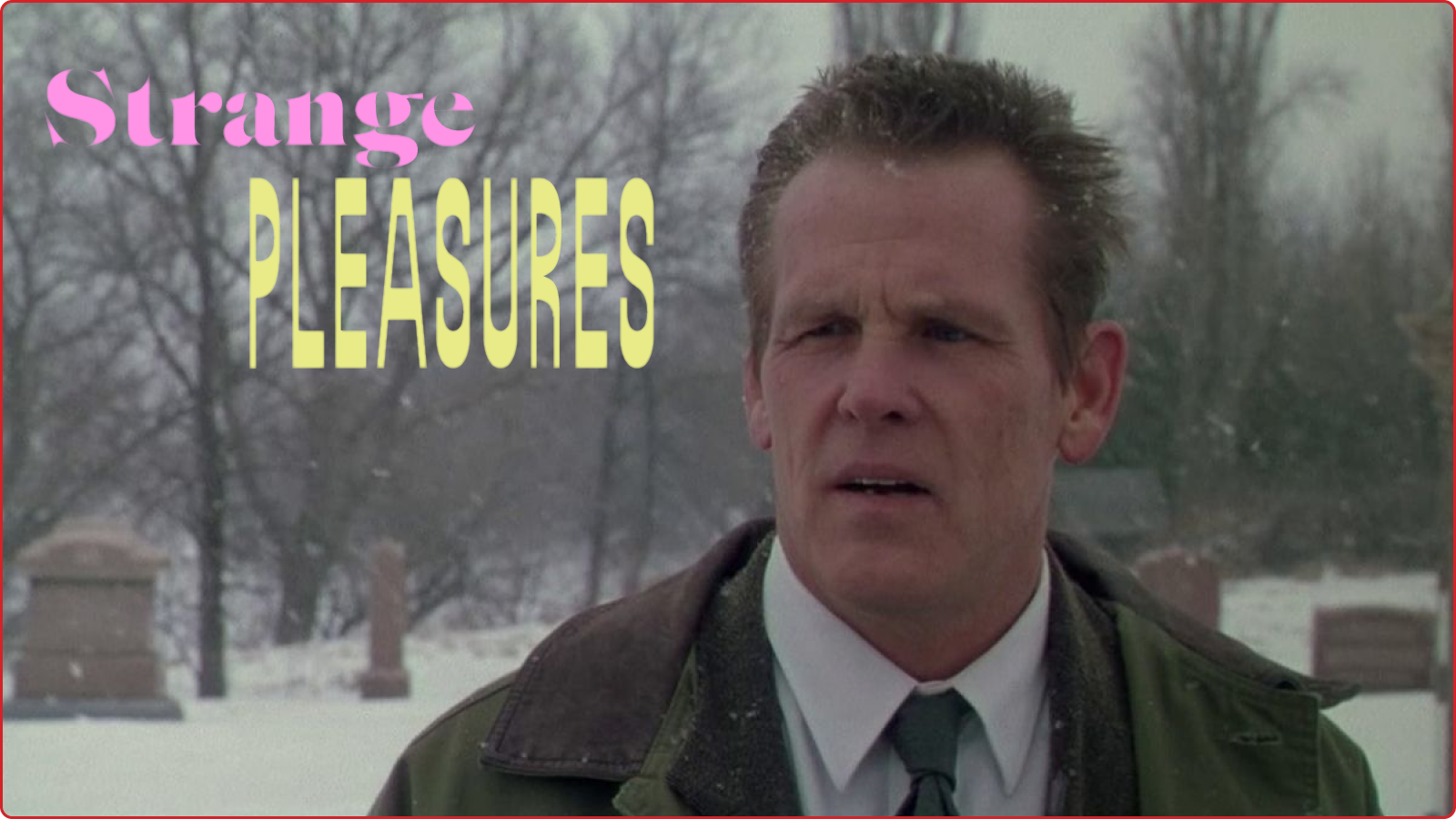
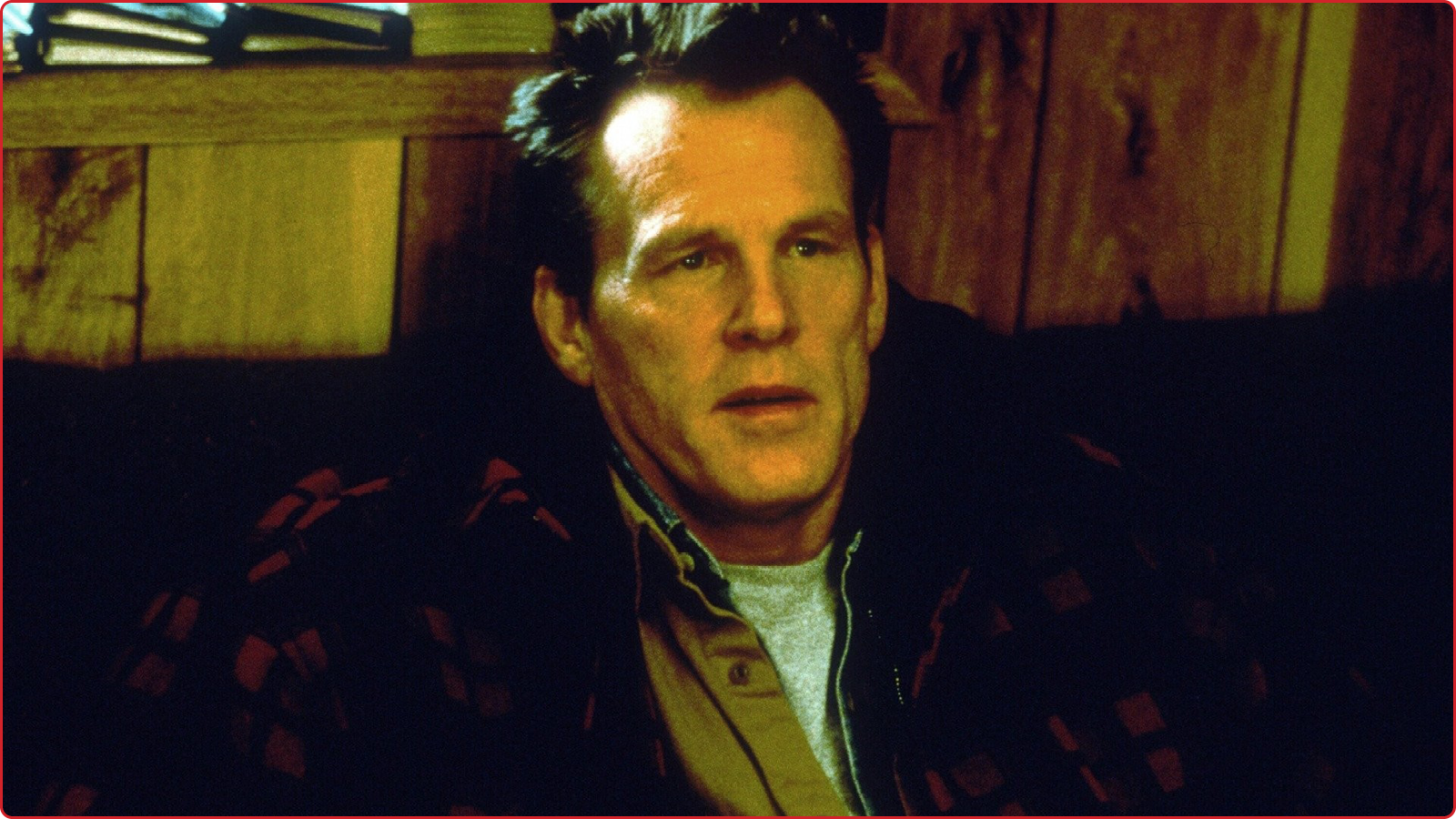
Nick Nolte looks awful in Affliction, Paul Schrader’s small-town, man-in-a-downwards-spiral drama from 1997. His skin is a rashy red; his face, haggard and dented, like he’s slumped over-face down, bang-one too many times at the bar. Nolte plays Wade Whitehouse, a part-time cop, part-time handyman, who zips around his dreary New Hampshire village doing his contractors’ biddings. A quintessential Schrader-Lonely Man, Wade is damaged, guilt-ridden, and desperate to find salvation, but Affliction stands out among the director’s studies in masculine solitude for its frostbitten anguish; its funereal air of suffocation; its bleak familial melodrama so humorless you can’t help but nervously laugh.
The film hinges on a sort-of murder case. A local bigwig set to testify in a high-profile trial dies in what’s likely a mere hunting accident. Wade is certain there’s a conspiracy afoot. Affliction was released one year after Joel and Ethan Coen’s Fargo, and there are superficial similarities between the two films (the cops-and-criminals dynamic; the isolated wintry setting; the US-Canadian-border accents, courtesy of Holmes Osborne’s Quebecois selectman Gordon LaRiviere in Schrader’s film). The other movie’s great success seemed to cast a shadow over Schrader’s joint. Not that Affliction has been wholesale neglected; it was celebrated for its performances-Nolte was nominated for an Oscar, and James Coburn, who plays Wade’s vicious, alcoholic father, Glen, nabbed a supporting actor win. Affliction is its own beast: the supposed murder is just a pretext; a last grab at relevancy from a wretched man, from a wretched place soon to be razed over and flicked out of memory by a commercial developer who plans to transform the town into a ski resort. The hunting mishap, shown repeatedly throughout in different paranoid iterations seemingly projected from Wade’s mind, gives the film a jolt of menace-not for the possibility of his exposing a criminal web, but for the dangerous desperation it conveys on behalf of our delusional hero. If, in 2023, this sounds like a dime-a-dozen takedown of toxic masculinity, Nolte’s cracked visage and his shame, so fully embodied, takes the conceit of a white man’s tragic alienation-his perpetuation of his father’s sins-and genuinely makes it sting.
The sense of tragedy is felt from the start. Wade is fixated on gaining custody of his daughter, Jill (Brigid Tierney), a mousy elementary schooler who nevertheless still has the guts to tell her dad, straight up, that she’d prefer not to visit. She loves him, she says early on (convincingly, if powered by filial obligation), but she really wants to go back home. You feel bad for Wade, at least in the beginning, before we fully understand why Jill doesn’t feel at ease around him. Initially, Wade carries himself with a certain warmth and vulnerability, especially around his little girl, for whom his voice rises slightly in pitch. The film opens with the pair on their way to a Halloween party at the local school, and Jill behaves like a total curmudgeon. At the fete, she absconds to phone her mom to pick her up; Wade is hurt, but when he steps out to ward off neighborhood loiterers, he ends up going on a drive around the block to smoke a joint with an old ne’er-do-well pal Jack (Jim True-Frost). When he’s back, there’s Jill being taken off by her mom and new stepdad, fancier folk who wear peacoats and steer clear of junk food.
Affliction (1997)
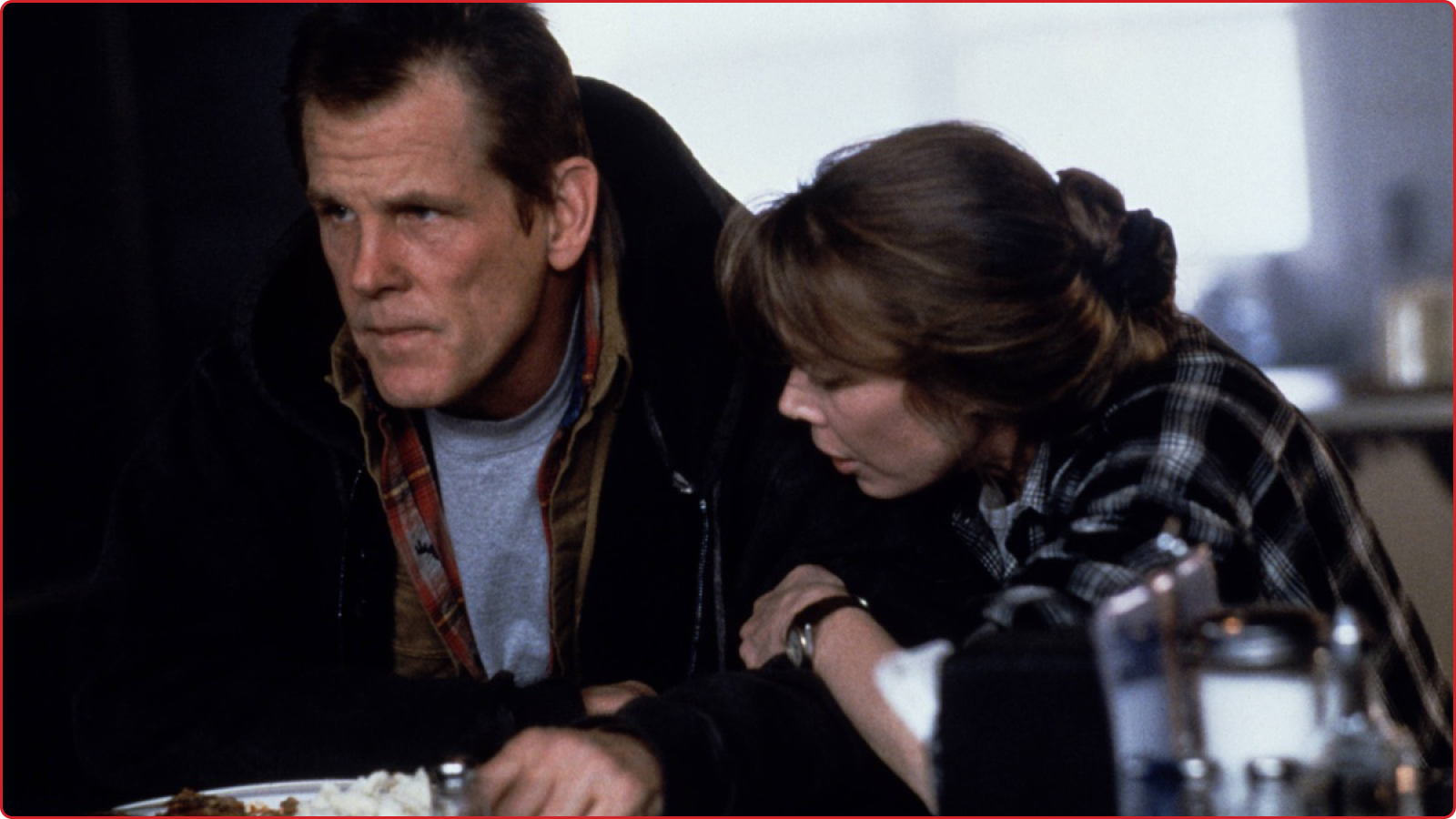
Schrader’s balanced empathy toward Wade is most effectively conveyed by his relationship with his daughter. It’s devastating to see how she cowers from his gestures of paternal affection, as if he’s being told his love is not the kind worth receiving. The class distinction, between Wade’s no-town abode and Jill’s mother’s suburban haven, makes this painfully understandable; but in Nolte’s performance, there’s a nervous energy to Wade’s Good Dad attempts, which feel uncomfortable, edgy, and over the course of the film, increasingly manic. Add to this the fact that when he does receive love-from Sissy Spacek, who plays his preternaturally compassionate girlfriend Margie-Wade seems borderline unaware of the godsend sleeping next to him in bed.
Historically, Nolte has a reputation as an all-American bastard: he’s a football jock and high school dropout from Omaha, Nebraska, turned showbiz enfant terrible with a record. In 1992, fresh off playing the family man with a dark side in Cape Fear and the middle-aged heartthrob in The Prince of Tides (both 1991), he was voted People‘s Sexiest Man Alive-bizarre, considering what he’d look like in Affliction a mere five years later. Distinct as a performer for his gravelly, cocksure aplomb, Nolte’s dipped in and out of substance abuse throughout his entire life. No role of his, at least within my viewing purview, wields his persona in such a way that so systematically shatters it, and lays bare its latent, raw fragility.
Schrader positions Wade’s long-churning tragedy as a buried story within a repository of forgotten histories, an effect achieved by voiceover narration delivered by Wade’s brother Rolfe (Willem Dafoe)-a literal historian. In flashbacks rendered in a desaturated color scheme and captured with a wobbly handheld camera reminiscent of home video, we see young Wade attempting to defend his mother from his father’s violence, receiving blows for his heroism that mark him for the rest of his life. In the present timeline, his father-still a raging alcoholic-has been reduced into a shriveled old man. Glen’s cruelty, which previously had a robust physical dimension, now manifests as casual misogyny and narcissistic oblivion. Wade visits his parents and finds that his mother has frozen to death, likely days earlier, because of Glen’s drunken stupor. The moment when Wade realizes he’s staring down at a corpse is horrifying, and the absence of music heightens its grim emptiness, but there’s also something pathetic-embarrassing-about the whole thing. Margie is there, too, an outsider looking in at this warped family drama. Nothing heightens self-consciousness quite like a guest. When Glen shuffles upstairs to join them and see the body for himself, he’s sheepish and awkward, knowing the blame is all his.
The hunting accident, Wade’s fractured relationship with Jill, his mother’s death, and a throbbing toothache -all these elements aligning at once seems to be the true conspiracy at the heart of the film, what makes Wade crack and transform into a monstrous version of himself, one not unlike his own despised father. Affliction, based on the novel by Russell Banks but also eerily reminiscent of Schrader’s own miserabilist Midwest upbringing, stages a familiar nightmare of American devastation. Here is a divorced father, a man abused as a child, anchored for life to everything that’s made him ugly; everything he’s grown to hate-a ghost stuck in a ghost town.
Beatrice Loayza is a writer and editor who contributes regularly to The New York Times, the Criterion Collection, Artforum, 4Columns, and other publications.
Affliction (1997)