

Somersault (2004)
Essay
Somersault
On the grimy romance of Cate Shortland’s feature debut.
The new 4K restoration of Somersault (2004) plays at Metrograph from Friday, February 20.
Share:
IF YOU GREW UP MIDDLE CLASS in Sydney, there’s a high chance you holidayed at Jindabyne, a small town surrounded by ski resorts, five hours’ drive from the city. It’s a place that has its own particular beauty—a big lake, verdant mountains, slumped snow gum trees—but its scraggly splendor stands in stark opposition to the log cabin fantasy of, say, Aspen, or the Swiss Alps. In Jindabyne, the landscape is suburban and gloomy, trafficked by a mix of entitled tourists and poorer, begrudged locals. The snowfall can be pitiful. My most vivid image of the town, from a family trip when I was a child, is a circle of fan cannons, spraying a hill with frothy, fake snow.
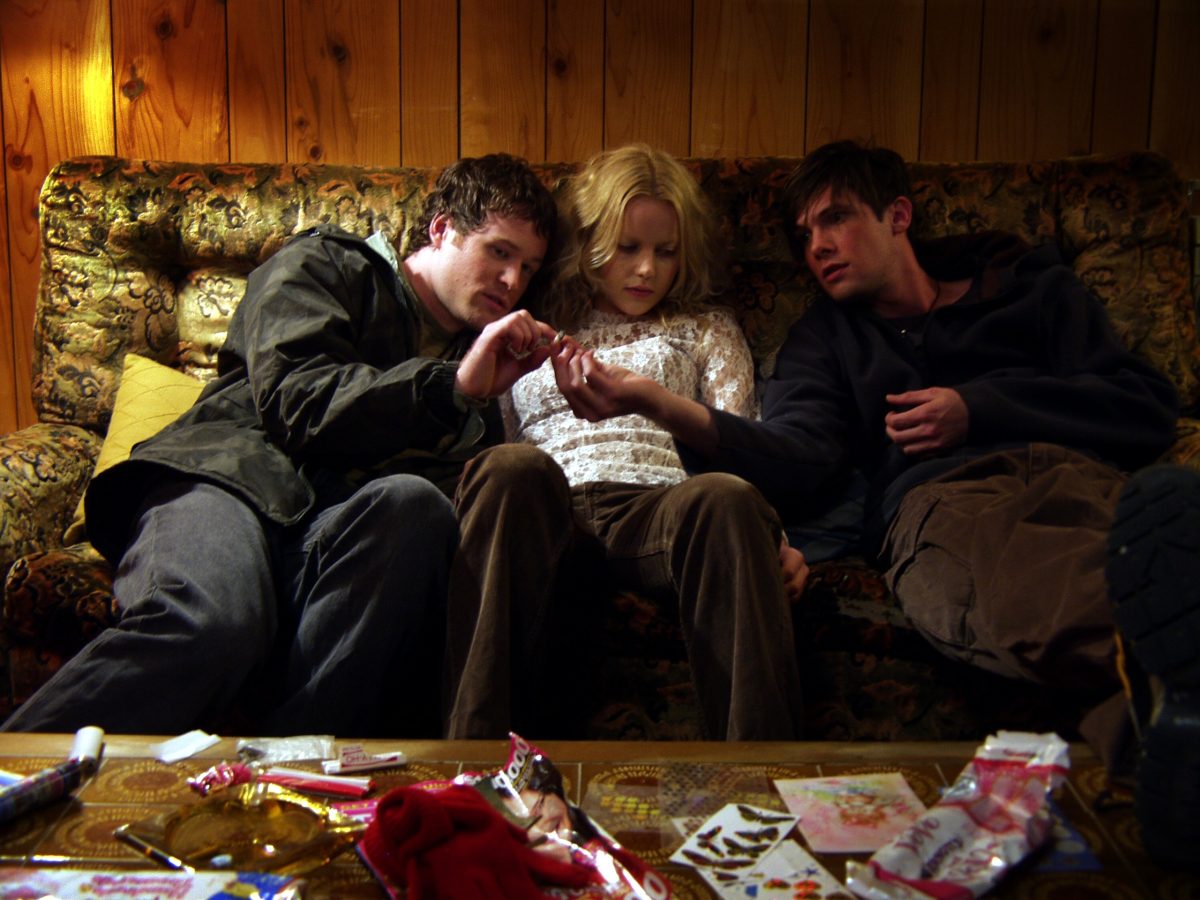
In other words, it’s the perfect locale for a 16-year-old runaway, caught between the reveries of childhood and the startling, sometimes brutal, revelations of adulthood. In Cate Shortland’s 2004 debut feature Somersault, Heidi (Abbie Cornish) is young enough to paste sparkly unicorns into a scrapbook, but old enough to recognize the desire roiling underneath her interactions with men. She is wide-eyed and a little foolish, with wispy white-blonde hair that curtains her face. She flees the family home in Canberra (Australia’s tiny, deeply unglamorous capital city) after being caught pashing her mother’s boyfriend in bed. Heading two hours north on a dingy regional bus, she lands in Jindabyne, hoping to reconnect with a parka salesman, heavily implied to be an old hook-up.
Somersault (2004)
After the parka man pretends not to know her, though, Heidi is left to idle in the cold, bored and hungry. Sex, that newly discovered pleasure, is sought, with lanky university boys on ski trips. She also stares down older men, wondering how she might wield her youthful allure to get what she wants. It would be easy to reduce Heidi to a lost girl fucking to find a proxy father, but Shortland nudges us towards more complicated ideas: the agony of needing intimacy while being totally unclear of its contours; the realization of both power and powerlessness that pervades early sexual experience.
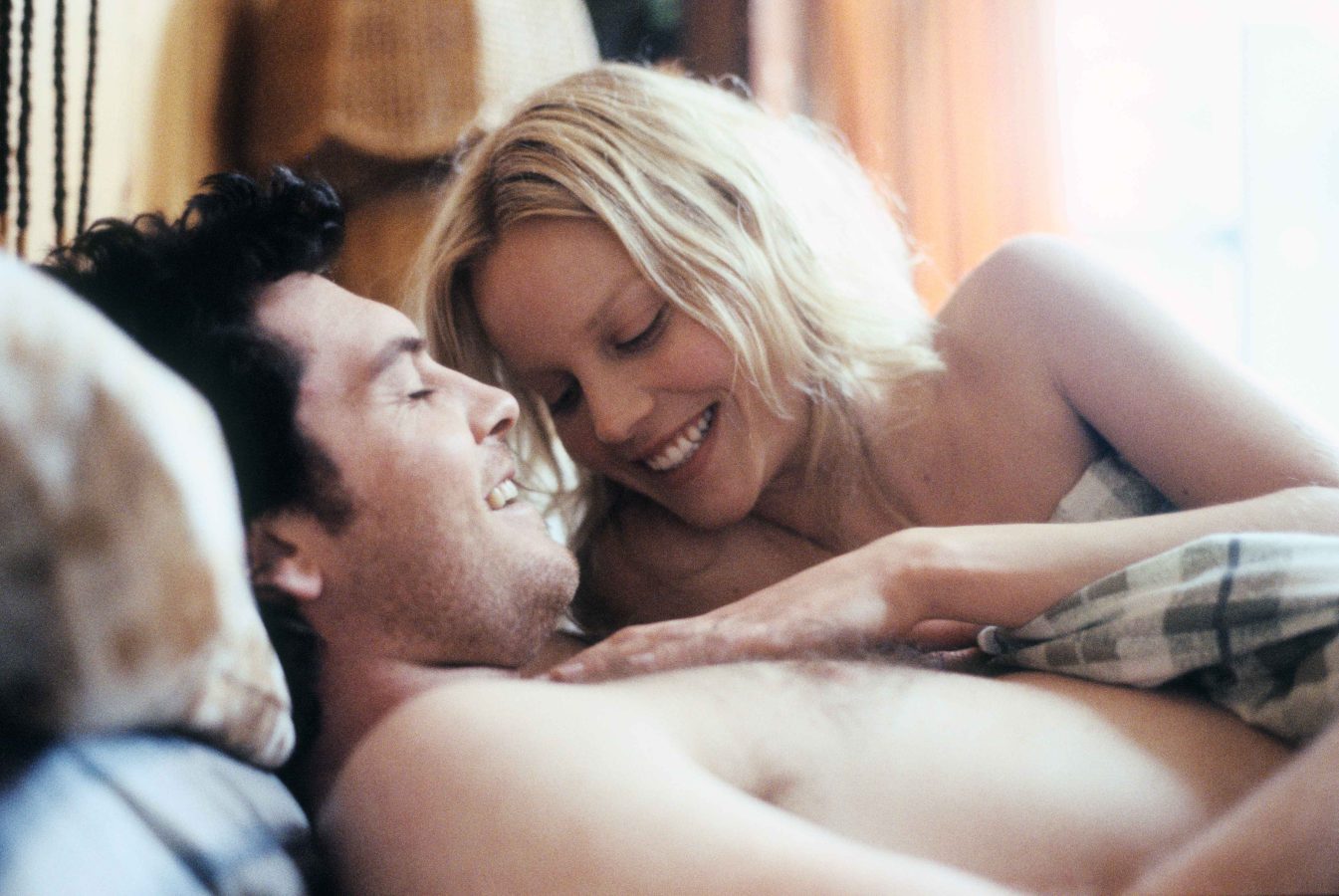
Heidi tethers herself to Jindabyne with a job at a local “servo”—slang for gas station—and rents an apartment plastered with Metallica posters behind a dusty motel. Her days largely orbit around Joe (Sam Worthington), a brooding, mulleted farm boy, capable of great tenderness (dusting toast crumbs off Heidi’s belly, post-coital) but prone to retreating into a pose of steely reserve, only able to speak freely when a few whiskies deep.
Joe chastises Heidi for her naivety, yet he is equally unsure and unsteady, wading through his own sexual confusion brought on by an older gay acquaintance who is back in town. “For these guys, their lives are already mapped out; the farm will go to them when their family passes on, but to hang out with them you realize that they want more,” said Worthington of his time shadowing young men in Jindabyne. “Because they have so much responsibility, they tend to party really hard, to try and find something. I’m not even sure they know what they’re really looking for.” Cornish and Worthington carry the film with their emotionally stunted, jerky performances. Worthington is a vibrating bundle of fear and doubt, spitting out bratty retorts when put on the spot. Cornish plays Heidi with a glazed-over wonder, frequently mystified by her surroundings and social cues.

Somersault (2004)
Cinema history is rife with women roaming about, and of course, Australia has its own set of wanderers—Walkabout (1971), Picnic at Hanging Rock (1975)—white schoolgirls who fall victim not only to the men around them, but the country’s harsh, unforgiving landscape (as perceived, that is, by the colonial imagination). In such films, the bush, all ancient wildness and heat, provides an easy metaphor for the emotional and bodily uproars of adolescence. The Australian Alps, meanwhile, are freighted with their own recent, unresolved haunting. In 1967, the original town of Jindabyne was purposely flooded and rebuilt on higher ground to make way for the lake, as a part of the Snowy Mountains Scheme, a giant hydroelectricity and irrigation project—seen by Australians as either a marvel of multicultural labor (the majority of its workers were European migrants, displaced after World War II), an ecological disaster, or both. Loss is literally in the water, houses and history rotting in the benthic zone.
Shortland seizes upon this uneasy provenance to remind us that a coming of age is a submersion someplace obscuring and reflective. No surface is clear in Somersault, but there are plenty of mirrors. Heidi conducts an imagined conversation with Joe in front of one, a typical teenage scene we’ve seen over and over. Cornish’s performance, all assured, lingering gazes and excruciating come-ons (“Fuck, I love your mouth,” she intones, voice lowered) gets to the thrumming core of this adolescent mirror stage—to finally know yourself to be an object of desire, and a desiring object, who through a few small movements can set in motion seduction.
Somersault (2004)
Shortland first wrote the script during a period living between Sydney and Canberra, basing Heidi on a girl she encountered while working in a support role for disturbed children. In interviews, she has spoken about the influence of Rainer Werner Fassbinder’s Ali: Fear Eats the Soul (1974) and the work of Melbourne photographer Bill Henson—perhaps surprising touchstones to those who know Shortland best for her 2021 foray into the Marvel media franchise for the Scarlett Johansson-led Black Widow. In Somersault, though, these are easy to spot. You can see Fassbinder in Heidi’s desperate, depressing quests for connection; Henson in the film’s unsettled, risky eroticism, and all its grimy, pale young bodies, shrouded in nocturnal black. Yet Somersault’s fluorescent lighting, washed-out vistas, and interior shots flooded with orange and pink light also make it specifically an early aughts artifact. This style has been posthumously associated with vague notions of Y2K futurism, but Somersault sits within a collection of films that saw drained, cyan-heavy color grades and neons as a means of entrenching atmospheres of alienation. I’m thinking in particular of Hou Hsiao-hsien’s youth drama Millennium Mambo (2001)and Olivier Assayas’s techno-thriller Demonlover (2002). A little closer to home, my fellow Australians might picture any of the music videos off Silverchair’s fittingly titled 1999 record Neon Ballroom.
Somersault swept the Australian Film Industry awards in 2004, winning every category, and made local stars of Cornish and Worthington, then 22 and 28, respectively. Both would soon decamp to LA, only to find themselves at opposite ends of the Hollywood spectrum. Worthington’s good looks and gruff aloofness managed to land him brief spells of action stardom and, more enduringly, to charm James Cameron (“You had me at Uh-huh,” the director apparently told the actor after he nabbed the lead in 2009’s Avatar). Cornish, after her turn as Fanny Brawne in Jane Campion’s Keats biopic Bright Star (2009), has largely been relegated to side roles, including as Bradley Cooper’s girlfriend in Limitless (2011) and Woody Harrelson’s wife in Three Billboards Outside Ebbing, Missouri (2017).
Cornish’s last great leading performance might be in Candy (2006),which is something of an addendum to Somersault. The film chronicles the downward spiral of a young Sydney couple addicted to heroin, at first sweetly consumed by one another (making out at McDonalds, riding Luna Park’s Gravitron), then quickly bulldozed by their intensifying drug dependencies. Heath Ledger, as a hopeless layabout poet has never been hotter, while Cornish as the titular painter could very well be Heidi years later—agog and love stricken, making bad decision after bad decision, despite a steady stream of debasements, realizations and finally, full-blown psychosis. Somersault ends with Heidi’s charade of adulthood dismantled, and a homecoming, but implicit is that adolescence is just the beginning of a lifetime of transformative revelations and misjudgments; we might manage to gather a few scraps of self-knowledge, though in the end total awareness will always elude us. What bliss! What terror!
Share:
Recommended
- Long Live the Republic!
 On a slippery, beguiling vision of war-torn Czechoslovakia seen through the eyes of a 12-year-old boy.
 - Shunji Iwai
 A discussion with one of the premier pop poets of the dawning digital era.
 - Futures and Pasts: Dead Mountaineer’s Hotel
 On Kromanov’s rug-pulling amalgam of whodunnit and science fiction, an enduring cult item and one of Estonian cinema’s towering peaks.