
Essay
Memories of a Vietnamese Cinema
On the romance that shaped Vietnamese revolutionary cinema.
Memories of a Vietnamese Cinema opens at Metrograph Theater Friday, Oct. 17.
Share:
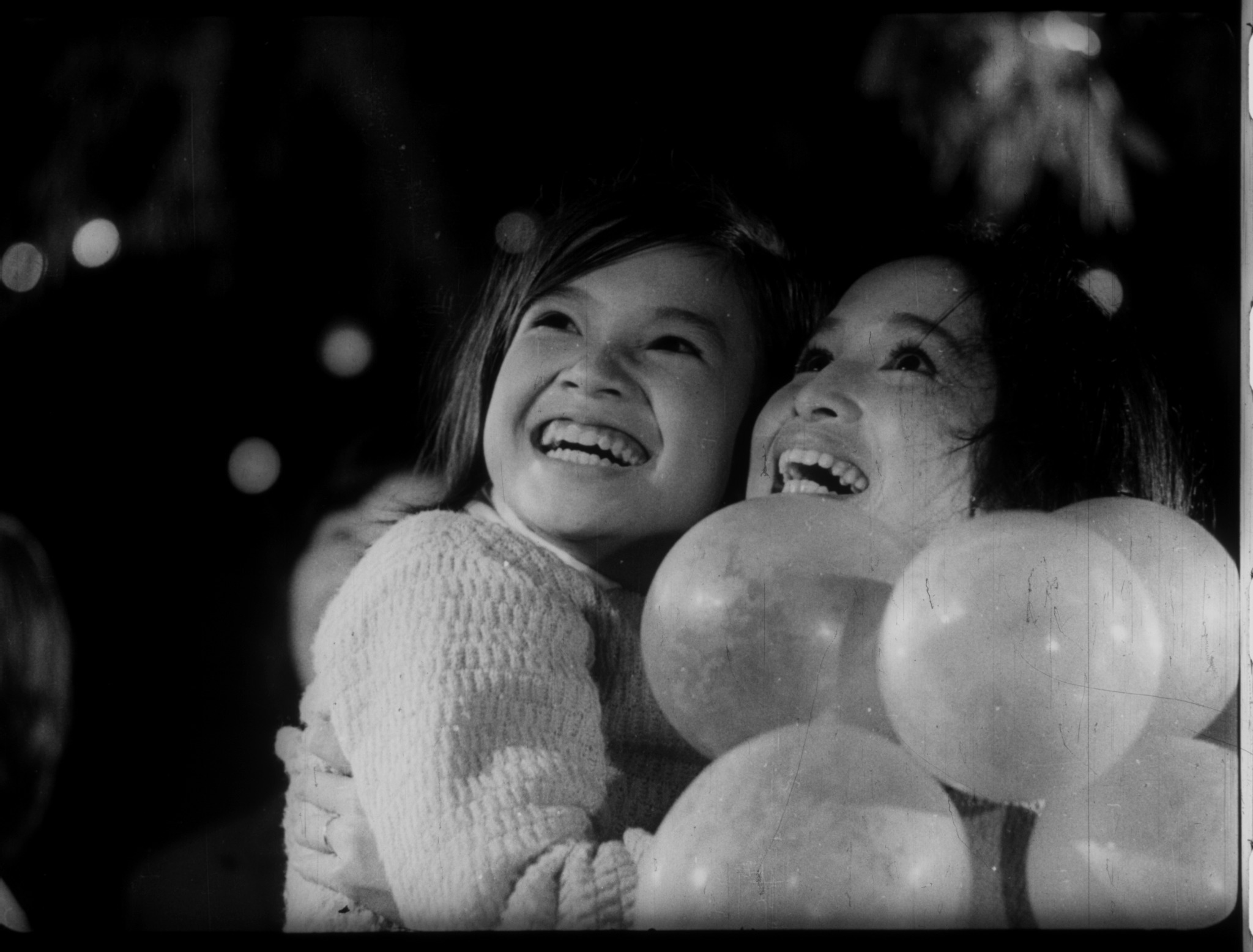
Girl from Hanoi (1974)
THE FIRST FEATURE MADE BY North Vietnam’s new socialist film industry was a love story. Directed by Nguyễn Hồng Nghi and Phạm Kỳ Nam, On the Same River (1959) tells the story of a Northern guerilla soldier Hoài and a young Southern activist Vận (Mạnh Linh and Phi Nga, respectively) who meet during the resistance war against the French, and are separated when the Geneva Agreement partitioned the country. The Bến Hải river becomes a wall, and Vận must decide between reuniting with her lover across the border or staying with her village. Co-director Nam was an established photographer who had just returned from Paris’s École Supérieure d’études Cinématographiques, but he was virtually the only one with experience. From a production standpoint, the film was in uncharted territory. The cast and crew learned as they went, piling equipment onto a single boat and swimming alongside it to reach their set location. The film was created to instruct the country’s citizens about ongoing colonialism and their place in the resistance. Why tell it through romance?
From Vietnamese revolutionary cinema’s inception, this was a productive tension: love was both something irreducible to political ideology, and the vehicle through which the Party found its most persuasive form. The Việt Minh’s cultural policy grew out of a culture steeped in romanticism—from both the country’s own traditions and French influence—which they termed cách mạng lãng mạn, or “revolutionary romanticism.” This largely referred to the allegorical use of human relationships: that is, people representing the existential fate of the nation through their desire, their subjectivity linked to collective destiny. Despite the constraints of the political system, cinema workers approached their work with pride, producing films that were surprising and complex. Nam would later dismiss On the Same River as insufficiently artistic, a testament not to the work’s failure, but to the movement’s non-distinction between aesthetic ambition and political purpose.
Vietnamese revolutionary cinema tells the story of utopianism and foreclosure, of love as both liberating and coercive. In 1953, Hồ Chí Minh established the 147/SL film decree that declared two tasks for Vietnamese cinema: “to build socialism, and to struggle for the liberation of the South for the reunification of the country.” The Vietnam Film Studio was created shortly after, the latest among state-run cultural departments such as visual arts, theater, photography, and literature. Three decades of this “Golden Era” would produce thousands of newsreels, features, melodramas, and even children’s animations. The multiplicity of this cinema explodes conventional distinctions between art and propaganda. But this expansive canon also contains a skewed perspective, a glaring elision—the systematic erasure of contributions from the South.
In 1947, cameramen of the Southern Cinematography and Photography Branch developed their own style of combat documentary during the French war, and created documentaries like Mộc Hóa Battle (1948). Unlike the Northern films carefully preserved by the state, Southern works survive only through precarious grassroots networks. Vietnamese state archives preserve materials exclusively from the North, erasing Southern works entirely—a circumstance that reproduces its limitations in curatorial programs like this one. These compromised conditions have led some to write off the entire canon of Northern cinema as propagandistic fodder. This would be a profound mistake, as these films offer us something radical: that artists can create formally inventive, emotionally resonant work under systems of constraint; that political commitment can generate rather than stifle beauty.

The Last Hope (1981)
Vietnamese revolutionary cinema emerged from Soviet cinema’s institutional and theoretical framework, where avant-garde aesthetics and vanguard politics achieved their convergence. The Vietnamese film industry comprised artists, poets, stage performers, musicians, and writers, many established members of anti-colonial intellectual movements. Some had fought in the French resistance and attended the People’s Art School in the Việt Bắc War Zone, like Trần Phương, who was both an actor and director. Many filmmakers studied at Moscow’s Gerasimov Institute of Cinematography (VGiK), one of the oldest film schools in the world, absorbing influences from Sergei Eisenstein and Vsevolod Pudovkin to Jean Renoir. It was a period of international exchange; foreign filmmakers including Joris Ivens, Malik Kaiumov, and David Ibragimov came to Vietnam to help build the cinema system. As Ibragimov recalls in his memoirs, the energy was electric. When the Vietnam Film School opened in October 1959, more than 10,000 people applied. Classes were taught by master artists. The renowned painter Tô Ngọc Vân taught Ngô Mạnh Lân, who would become the first animation filmmaker and created works like The Talking Bird (1967) that conveyed anti-colonial and anti-capitalist ideas through the cartoon form.
Even amid the chaos and emergency of the Vietnam War, the cinema produced at the time maintained a remarkably tender, sentimental character. In 1974, Vietnamese director Hải Ninh released The Little Girl of Hanoi, filmed in the actual rubble of America’s 1972 “Christmas bombing” that dropped 20,000 tons of explosives and killed nearly 2,000 civilians. Hải Ninh himself survived those bombings, sheltering with his three-year-old daughter under debris for days in cold rain. From this trauma, he created something remarkable—a film that refuses to surrender childhood’s lens, that insists even amid apocalypse on the child’s soft-edged, dauntless worldview. Little Ngọc Hà (Lan Hương) wanders the streets—dazed, possibly amnesiac, yet impossibly poised, carrying a violin. As a soldier helps her find her family, memory returns through a montage of flashbacks that flow with dream logic rather than linear causality. Traumatic sequences—explosions, terrified huddled classmates, recounted death—are insulated by others of gauzy affection: grandmother’s embrace, baby sister’s laughter, teddy bear’s fuzzy comfort. Despite the warzone, she inhabits a fantasy realm of safety. The care that insulates her is divine protection, an expression of militant faith.
These films must be understood as counter-propaganda: direct responses to U.S. media in which the Vietnamese were not considered human, their deaths at the time literally uncounted by the press and American military intelligence. Justifying U.S. military actions through the moral imperative to save Western civilization from “the evils of communism,” American media depicted the war as a battle against inanimate forces rather than human beings. The invocation of emotions in Vietnamese agitprop was thus an act of rehumanization, an attempt to re-instill humanity for the Vietnamese in the eyes of an international audience.
Resistance groups from France, Palestine, and Cuba collaborated with and drew inspiration from Vietnamese militants, who occupied a unique Cold War position that connected Comintern anti-capitalist critiques with Third World liberation struggles. For those across the world, Vietnam’s struggle exposed how imperialism justified its violence through claims of defending democracy against a Communist/Terrorist other. Its triumphal defeat of the U.S. in 1975 became powerful inspiration, evidence that even powerful empires could be toppled.

On the Same River (1959)
After reunification and the 1986 “market socialist” reforms, film production increased even as the state system declined. This phase brought critical reevaluations that mirrored broader political tensions. Filmmakers began reconsidering their work with candid self-reflection, contemplating humanist subjects like love as disentangled from nationalist determinations. The filmmaker Trần Văn Thủy, for instance, was commissioned by the state to make a documentary celebrating the city’s tourist attractions. Instead, Trần made Hanoi Through Whose Eyes? (1987) with the help of animator Ngô Mạnh Lân, a somber documentary of artists, musicians, and filmmakers speaking frankly about their past and the alienation they felt in the newly urbanized city. The film was initially banned, but later rehabilitated and is now widely celebrated.
Đặng’s When the Tenth Month Comes (1985), the first Vietnamese film to screen in America, demonstrates how socialist cinema’s sensibilities evolved. The film follows a woman named Duyên (Lê Vân) who learns that her husband has died in the Cambodian-Vietnamese war and tries to keep the news from everyone around her. Her late husband’s friend finds out and becomes complicit in her secret, penning letters in imitation of her husband’s voice, their clandestine ploy a muted act of romance itself. Đặng uses montage to convey her dismay, her composure eventually bursting apart as her sorrows spill over in dreams. Her husband appears as the fitful flicker of a candle, and his vision drenches her in sweat as she sleeps. In a hallucinatory spell she wanders through a sea of strangers in the market, seeing figures who resemble her husband. Đặng uses the montage technique of parallel editing to generate dramatic suspense and emphasize Duyên’s heartbreak, portraying love and death as experiences integral to the social fabric. We can recognize the genealogical connection to earlier revolutionary cinema.
In Vietnam these films are relatively known, commemorated as national cinematic history, preserved by the Vietnam Film Archive, and their makers honored as People’s Artists. Since the state maintains strict terms in which these films are preserved in public memory, the challenge is less to build the narrative of Vietnamese film history, and more so embracing its complexity. Projects like Hanoi’s film festival Như Trăng Trong Đêm have taken up this work exceptionally well. Outside of Vietnam, these films remain far less accessible. They occasionally surface through festival retrospectives and partisan programming. But in the United States, they are exceptionally rare.
What makes Vietnamese revolutionary cinema compelling—what fulfills their original aims—is their capacity to render the world through a sensuous sensitivity that had been systemically foreclosed, to convey the possibility of integral rather than alienated existence. For contemporary viewers navigating our own moment of imperial violence and ideological constraint, these films offer more than historical interest. They demonstrate that cultural production can express individual subjectivity while maintaining collective critique. They show us how to prefigure desired forms of life rather than reproduce imposed social relations—to depict life in all its intensity, animated by the fantasy of a better world within reach.

When the Tenth Month Comes (1984)
Share:
Recommended
-
Susan Seidelman
 An intimate conversation with the trailblazing American filmmaker.
 -
Carol Kane
 Fifty years in 50 minutes with the irrepressible screen icon.
 -
Mark Lee Ping-bing
 The legendary cinematographer reveals his three core beliefs.
- Travel Companions: Bahram Beyzaie & Amir Naderi
 On two defining Iranian filmmakers, and two of their most enduring works.
 - A New Love in Tokyo
 On the pulse of pleasure in Banmei Takahashi’s effervescent Pink drama.
 - Let the Dead Bury the Dead: A. S. Hamrah in Conversation
 On the so-called “death” of theatrical moviegoing, Romero’s oft overlooked fourth Land of the Dead (2005), and a whole lot more.