

The Metrograph Interview
Mark Lee Ping-bing
The legendary cinematographer reveals his three core beliefs.
Share:
Over a six-decade career, Mark Lee Ping-bing’s striking collaborations with filmmakers such as Wong Kar-wai, Trần Anh Hùng, Ann Hui, and most notably, his long, rich collaboration with Hou Hsiao-hsien, have inspired a rising generation of cinematographers-amongst them Bradford Young, whose elegant DP work in films such as Ain’t Them Bodies Saints (2013), Selma (2014), and Arrival (2016) has garnered widespread acclaim. Over Zoom, Young spoke to Lee, quizzing his hero about the necessity of taking risks, his partnership with director Hou, and bringing their daring visions to the screen. -Metrograph
BRADFORD YOUNG: It’s an honor to finally meet you. How are you?
MARK LEE PING-BING: Good, good, thank you.
BY: First and foremost, I want to say thank you for allowing me to speak to you. You’re one of the cinematographers I deeply respect, and this is an honor for me and a joy. Funny story: there’s a group of us filmmakers, we lived all over the world but all moved to Baltimore five, six years ago, so that we could make small independent films together-because we had all made big movies and didn’t like that environment, and we wanted to continue to make small films. We developed a nomenclature amongst us because we really admire the films that you and director Hou Hsiao-hsien have made together: whenever we set up a shot that we want to try and do in one setting, a oner, we always say, “Let’s do a Mark Ping-Bing/Hou Hsiao-hsien.”
I want to ask specifically about this visual grammar that you and Hou have developed, where it’s not just for efficiency, but because of storytelling. You’ve developed a language where the camera does so much without depending on editing, and I know that requires a lot of input from you. Obviously, the mise-en-scène has to be set up by Hou, but the only way those single-take shots can be pulled off is if the cinematographer has a particular kind of taste and way of seeing.
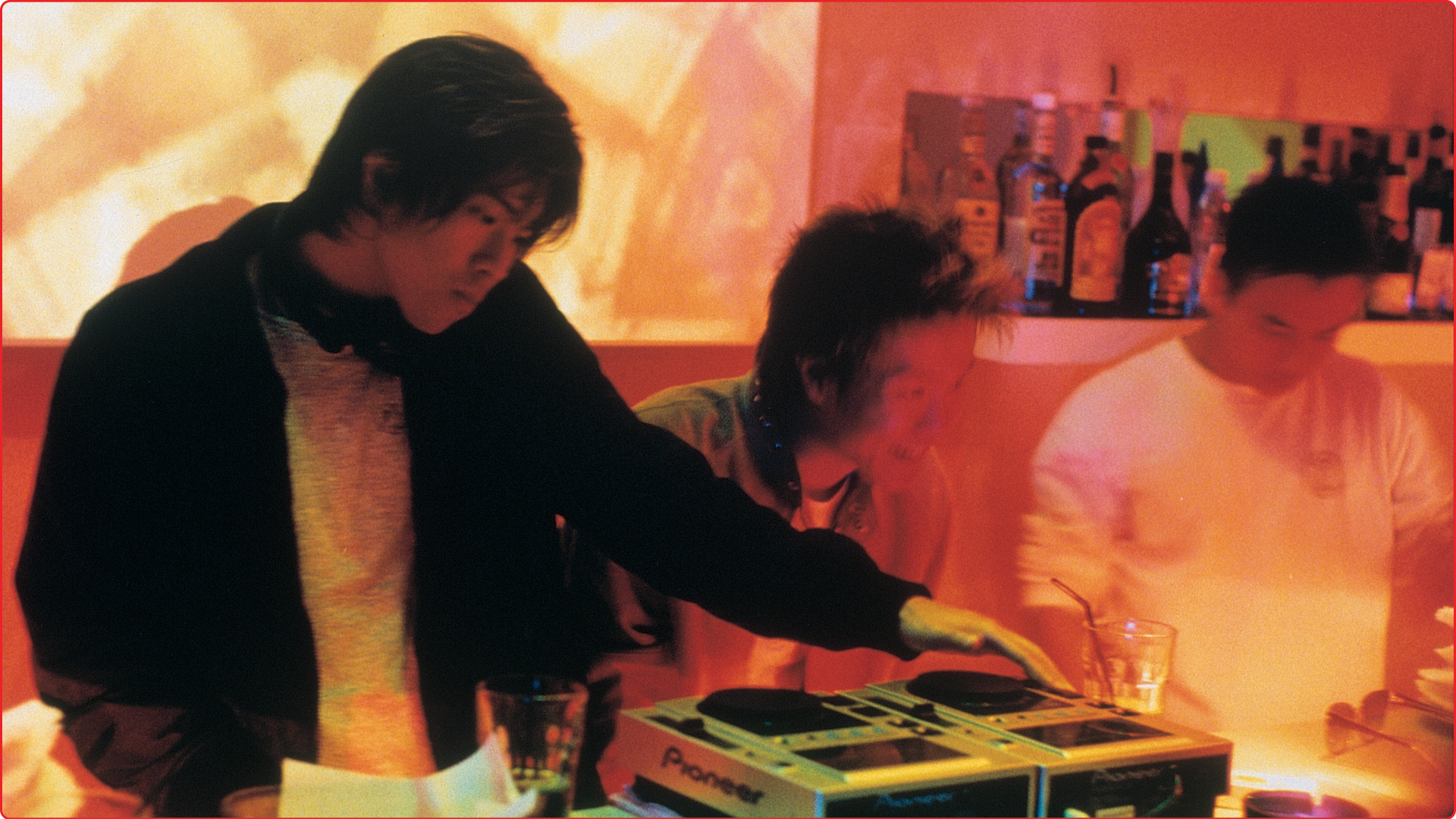
Millennium Mambo (2001)
MLPB: I’ll start with myself as a cinematographer. I love ancient poetry and prose-things with very few words, but rich with meanings and context and textures-and I try to embed that sense of poetry into my visual images. How can you convert that poetry and prose? That’s what I really see as the focus of my work. Working with director Hou, our collaboration has made me realize it’s not just about the lights and shadows that I can create and capture, it is very much about the narrative, or the text, too. The textual side of things is the most challenging part, and where we need to collaborate the most. Director Hou has a keen visual sensibility, but in terms of lighting design, he’s used to working with cinematographers who set up lights in a complete and comprehensive way, to the point that the shot is so perfect. It was through our collaboration that I started to understand what he wants when he’d say that he needs a particular type of flavor, visually. In our collaboration, at first I was trying to do some things other cinematographers tend not to do. For example, I set up very simple lighting. At the time we were shooting using film stock and it’s hard to film in low-light situations or with simple lighting setups. Later on, director Hou became even more daring; even with my simplest setup, he would say, “Do we really need that? Can we do it without?” He wanted to push the limits of what we could capture with film stock. He was pleasantly surprised to see how, even in low-light situations, I could still capture the unique flavors or feelings he wanted.
In terms of the evolution of our collaboration, other than the fact that the lighting setup has gotten more minimal-we even joke about the fact we call the lighting designer for our films the “one light master” because all we need is one simple light-the other evolution is this aspect of static shots. When we started collaborating, the camera was very stationary; it didn’t move. I really wanted to incorporate dollies and tracking shots into the films. At first, I tried passing it off as, “I’m setting this up just so that I can move the camera for different jobs easily”-but in fact, I was trying to see whether or not I could sneak in some tracking shots, some movement.
I experimented with that when shooting The Puppetmaster (1993); later, I found out all the moving components had been edited out completely by director Hou. It was not until Flowers of Shanghai (1998) that I persuaded director Hou to set up tracks to capture what was going on in a more comprehensive way. Instead of just static shots, now we had moving components, which have become the staple of our later films. Now director Hou will ask, “Should we be moving around a little bit here? It seems too static.” After Flowers of Shanghai, I think I earned my place; I think I earned his full confidence. Since Flowers of Shanghai, he doesn’t get too involved with each shot, because we trust each other, and we grow together with every single film we make.

Flowers of Shanghai (1998)
BY: Beautiful. I love hearing about the way a language evolves as collaboration and not just as a singular voice. It seems you have a real, true relationship, and that’s evident in the films. Everything from Flowers of Shanghai to The Assassin (2015), it’s all very different, and I love all these films because I can see the evolution. As a visual storyteller myself, I’m always watching your work to see what kinds of choices you make next, because I understand that evolution is inevitable. One thing I think about often is how we as image-makers don’t get to communicate but our voice is materialized in the work. Like, I often tell people that I think about my grandmothers’ houses: I’m always trying to recreate the lighting I experienced in those houses as a young person. As an artist, where do you see your voice? Maybe it’s in lighting, maybe it’s in camera movement, maybe it’s a lack of camera movement or lighting, maybe it’s not evident on the screen, but where do you see your voice in these films?
MLPB: I can express my voice on three different levels, through three different beliefs. The first is that I always think the scene and the space should be left for the director and actors and actresses. As a cinematographer, one way I can express my voice is to keep all the difficulties and challenges to myself; I will not get directors and actors and actresses involved. I keep a distance when I’m trying to capture something. Distance gives me space to think about how I’m going to set up the lights and the shadows: the simpler the better, like the joke about the “one light master.” As a cinematographer, you need to think about how to set up the lights and shadows in such a way that the visuals happen organically, magically, almost like a miracle.
The second is very much about the idea of taking risks, trying something new every time. When you have a story and a script, the visual components are pretty much there already. You mentioned your connection to childhood memories, and I experienced that as well when I shot A Time to Live and the Time to Die (1985) with director Hou. It was very daring for me as a cinematographer to ditch all the professional lighting that I’m well-versed in and to use just regular lights and light fixtures on site. Those risks proved fruitful in the end: it was very successful. But without trying, I would never have realized this could be done. That encouraged me to take even more risks and be even more daring.
On the third, a huge part of my voice has developed by working with other filmmakers through trial and error. I remember when I was working with Wong Kar-wai on Fallen Angels (1995), I learned that in terms of what you can do with your camera-with your lights and your frame, your apertures, all the different things-the possibilities are endless. There might be conventional ideas of how things should be done, but if you break out of that, you allow yourself to try something new. In Fallen Angels, we were shooting with a 6.8mm [wide angle lens] for the most part, and some shots were done with 50mm, and then director Wong asked me, “Would you be able to do a shot of the actress using 6.8mm without any distortion?” Most cinematographers would say, “That’s impossible. There’s going to be distortion…” But I allowed myself to try it out. Yes, there’s a slight distortion, but at the same time we created a unique feeling that actually worked well with that particular film.
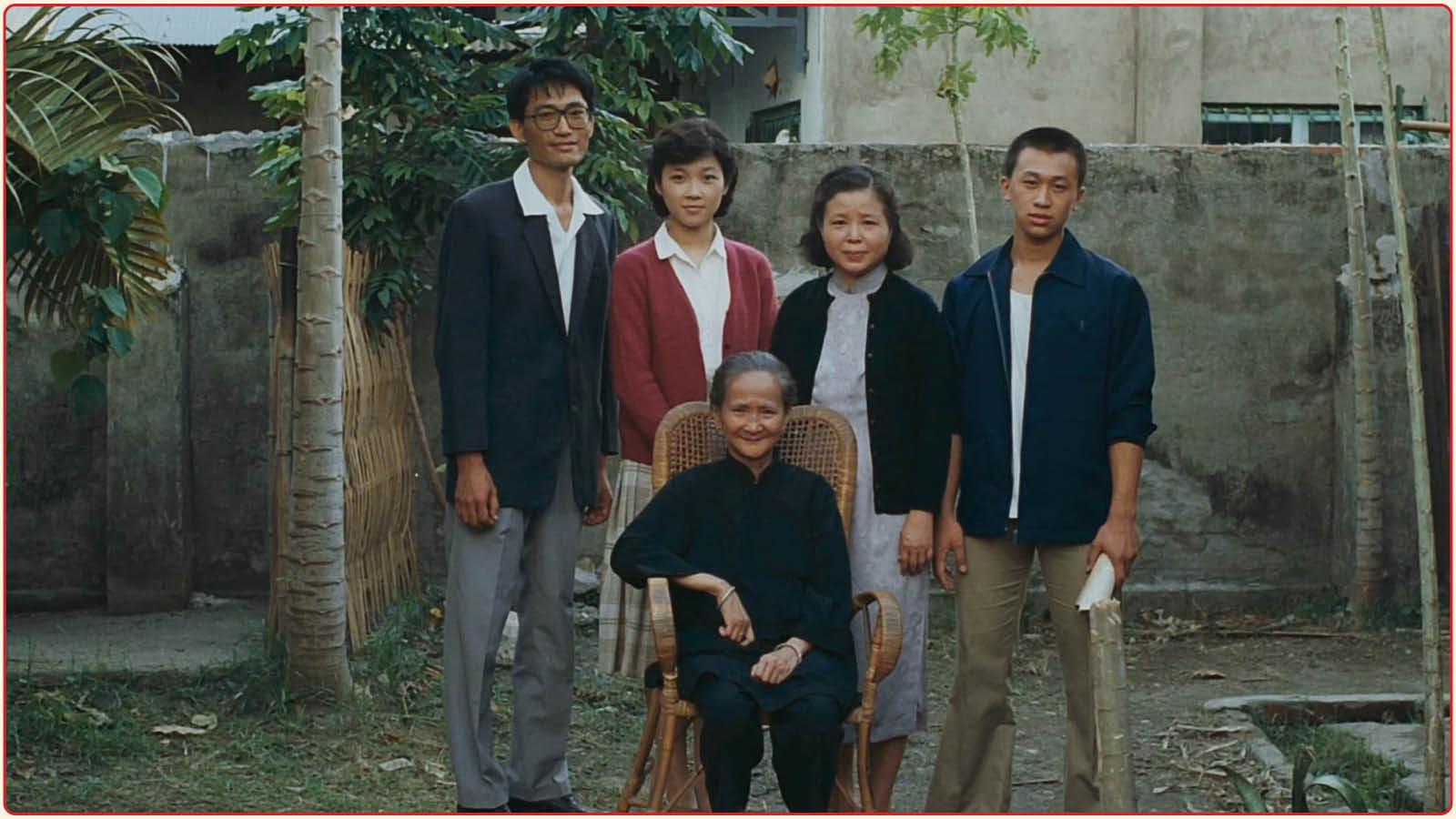
A Time to Live and A Time to Die (1985)
BY: You mentioned how difficult it is when we work with film, we often question our instincts, because film is so temperamental. I’ve enjoyed listening to you talk about how that was a discovery for you. But what about digital, with all of its complications but also its value-because it has its own virtues. Obviously with digital, you have to give it another texture, the texture is not always there: you have to present other layers, other things to bring that texture to it, but what are the things that digital has allowed you and director Hou, or any of the other directors you’ve worked with, to discover? How has it freed up that process?
MLPB: It’s something that is hard to describe. On set, it happens organically and magically with the lights and shadows, and also the atmosphere director Hou sets up. When that miracle happens, it somehow resonates with the audience. I often say that if I can move just one person, then this is a success story. That’s what film can do. It’s a human connection, somehow you can touch people with the visual components you create. On the digital side of things: I didn’t come to the digital game until very late. When we made The Assassin in 2015, we were still using film stock. At that time, HD or digital technologies were in their infant stage-I welcomed this type of technology, but I didn’t feel that it was mature enough yet for me to take it on as a tool.
The first time I fully embraced this new technology was with Norwegian Wood (2010). I was using an American digital camera, a Viper, and it has a very green tint to it. It was hard to present the natural colors I wanted to express. It was not until later on, when I used the Sony F65, that I was able to really see how this technology had matured to the point where I could capture the details, the tints, the color temperatures, and the lighting in the way that I wanted.
I think a lot of it has to do with the details for many digital cameras: they always come with some kind of suggested setup, what they think is the best way to utilize the camera. For me, I always want to try something else. Because without taking risks, you can’t create something new-that’s always been my philosophy. And I do think digital cameras can keep the lighting even more simple and even more minimalist, a lot of details can be captured, and you can somehow create an aesthetic that is beautiful. But when I say “beautiful,” it doesn’t mean “pretty”-“beautiful” means an aesthetic that is unique. There’s a special sense of beauty that can be captured by playing around.

Norwegian Wood (2010)

Share:
Recommended
- Yuliya Solntseva
 On the actress-turned-filmmaker’s unsung authorship.
 - Futures and Pasts: Socrates
 Rossellini’s one-of-a-kind approach to the costume drama, and his 1970 film on the last years of the Athenian truth-seeker.
 - The Illiac Passion
 On the most elaborate of Gregory Markopolous’s modern myths.