
From the Magazine
Minor Indignities in Moviegoing
Two friends—writer-director Ari Aster and cartoonist and screenwriter Daniel Clowes—swap stories about their weird and wonderful experiences at the cinema.
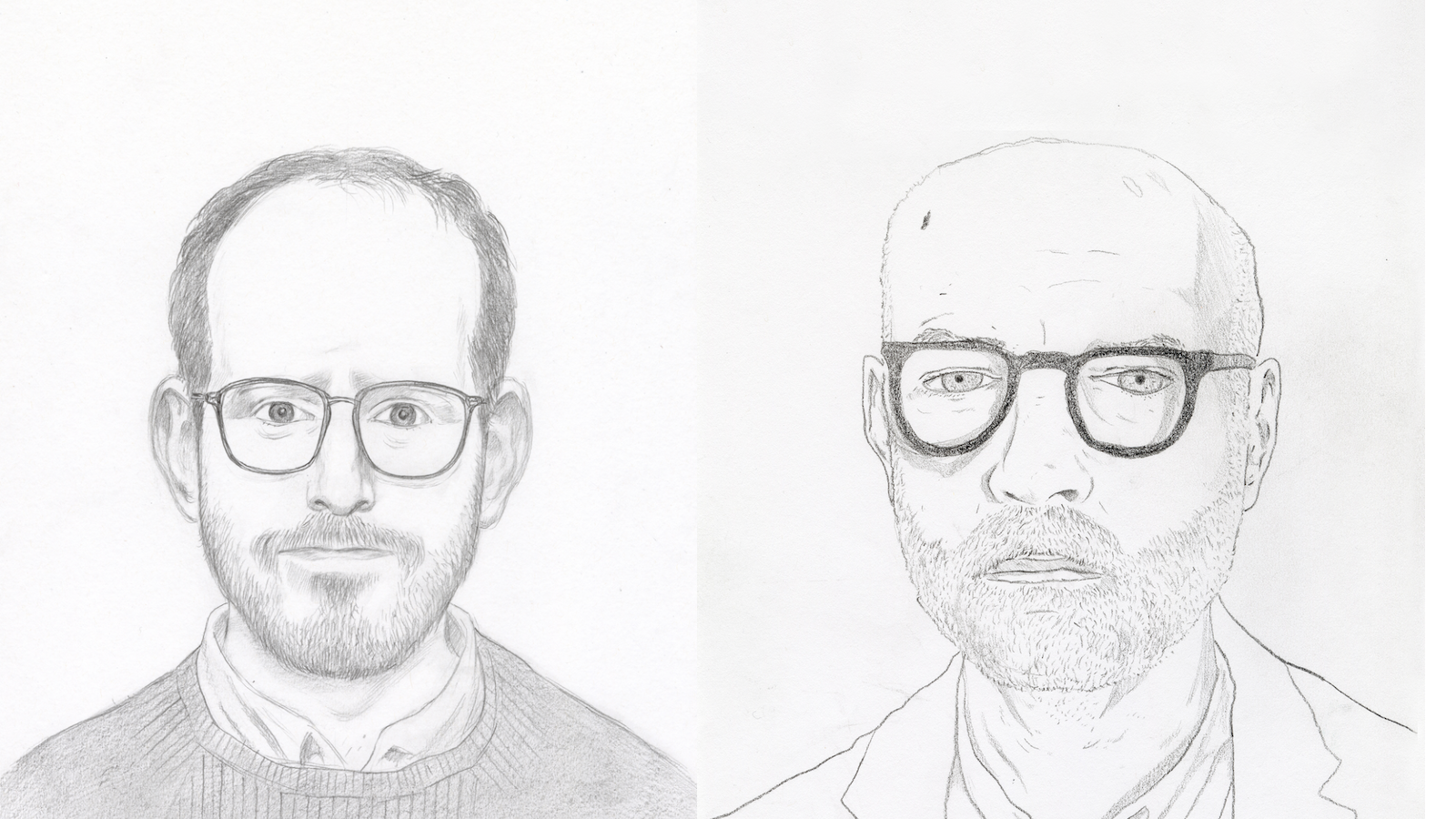
Ari Aster drawn by Daniel Clowes (left); Daniel Clowes drawn by Ari Aster (right).
Share:
This interview appears in Issue 1 of The Metrograph, our award-winning print publication. Explore more of Issue 1 and newer editions here.
DANIEL CLOWES: I often get asked in interviews, “What’s the difference between comics and movies?” I always have a rote answer because I find it a boring question, but recently I thought about it from more of a reader’s perspective. I feel comics are a one-to-one experience. When someone reads a comic, they’re having a direct relationship with you. It’s a solitary moment, a communion of two people, very intimate—and different from literature, in that it’s a visual experience. You’re transmitting your visual perception of the world to another individual consciousness.
Whereas I believe movies are optimally a communal experience, and they work best if you’re part of an audience. Even when you’re watching a movie on an airplane or at home, it’s still projecting out to the room, and anybody who walks through the room affects your experience. For example, every year in San Francisco they have the Silent Film Festival and the Noir City film festival. They’re in beautiful theaters, like the Grand Lake Theater near my house, and they’re absolutely filled, every seat: a thousand people of all different ages, and then a name like Gloria Grahame or Victor Mature appears on screen and everybody applauds with pure joy. That’s the only time of the year I feel good about humanity. I always leave feeling like humanity is redeemable because you can fill a theater to see Dreyer’s The Passion of Joan of Arc (1928). So that got me thinking about the great joy of seeing a movie in a theater—those are always the most memorable movie experiences I’ve ever had. They’re enlarged by being with the right audience and feeling that camaraderie.
ARI ASTER: Yeah. Or an enmity with the audience!
DC: I will go see even a bad movie in the theater, just to have that communal experience… Especially when I was younger, I’d go see any comedy. I never liked Blake Edwards movies that much after The Pink Panther (1963), that whole era, but I’d see every single one of his films. I would laugh and laugh and love the experience, and then two days later, I’d think, “Oh God, that was just awful. Why did I watch that?” But it’s such a joy to be in a room with people laughing at the silly antics of Dudley Moore, or whatever. Did you have any funny experiences in theaters as a kid? Did you ever cry in a theater?
AA: I did run in terror from a theater once—I remember it as being Dick Tracy (1990) but recently my mom contradicted me. Or I might’ve fled before we even entered. There was so much dread.
DC: [Laughs] There are many good reasons to run from that. I would think all artists—filmmakers especially—were terrified by movies as children. Nobody ever took me to the cinema—it was rare, once a year, so it was always the most incredible experience. I remember going to Chitty Chitty Bang Bang (1968) when it came out. I kept looking down at my watch to try to figure out how much time I had left because it was unbearable to think it was coming to an end.
AA: I remember watching Mighty Morphin Power Rangers: The Movie (1995) when I was nine, and I became very depressed halfway through that I didn’t own it, that I couldn’t possess it. I knew the day that I’d be able to own it on VHS and watch it whenever I wanted was so far away. I felt that same sorrow when I watched Surf Ninjas (1993).
DC: When I was growing up in Chicago, and then when I lived in New York in the late ’70s, there were endless crazy experiences in movie theaters. People don’t do crazy things as much as they used to. I remember the first movie I ever saw in New York was Don Siegel’s Escape from Alcatraz (1979).
AA: Aw man, the greatest.
DC: And I was a huge Patrick McGoohan fan. I went by myself to Times Square, bought a ticket for a 4pm screening. I was one of maybe 10 people in the audience. About 20 minutes in, this guy comes with a ladder and starts changing the light bulbs as we’re watching the movie. Everybody’s like, “Uh, can you do that later?” I’m sure the manager was like, “They’re just a bunch of losers and drunks in there, go do it now. We’ve got to have it fixed for the evening screenings.”
AA: That feels like a story you neglected to put in Eightball. Something that might have been in “Blue Italian Shit.”
DC: “Minor Indignities in Moviegoing.”
“Oh man, Eightball was such a huge influence for me, too huge to adequately express here.”
AA: Oh man, Eightball was such a huge influence for me, too huge to adequately express here. We’ve talked about this, but it was one of the first things I ever read that felt like it was speaking directly to me. I remember thinking, “I feel such kinship with whoever wrote this.”
DC: And then you got in touch because you wanted help writing a script that we shall not discuss because it’s top secret.
AA: Yeah. It was something I’d been trying to write for several years, but I have a problem with discipline, and everything ends up too long. I needed a co-writer, and you were one of my heroes; I thought, “If I’m going to reach out to somebody to co-write, I might as well try Dan Clowes and get turned down.”
DC: I remember I’d heard of your movies, but I had a policy to never watch modern horror movies because they were always disappointing.
AA: Yeah, I get that.
DC: My friend the cartoonist Richard Sala watched every single horror movie. I remember asking Richard, “Have you ever seen any of this guy Ari Aster’s films?” He was like, “He’s one of the only good modern horror directors. Hereditary (2018) is a masterpiece. It’s one of the greatest films I’ve seen in the last 10 years.” That meant so much more to me than anything else, any review. So I watched that and Midsommar (2019) and I was like, “Oh, this is somebody who actually knows film history and is in a completely different realm than I was imagining.” I thought, “Well, it’ll be fun to talk, but I’ve got my own stuff going on.” Then we talked on the phone for an hour, and by the end I was like, “I’ll do whatever he wants!”
AA: In your work, the closest any of your books get to adventures inside movie theaters, I think, is Like a Velvet Glove Cast in Iron. Interesting Productions, right? That was the name of the studio that made the movie in the porn theater?
DC: That was based on a theater that was on Third Avenue, near Fourteenth Street, called the Variety PhotoPlays. There’s a movie about it, Variety (1983), written by Kathy Acker.
AA: So cool that you knew that theater.
DC: My friends and I would just walk in. They did not announce what movie was playing, so you’d go and it could be a ’60s sub–Russ Meyer film, or a disgusting ’70s bleached-out porno, anything. You were in there with the least discriminating degenerates in New York, people who couldn’t bother going all the way to Times Square. There were prostitutes roaming the aisles: “Hey, slugger, want a date?” And we’d be cowering, praying for a Joseph Sarno movie to come on. It had a really terrifying, diseased vibe. Every sense was offended. And there was an endless line for the bathroom all the way down the left aisle. God knows what was happening in there.
AA: In Santa Fe, there was one really sleazy theater—well, it was a United Artists, but totally neglected. I remember I was 12, maybe 13, and I went to the bathroom and a man followed me, this big obese guy. He was standing by the door while I was at the urinal. I turned around and he looked terrified, like he was vibrating. He was just able to muster the words, “You want to party?”
DC: Wow.
AA: Yeah, it was scary. I managed to squeeze past him, like, “Sorry, thank you. Maybe next time.” Thank goodness he was deferential. He wanted to know if I wanted to party… Another theater story: it was the LA premiere of Mr. Turner (2014), which is one of my favorite movies now. Along with Topsy-Turvy (1999) and Edvard Munch (1974), it’s one of the great artist biopics, which is definitely the worst of all genres.
DC: For sure the worst genre there is.
AA: I was near the front of the Chinese theater—not Grauman’s, one of the smaller ones. Midway through the film, we heard this shouting from the back—two people just barking insults at each other, pretty unremarkable—and then, suddenly, the most terrible shriek. They stopped the film and the lights came up: this man who could not stop screaming was being ushered from the back. Behind him, a woman was resisting two people who were guiding her out. Apparently, she was on her phone and he had asked her to put it away. She wouldn’t do it and he kept insisting. Her response was to pepper spray him. Burn his eyes out of his head.
DC: I’ve seen a few fistfights in theaters. Opening weekend of Raiders of the Lost Ark (1981), I remember, in my row, there was a husband and wife. The husband went to buy popcorn, and while he was gone this huge muscle-bound guy took his seat. The wife was like, “Hey, that’s my husband’s seat,” and he just stared ahead. The husband came back and the guy refused to move. It got heated, and then the guy who stole the seat punched the husband in the face. They had to delay the movie, cops came and took the guy away, it was this big rigmarole. In a way, it gave the movie this feeling of danger, like anything could happen. Now, when I think of that movie, I think of only that moment, this terrifying guy punching this poor guy who was just trying to bring popcorn back to his wife.
AA: Wow.
DC: Whereas the funniest experience like that I ever had was when I went to Alien (1979) on opening night in downtown Chicago. Back then, you didn’t know what a movie was really going to be about. I knew there was an alien on a spaceship, and we comic nerds knew it was partly designed by Mœbius.
AA: That’s right. H.R. Giger gets so much credit, I forgot Mœbius was involved.
DC: He did the space suits, I think. So opening night, we’re not knowing what to expect. Suddenly, we’re watching this tense, terrifying, unpredictable movie. As soon as John Hurt’s chest-burster scene happens, it feels like the rules go out the window and every gruesome thing is on the table. We get to near the end of the movie, to that scene where Sigourney Weaver is in her underwear and she gets into the pod. Everybody in the theater is thinking, “Something horrible is going to happen. Something alien is going to leap out of her stomach, or she’s going to get bitten in half, or…” We’re ready for the most horrifying capper. Then this one guy in the theater yells out, “TAKE IT OFF, BABY, TAKE IT OFF! JUST A LITTLE BIT MORE, BABY! OH, COME ON, YOU CAN DO IT!” He’s in a completely different world. Half the audience is suddenly laughing their heads off; everybody else is like, “Shut up! Shut up!” Normally, when somebody talks in a movie, there’s nothing worse, you want to just have them erased from humanity, but occasionally something happens that adds much more than it subtracts.
One other memorable experience I had that was more about the audience was this movie nobody remembers called Yellowbeard, from 1983. Back then, you’d just see a movie in the paper: “Oh! Here’s a movie with so-and-so, I’m going to see that.” I remember there was an ad—and it was not a big ad—but it was Yellowbeard, starring Graham Chapman as some kind of deranged pirate. Peter Boyle is in it, Peter Cook is in it–
AA: Peter Cook is the greatest.
DC: All these actors: Spike Milligan, Marty Feldman… How can this be anything but great? So I’m there opening night. The theater’s crowded; everybody’s had the same experience, which is reading that ad and thinking, “Eric Idle’s in this movie, I have to see it.” And it was the single most unfunny movie I have ever seen in my life. With a good director it might’ve worked, but the jokes all land so flat. The audience is waiting for it to kick in, but not a single joke works. About 45 minutes in, you could feel the room getting frustrated. There’s another in an endless series of terrible jokes, Graham Chapman delivers the punch line, and there’s this deadness, then one guy in the theater yells out, “HA HA,” this flat, fake laugh. It was the first acknowledgement that this movie sucked, that even though they’re trying, nothing was funny. The theater erupted in laughter at this guy giving us the release. In unison, everyone started laughing, and then, for the rest of the movie, we were all laughing at the deadness of every joke. We came together in mass criticism of this movie, in a joyful way. It’s one of the few memories I have of seeing a terrible movie where I wouldn’t trade it for anything. I felt like we all were pals by the end, like we’d all been through something.
Have you been to movies that had mass walkouts early on? I haven’t seen a walkout in a long time. I feel it’s too expensive now, maybe.
“I remember going to see Inland Empire: when the lights came on, it was all single people sitting as far apart from one another as mathematically possible. The ultimate audience of loners.”
AA: That amazing Aleksei German film Hard to Be a God (2013) lost a lot of people in my theater, but I was so happy. Nonstop shitting and pissing and puking on one of the vastest and most intricate movie sets ever assembled. And Inland Empire (2006) had some walkouts.
DC: I love the feeling at the end of a movie when the audience is revealed to you, and you realize you’re part of a strange, specific group. I remember going to see Inland Empire: when the lights came on, it was all single people sitting as far apart from one another as mathematically possible. The ultimate audience of loners.
In Blue Velvet (1986), I’d say 10 people walked out during the first Frank Booth scene. There was this couple on a date sitting in my row. You could tell the woman was really intrigued, but the guy was just so angry, he dragged her out, yelling, “This is fucking disgusting. You people are all sick!”
AA: I have many more memories of the opposite experience, where I’m hating something passionately and the audience around me is in thrall to it. Though actually, I do remember seeing Paul Greengrass’s Bloody Sunday (2002) at the DeVargas Mall, and nobody else was in the theater except for two people in the back. Halfway through, I started hearing rustling and faint sounds of lip-smacking, noises just short of moans of pleasure. It became apparent to me that they were having sex. Meanwhile, on screen, British paratroopers were massacring Irish demonstrators. Steamy stuff.
DC: I had a G-rated reverse version of that. I was with a girlfriend from art school. It was raining, and so we went into a revival theater—it might’ve been the Thalia, which used to be on the Upper West Side. Coincidentally, it was playing Singin’ in the Rain (1952). We were near the back, talking quietly; we thought, “Nobody’s in here, the one guy a few rows up can’t possibly hear us.” But we were talking a little too loud, I guess. The guy turned around, and it was Roger Ebert. He said, “Shhh! This is one of the greatest movies ever made!” And then he turned back around.
AA: Singin’ in the Rain is in his Great Movies book.
DC: Of course, I grew up in Chicago with Roger Ebert, so to see him out in the wild was amazing. And that was at the height of his fame, when Sneak Previews was on.
AA: And he was the biggest champion of Ghost World (2001)!
DC: He was there with a tub of popcorn all by himself, going to see this movie he’d seen 100 times, just because it was on the big screen. That made me love him more than anything.
AA: One last story, this is a weird one. I was at the Guild Cinema in Albuquerque watching the Iranian film Iron Island (2005). The whole thing’s set on an oil tanker, it’s really good. It was an otherwise empty theater. Then this guy—total mouth breather—comes in, sits in my row. Nobody else in the entire theater. And he’s got popcorn. And he is eating it so loudly. I’m polite to my own detriment, I’ll sit through agony in order to not offend somebody, but I couldn’t do it. So I got up, had to move past him and go to another seat, a couple of rows away. A minute later, he gets up and moves right back, two seats away from me. He’s eating and looking straight ahead. No acknowledgement. Again, I move. He follows me to the next seat. So I go out to the bathroom, thinking I’ll come back in and just sit in the back, which I do. It takes him a few minutes to notice. Then he comes back and sits with me.
DC: Did he ask if you wanted to party?
Share:
Recommended
- Material Memories
 The ongoing effort to bring African film heritage home.
 - Minor Indignities in Moviegoing
 The two friends swap stories about their weird and wonderful experiences at the cinema.
 - Limelight: Ann Hui
 On the long, tenacious career and lyrical films of the cinematic poet laureate of Hong Kong.