
From the Magazine
Material Memories
The ongoing effort to bring African film heritage home.
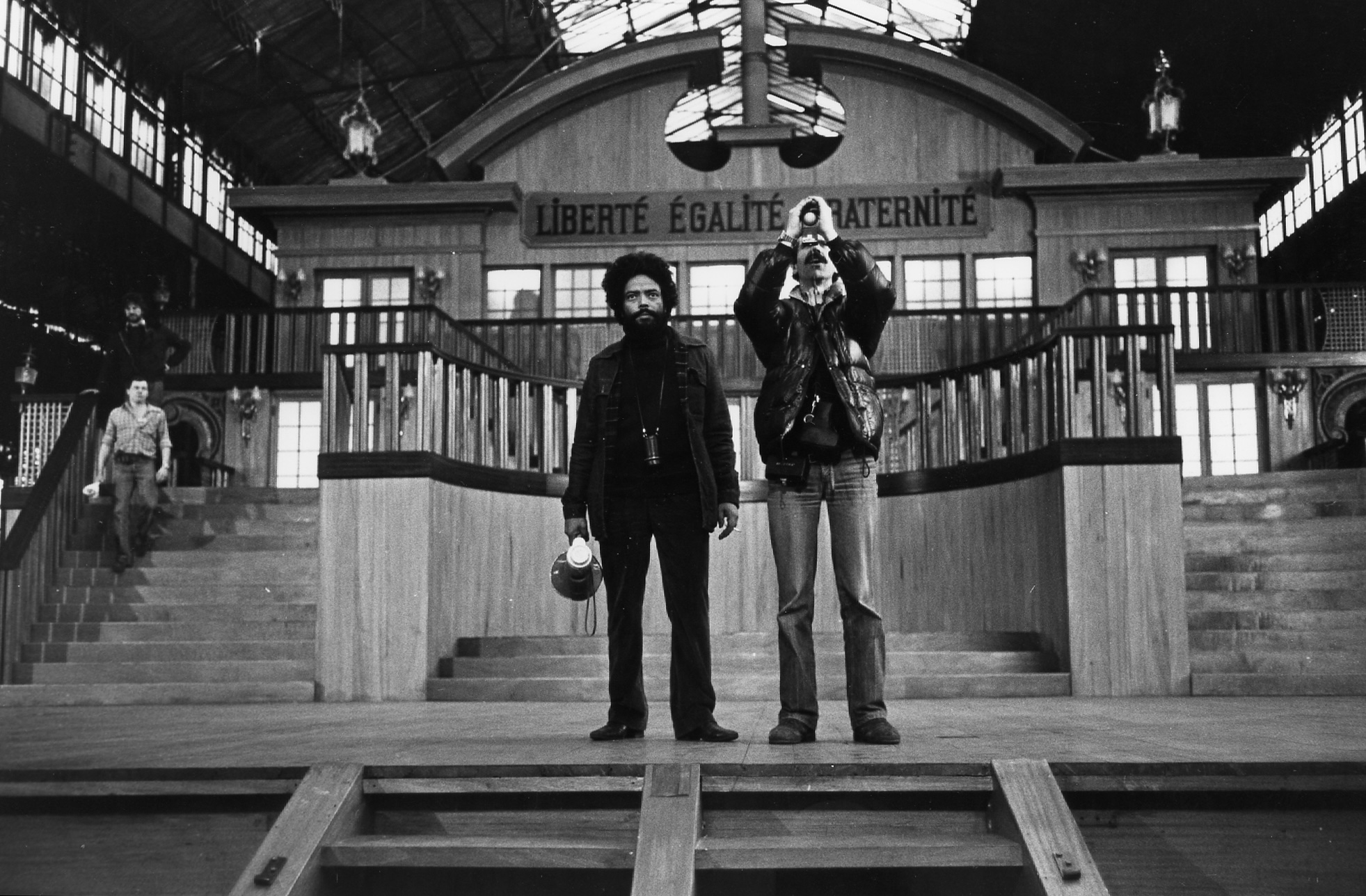
Med Hondo and François Catonné on the set of West Indies, 1979, courtesy of Ciné-Archives,
Share:
This essay appears in Issue 1 of The Metrograph, our award-winning print publication. Explore more of Issue 1 and newer editions here.
AFRICAN FILMS ARE PROTEST WORKS, invariably marked by the sociopolitical contexts from which they emerge. Many of the first generation of African filmmakers joined liberation movements and were inspired by the writings of thinkers such as Frantz Fanon, Kwame Nkrumah, and Amílcar Cabral. In the wake of colonial censorship and the suppression of African authorship, their films of this first wave became an instrument of empowerment of and for the people, a “night school” as the Senegalese auteur Ousmane Sembène—widely regarded as the father of African cinema—would say.
By the time most African countries had gained their independence in the late 1960s, various support structures for the arts had been established, launching landmarks of African cinema that are now celebrated and screened worldwide. Yet the majority of African film productions have been, and continue to be, financed by Western bodies—the World Cinema Fund, for one. As a result, a local scene has never been sufficiently financed, and Africans today rarely have access to pioneering films produced in Africa because distribution rights and materials are often held elsewhere, sequestered by Western companies and archives, even when have been restored and digitized.
To take one example, the Harvard Film Archive instituted the McMillan-Stewart Fellowship in 1997, enabling filmmakers such as Sembène, Rabah Ameur Zaïmeche, Tariq Teguia, Dieudo Hamadi, and Hassen Ferhani to enter the archive’s African film collection, which until then had consisted mainly of propaganda films, colonial films, ethnographic films, educational films, and jungle melodramas made by non-African filmmakers. Through its support the fellowship has also ensured that these African works remain housed in the US.
In much the same way that the concept of restitution functions in relation to stolen artifacts, land, and human remains, the restitution of African film heritage, though much less discussed, is of vital importance in redressing the violence of colonialism. This was the starting point for my ongoing project: Restitute African Film Archives.
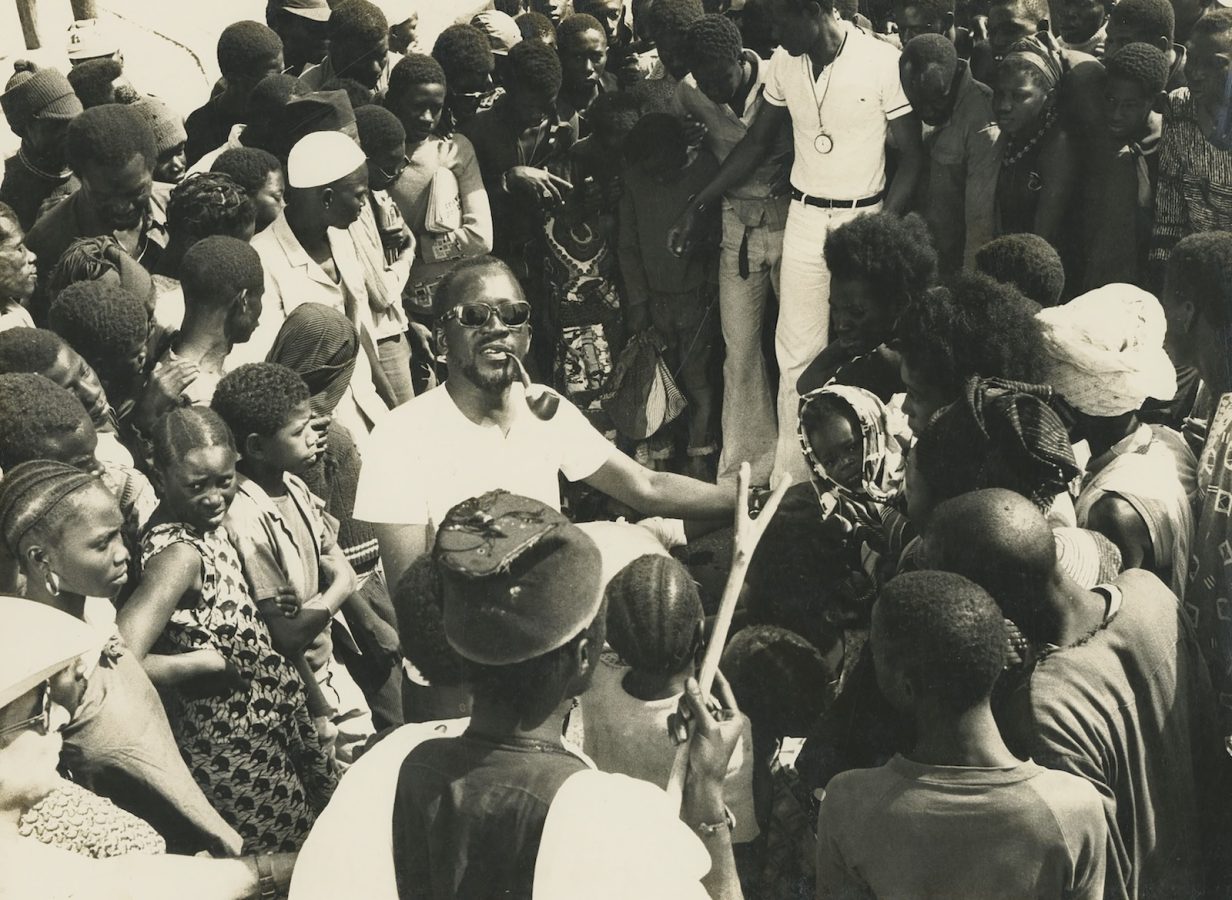
Ousmane Sembène, 1971. Photograph by Michel Renaudeau, courtesy Gamma-Rapho.
*
The French Senegalese filmmaker Mati Diop, niece of Djibril Diop Mambéty, describes the original theft and ongoing displacement of African artifacts as a “colonial trauma.” Her Berlinale Golden Bear-winning Dahomey (2024)—a speculative documentary that charts the return in 2021 of 26 royal treasures looted from the former Kingdom of Abomey (in present-day Benin)—explores her question: “How do we deal with this shared past to rebuild our relationship on a basis of equality?”
Dahomey was inspired by Emmanuel Macron’s pledge in 2017 that all African heritage would be returned from French institutions within five years—an announcement that Diop told Le Monde landed like “a slap in the face,” as it made her realize the monopolization of African heritage by European museums was an issue to which, until then, she had given little thought. Diop’s prior work has, for the most part, been preoccupied with the migration of young Senegalese, a topic to which she has devoted several films: the short Atlantiques (2009), the medium-length A Thousand Suns (2013), and her Palme d’Or-competing debut feature Atlantics (2019). They are “all about migration,” she said, “[yet] there was a huge part of the problem that I hadn’t understood.”
In Dahomey, we watch as a wooden statue of the ancient ruler King Gezo is packed up and shipped back from the Musée du quai Branly, 61 years after Benin gained independence (and 129 years after the treasures, including sacred altars, were first plundered by French invaders). The statues’ thoughts and memories are given voice, literally, in a narration spoken by the Haitian writer Makenzy Orcel. “I wanted to question the meaning of the word ‘restitution,’” said Diop. “I wanted to give this question back to young people.”
*
Though there have been calls made for the repatriation of African film heritage for over six decades now, numerous archives in the US and France—such as the Institut national de l’audiovisuel and the Cinémathèque Afrique—have faced little scrutiny. The continued existence of these archives restricts any process of memorial reconstruction, perpetuating the disruption caused by colonization that estranges African people from their lineage and history. Landmark films, including those made after decolonization, are often contained in such venues—for example, the Med Hondo collection at Harvard and the Ciné-Archives in Paris contain materials belonging to Hondo‘s films West Indies (1979) and Sarraounia (1986), which were digitally restored in 2019 by both institutions.
Some might ask: how is the medium of film, being a technical object with its own specific operations and possibilities, including the fact that it can be reproduced in both analog and digital formats, relevant to the concept of restitution? As scholar Nikolaus Pernezsky writes, “There is good reason to question whether the removal of African films is comparable to the systematic extraction of African bodies and artifacts and their subsequent accumulation in Western museums and ethnological collections.” When we begin to consider the restitution of African film heritage in all its possibilities, we begin to rethink the paradigm of restitution itself.
Pernezsky continues: “The majority of films—prints and files—arrived there ‘legally,’ through the force of co-production contracts, the push and pull of technical and economic dependence, and the muted coercion of global market forces against African filmmakers—all factors that contribute to what we might call the ‘forced internationalism’ of African cinema, or its ‘extraversion,’ which extends across the entire syntax of the moving image, from film production, distribution and consumption to archiving.”
Indeed, the mere fact that an object was legally acquired does not rule out the presence of coercion and subterfuge.

Alain Kassandra’s Colette and Justin (2022)
To understand the complexities of the current situation regarding African film heritage it is necessary to understand that the history of cinema is inextricable from the history of colonization, white supremacy, and imperialism. The Lumière brothers’ first film played in 1895, only 10 years after the Berlin Conference regulated European colonization and trade in Africa, and cinema rapidly became an imperialist tool that extolled the myth of the civilizing mission undertaken by the European empires on the continent. The French and the British progressively set up production units in the colonies; so-called newsreels (in fact propaganda films) were shown in cinemas in Europe as previews. The voices of the colonized peoples were further silenced by the Laval Decree of 1934, which stipulated that anyone wishing to make films in French Africa had to request authorization from the colonial administration.
The interwar period saw the rise of ethnographic films shot in the colonies. Film and sound equipment became lighter, enabling anthropologists to use the camera for fieldwork, paving the way for figures like Americans Robert Gardner and John Marshall, who, from 1950 onwards, made expeditions to locations such as the Kalahari desert. The pair played a crucial role in developing the new academic discipline of visual anthropology, and in the 1957 founding of Harvard’s Film Study Center—which originated in the Peabody Museum, one of the oldest museums of anthropology and ethnography.
As these films were often the only ones authorized during the colonial period, this Western imagery inevitably influenced the first African filmmakers after independence. A generation of filmmakers—including Sembène, Hondo, Mambéty, and Safi Faye—emerged in the 1960s and ’70s, bearing what is now often referred to as the “burden of representation.” Conscious of this task, they sought not only to make films, but also to reverse the colonial gaze that had been cast upon the continent. As Sembène said in 1969, “Let’s not talk about the West. Let’s talk about us… You have to start by getting to know your country, while situating it within the international revolutionary movement as a whole.”
In recent years, this ongoing effort by filmmakers to assert themselves politically is epitomized in works such as those of French Congolese director Alain Kassanda, who set out to collect archival films from the colonial era to help tell the story of his grandparents’ lives under Belgian oppression—the topic of his documentary Colette and Justin (2022). Speaking at the African Cinema Festival in Tarifa, he likened the representation of the Congolese people in these images to that of “ghosts,” adding that “the Congolese perspective was never shown.”
What’s more, for access to the images, which were distributed throughout various Belgian institutions, Kassanda was charged over $27,000: “They recorded us without our consent and now we have to pay for what they stole from us. They took the images in the same way they stole works of art that are now in European museums. The first step towards restitution is access to these archives.”
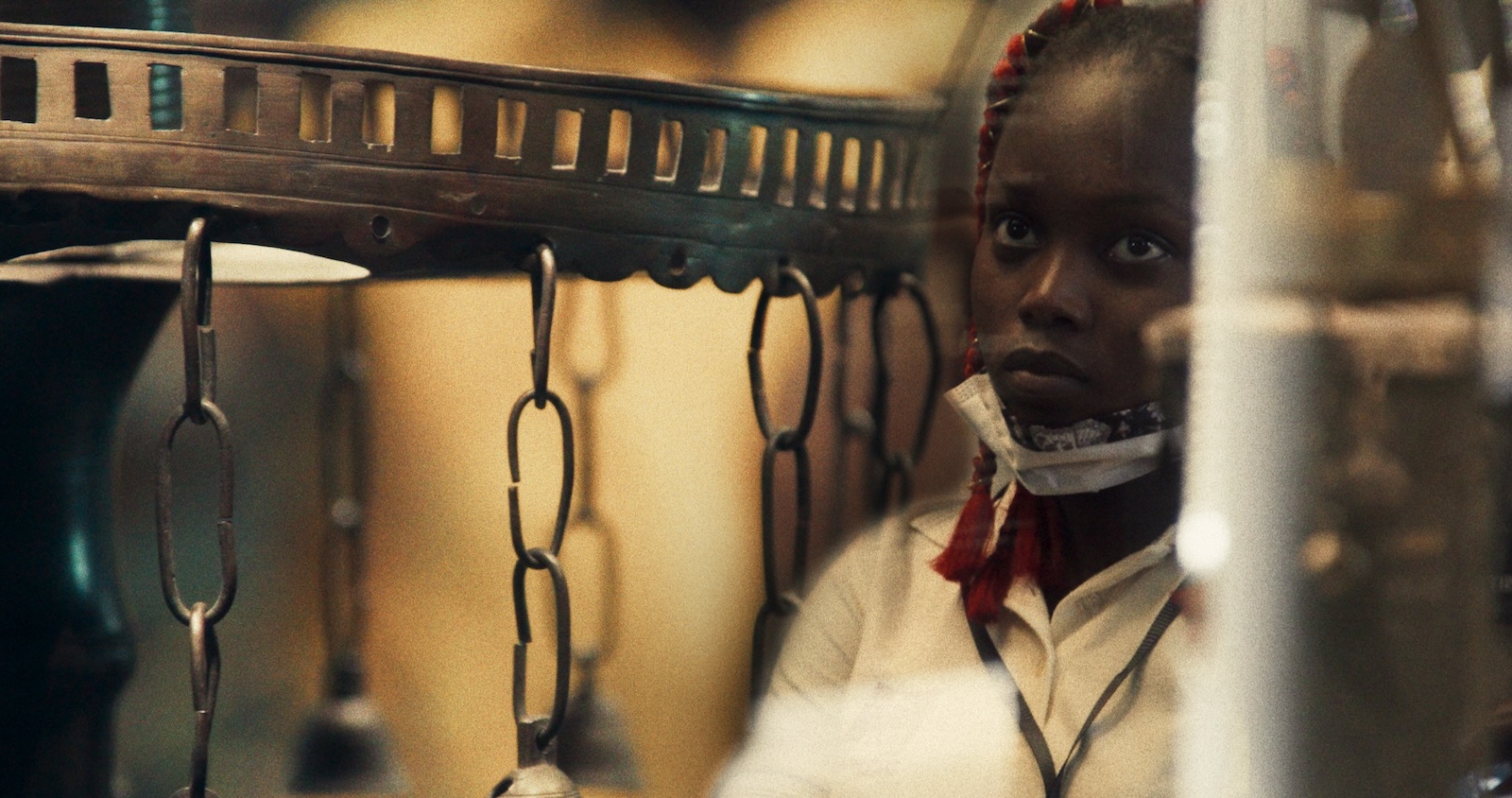
Mati Diop’s Dahomey (2024)
In the absence of developed cinema networks, the screening of African films occurs considerably less often in Africa than outside the continent. Although film festivals created in the aftermath of Independence—notably the Carthage Film Festival in 1966 and the Pan-African Film and Television Festival of Ouagadougou in 1969—have become key players in the dissemination of cinema in Africa, increasing access, there are still far fewer festivals and fewer opportunities for local audiences to enjoy these works than for their Western counterparts.
In response to this situation, in January this year I curated the exhibition Afrotropes at the Théodore Monod African Art Museum in Dakar. Filmmakers, academics, and programmers came together for four ciné-palabres (ciné-talks), and film club was set up to present a program of rare African films—such as Jom or the History of a People (1982) by Aboubacar Samb, The Cemetery of Cinema (2023) by Thierno Souleymane Diallo, Sector IX B (2015) by Mathieu Klebeye Abonnenc, Giving Birth (2015) by Fatou Kandé Senghor, Coconut Head Generation (2023) by Kassanda, and Aequare: The Future that Never Was (2022–23) by Sammy Baloji. Outdoor screenings were organized in the museum gardens and at four partner venues. Each screening was attended by young people from Dakar and its suburbs who rarely get to watch these kinds of films. The same question came up again and again: where can we see more?
It’s a question many have been asking for years now, which in part led me last year to launch Restitute African Film Archives, a project that aims to describe, document, and make accessible the resources related to the decolonization and restitution of African film archives, and to decolonize Western collections in order to reinstate the legitimate owner of the property in their rights of use and enjoyment. As a visiting scholar at Harvard—part of reparations efforts, especially with regards to its cinematic archives, made by the university to address their ties to slavery—I have been engaged in identifying and mapping Africa-related films in their collection with the long-term hope that, one day, these films will be returned.
While restitution has long been an issue fought over by scholars, activists, politicians and bureaucrats, our project has found renewed strength because of its original approach, looking at the issue afresh from the perspective of African film programmers—because programmers are often the first people to be confronted with the logistical difficulties associated with access.
To this end, last year we co-created a programming and think tank committee last year in Senegal with several ciné-clubs such as the Yennenga Center and the Senegal Cinema Club Federation. Earlier this year, in Dakar, we brought together the association of ciné-clubs for a seminar and workshop, and while writing this essay, I’m preparing the next workshop, which aims to identify 10 Senegalese films that we’d like to be restituted.
To be continued…
Share:
Recommended
- Material Memories
 The ongoing effort to bring African film heritage home.
 - Minor Indignities in Moviegoing
 The two friends swap stories about their weird and wonderful experiences at the cinema.
 - Limelight: Ann Hui
 On the long, tenacious career and lyrical films of the cinematic poet laureate of Hong Kong.