
From the Magazine
Movies Come to This Place for Magic
The secret history of Hollywood’s top magical consultancy firm, Deceptive Practices.

Artwork by Toma Vagner
Share:
This interview appears in Issue 1 of The Metrograph, our award-winning print publication. Explore more of Issue 1 and newer editions here.
SINCE CINEMA’S INCEPTION, FILMMAKERS HAVE often turned to professional magicians to help depict the impossible on-screen. Though the films the company has worked on don’t always bear its name in the credits, one of the greatest contributors to the history of movie magic is undoubtedly Deceptive Practices, a consultancy founded in the early ’90s by Ricky Jay and Michael Weber, two magicians and magic scholars of the highest order, with Jay described in a 1993 New Yorker profile as “perhaps the most gifted sleight-of-hand artist alive.”
Over the years, Deceptive Practices has consulted for countless productions, including Forrest Gump (1994), Angels in America (2003), The Prestige (2006), and Ocean’s Thirteen (2007). Details of the company’s work, however, have heretofore been shrouded in mystery. When Jay passed away in 2018, Weber invited his friend and fellow magician Derek DelGaudio—best known for his 2020 special In & Of Itself—to help continue the tradition. After years of operating in the shadows, the people behind Deceptive Practices agreed to share its story, sitting down in the New York home of actor Steve Martin, a onetime close-up magician employed at the Disneyland magic shop and no stranger to the world of illusion, to give us a peek behind the curtain.
STEVE MARTIN: I knew Ricky Jay. And his stage show Ricky Jay & His 52 Assistants, that was my first date with my wife, actually. But it’s always been cloaked in mystery, what you guys do, what Ricky did.
DEREK DELGAUDIO: If you look at Caleb Deschanel’s The Escape Artist (1982), that was Ricky’s first big feature film job. There’s a scene where young Griffin O’Neal is preparing to run away from home. He makes himself a sandwich and prepares a handful of carrot sticks and, as an afterthought, picks up one of the discarded carrot peels and drops it into a glass of water, where it transforms into a live goldfish. It’s magical, without cuts or CGI, and it effectively conveys his independence while giving us a glimpse of his preternatural skill with sleight of hand. This wasn’t in the original screenplay. It was conceived of and choreographed by Ricky.
SM: So does the story of Deceptive Practices begin with Ricky?
MICHAEL WEBER: Actually, it probably dates back to Charlie Miller, the greatest sleight of hand artist of the 20th century. He worked as a magic consultant on films like Highways by Night (1942), The Mad Magician (1954) with Vincent Price, Tarzan’s Savage Fury (1952), and Otto Preminger’s The Man with the Golden Arm (1955). When I first met Charlie, he treated me seriously, even though I was only in my teens. He told Ricky, “There’s a kid you need to see.” The result of that was my lifelong friendship with Ricky and the start of Deceptive Practices.
SM: When you and Ricky started the company, was it just underground information, people knew they could go to you?
MW: It was word of mouth. Ricky and I started working together—we did The Natural (1984), Sneakers and Leap of Faith (both 1992). I also started working with Wes Craven, on The Serpent and the Rainbow (1988). After that, Ricky and I made it official and formed the company before the first feature Vince Gilligan wrote, Wilder Napalm (1993), and I Love Trouble (1994).
SM: I remember Leap of Faith. Wasn’t I in that? Derek, I don’t remember seeing you there. When did you come into the picture?
DD: A few years later. Though I suppose my first unofficial collaboration was The Prestige.
MW: Yes. Ricky and I were working on The Prestige and Neil Burger’s The Illusionist (2006) at the same time, plus we both had active performing careers. A critical point came late in the production when we needed a third hand—and Derek was the one we trusted to step in. I had met Derek about 10 years earlier. It was a lot like the story with me, Charlie, and Ricky. People had been telling me, “There’s this kid in Colorado you need to see.” As soon as I met Derek, I knew he got it. He was unusually comfortable with difficult sleight of hand, well versed in magic history and theory, but he also showed a willingness to learn. He had a deep reverence for the art.

Derek DelGaudio (left), Michael Weber (right), and Steve Martin (center). Photography by Erik Tanner.
SM: Do you remember what you did to earn that place at the table?
DD: No, but I remember when I learned it existed. It was a literal table at a hotel where Michael was sitting with a few older, more experienced magicians. I was allowed to join for a while, but at one point Michael politely explained that they were about to discuss some things in private. I walked away inspired. I felt I’d finally encountered a magician with secrets.
SM: Derek, when you first joined Ricky and Michael to work on The Prestige, did you already know Ricky, too?
DD: A little. I first met him when attending the LA Conference on Magic History, which he co-founded. I had stepped outside for some air. The only other person out there, sitting alone on a park bench with a deck of cards, was Ricky. I introduced myself. He put the cards away, shook my hand, and went back inside.
SM: Perfect.
MW: Ricky was skeptical of Derek at first—but Ricky was initially skeptical of most magicians. Because Derek had done such impressive work on The Prestige, when Ricky needed someone he could trust backstage during the run of his 2009 stage show A Rogue’s Gallery at the Geffen Playhouse, Derek was the only person he asked. In the years that followed, we watched Derek establish an impressive career of his own, and he was getting calls from people like Steven Soderbergh to star in movies. After Ricky passed away in 2018, Ricky’s wife, Chrisann, and I both agreed that the right way for Deceptive Practices to continue was to ask Derek to make it official. He did, and the tradition continues.
SM: Well, it says here, “Deceptive Practices is a creative firm known for designing illusions, magical problem-solving, and providing vast expertise on subjects including but not limited to sleight of hand, mind reading, spiritualism, swindling, confidence games, crooked gambling, and pickpocketing. Their motto: Arcane Knowledge on a Need To Know Basis.” I think I understand the consulting aspect. Like when someone has a movie about Houdini, you guys make sure the actor’s using the right handcuffs, that sort of thing?
MW: There was a time when we worked on seven different successive Houdini projects.
SM: With something like that, do they come to you and say, “We have this script. Can you help?”
MW: Basically, yes. We read the script and come up with a dozen ideas; they love eight of them but can afford to build only six; they shoot five, and you’re lucky if three end up in the movie.
SM: When you say “build,” are you referring to illusions? How does one go about designing an illusion?
DD: It depends on the story and how it’s being told. Sometimes we’re asked to design illusions that are presented and seen as illusions. Other times we use illusionary techniques to simulate something real, to create an illusion of reality.
MW: For example, in The Illusionist, Edward Norton’s character needed to perform an illusion during his show in response to a challenge from Rufus Sewell’s menacing prince. The story required something that addressed the power dynamic between the characters and gave the magician access to the prince’s sword. We ended up creating a moment where Ed’s character borrows the prince’s sword, which he inexplicably balances so that it stands upright on its own tip. Ed then invites the prince, who is mildly amused by the trick, to take his sword back. When the prince tries to lift the sword, it won’t budge until Ed allows it.
SM: Like in The Sword in the Stone.
MW: Exactly. That’s an illusion that’s seen as an illusion. On the other hand, we created the illusion of reality in Wolf (1994), where we had to figure out how to get Jack Nicholson to catch a Frisbee between his teeth like a dog. Obviously, one could have thrown Frisbees at Jack Nicholson’s face all day until he caught one. But the right choice was to devise a secret method to make it happen safely every take.
DD: In that sense, sometimes our job is to overcome chance and design ways for incidental things to happen 100% of the time, like rolling a pair of dice and having them come up snake eyes the very first time.
MW: Wilder Napalm has a scene where a Post-it note starts stuck to the heel of a character’s shoe. The camera follows at ground level as the note comes loose, flutters along the ground, and stops at a specific spot, where the wind blows the note open enough for the audience to read it, then it flies out of frame. Now that’s something that could happen in everyday life, but getting it on camera efficiently is another story. We devised a method that guaranteed that sequence of actions would happen exactly that way in a single shot.
SM: Would the wheelchair in Forrest Gump fall under this category?
MW: Yes. Robert Zemeckis asked us to help design a special wheelchair to create the convincing illusion that Gary Sinise’s character, Lieutenant Dan, was legless. He wanted a practical method that would blend with the digital version.

Artwork by Toma Vagner
SM: These days, a lot of these effects could be faked digitally. Where does Deceptive Practices fall between magical effects and special effects?
DD: Most of the effects we create are meant to be shot by the camera. But we also understand the value of combining methods. Lieutenant Dan’s chair is a great example because it was practical, but the scenes where he’s out of the chair were rendered digitally, by Industrial Light & Magic. It’s seamless. Go back and watch that scene where Lieutenant Dan hoists himself out of the chair and over the ledge of the boat—it’s astonishing, even today.
MW: We should point out that when you ask about special effects, magicians invented them. Georges Méliès was a stage illusionist who wanted to create a new type of magic. He saw the Lumière brothers’ films and thought, “I can use this,” and started creating magic shows on film.
DD: And it’s ironic that Méliès put himself out of a job by elevating cinema to magic. Until then, magic was one of the most popular, or at least one of the most prestigious, forms of stage entertainment that you could see.
SM: Are you allowed to reveal what “Arcane Knowledge on a Need To Know Basis” means?
MW: S. J. Perelman wrote a thing in The New Yorker that I remember tickled Ricky and sums it up perfectly: “Do you happen to know how many tassels a Restoration coxcomb wore at the knee? Or the kind of chafing dish a bunch of Skidmore girls would have used in a dormitory revel in 1911? Or the exact method of quarrying peat out of a bog at the time of the Irish Corn Laws? In fact, do you know anything at all that nobody else knows or, for that matter, gives a damn about? If you do, then sit tight, because one of these days you’re going to Hollywood as a technical supervisor on a million-dollar movie.”
DD: I suppose that’s what we try to do. Except people ask us how to make a person vanish while climbing a ladder. Or how to get a gorilla to drink a martini.
SM: And why on a need-to-know basis?
DD: Knowledge dilutes wonder.
SM: I assume you won’t elaborate on that.
MW: [Laughs] We believe that as magicians, we don’t keep secrets from our audiences, we keep secrets for our audiences. We’re not trying to be gatekeepers or the magic police. If a member of the creative team needs to understand something in service of the story, that’s “need to know.” When a simple but powerful secret makes someone’s job easier or the outcome better, people tend to value it as a tool rather than viewing it as a novelty.
DD: There’s this dictum, “Magicians guard an empty safe.” It’s about the disappointment laymen experience when they discover a secret is something simple or banal, like a mirror. Magicians often use that quote to support their stance that secrets don’t really matter, that it’s what you do with them that matters. I grew up surrounded by this mentality, but it only ever felt half-true. Then I met Michael. I didn’t know what he was guarding, but I knew it mattered that he was guarding it.
SM: I remember, at 14, taking the magicians’ oath. It was more potent to me than church.
MW: Yes!
SM: It was the one thing I believed in. I took up vows.
DD: Because what you’re actually vowing to do is preserve and propagate mystery.
SM: What happened to “a magician never reveals the secret”? What’s changed?
MW: For me, nothing. But I also know that when information became widely accessible, hobbyists took over. Magic became seen primarily as content, or a product to sell. For many, there’s no such thing as exposure anymore, they just label it “sharing.” There’s a difference between things that are given to us and things that we earn. Practicing magic has to begin with a sincere interest, backed up by a willingness to invest a part of yourself, your time, your effort into something before you expect to receive anything in return.
SM: So you guys work on films and theater shows. What else?
MW: TV shows and occasionally projects with R&D companies. Applied Minds. Disney Imagineering. One particular bank bag manufacturer.
DD: Places that require us to sign lengthy NDAs.
SM: The government?
MW: We try to avoid that. One of our guiding principles is to never be interesting to the government.
SM: Okay, I want to go back to the gorilla for a moment. You made a gorilla drink a martini?
MW: That call came from Frank Marshall and Kathleen Kennedy for the movie Congo (1995). Stan Winston and his team had made a gorilla suit that was designed so a person could fit into it, but the head was a state-of-the-art animatronic controlled remotely by several puppeteers. This thing was amazing… but there was a scene that required the gorilla to drink an entire martini from a stemmed glass, in one shot. They realized that the wires and servos inside that one-of-a-kind gorilla head were not liquid-friendly. And because of the construction of the suit, the actress inside couldn’t see or feel the glass or the liquid inside it.
SM: May I ask about your solution?
MW: Yes, but don’t tell anyone. In the ancient Greek book The Pneumatics of Hero of Alexandria, there’s an object described as the Vase of Tantalus, a cup designed so that you can fill it and drink from it normally, but if you get greedy and overfill it, the cup empties its contents into your lap.
SM: History’s first dribble glass?
MW: Probably. The book describes a tiny self-priming siphon built into the cup. We took that principle, made it all out of glass with the same index of refraction as the liquid, and built a self-contained martini glass that completely drained its own contents—all triggered by the natural action of tilting the glass to drink.
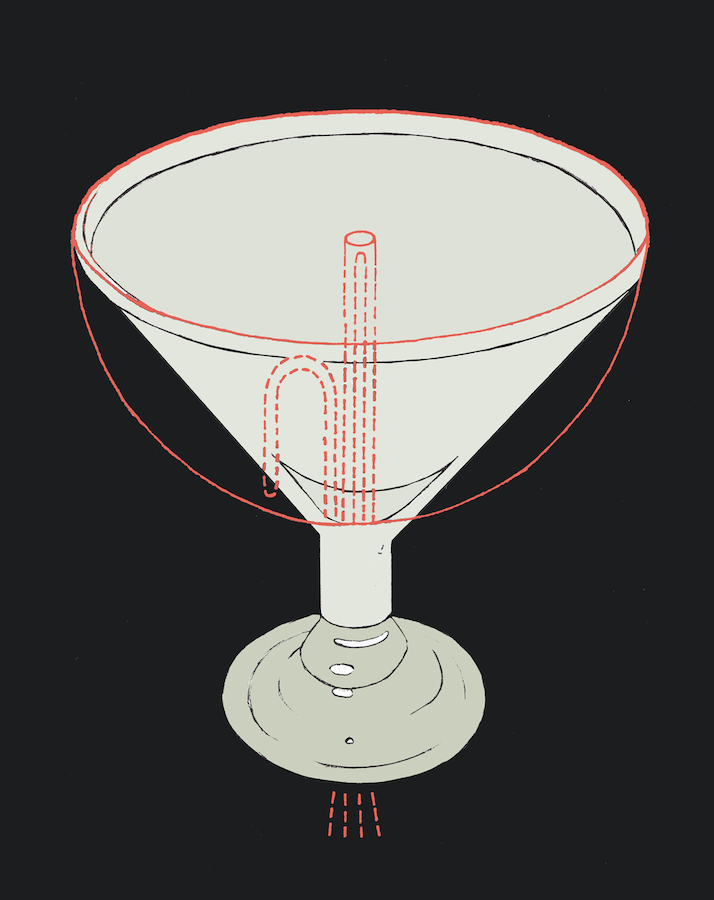
Artwork by Toma Vagner
SM: You guys must have bookshelves of antiquarian books full of weird stuff. Is that where you get all this?
MW: Yes. Plus experimentation, invention, and many things not in any books or on the internet. But mostly it comes down to problem-solving.
DD: For the gorilla, the question everyone was asking was, “How do we make it look like the gorilla is drinking?” Our solution came from changing the question; we asked ourselves, “How can we get a martini to drink itself?”
SM: What’s the thing you’re asked to consult on most?
DD: Making a coin appear from behind someone’s ear.
SM: You mean… like this? [Steve produces a quarter from behind Derek’s ear.]
MW: You’re hired.
DD: When we see that in a script, in many cases what they really mean is “something magical happens here.” We try to help find the answer that avoids the trope. If they insist on a coin trick, we do our best to tailor it to serve the narrative.
MW: We always design the magic to fit the character, the story, and the moment. In The Prestige, Christian Bale produces a symbolically two-headed coin while face-to-face with a child. It’s an intimate scene, so the magic needs to feel intimate. In The Illusionist, the moment is more playful and performative, so we choreographed a small routine where Ed Norton’s flourished production matches the energy of the scene, with the number of coins increasing as the crowd of kids grows. In The Natural, when Redford does a coin production, it’s like a mic drop. Redford’s single action of reaching out with one hand to produce two silver dollars from behind Kim Basinger’s hair wins a bet, impresses Kim, and is a rejection of Darren McGavin’s suggestion that he would throw a game, all at once. Plus, we didn’t want Redford to have to think about anything other than elegantly crushing his opponent’s ego, so we used a surefire method that allowed him to execute the magic with absolute confidence.
SM: What do you do when the story calls for exposure? For example, in The Prestige, the secret behind the vanishing birdcage trick is revealed. How do you navigate that?
DD: We create false methods.
SM: Seriously?
DD: Of course. That’s the job.
MW: The Prestige is a movie about sacrifice, so the methods needed to reflect that. The secret to the vanishing birdcage has to feel menacing the first time you see it because later, when it’s part of an onstage accident, it has to be dark and dramatic. The deadly-looking spring-loaded device mounted on Hugh Jackman’s back was inspired by an old lazy-tong holdout we have, the kind crooked gamblers used to secretly move cards up and down their sleeves.
SM: What’s the hardest part of your job?
DD: I’m not sure “hard” is right, but it can be challenging when people come to us late in the process. They write a script that involves magic or con artists, they cast it and go through preproduction, and it’s not until they’re on set shooting that they realize, “Oh, we should probably get someone to help with this…” At that stage, people have often written themselves into a corner.
MW: Sometimes the simplest things make all the difference. I remember when we got the script for I Love Trouble—we were needed for one scene at the end of the movie, when Julia Roberts’s character uses sleight of hand to make a ring vanish. But in the original script, the only thing that previously suggested she was capable of such a thing was a Houdini poster on the wall behind her desk. We discussed it with Nancy Meyers and Charles Shyer, the writer and the director, and worked with them to find places earlier in the story where Julia’s character could do something that fit the moment and established that she had chops.
SM: That just sounds like good storytelling.
MW: Everything worked because we were brought in early enough in the process to come up with new things that blended in, without having to change a scene.
DD: The challenge with a lot of the magic you see in movies is that it’s either something a writer has seen before or it’s something they just dreamed up. The former leads to seeing the same things time and again. The latter leads to effects that usually can’t be achieved practically, so they end up relying heavily on CGI. Both can be avoided, but that requires thinking about it early.

Artwork by Toma Vagner
SM: I can see how people might underestimate how long it can all take, and how magic and a story can work—or sometimes not work—together.
MW: There is a fundamental difference between drama and magic. Drama aims to keep the audience wondering, “What happens next?” But an audience’s reaction to magic is the opposite, it’s reflective. They see something magical and ask, “Wait, what just happened?” And in a contest between what just happened and what happens next, the drama has to win. Our job is to design the magic so that it always helps drive the story forward.
SM: Is there a specific project that turned out to be much harder than you anticipated?
MW: There was a Disney movie where we were asked to design pranks for kids to play on one another at camp. But the legal department had to approve every part in advance. They didn’t want kids who watched the movie to get hurt trying to imitate what they saw, which we understood. Since we had no idea what kinds of things legal would okay, we had to come up with more pranks than they could ever use. And every one of those pranks had to fit the tone of the story, the characters, and look great on film.
SM: Do you remember any of the ones they rejected?
MW: Only, “Whipped cream, yes. Shaving cream, no.”
SM: What’s the biggest lesson you’ve learned from working on movies?
MW: It’s a constant reminder that the most powerful magic is functional, driven not by the suggestion of the performer but by the wants and needs of others. The best magic is not an action, it is a reaction.
SM: An audience’s reaction to wanting to see magic?
MW: No. The magical fulfillment of something they actually want. A classic example: if I ask, “Would you like a ham sandwich?” and you say, “Yes,” it doesn’t matter how magically I produce it, the appearance of that sandwich can’t be a miracle. At best, it’s a neat trick. But if we’re hanging out and you say, “I could really go for a ham sandwich right now,” and I say, “Reach into your coat pocket,” and you find a neatly wrapped sandwich…
SM: Miracle.
MW: Right. That’s what drives good magic, but it’s also what drives a good story.
SM: One last question: what is your ideal project?
DD: Only Murders in The Building. [Laughs]
SM: Perfect answer.
Share:
Recommended
- Material Memories
 The ongoing effort to bring African film heritage home.
 - Minor Indignities in Moviegoing
 The two friends swap stories about their weird and wonderful experiences at the cinema.
 - Limelight: Ann Hui
 On the long, tenacious career and lyrical films of the cinematic poet laureate of Hong Kong.