
Interview
Iva Janžurová
The Czech star on her surrealist collaborations with New Wave filmmaker Juraj Herz.
The Gothic Visions of Juraj Herz opens at Metrograph on Saturday, October 25.
Share:
Morgiana (1972)
IN 1971, JURAJ HERZ’S LAVISH and melancholy drama Oil Lamps screened in the Cannes Film Festival, and while it was destined to be the last Czechoslovak film to compete at the Croisette, it also marked the second of the celebrated filmmaker’s three memorable collaborations with actress Iva Janžurová, who is today known as one of Czechia’s best known and celebrated actors. With a decade’s worth of roles under her belt already by the time she appeared in Oil Lamps, she was no discovery, but her elegant, committed portrayal of 30-year-old Štěpa, a woman way too independent for the stifling 1900s of the film’s setting, allowed her and Herz to explore women’s psychology in depth: erratic, libidinous, unbound.
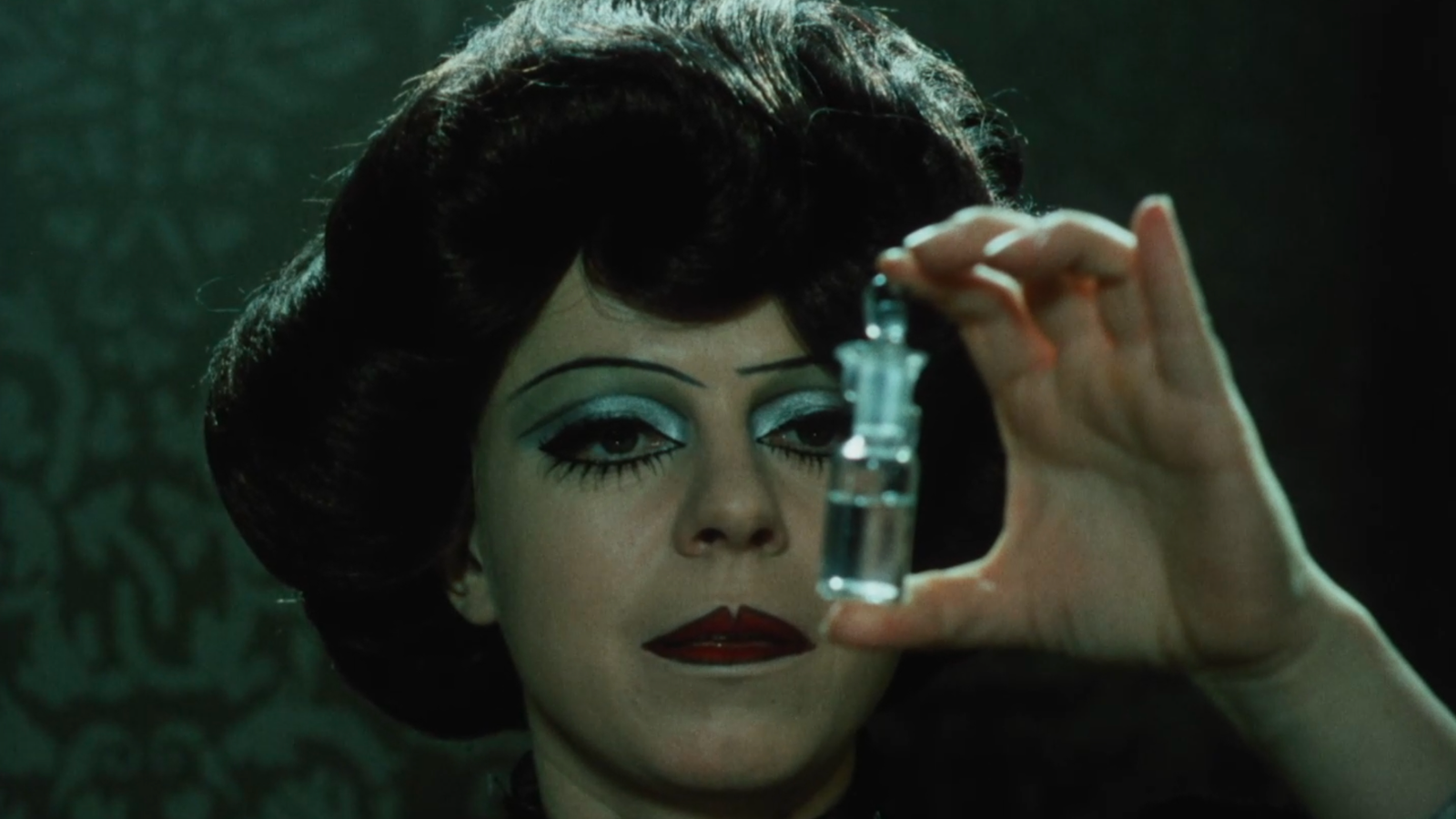
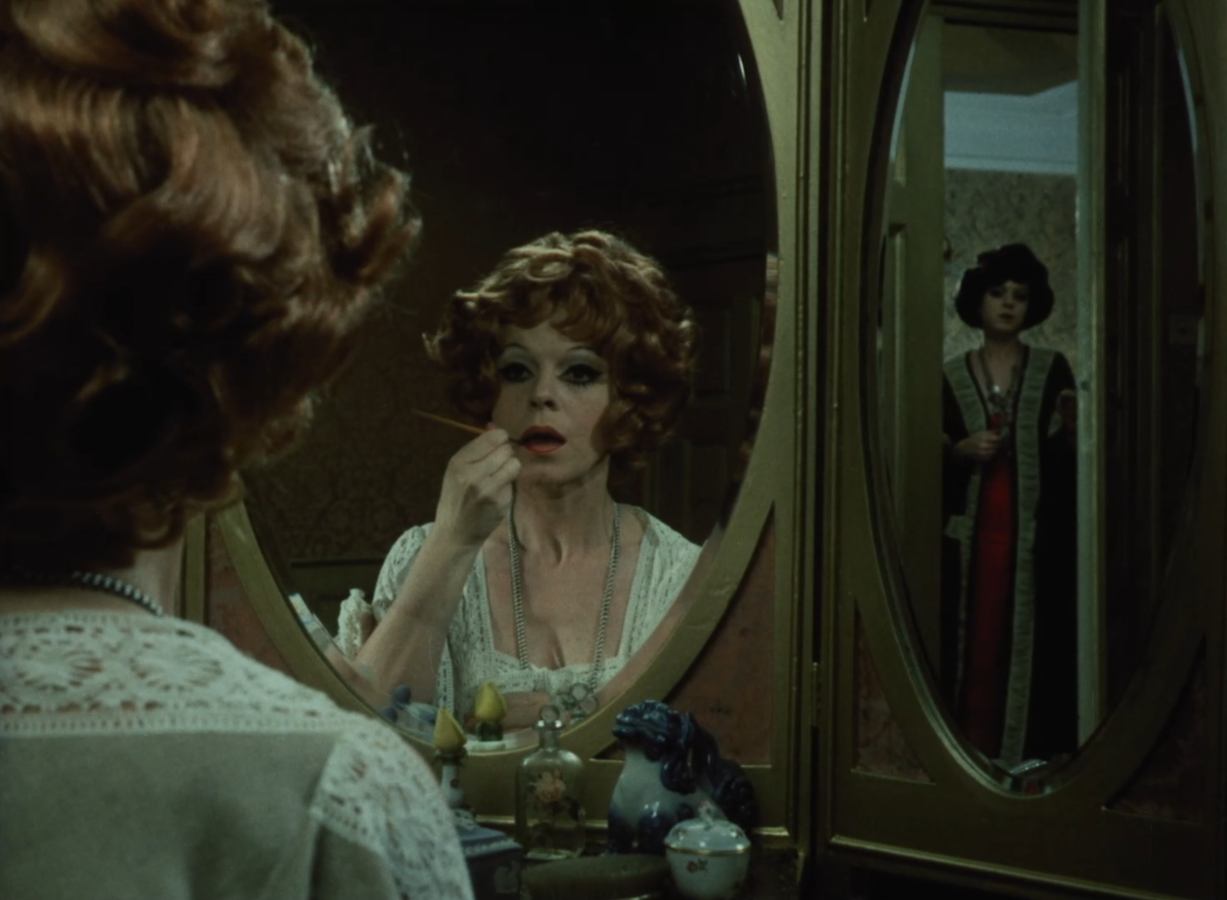
Only a year later, Janžurová starred in a double lead role in Herz’s gothic melodrama Morgiana (1972), chronicling a feud between twin sisters. The actress embodies both the virtuous, ethereal Klára and the scheming, witchy Viktoria. Morgiana is a baroque work of art, expressionistic and experimental in its lurking camerawork, often resorting to the point of view of Viktoria’s eponymous cat. The original script concerned a schizophrenic state, but this was deemed a “bourgeois illness,” so the censors forced Herz to change the story to a more literal split. This break meant Janžurová could craft two starkly different heroines and playfully switch between registers; indeed, the morbid and the humorous so often go hand-in-hand in Herz’s films.
After starting to make films in the mid-’60s, Herz’s mesmerizing and macabre vision is encapsulated by his best known title, The Cremator (1969). In all his films, though, the Czechoslovak New Wave director digs into human relationships—be it family, romance, or labor—to excavate odd and revealing truths about the nature of power and authority. His collaborations with Janžurová stand out with a specific rhythm: vivid expressionism punctures a composed performance as a way of legitimizing emotional defiance. The actress brings a degree of levity to the troubled women she plays that radiates from the screen.
Whether producing period dramas, horror, or fairy tale narratives, Herz anchors his political concerns in the individual whose freedom is at stake—often most enchantingly with Janžurová in the lead. On the occasion of her forthcoming visit to Metrograph, I exchanged questions over email with the multivalent actress about working with Herz as an actor and filmmaker, how she shaped the performances that helped define her screen legacy, and her connection with the close-knit network of artists that brought these fantastical Czechoslovak New Wave works to life. —Savina Petkova
Morgiana (1972)
SAVINA PETKOVA: How did you first meet Juraj Herz?
IVA JANŽUROVÁ: I was just starting out in my acting career. Despite predictions from my professors and classmates at acting school that film roles would probably pass me by, small offers started coming in. I think Juraj’s film Sign of Cancer (1967) was one of his first opportunities as a director. He invited me to audition for a small role as a patient who ultimately turns out to be a murderer. They also invited Dr. Plzák, a respected psychiatrist, to advise me on my performance, and when it came time, Dr. Plzák said that my performance was spot on, and that was that.
SP: Before Morgiana, you worked with Herz in his previous film, Oil Lamps. Your character Štěpa is as tender as she is rebellious. How did that first collaboration pave the way for your double role in Morgiana?
IJ: We had already gotten to know each other well, and the dangerous inhibitions and fears of not expressing our ideas had fallen away. Juraj’s talents included acting, and we worked together, for example, on How About Some Spinach? (1977), where he excelled with his slightly grotesque, Chaplin-esque performance. Even before the final edits to Oil Lamps were completed, he kindly revealed to me that he was planning a new film about two sisters and would like to offer me one of the roles, which I could choose. During the post-synchronization in Oil Lamps, I managed to visit the hairdresser and asked this renowned hairdresser to dye my hair, which had been bleached blonde for the previous film, The Unfortunate Bridegroom (1967), from red, which had been my color since childhood. It turned out so well that I left the best hair salon in Prague as a brunette. The next day, Juraj saw me during the post-synchronization and when we were leaving the Barandov studio, he said, “I already know which sister you’ll play!” I exclaimed, “No, I haven’t decided yet!” And Juraj said, “You’ll play both!” So the preparation consisted mainly of enthusiasm for such a wonderful opportunity!
SP: Herz was pushed to rewrite the script for Morgiana to remove any reference to schizophrenia, but the film still has a strong psychological, even psychosexual drive. A lot of that power has to do with your masterful performances. What conversations did you have about your double roles as the sisters Klára and Viktoria to shape each one differently, yet to maintain an invisible, spiritual link between the two?
IJ: In a nutshell, everything was guaranteed by excellent professionals. In every department: cameraman Jaroslav Kučera, costume designer Irena Greifová, Juraj of course, and my wonderful colleagues, makeup artists, prop masters… even the Bulgarian sea seemed to be trying to help, and in addition to all the joys of hard work and the unifying fate of the citizens of occupied Czechoslovakia—it was good! Thank you for praising my performance in your question, but that invisible spiritual bond was already enchanted in Juraj’s idea and decision about my double role.
SP: I’ve read that Herz himself wasn’t too fond of Morgiana because of the tampered script, but the film is so striking that it seems implausible he didn’t put all of his heart in it. What were, if there were any, the restrictions or interference on behalf of Barrandov Studios on your work as an actor at the time?
IJ: A lot was happening in Barrandov, and I may not be the most reliable witness, but in the cultural sphere, there was a period of severe psychological oppression for many valuable authorities in the years leading up to 1968. After Morgiana, I also shot Papoušek’s film Homolka and Pocketbook (1972), and there was no political approval for my casting in the next three scripts I already had at home. That’s another story. Then productions were banned from sending scripts without the approval of the chief dramaturge at the Central Committee of the Communist Party. But here’s a gem related to Morgiana. I took the liberty of asking for two roles to be financially evaluated in my contract. They put a knife to Juraj’s throat, saying that if I insisted, the film would not be made. So I didn’t insist.

Morgiana (1972)
SP: Your characters in Morgiana undergo complete transformations thanks to Herz’s collaborator, makeup artist Ladislav Bacílek. What was it like inhabiting those roles, as shaped as they are by the expressive, gothic style of hair, makeup, and costumes?
IJ: The makeup was very demanding and even more so given the time allocated for filming. There were many days of filming when I had to change clothes and completely transform from one sister to another and back again. Each sister’s makeup was completely different and took up to an hour and a half, but according to the work schedules, it was necessary to always use the location where the two nurses met or alternated so that the entire day’s program could be filmed without extensive moving around. Double exposure—a dialogue between the two in one shot—was technically very difficult on film. It’s also difficult for me to describe now. But for me, it was part of the joy of such complexity.
SP: How would you describe working on the sets and in the worlds constructed by production designer Zbyněk Hloch, who worked on both Oil Lamps and Morgiana? What kind of effect did this elaborate baroque world have on your performances?
IJ: Zbyněk Hloch was also my friend. Actors don’t see film architects very often; they do most of their work before filming begins. Only now, when my son-in-law Adam Pitra is doing the same job, do I see up close what it entails: that is, I see him, but I hardly ever see him. He leaves the house at five in the morning; he has to be the first on set, arrange the furniture, bring in paintings, vases, rugs, and pillows by car, rent a number of rare items from private individuals, guarantee that they will not be damaged, etc. Zbyněk also taught new recruits like this. Every year we would meet at a festival in southern Bohemia at the home of our mutual friend Prof. Marie Pešková and discuss all the latest events, including those in the world of film.
Once he asked me if I knew which of my two daughters would be more successful. At that time, Sabina [Remundová] had written two nice television plays for me, but she was preoccupied with caring for her two children and did not care about or pursue an acting career. Zbyněk jokingly predicted that it would be Theodora, because she knew what she wanted; he knew her from FAMU (Film and TV School of the Academy of Performing Arts in Prague). Today, Sabina has achieved truly valuable popularity in television and theater, and Thea, among other things I admire, has made the documentary Actress (Janžurka, 2024). So, Zbyněk, how did you guess? I don’t know, and neither do you anymore. Everyone is leaving me!
SP: Psychological horror, masked as a fairy tale, characterizes a lot of Herz’s cinema and especially the selection of restored films showing at Metrograph. In your opinion, as an actress in two of his internationally quite successful films, what is it about his films that resonated so powerfully with audiences?
IJ: I would like to leave this answer to film scholars and reviewers—the good ones—and certainly to viewers as well. Different impressions may resonate within each of us. Juraj had his temptations and inclinations to present his urgent intention in many ways. I am happy that I was able to be a part of this; it was an artist’s effort to express himself, to choose his models so that he could speak to the audience. And he did so with his originality, which he considered important for his thinking as a citizen and creator. And his films could not be without subtexts that will speak to us over time, painfully and pertinently, as is the case with the works of significant creators of every era.
SP: Your prolific career includes a lot of comedic roles, while your appearances in the films by Herz are mostly dramatic, although humor is never entirely absent. If you were to look at your roles in his films on a spectrum between restraint and excess, what would it reveal about your performances and practice? (I’m especially interested in degrees of restraint and excess in relation to femininity and the image of the “mad woman.”)
IJ: If only roles had mouths and could speak for me! They are living beings, and when a good director allows me to, I want to confirm and prove that they are alive. Through some supernatural miracle, I immerse myself in their souls and simply repeat their words. It’s simple, easy. All it takes is to listen carefully and understand their humanity, which is both sad and joyful, depending on how humbly we want to understand them. I won’t reveal any more than that.
Share:
Recommended
-
Susan Seidelman
 An intimate conversation with the trailblazing American filmmaker.
 -
Carol Kane
 Fifty years in 50 minutes with the irrepressible screen icon.
 -
Mark Lee Ping-bing
 The legendary cinematographer reveals his three core beliefs.
- The Maiku Hama Trilogy
 On the retro riffs and magnetic lead of Kaizo Hayashi’s newly restored cult trilogy.
 - Juliette Binoche
 On the eloquent hunger of the iconic French actress.
 - I’m Not Everything I Want to Be
 On Libuše Jarcovjáková, the queer photographer drawn to the social fringes of Soviet Prague.