

Essay
[wpbb post:title]
By Luke Goodsell
On Gregg Araki’s ’90s death wish, The Living End.
The Living End screens at Metrograph as part of the Pioneers of Queer Cinema series through Thursday, July 7.
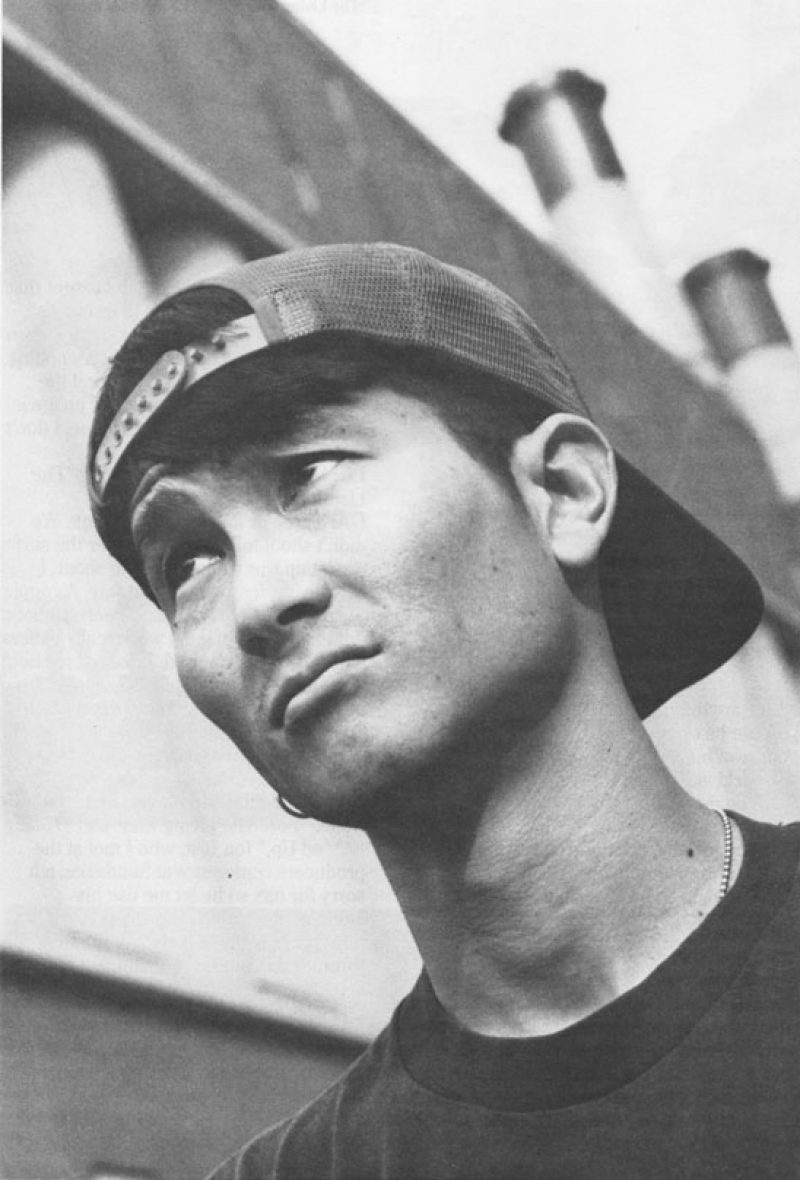 Gregg Araki
In multiplexes all across America in the spring of 1992, suburban kids partied on with the goofball adventures of Wayne Campbell and Garth Elgar, two enterprising knuckleheads riding a wave of straight culture’s accumulated debris-classic rock, hairspray babes, SNL-into the era of Rock the Vote and blithe Clinton optimism. But over in the darklands, beyond the fringes of Wayne’s World‘s schwinging satire, another pair of Gen-X wastoids in a pale blue ’80s compact were going nowhere fast. Goosed by a soundtrack of industrial music, the gay lovers on the lam in Gregg Araki’s The Living End steered head on toward the fallout from the Reagan decade-their “CHOOSE DEATH” bumper sticker, a bratty inversion of the ’80s pop slogan, the movie’s bluntly subversive raison d’être.
Written and shot in 1990, and released two years later, Araki’s pomo-erotic picaresque detonated like a time bomb, set ticking in a moment when ACT UP was exposing the Reagan-Bush administration’s indifferent response to the AIDS crisis that was decimating the gay community. In the confrontational spirit of those activists, Araki’s third feature takes the well-intended but patronizing AIDS weepies of the time and throws them into a seething vat of blood, sweat, and semen: rather than politely expire for the reassurance of the straights, his hunky, HIV-positive lovers embark on an accidental crime spree up and down the West Coast, damned yet liberated by the realization that they’ve nothing left to live for but the thrill of the moment.
The Living End opens on hustler Luke (Mike Dytri), rough trade pitched somewhere between Joe Dallesandro, Beverly Hills, 90210 villain, and a backup dancer in a Herb Ritts video: all torn blue denim, black biker jacket, and permanently dangled (but never lit) cigarette. Looming against the Los Angeles skyline like some beefcake wanderer above the sea of smog, he’s fond of decorating the city streets with spray-painted aphorisms like “fuck the world” and “I blame society.” Unusually hot freelance film critic Jon (Craig Gilmore), meanwhile, is about to have his nerdy, anxiety-wracked life upended: first by the revelation that he’s HIV positive, and then by the arrival of Luke, a fellow member of the infected whom he picks up fleeing from an altercation with some violent homophobes. Conjoined, their names pay homage to Jean-Luc Godard, whose apocryphal meme gets flipped by Araki-here, all you need to make a movie is two guys and a gun. The ensuing montage à trois draws a queer line through every us-against-the-world road movie, from They Live By Night (1948) and Bonnie and Clyde (1967) to Badlands (1973), but it was Howard Hawks’s Bringing Up Baby (1938)–in which Cary Grant’s mild-mannered Poindexter has his world spun dizzy by a Katharine Hepburn-shaped tornado-that provided Araki with the blueprint.
“Do you want me to take you someplace?” Jon asks Luke, as they tear off into the night. “Yeah, off this insane fucking planet,” comes the reply, which doubles as an invitation to Araki’s parallel universe of chaos. When he’s not killing cops or beating SoCal bigots to death with a boombox, Luke is leading Jon on a fugitive zigzag through shitty motels, fast food joints, and liquor stores, the shadow of their numbered days hanging over every frame like so many tacky, leering billboards. “By no means should you consider this a death sentence,” says Jon’s bad-news-delivering doctor, played in a droll, cartoon-villain voice by the late London Lesbian & Gay Film Festival founder Mark Finch. But treatment for AIDS was only in its early stages, and public understanding of the illness wasn’t exactly enlightened in 1990. (Magic Johnson’s announcement that he was HIV positive, a watershed moment, at least for wider hetero compassion, wouldn’t happen until November 1991.)
“Do you want me to take you someplace?” Jon asks Luke, as they tear off into the night. “Yeah, off this insane fucking planet,” comes the reply, which doubles as an invitation to Araki’s parallel universe of chaos.
“Those years were like living in a war zone,” Araki told Dazed in 2011. “Young people today have no idea what it was like to be 25 and think, ‘I’m going to die.'” Considering himself collateral to the sexual revolution, Luke at one point suggests they pay a reparative visit to Bush Snr.: “We could hold him at gunpoint, inject him with a syringe full of our blood,” he tells Jon. “How much do you want to bet they’d have a magic cure by tomorrow?” (In 1991, ACT UP protestors would throw cremated ashes, in one of their many radical stunts, onto the White House lawn.)
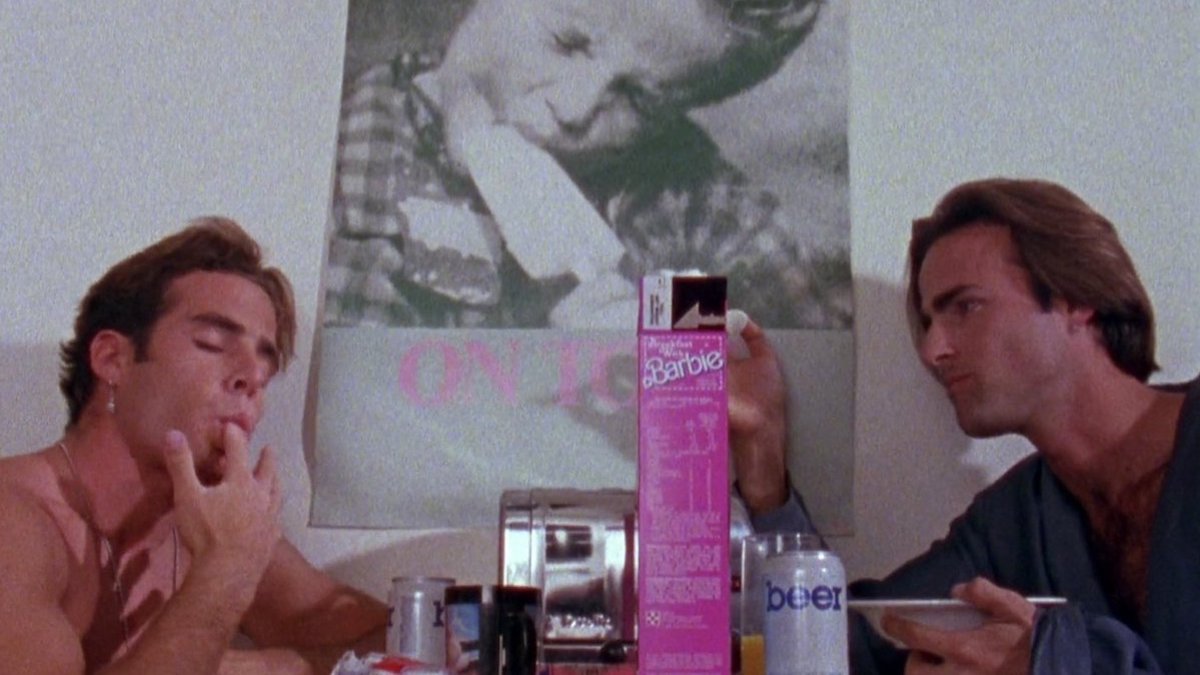
A film school brat who cheerfully admitted to being a “pretentious fuckhead,” Araki liberally mingles punk rock, camp, and the nouvelle vague with plenty of juvenile humor. The movie takes its paradoxical, limp-wristed title from the second track on the Jesus and Mary Chain’s 1985 album Psychocandy, and tilts its dime-store shades to Derek Jarman, the Kuchar brothers, and John Waters, with Warhol-esque blow-jobs, Godardian framing, and a giant inflatable Godzilla that’s nothing if not a PVC progenitor of the reptilian weirdos that recur in Araki’s later work. With all the energy of your cool older sister’s tape collection, The Living End plays like a catalog of the underground pop culture of its time, a turn of the ’90s collage that includes Nine Inch Nails stickers, Misfits tees, Joy Division references, and a soundtrack-supplied by legendary Chicago label Wax Trax!-that features Chris & Cosey, Coil, and Psychic TV. (In one scene, Jon and Luke hatch non-plans over a bowl of Barbie cereal and a Smiths poster, a tableau that spoke to this young and naive VHS viewer in hyper-specific ways.) Early on, Araki offers a viciously silly riposte to Ridley Scott’s Thelma & Louise (1991), when Luke gets picked up by two arch, misandrist lesbians in a red convertible-played by performance artist Johanna Went and Warhol superstar Mary Woronov-who crudely objectify him before he turns the tables (and tosses their k.d. lang and Michelle Shocked cassettes onto the highway).
Araki grew up in the decidedly un-punk rock, middle-class surrounds of Santa Barbara, though the Japanese American was perfectly placed as a teenager to experience punk’s late ’70s explosion. After moving to L.A. and graduating from University of Southern California’s School of Cinematic Arts in 1985, he taught a class on guerrilla filmmaking at University of California, Santa Barbara, where the syllabus included Todd Haynes’s Superstar (1988), and the students numbered his soon-to-be producer Nicole Sperling. His first two films, 1987’s Three Bewildered People in the Night and 1989’s The Long Weekend (O‘Despair), gave him practical experience in run-and-gun film production; made for just $20,000, The Living End was filmed on 16mm and without permits, with Sperling lifting costumes from her day job at fashion boutique Avenue, and the leads driving Araki’s own car and in some scenes wearing his clothes. (The film’s dreamy Texas landscapes were shot by Richard Linklater, to whom a broke Araki had sent a can of film and a request.)
Debuting at Sundance alongside Jarman’s Edward II, Tom Kalin’s Swoon, and Isaac Julien’s Young Soul Rebels, The Living End catalyzed a mini zeitgeist that would eventually be dubbed New Queer Cinema-films that included the likes of Haynes’s Poison (1991), Jennie Livingston’s Paris is Burning (1990), and another road movie centered on a dreamboat gigolo, Gus Van Sant’s My Own Private Idaho (1991). At the festival, Araki and his producers wore buttons with the line “When I start to come, choke me,” a reference to the film’s notorious shower scene, where Luke’s erotic request crystallizes the movie’s provocative fusion of sex and death. (The merch must have been as hot to handle as Batman Returns Happy Meals.) Writing for the Village Voice in March 1992, B. Ruby Rich called The Living End “an existential film for a postporn age, one that puts queers on the map as legitimate genre subjects,” while locating Araki’s film in a wave of works that were “renegotiating subjectivities, annexing whole genres, revising histories in their image.” Like Grant’s character in Bringing Up Baby, indie filmmaking seemed to have gone gay all of a sudden.
Still, even among his peers, Araki was something of an outsider, slapped with the dubious mantle of New Queer Cinema’s bad boy. One of The Living End‘s funniest, brattiest scenes involves Luke gunning down a trio of baseball-bat-wielding homophobes, two of whom wear T-shirts from indie sensations sex, lies, and videotape (1989) and Drugstore Cowboy (1989), the former unceremoniously, graphically splattered with blood in cheeky close up. (Araki was in fact tight with Van Sant, who gets another gentle ribbing later in the film via an uptight Bay Area queen named Gus.) If The Living End stirred controversy-straights and gays were, to paraphrase Pauly Shore, edged ’cause Araki was weazin’ on their grindage-then it only helped boost the movie’s cultural cache. In its brief theatrical run it was, by a per-screen-average metric at least, the most attended movie in America. In San Francisco, lesbian protestors, already on guard in the wake of Basic Instinct (1992), picketed the Castro over what they saw as Araki’s negative portrayal of sapphists (“The screen does not need any more killer lesbians at the moment,” quipped Janet Maslin, in her otherwise favorable New York Times review). Yet for all of Araki’s anal-middle-finger subversiveness-for a filmmaker who, as critic Nathan Lee later wrote, “put the ‘ew’ in New Queer Cinema”-the sex in The Living End, while explicit for the cinematic moment, is surprisingly tender, a respite from the horror of the world and a way for Jon and Luke to reclaim the chaos of their bodies. The romantic oblivion is touching.
If the movie is Araki’s most overtly political, then it also anticipates the kaleidoscopic formalism that came to define his style-an aesthetic blitz that forged his giddy, career-high ’90s ‘teen apocalypse trilogy’ of Totally Fucked Up (1993), The Doom Generation (1995), and Nowhere (1997). In those films, with their breakneck nihilism, wildly fluid sexuality, repurposed junk culture, and trans-dimensional lizards, Araki catches the new millennium before it arrives. A fairy godfather to gender fluid zoomers, Araki can lay claim to a legacy that’s all over 21st-century teen screens, where everything feels like the dramatically overblown end of the world-for better or worse, there’s no Euphoria without him. His discovery of longtime muse James Duval, meanwhile, also meant he helped introduce the world to Donnie Darko‘s Frank the Bunny, that enduring icon of the abyss who always seemed like he’d been loosed from an Araki movie to wreak havoc on a Spielbergian ’80s.
The apocalypse is certainly a lot less fun-and feels a lot more immediate-in The Living End. By the time of the movie’s unshakeable sex-and-death climax-set against a scuzzy beach and an ambivalent sunset worthy of Antonioni-its manic protagonists are finally exhausted, silent in the knowledge that there is no future. For Araki, the world keeps ending over and over, just as he knows it does for each successive generation. Maybe that’s why he never stopped being a teenager, never relinquished the wisdom of youth. “It’s like we all know, deep in our souls, our generation is going to witness the end of everything,” Duval’s camcorder-toting slacker said in Nowhere, all the way back in 1997. And if that’s all there is, well, we might as well crank The Smiths and keep dancing.
Luke Goodsell is a writer, editor, and festival programmer who has contributed on film to ABC Arts, The Monthly, and MUBI Notebook, programmed film series for Metrograph and the Art Gallery of New South Wales, and runs the Critics Campus program at Melbourne International Film Festival.
