
Columns
Futures and Pasts: Don’t Play with Fire
In Futures and Pasts, Metrograph’s Editor-at-Large Nick Pinkerton highlights screenings of particular note taking place at the Metrograph theater. For the latest entry, he considers Tsui Hark’s foul and fragrant third feature, Don’t Play with Fire (1980).
Don’t Play With Fire: The Films of Tsui Hark opens at Metrograph on Friday, September 4.

Don’t Play With Fire (1980)
Share:
IT’S UNCERTAIN WHO STARTED CALLING Tsui Hark “the Stephen Spielberg of Hong Kong,” or where; the moniker appears in David Bordwell’s invaluable 2000 study Planet Hong Kong and seems to pop up whenever Tsui needs to be sold to the English-speaking world. In some regards, the equivalency holds water: both men work wonders with widescreen, favor an active, roving camera, and have a penchant for blasts of backlighting. Both are producer/directors and tend to leave their directorial fingerprints on projects ostensibly directed by others (e.g. Spielberg/Tobe Hooper’s Poltergeist, 1982; Tsui/Peter Mak’s The Wicked City, 1992). Both have an interest in state-of-the-art special effects, with Tsui having imported Hollywood craftsmen and technicians to work on his Zu: Warriors from the Magic Mountain (1983); founded his own effects house, Cinefex Workshop; and become one of Hong Kong cinema’s early adopters of CGI in 2001’s The Legend of Zu. Both men are historically oriented, interested in the foundational mythology of their respective cultures, and both are, in the balance, popular artists. The comparison breaks down, however, when one contrasts their early careers, for never, even when dealing with subjects like the Holocaust, the Middle Passage, and the Israel-Palestine conflict, has Spielberg produced anything as unremittingly bleak as Tsui’s 1980 Don’t Play with Fire.
The film, Tsui’s third, is more commonly known by the positively Spielbergian English title Dangerous Encounters – First Kind or, sometimes, Dangerous Encounters of the First Kind. It appears the Hollywood wunderkind’s 1977 Close Encounters made quite the impression in Hong Kong; Sammo Hung’s hopping vampire jape Encounters of the Spooky Kind was released the same year as Tsui’s film, whose title derives not from Ufology but, as an opening text explains, a 1956 article of Hong Kong penal code dealing with explosives. As the distributor handling the new restoration of Tsui’s film, Cult Epics, has favored the original English-language release title Don’t Play with Fire, I will refer to it as such from hereon; it scarcely makes any difference. As a rose by any other name would smell as sweet, so Tsui’s agonized howl of a movie would retain its pungent bouquet of adolescent armpits and powder burns if it were billed as Love, Actually.
Don’t Play with Fire (1980)
Don’t Play with Fire consists of two narrative threads that overlap and, finally, immolate. The first involves a trio of young male delinquents, Paul, Ah Kao, and Loong—Albert Au, Che Biu-law, and Lung Tin-sang, respectively—joined in time by a female cohort, Wan-chu (Lin Chen-chi). The second concerns an arms trafficking operation by American ex-servicemen, implicitly Vietnam vets, and its investigation by the Hong Kong police—among their ranks, Wan-chu’s brother Tan, played by Lo Lieh, the nearest thing to an established star in the cast, a regular in Shaw Brothers Studios wuxia in the previous decade. His co-stars, if not unknowns, weren’t precisely household names: Au, here making his screen debut, was a fledgling folk singer with a few albums for the Philips label to his name; Lin, a severe and striking Taiwan-born beauty who’d come to Hong Kong in the mid-’70s, had found steady work with the Shaws, but no breakthrough success. Tsui would recall: “She was not very popular, but I realized something about her: she had very strange eyes. She looked at things like a cat, like a predator, looking for food.”
Paul lives with his folks in a naff split-level pad, which features a well-stocked bar and a rear-projection big-screen TV, while Ah Kao and Loong go home to a grubby government housing estate of the sort that provides the setting for Fruit Chan’s Made in Hong Kong (1997), a later youth-in-revolt film whose existence is difficult to imagine without the precedent of Don’t Play with Fire. The cherubic, runty Paul doesn’t look a day past 12 (though Au was in his mid-twenties during the shoot); Ah Kao is a lanky ectomorph with a bladelike Adam’s apple that threatens to extend past his dearth of jawline; Loong is no taller than Paul, and his hairline is already signaling a retreat. All three boys are clammy and caulk-y of complexion, wear identical chunky rimmed glasses, and, from what we can see, their experience of the opposite sex is limited to maternal disapproval and Paul’s little sister leveling accusations of marathon self-abuse at him when he steps out of the family bathroom.
Their luck does not change through their “meet-cute” with the slightly older Wan-chu, seen early on walking off her job at a printing press after dumping a pot of ink on a smarmy coworker. Throughout the film, Wan-chu has her hands full beating back the lewd and downright violent advances of men, and to all appearances she’s more interested in tormenting small animals and detonating homemade bombs than sex, showing no inclination to introduce any of these dorky mouth-breathers to the mysteries of physical love. When one night she is lone witness to the trio, out for a joyride in Paul’s parents’ car, fatally flattening a pedestrian, she comes to see them as not so much kindred sociopathic spirits as some callow, pliable stooges whom she can blackmail into playing accomplice in her games of chaos-sowing, including an attempted hijacking of a busload of tourists.
Don’t Play with Fire (1980)
The four form a “team” only when united by a common enemy: a white driver who throws a fit when he finds the progress of his Holden Premier impeded by Wan-chu, who is in the process of trying to light the boys on fire as punishment for their defection on the bus job. Played by Bruce Baron, a footloose American whose resumé includes Filipino beam-’em-ups and Italian science fiction, the fulminating gweilo is patriotically pelted with rocks by Paul, Ah Kao, and Loong, and when the dust of the fracas has cleared, the quartet of delinquents find themselves holding a very interesting piece of contraband cargo: a packet of hundreds of Japanese banking orders worth a million yen a piece. Having cut their teeth in vehicular manslaughter and a little light domestic terrorism, our amateur anarchists will henceforth be dealing with professionals in the field of criminality, including the Yankee gunrunners to whom those bank orders belong, something for which they are thoroughly ill-prepared.
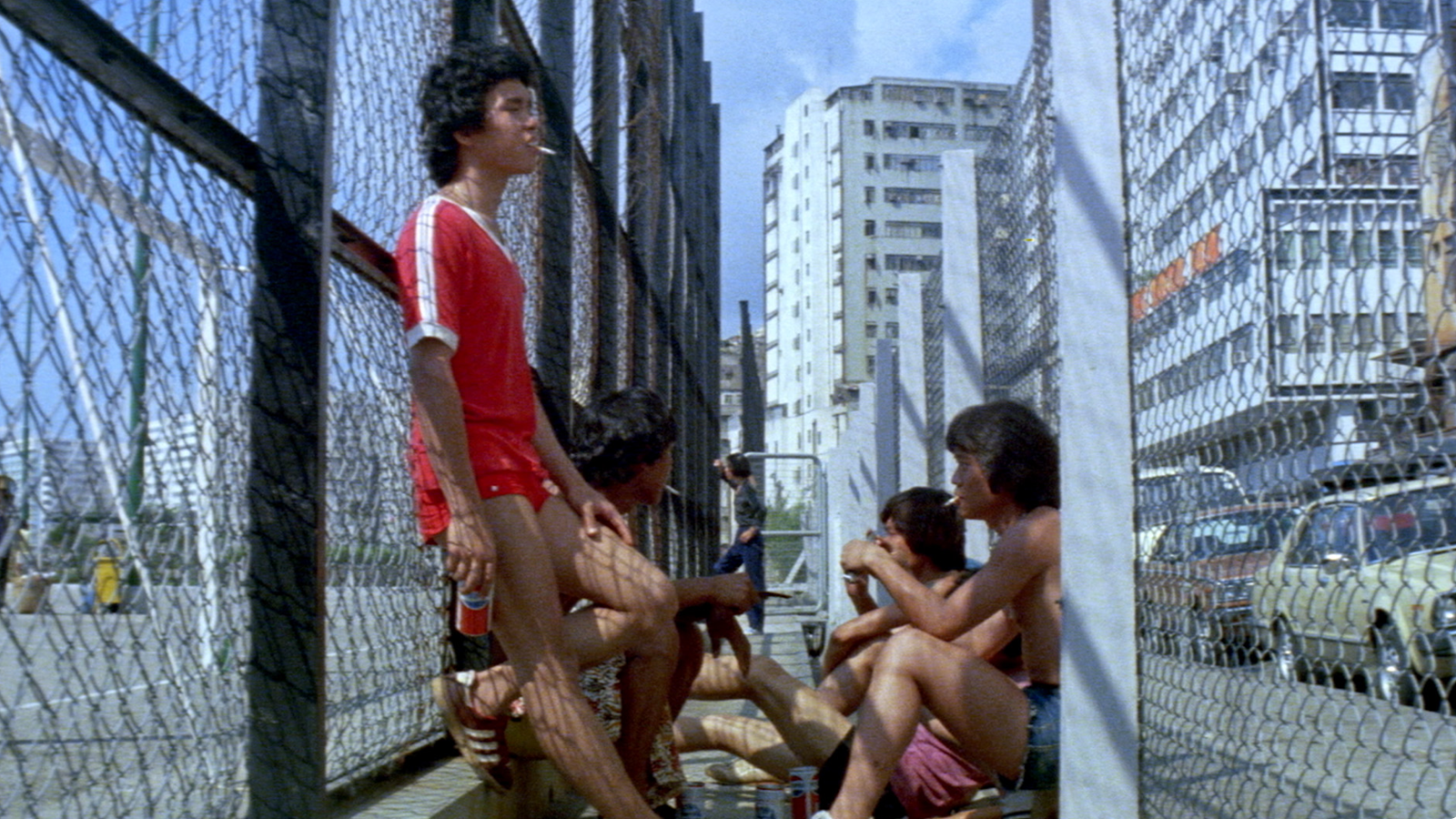
If one accepts this bit of Dickensian happenstance as a plot device, it’s because Tsui’s Hong Kong, like Dickens’s London, comes off as both teeming and oddly intimate, a city where the closeness and squalor of housing leads to much of life being lived on the streets, and people’s paths are constantly crisscrossing; the city, as Wan-chu threateningly tells the cornered boys, is “a small place.” Don’t Play with Fire is filled with images of entrapment: the narrow corridor between chain-link fences by a blacktop soccer pitch where Wan-chu is waylaid by loutish Triads; her caged mice, spinning their exercise wheel and going nowhere; the club, a seething scrum of New Wavers frugging to Stars Wars–inspired French synthpop duo Droids’ “(Do You Have) The Force, Part 1” where Wan-chu enlists help pawning off the stack of bank orders through underworld connections; the seemingly endless parking garage through which our “heroes” are pursued by their erstwhile partners-in-crime. Short lenses, used throughout, lead to barrel distortion in the image, which often lends the architecture an ominously looming quality. As abject and anguished as Tsui’s film may be, it is anything but enervating; the combination of virtuoso talent and fierce commitment to a vision never is. (By contrast, the blithe facility of Tsui’s next feature, 1981’s laborious whodunnit farce All the Wrong Clues for the Right Solution, is rather depressing.)
As Ann Hui had done in her The Secret (1979) and Patrick Tam would do in his Nomad (1982), Tsui in Don’t Play with Fire was making a clean break with the studio-bound Shaw style, using the city as a stage—one commonality, along with their shared backgrounds in television production, of the disparate talents who constituted Hong Kong cinema’s “New Wave.” (Nagisa Ōshima is a key figure for both Tam and Tsui, but where the former gravitated towards the Eros of Ōshima’s 1976 In the Realm of the Senses, the latter seems to have preferred the death-drive aspects of 1960’s Cruel Story of Youth.) Don’t Play with Fire is a trawl through the seamy side of Hong Kong: the bustle of Lan Kwai Fong; the squatter’s hut where Wan-chu goes to score contraband firecrackers; the grotty apartment building rooftop, clotted with antennae, where she asserts her dominance over the boys in a glorious low-angle composition; the Kwun Tong Public Pier, where Paul washes telltale signs of the fatal collision off the family car with water from the sullied Harbor.
The film’s climax lays its scene in one of those terraced, tightly packed hillside cemeteries that Hong Kong filmmakers cherish as locations—see for reference Ringo Lam’s City on Fire (1987) and Victim (1999) or, again, Made in Hong Kong—a monumental necropolis where, in death as in life, the citizens of the city-state are stuffed together in cheek-and-jowl proximity. When, for a tantalizing moment, our young protagonists believe they’ll be able to cash in on their windfall, their first thought is of decamping to Canada’s wide-open spaces, the dream of immigration being another staple of the local cinema. (It beggars belief that anyone would prefer a life in, say, Edmonton, to that in Hong Kong, but that is the premise of Alfred Cheung’s 1988 Paper Marriage, in which the capital of Alberta stands in for Los Angeles.)
In point of fact, Tsui was a relative newcomer in Hong Kong when he delivered this poison-pen letter to the city, having spent three years in secondary school there in the mid-to-late ’60s—theoretically in time to experience the anti-government riots of 1967 that set the city aflame for months on end, archival stills of which conclude Don’t Play with Fire—before decamping to the US, only returning in ’77. He was born in Guangzhou in 1951, from whence he moved with his prodigious family—16 siblings!—to Saigon, where he lived until his early teens. (His hometown would be the setting of Tsui’s second most furious film, 1989’s A Better Tomorrow III: Love & Death in Saigon.) His time in the States was spent first at Dallas’s Southern Methodist University, then at the University of Texas, Austin, where he would have arrived around the time that U of T alumni Hooper’s The Texas Chain Saw Massacre (1974)—almost certainly a crucial influence on Tsui’s sophomore film, We’re Going to Eat You (1980)—was doing gangbusters business. He closed out his stay in New York just as punk was breaking, and though there is no compelling evidence placing Tsui at Max’s Kansas City or CBGB, he would undeniably inject Hong Kong cinema with a hotshot of propulsive, raffish energy and snarling rancor.

Don’t Play with Fire (1980)
Selina Chow, the king- and queenmaker of ’70s Hong Kong television, employed as general manager at TVB and, beginning in ’77, CTV, spotted Tsui as a comer, and in short order he was commanding a film set. (All evidence suggests Tsui gets on well with authoritative woman; his films are full of them, and no small amount of credit for his brilliant career belongs to his longtime partner, the late Nansun Shi, with whom he co-founded production company Film Workshop in 1984.) His feature debut, The Butterfly Murders (1979), was an inspired pastiche of wuxia, locked-room mystery, creature-feature horror, and giallo thriller, with a masked killer who wouldn’t be out of place in Mario Bava’s bestiary. That Tsui was conversant with international horror is evident from his soundtrack borrowings alone: Goblin’s score for the Italian release version of George A. Romero’s Dawn of the Dead (1978) features in Don’t Play with Fire, while We’re Going to Eat You lifts from their work on Suspiria (1977).
We’re Going to Eat You drops Norman Chu’s Agent 999 into a remote Mainland village ruled with an iron fist by authoritarian Chief of Security Eddy Ko, who keeps the rabble in line by controlling the supply of their only nutriment: human flesh. The slapstick Grand Guignol has frequently been interpreted as a sendup of the CCP, tapping into the anxiety that many Hong Kongers felt about their little Crown colony being devoured by their mighty neighbor.
But if Tsui was regarding the border warily in We’re Going to Eat You, with Don’t Play with Fire he made it clear that this was not because he regarded his hyper-capitalist home as an unblemished paradise. British Hong Kong for most of its existence wasn’t anything approaching a democracy, but its filmmakers did have a certain freedom to express their disgust with the abject rottenness of the place—up to a point, at least. A rich history of Hong Kong–made juvenile offender pictures preceded Tsui’s film—The Orphan (1960), starring a 19-year-old Bruce Lee; Lung Kong’s reform school revenger’s tragedy Teddy Girls (1969)—but the limits of local censors’ leniency were reached by Don’t Play with Fire. Numerous cuts were called for in the film that Tsui submitted for inspection, with scenes pertaining to Paul, Ah Kao, and Loong’s planting an explosive device in a packed cinema house among those that didn’t survive, the memory of the acrid smoke of petrol bombs back in ’67 being perhaps a little too fresh in the minds of colonial authorities.
Don’t Play with Fire (1980)
Tsui’s original edit, or a version of it, can be seen today, with a very different structure and excised material, taken from a VHS workprint, now visible, if rather blearily so. Neither this version the nor the film’s theatrical cut can be taken as a paragon of civic pride. Life in the Hong Kong of the film is lived according to the law of the jungle, where pack allegiances form according to contingency and the weak are prey to the strong. Wan-chu, ill-treated by men, relishes the opportunity to lord over her captive pipsqueaks. When the kids, under Wan-chu, endeavor to cash in the money orders, they are regarded as so much fresh meat by the unscrupulous Triads they contact, who in turn will be brutalized by the better-armed, further-up-the-food-chain American freebooters—who don’t hesitate to kill their own when circumstances demand.
Those looking for a moral anchor in the world of the film might expect it to come courtesy Tan, as representative of law and order, but he soon shows himself a pretty shabby excuse for a hero: sloshed and struggling up the stairs to the apartment he shares with Wan-chu to, upon her opening the door, heave up his dinner in her face; later, after saving his sister from a certain gang rape, beating her bloody and leaving her zip-tied to a barred window. Concerning the production of his frothing, feral, snarling cur of a film, Tsui recalled: “I was so angry, angry with myself, angry with everybody in the industry, so that’s why I was being very… beast-like. … I devolved every character to a very animal, basic instinct, very primitive state of mind. Survival is the attitude.”
In this overcrowded, unventilated environment, violence is inevitable, endemic, and often quite inventive in its savagery. Under the opening credits a woman’s hand—that of Wan-chu, we learn—presses a push pin into the neck of a white mouse; later, when she finds a cat menacing her caged pets, she chucks it out of a high window, to be impaled below on an iron spike. (The killing of the mouse is real; for the sake of my enjoyment of the movie, I choose to believe the feline death was inventively staged; in any case, I can’t convince myself that it enjoyed its time on set.)
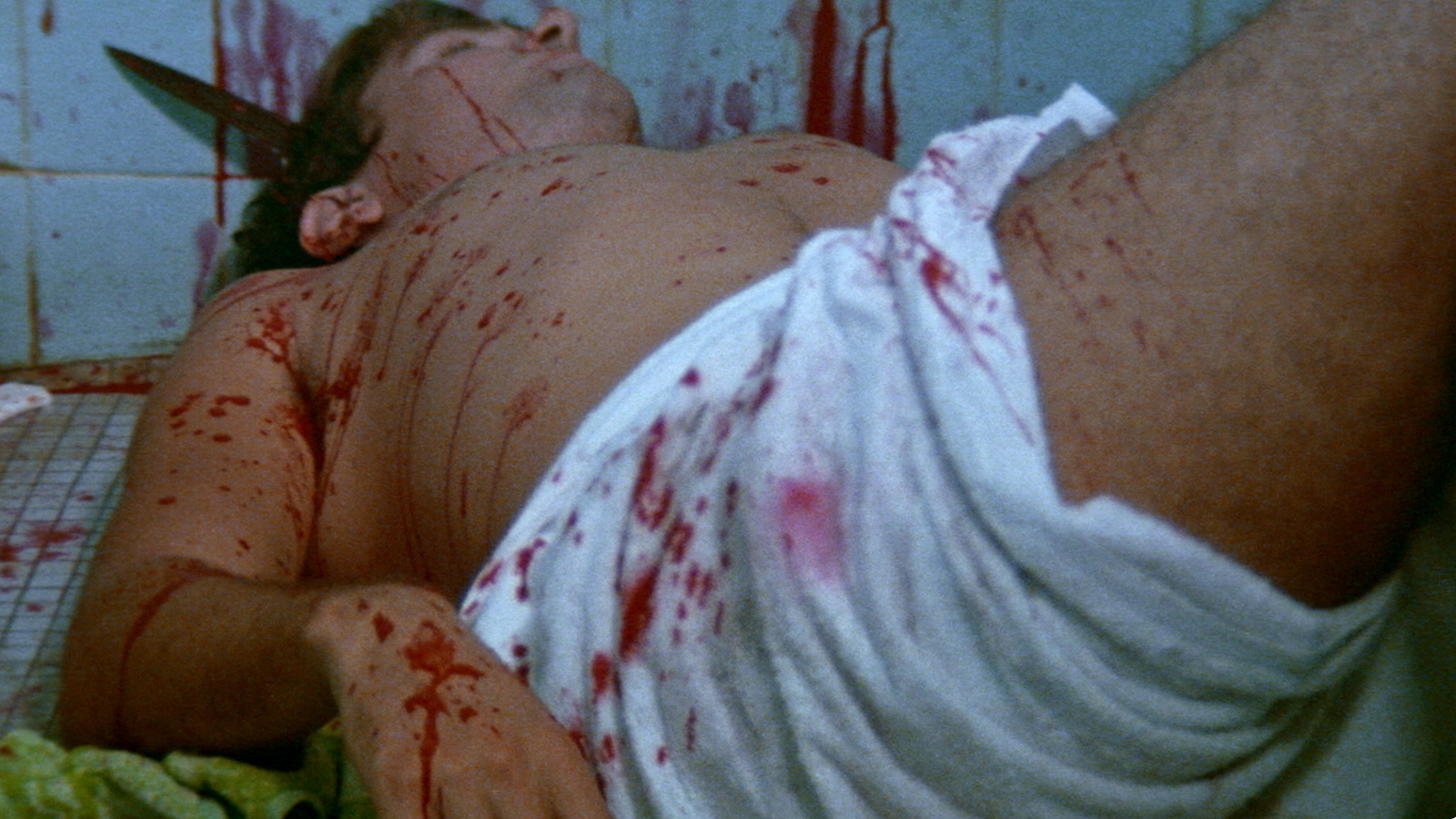
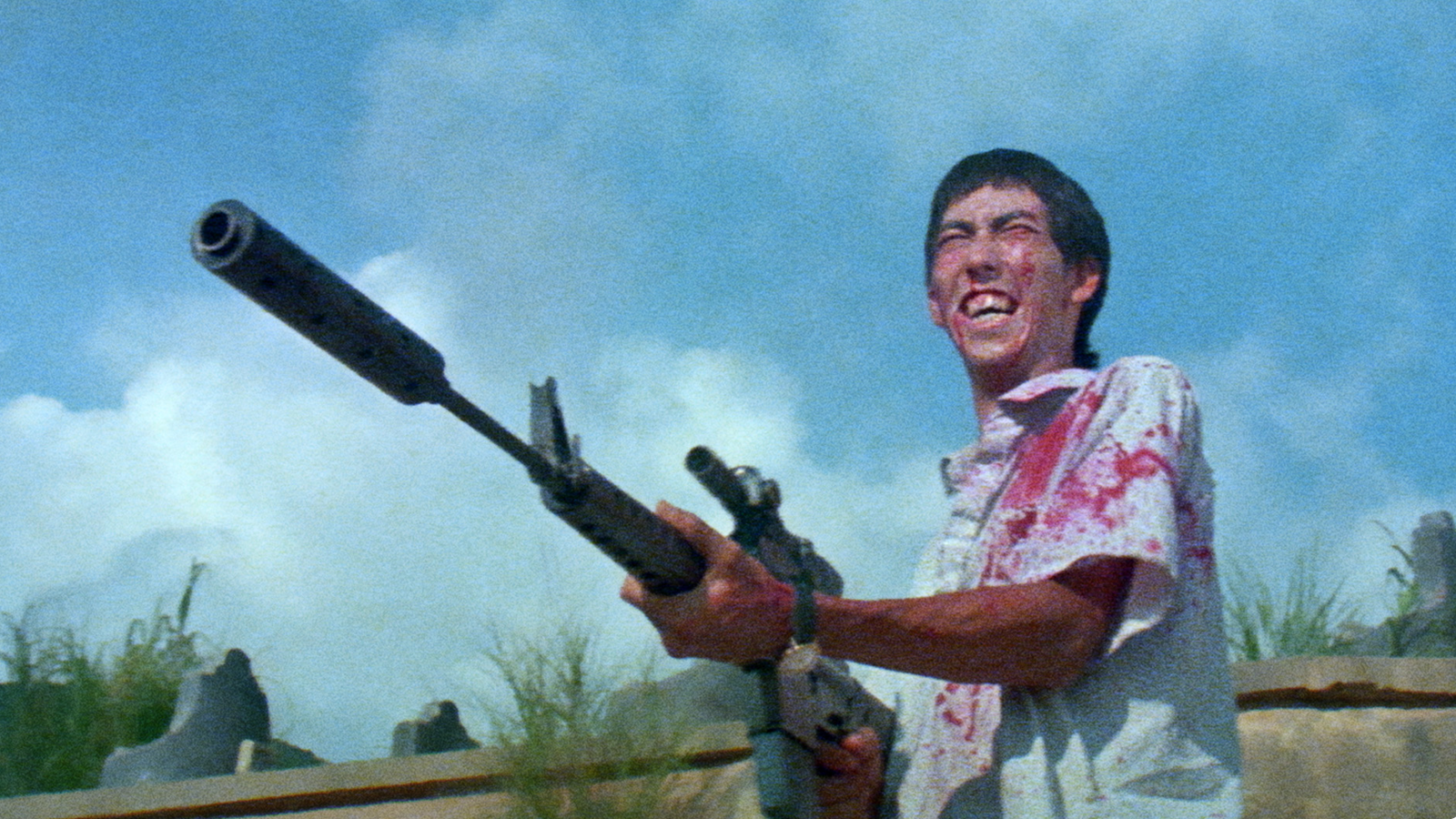
At various points nail guns and Molotov cocktails are brought to the party, a hefty pipe nut is employed in the fashion of brass knuckles, a recalcitrant hostage has his mouth sewn shut with baling wire, and a “former Mr. Hong Kong” has his magnificent physique blown into hunks of muscle mass. Killings committed by firearm tend to entail the expenditure of several times more ammunition than is necessary to end a human life. In one particularly inspired moment, we watch a fellow getting his hand lopped off before being dragged several blocks dangling from the passenger side of a speeding car, leaving a swath of gore like Chinese calligraphy in his wake. This is followed by a scene in which, by light of early dawn, a street sweeper, unawares at first of the human origins of the scattered offal, grumblingly piles it into her rubbish bin. The digression is significant: this is the metropolis as human dumping ground. Tsui’s bilious, brilliant movie has enough titles as it is, but there’s another, coined by Rainer Werner Fassbinder, that would suit it just fine: Garbage, the City and Death.

Share:
Recommended
- Futures and Pasts: Don’t Play with Fire
 Foul times in the Fragrant Harbor, in Tsui Hark’s newly restored third feature.
 - Anja Breien
 On the late Norwegian filmmaker, master chronicler of feminine ennui.
 - Mississippi Mermaid
 On Yves Saint Laurent’s striking costumes in François Truffaut’s subversive neo-noir.