
Columns
Futures and Pasts: Scattered Clouds
In Futures and Pasts, Metrograph’s Editor-at-Large Nick Pinkerton highlights screenings of particular note taking place at the Metrograph theater. For the latest entry, he considers Japanese master Mikio Naruse’s swan song, Scattered Clouds (1967).
Scattered Clouds opens at Metrograph on Saturday, June 29 as part of Mikio Naruse: The World Betrays Us.
Share:
The crux of 1967’s Scattered Clouds, the final film directed by Mikio Naruse in a career stretching back to the late years of silent cinema and among his greatest, can be found in a line spoken by the actress Yōko Tsukasa towards the end of its first act: “How awful to depend on someone for your livelihood.” Tsukasa’s character, Yumiko, is here referring to the monthly payments she receives from Shiro Mishima (Yūzō Kayama), a young businessman who has been voluntarily tithing a portion of his salary to her since the fateful night that an automobile he was behind the wheel of—through no fault of his own—struck and killed her husband (Yoshio Tsuchiya), a rising star in the Ministry of Trade. She might, even if she wouldn’t permit herself such a thought, also be speaking of her late spouse, upon whose professional fortunes all of her hopes for the future had been pinned—an assignment to Washington, D.C., was in the offing, a baby is on the way—and whose death has left her rudderless, reliant on the goodwill of a man she despises the very sight of… at first, that is.
The blindsiding intrusion of disaster into the ordered routine of everyday life has a well-established precedent in Naruse’s work: his first surviving film as director, the comedy Flunky, Work Hard (1931), takes a hard tragic turn when its hustling insurance salesman protagonist, played by Isamu Yamaguchi, learns that his son has been hit by a train, and auto accidents figure in his Street Without End (1934) and Hit and Run (1966), the latter also featuring Tsukasa. This was also an experience that Naruse knew firsthand. He had lost both parents before he was out of his teens, an experience that, along with an early acquaintance with the sting of poverty, has been credited with shaping a saturnine disposition both observed by colleagues (Naruse, a private man whose favorite pastime was tippling alone, does not appear to have been much for “friends”) and evidenced in his films, the most cherished of which overwhelmingly concern themselves with people clinging by their fingertips to the lower rungs of the middle class, trying to proceed with a modicum of dignity in a pitiless social system that gives no quarter to the sensitive, susceptible, and sentimental.
Yumiko is not the only victim of Scattered Clouds’s pivotal smash-up; Shiro survives his accident unscathed in one sense, grievously wounded in another. Though acquitted of all wrongdoing in a court of law, his involvement in the death of a government employee—and one with a role in shaping financial policy, at that—marks him as a liability to his employers at Meiji Trading. His boss’s daughter, to whom he is engaged, breaks off the affair, understanding her fate is inextricable from that of her chosen partner, now become tainted goods, and the firm ships him away from Tokyo to their office in Aomori, at the far northern tip of Honshu island. (By all accounts a rather picturesque medium-sized city, Aomori is here depicted as a dusty, drab backwater.)
Yumiko, following the trauma of a miscarriage and a scuttled attempt at entering the workforce, will follow Shiro into an exile of her own, landing a short bus ride away at the house where she was born on the lushly forested shores of Lake Towada, now an inn managed by her widowed sister-in-law, Ayako (Mitsuko Kusabue). Cut off from life in the capital and demeaned by their respective occupations—Shiro is called upon to fete crass visiting Westerners with geishas, sake, and song, while the pretty, petite Yumiko is clearly seen as valuable by Ayako as window dressing for her male customers—Shiro and Yumiko, over the course of a series of encounters, gradually develop something that approaches friendship, one that in turn becomes a smoldering passion that both variously struggle to stamp out before it reaches the point of conflagration.
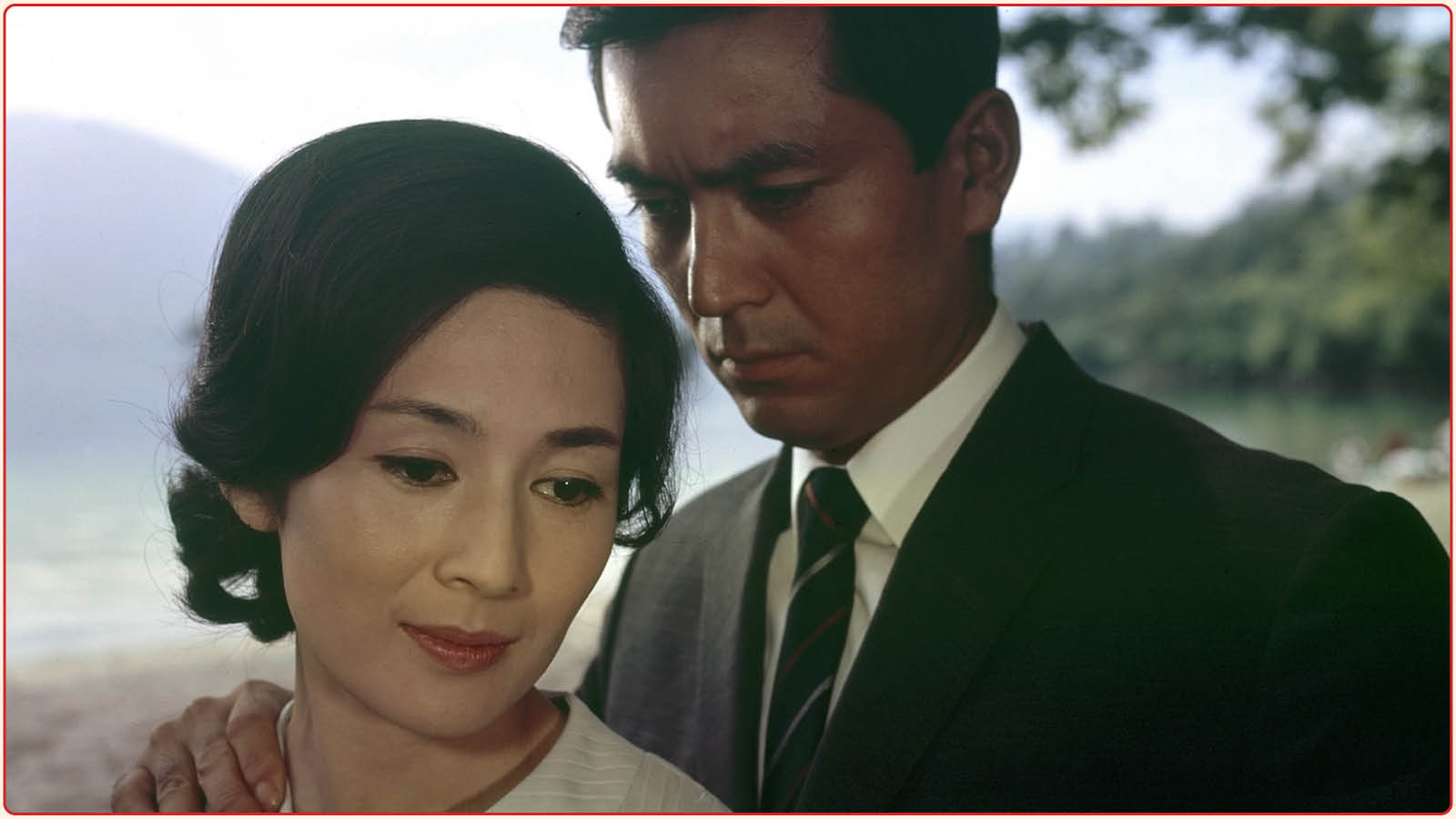
Scattered Clouds (1967)
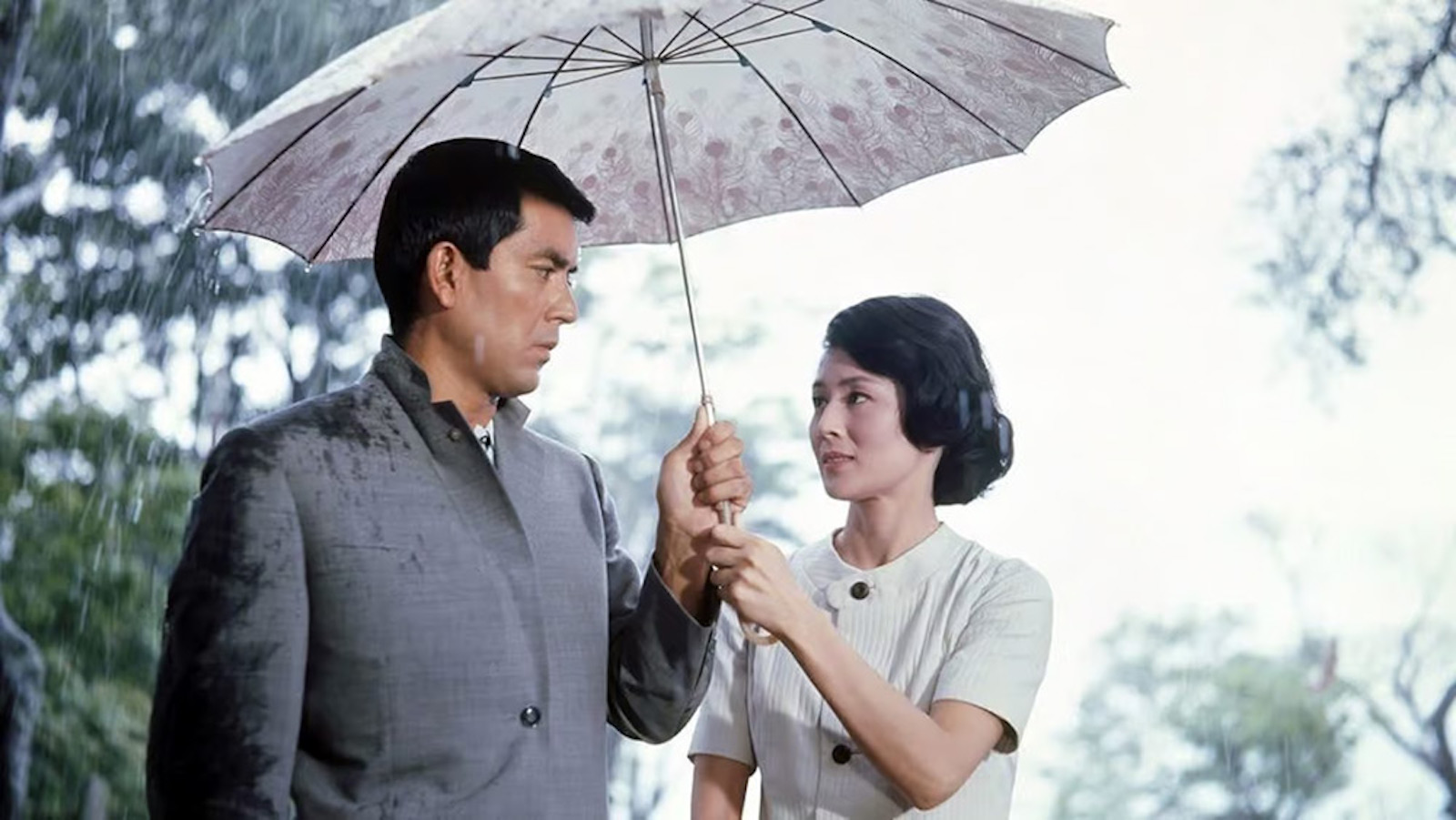
By the time their reserve begins to crack, it is nearly too late: Shiro, in the belief that his continued presence in Aomori is a burden to Yumiko, puts in for a transfer, hoping to return to Tokyo, but finds himself instead condemned to three years in Lahore. (“The birthplace of cholera,” per a visiting colleague, who delivers the news like a death sentence, followed by a pointed cut to a moth struggling in a bowl of grease used for the at-table preparation of kushikatsu sitting between them.) His departure forthcoming, he asks Yumiko to give him a guided tour of the lake and its environs, during the course of which they are caught in a sudden summer shower, and Shiro is taken with a violent fever. Yumiko attempts to shelter the shivering Shiro with her umbrella, but he rebuffs the offer, to which she replies: “You’re stubborn.” As her bus arrives, he insists that she should take it and leave him to wait for his alone, but she remains, smilingly stating: “I’m stubborn, too.”
Here we have the essence of the matter: Shiro and Yumiko, flawed but ultimately principled individuals surrounded on all sides by endemic corruption, have much in common, and paradoxically it is because of their similarity that they cannot, or will not, end up as a couple. Their reticence to compromise, their integrity, is by no means commonplace. While Yumiko fulminates over the indignity of accepting Shiro’s money, her brother-in-law (Yū Fujiki) observes that, were he in Shiro’s position, he likely wouldn’t pay out anything at all. Ayako, to take another immediate example, is seen to genially play along with the rules of a society in which a certain amount of dishonesty and double-dealing must be accepted as a matter of course, and attempts to entice Yumiko to do the same: her rotund lover (Daisuke Katō, a Naruse favorite), is the married owner of a lumber mill who helped her to build an expansion to the inn, and when Ayako attempts to interest her sister-in-law in a widowed local politician, middle-aged and with a face unlikely to inspire overwhelming desire in a still-young woman’s breast, it’s clearly with the possibility of calling in future favors in mind.
Scattered Clouds is a film of bargaining, bartering, and transactional exchanges, in which the guidelines and logic that dictate conduct in business have infiltrated every aspect of daily life. Shiro’s fiancée terminates their engagement like a controlling partner backing away from a risky merger with cold feet; Yumiko’s husband is scarcely cold in his grave before her in-laws in Kyoto begin the process of removing her name from their family register; and Naruse devotes an unusual amount of attention to the bureaucratic hoops that Yumiko and her sister must jump through in collecting the survivor’s pension that Yukiko is due. (“No additional postnatal allowance will be paid for a pregnancy under five months,” he matter-of-factly informs the expectant mother, two months short of qualification.)
Naruse’s lone film from a script by Nobuo Yamada, notable for his contributions to the filmographies of Masahiro Shinoda and Koreyoshi Kurahara, Scattered Clouds might have been the beginning of a simpatico collaboration were its director not carried off by colon cancer less than two years after its release. As it is, it feels like a final distillation of the filmmaker’s cinema of thwarted longing, a film, in the words of director and critic Dan Sallitt, that “delves into the ontology of unhappiness.”

Scattered Clouds (1967)
There are signs here that Naruse was not wholly shut off from developments in contemporary cinema—as in The Stranger Within a Woman (1966) and Hit and Run he makes parsimonious use of a handheld camera, here tracking an inebriate Yukiko as she weaves her way towards a bar during a girl’s night out—but the Naruse connoisseur will find more that is familiar here than not. There is Katō, and also Kumeko Urabe, a member of the Naruse troupe since 1951’s Repast, moving here in the role of Shiro’s worry-worn mother. There is that staple Naruse scene, that of a drunken homecoming, here performed by Kayama, as ever an elaborate dance involving slouching against the doorframe for support and struggling to kick off shoes. (This scene is, to those of us who admire Naruse, what the opening chords of “Wheel in the Sky” are to a classic rock enthusiast.)
The close attention to monetary matters, too, is entirely typical of the filmmaker of whom Phillip Lopate wrote: “Naruse may be the most materialist director in the history of cinema. It is remarkable how much of his dialogue is taken up with the collection and solicitation of money.” The central not-quite-affair has a precedent in the dynamic between war widow Hideko Takamine and Kayama in Yearning (1964), while Scattered Clouds’s undressy, matter-of-fact visual vocabulary—shot-reverse shot dialogues abound—is much the same one that Naruse had relied on for the previous two decades. (Of the dynamism with which Naruse could infuse a locked-down shot, Shigehiko Hasumi has written that “the intricate play of the backlighting and front lighting falling across a face evinces Naruse’s affiliation with Griffith’s legacy.”) His handling of the material is lucid, assured and, until the last act, at least, almost entirely free of melodramatic emphatics, reflecting the director’s ongoing effort to filter his work of inessentials. Per Takamine, who altogether made 17 films with Naruse, when she visited the ailing director at the end of his life at his home in the Tokyo suburb of Seijo, he spoke to her of a cherished—and ultimately unfulfilled—dream, that of making a film “with no sets, no color, just a single white curtain as a backdrop,” a film that “show[s] nothing but the drama itself, unfolding before a white backdrop with no impediments.”
In Scattered Clouds, as in life, impediments are inevitable. The consolidation of Shiro and Yumiko does come very near to completion, only to finally be undone through exposure to a litany of inauspicious auguries—a careening freight train, an automobile wreck—encountered en route to the inn where they head with the intention of consummating their love, instead parting with tears and wishes for happiness that seem destined to go unfulfilled. If everything else appears to be negotiable or up for sale, this stubborn twosome, at least, will not relinquish the legacy of the accident that brought them together: Yumiko, her grief; Shiro, his guilt.
The film’s conclusion, which ends its director’s career with the clang of a coffin lid slamming shut, is not a “happy” one by most measures, though it does represent a triumph of unyielding individual integrity in a world that demands constant give and take, accommodation, and settlement. Yumiko will not have to depend on Shiro, nor he on her. A victory, and a bitter one.
Nick Pinkerton is a Cincinnati-born, Brooklyn-based writer focused on moving image-based art; his writing has appeared in Film Comment, Sight & Sound, Artforum, Frieze, Reverse Shot, The Guardian, 4Columns, The Baffler, Rhizome, Harper’s, and the Village Voice. He is the editor of Bombast magazine, editor-at-large of Metrograph Journal, and maintains a Substack, Employee Picks. Publications include monographs on Mondo movies (True/False) and the films of Ruth Beckermann (Austrian Film Museum), a book on Tsai Ming-liang’s Goodbye, Dragon Inn (Fireflies Press), and a forthcoming critical biography of Jean Eustache (The Film Desk). The Sweet East, a film from his original screenplay premiered in the Quinzaine des Cinéastes section of the 2023 Cannes Film Festival.
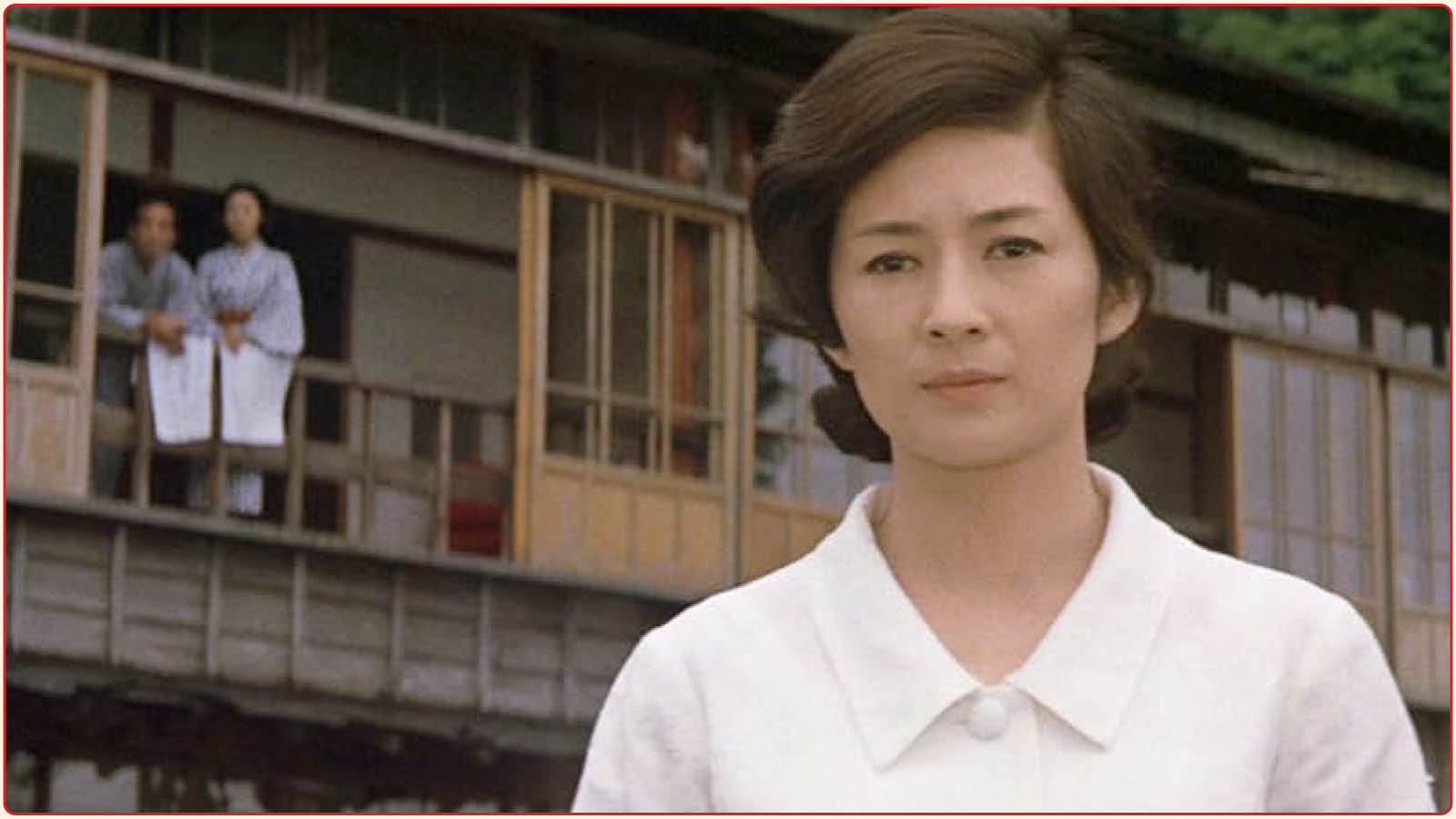
Scattered Clouds (1967)
Share:
About the Contributor
Recommended
- Futures and Pasts: Éric Rohmer’s Élisabeth
 On the French New Wave legend’s life before cinema, and his newly translated first and only novel.
 - When Carolco Was King
 On the maverick indie studio who ruled the multiplex for a golden decade.
 - Arnold Schwarzenegger
 How the heavyweight star became America’s favorite father figure.