
Columns
Futures and Pasts: Running on Empty
In Futures and Pasts, Metrograph’s Editor-at-Large Nick Pinkerton highlights screenings of particular note taking place at the Metrograph theater. For the latest entry, he considers Sidney Lumet’s tale of morally compromised counterculture veterans trying to keep a family together while remaining one step ahead of the law, Running on Empty (1988).
Running on Empty opens at Metrograph on Sunday January 25, as part of Fugitive Days.

Share:
Abolition of the family! Even the most radical flare up at this infamous proposal of the Communists.
On what foundation is the present family, the bourgeois family, based? On capital, on private gain. In its completely developed form, this family exists only among the bourgeoisie. But this state of things finds its complement in the practical absence of the family among the proletarians, and in public prostitution.
The bourgeois family will vanish as a matter of course when its complement vanishes, and both will vanish with the vanishing of capital.
Do you charge us with wanting to stop the exploitation of children by their parents? To this crime we plead guilty.
—Karl Marx and Frederick Engels
It’s about the consequences of our actions, and the dynamic of what makes a family. These people’s lives are a mess. The children are the only success they’ve got. It’s about their inability to break up this family.
—Sidney Lumet, discussing Running on Empty in 1987
THE “INFAMOUS PROPOSAL” ABOVE, FROM the second chapter of the Communist Manifesto, would prove one of the trickiest obstacles faced by the Bolsheviks tasked with turning the egalitarian society imagined by Marx and Engels some 80 years earlier into a practical reality. With so many other pressing problems to tend to in rebuilding Russia into a new Soviet dictatorship of the proletariat, the family was given a temporary stay of execution—albeit redefined, as historian Yuri Slezkine documents in his superlative The House of the Government, by one Yakov Brandenburgsky, first dean of Moscow University’s new Department of Soviet Law and chairman of the family law commission.
The family, wrote Brandenburgsky, would “of course, disappear and… be replaced by a state system of socialized child-rearing and social welfare,” but so long as this vestige of the benighted before times stubbornly remained, something would have to be done about its conception and regulation. The individualist, coresidential family, however, proved remarkably durable; per Slezkine: “In theory and iconography, family life was an integral part of socialist construction; in practice… the family remained autonomous and largely hidden from view.” Moreover, Soviet family life, at least among the hundreds of civil servants residing in Moscow’s House on the Embankment, the focus of Slezkine’s book, bore a marked resemblance to its bourgeois precursor: the same hierarchies, the same jealousies, the same poshlust decor…
Sidney Lumet’s Running on Empty is a film, released at the tail end of the Reagan era, that looks back to 1960s and ’70s direct-action radicalism and considers its aftermath in the present day. But unlike so many films of those bygone, fervid years that took revolutionists as their subjects, works focused on the cell or cadre—Jean-Luc Godard’s La Chinoise (1967), Claude Chabrol’s Nada (1974), Rainer Werner Fassbinder’s The Third Generation (1979)—Running on Empty is very much a family drama. At its center is a clan headed by two former militants who, while not entirely conciliated to a place in capitalistic American society, have formed a nuclear family unit of the sort that Barbara Bush would extol at the Republican National Convention four years later. The brood in question are the Popes: husband and wife Arthur and Annie (Judd Hirsch and Christine Lahti); 17-year-old son, Danny (River Phoenix); and the preadolescent Harry (Jonas Abry). Arthur and Annie have been on the lam from the law since their involvement in a 1971 bombing of a university military research lab, an incident that left one unfortunate janitor sightless. All these years later, their commitment to the cause has become their children’s problem, condemning them all to a furtive, peripatetic existence.

Running on Empty (1988)
In the world of the movie the targeted lab, at the University of Massachusetts, is “credited with the invention of napalm”—this dubious distinction belongs in fact to Fair Harvard—while the circumstances of the attack recall the 1970 Sterling Hall bombing, intended to take out the Army Mathematics Research Center at the University of Wisconsin–Madison, and resulting in one death and three injuries. Other parallels to real-life incidents and individuals abound: the characters of Jewish, self-defined “red diaper baby” Arthur and his wife, née Patterson, the child of old-money WASPs, have frequently been likened to Bill Ayers and Bernardine Dohrn of the left-wing militant organization the Weather Underground, for a time perhaps America’s most famous fugitive couple; as well as their onetime compatriots David Gilbert and Kathy Boudin, whose child was raised by Ayers and Dohrn after their arrest for involvement in a 1981 armed robbery that killed three. The film’s screenwriter, Naomi Foner, had known Weathermen member Eleanor Stein intimately from her early years in Brooklyn through their time together at Barnard—Arthur and Annie share their names with Stein’s parents—though once declared she’d written the Popes “more like [Jesuit priest and anti-war activist] Daniel Berrigan, whom the general audience would not dismiss as… radical fringe.”
Running on Empty opens with a scene of purest wholesome Americana: Danny, at the plate in a high school baseball game, whiffs in the final at-bat. Bicycling home, he is passed by a slow-rolling sedan, its occupants two men with the distinctive mien of federal agents on a mission. In what is evidently a well-practiced drill, Danny alerts first his brother, then his parents, and the Popes light out of their home in “Florida City,” hunkering down in a seedy motel room, where Danny busies himself by practicing fingerings on a silent piano practice board—a small plaque, reading “To Annie,” identifies this as an old gift to his mother, a relic from her distant, genteel upbringing in the pre-Casio days.
With the aid of new falsified identities and associates from the underground, the Popes—now the “Manfields”—start a new life in yet another town, the sleepy burg of Waterford, New York, and the familiar routine of blending into the background: Arthur gets a gig in the kitchen of an Italian restaurant; Annie, as a doctor’s receptionist; the kids return to school, all of them with new forenames and backstories. Difficulties arise, however, when Danny integrates a little too well; his music teacher, Mr. Phillips (Ed Crowley), singles out the boy as a self-taught piano prodigy, and presses him to apply to Juilliard—though he’ll be barred from attending without access to proper school transcripts and a larger chunk of cash than the Pope’s combined household income can possibly cover. Moreover, Danny has begun to fall in love with Mr. Phillips’s sardonic, slightly tomboyish daughter, Lorna (Martha Plimpton), from whom he must keep his true identity hidden.

Running on Empty (1988)
The central irony of Running on Empty is that the ex-radical Popes, due in no small part to the exigencies of their on-and-off-the-road existence, have become a distorted but recognizable image of the individualist bourgeois family unit that Annie, at least, once sought desperately to escape. Cut off from meaningful integration with the communities they pass through, they form themselves into a bulwark against the outside world, and for all his amiable, Borscht Belt clowning, Arthur can be quite the dictatorial patriarch when he doesn’t get his way. When Lorna invites Danny to a chamber music performance at the Phillips household, Arthur forbids his son’s attendance, inveighing against such “decadent, light-skinned, privileged crap”; later, getting word of his son’s ambitions for higher education, he puts his foot down: “If he goes we’re never gonna see him again, and that is unacceptable to me.”
This disjuncture between the Popes of yesteryear and the Manfields of today will be pointed out by an unexpected house guest, Gus, an unreconstructed radical working with the “Liberation Army,” old comrade from the dissident days, and former flame of Annie’s played by L.M. Kit Carson, best known for his role as a Godard-addled film school student in Jim McBride’s David Holzman’s Diary (1967). “How do you manage this?” he asks Annie while they play footsie on the sofa, “Got a house. Two kids. It’s kinda like your leadin’ the regular life.” Arriving home to find Gus and his wife getting a tad overfamiliar, Arthur storms out in a fit of pique, ostensibly over Gus’s proposition that they knock over a bank in the name of the cause, though Gus’s analysis—“Artie’s pissed because Artie’s jealous”—is at least partially correct as well. The “bourgeois” idea of one’s spouse as one’s exclusive property, it appears, dies hard, while children raised to question authority can become a nuisance when the authority being questioned is one’s own. For Lorna’s part, we hear her rankling at the strictures of the sort of normal, middle-class upbringing that Danny increasingly longs for, describing to him her discomfiture with “nice” people like her mother, who “gives her old clothes to the maid but… doesn’t really want to know her.” A commonality to the different families that appear in the film: the overwhelming desire of teenagers to escape their grasp.
Running on Empty is not a film without its rough patches—hambone Hirsch is grating as ever, though his role here at least locates a manipulative aspect to his earthy blowhard schtick, excruciating in The Fabelmans (2022); a certain scene set to James Taylor’s “Fire and Rain” is so self-consciously a “moment” as to set one squirming; the sound mix, never Lumet’s strong suit, includes some downright comical dubbing—but when Phoenix and Plimpton are together on-screen, it does achieve occasional sublimity, the actors, a real-life couple at the time of filming, displaying moments of awkward, naked vulnerability, spontaneity, and painful sincerity rarely captured. Two years earlier they had both appeared in the Peter Weir–directed, Paul Schrader–scripted The Mosquito Coast (1986), in which Phoenix’s character was likewise at the mercy of decisions made by parents who’d turned their backs on mainstream American society, in this case an eccentric inventor (Harrison Ford) who decamps with his family to Belize with the stated intention of carving a Utopian commune out of the jungle, only to devolve into a crackpot tyrant. (One can only speculate as to how Phoenix’s own upbringing, a significant part of which was spent with parents serving as missionaries for the Children of God religious cult in Caracas, Venezuela, prepared him for either role, but it certainly can’t have hurt.)
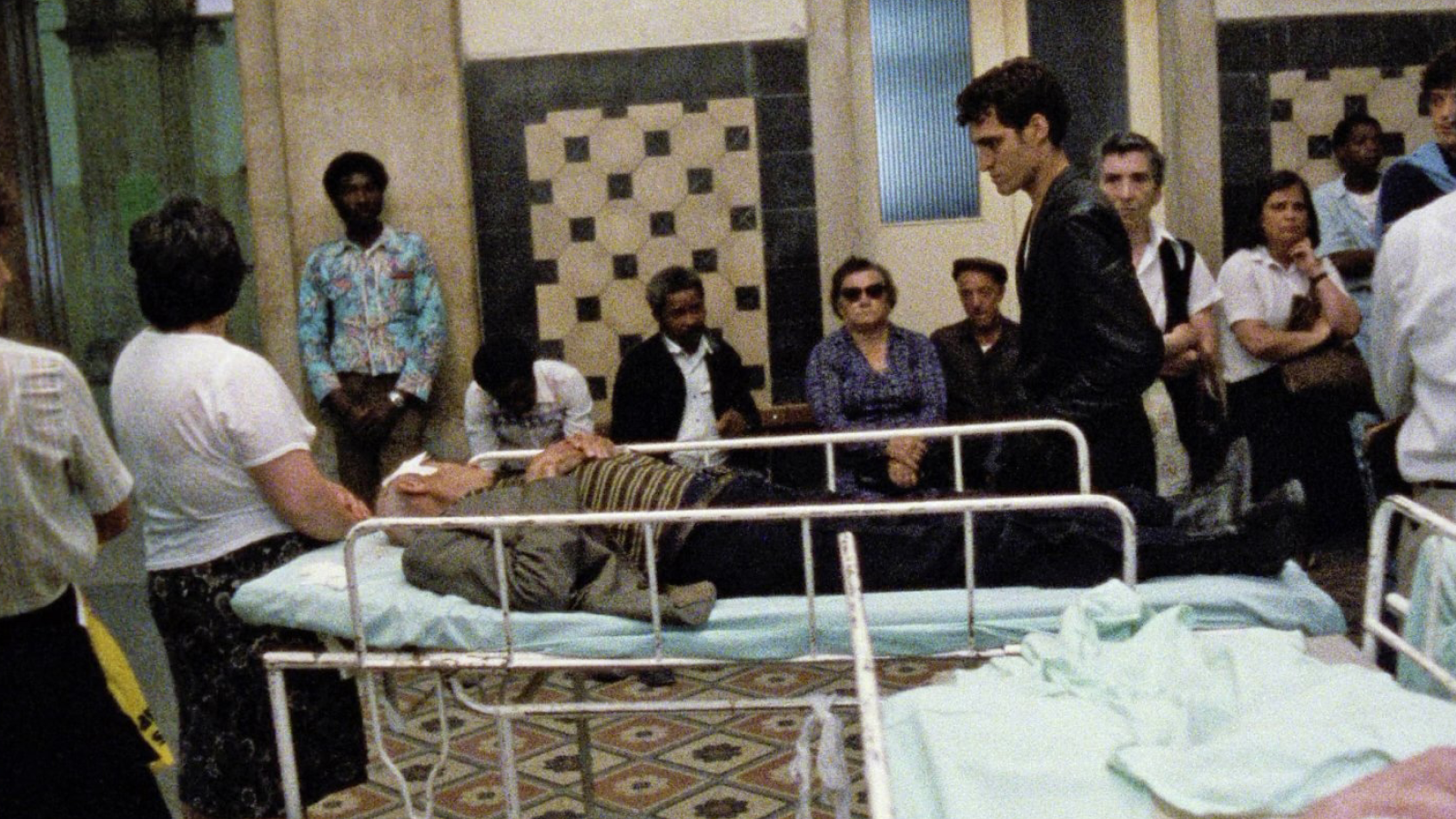
Doc’s Kingdom (1988)
An interesting point of comparison with Running on Empty is another film released the same year and dealing with not entirely dissimilar subject matter, Robert Kramer’s Doc’s Kingdom, starring Paul McIsaac and a young Vincent Gallo—who, however disagreeable you may find much of what he says, was correct in calling Phoenix “by far the best and most beautiful of his generation.” Filmed in Portugal by the expatriate Kramer, Doc’s Kingdom also concerns the relations between formerly militant fathers and their sons: Gallo’s character, following the death of his mother, sets out to meet Doc, the father he has never known, finding him practicing medicine in a Lisbon hospital, having turned his attentions from destruction to healing. (McIsaac was something of an alter ego for Kramer, earlier seen as one of the armed insurrectionists of 1970’s Ice, and later to return in his 1989 “homecoming” film Route One/USA.)
Both Running on Empty and Doc’s Kingdom, appearing during the last gasp of the Cold War, could be described as works of “left-wing melancholy,” though it is tempting to read the latter as retrenched in its radicalism, the former as reactionary. McIsaac’s Doc will not or cannot, finally, be drawn into the role of “father,” committed as he is to the service of the wider community in the persons of his patients, while Danny in Running on Empty will be returned to the world his parents had turned their back on, Annie securing the funds for his Juilliard education through a long-delayed meeting with her moneyed father (an excellent Steven Hill).
There are worlds of difference between Lumet’s film and Kramer’s, but they are akin in operating principally as character studies, and in being works that acutely understand that both compromise with the “straight” world and a refusal to do so comes with a price. Doc, a lush and a loner, remains stubbornly true to his principles, but at the cost of isolation from the world he hopes to better. To be irreconcilable to society as it exists is to become an outcast, or perhaps, as Annie calls the swaggering Gus, “a 46-year-old infant.” For Danny’s part, he will be made to choose between two families, each imposing its own constraints: staying on the move with the marked for justice Popes, or opting for Lorna, a shot at Carnegie Hall, and the chill of the Patterson grandparents’ Upper East Side townhouse.
It is perhaps unsurprising that the American-made film ends in concession and the expatriate-made film in repudiation, that the first appeals to the emotions above all and the latter to the head as much as the heart, but they share their prioritization of the human factor above schematic cant. Talking with Foner, I began to suggest that part of the strength of Running on Empty was its understanding that “Systems aren’t just made of bricks…” and before I could finish my sentence, she did it for me: “They’re made of people.”
Share:
Recommended
- The Maiku Hama Trilogy
 On the retro riffs and magnetic lead of Kaizo Hayashi’s newly restored cult trilogy.
 - Juliette Binoche
 On the eloquent hunger of the iconic French actress.
 - I’m Not Everything I Want to Be
 On Libuše Jarcovjáková, the queer photographer drawn to the social fringes of Soviet Prague.