
Columns
Futures and Pasts: Dead Mountaineer’s Hotel
In Futures and Pasts, Metrograph’s Editor-at-Large Nick Pinkerton highlights screenings of particular note taking place at the Metrograph theater. For the latest entry, he considers Grigori Kromanov’s raffish, rug-pulling amalgam of whodunnit and science fiction, an enduring cult item and one of Estonian cinema’s towering peaks.
Dead Mountaineer’s Hotel plays at Metrograph from Friday, May 29 as part of Hotel Europa.
Dead Mountaineer’s Hotel (1979)
Share:
JIM THOMPSON, AUTHOR OF SOME of the most compellingly unhinged crime fiction of the 1950s and ’60s, was, when in his cups—which was almost all of the time—known to opine: “There are 32 ways to write a story, and I’ve used every one, but there is only one plot: things are not what they seem.” While it’s unlikely that the American’s work, much less this particular dictum, was familiar to Grigori Kromanov, Estonian director of Dead Mountaineer’s Hotel (1979), in its upending of the traditional moral order of the gumshoe tale and in the constant reminders it offers of the deceptiveness of appearances, Kromanov’s film recalls both the man’s work and this maxim. Its title—from the source novel by Arkady and Boris Strugatsky, the two-headed coregents of Soviet science fiction and screenwriters of the picture—is darkly evocative as it is, but one of Thompson’s might have fit the bill just as well: The Killer Inside Me.
The putative “hero” of Dead Mountaineer’s Hotel, Inspector Peter Glebsky (Uldis Pūcītis), isn’t a psychopath hiding in plain sight behind hoary, folksy clichés, like Thompson’s Deputy Sheriff Lou Ford, but something altogether more commonplace: “a bureaucrat and a stuffed shirt,” as he self-deprecatingly describes himself in the Strugatskys’ novel. In brief: a “by-the-book” cop, and a cop who comes up sorely wanting when faced with a situation that appears nowhere in his almighty book.
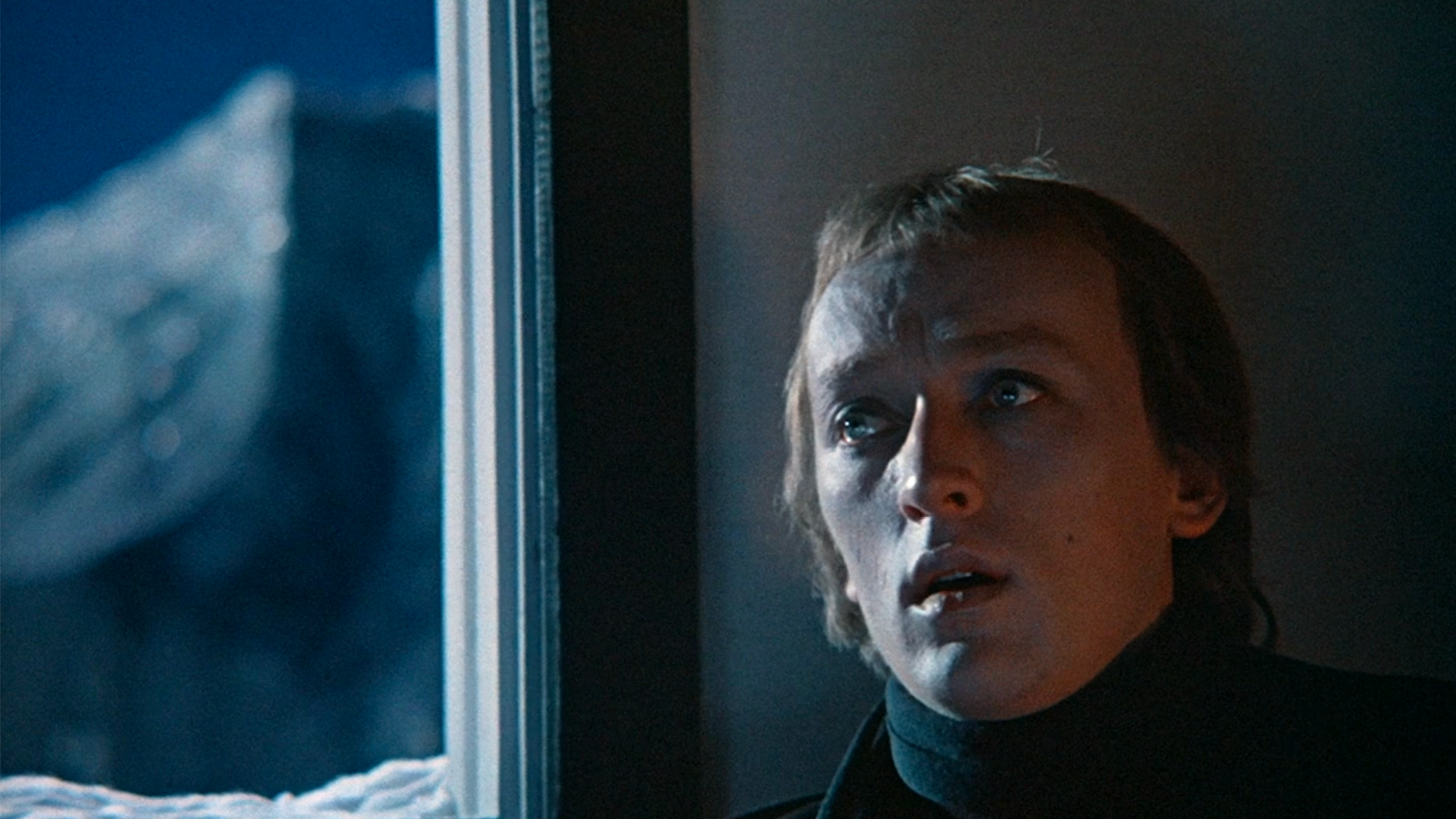
Kromanov introduces Glebsky piloting his sedan on a wending route through a snowy mountain range—the scene-setting suggests that of Stanley Kubrick’s The Shining, two years ahead—to the eponymous lodge, as a voiceover narration, our protagonist’s, speaks to us from a point somewhere in the future: “Many years have passed now, but on dull shifts or sleepless nights I often recall what happened…” The trappings are those of nocturnal noir,but the images have the bright, crisp clarity of high noon experienced a few thousand feet above sea level. Kromanov and cinematographer Jüri Sillart take advantage wherever possible of the albedo effect, using the drifts of driven snow as one giant bounce card, and frequently crane their camera toward the winter sun, filling the frame with constellations of lens flare. All of this lends the proceedings a somewhat extraterrestrial air, as do the opening images surveying the craggy landscape from the vantage of a helicopter… or some other unidentified flying object.
Further adding to the otherworldliness is the glinting, glistening electronic soundtrack, an unusually upfront and ubiquitous presence throughout Dead Mountaineer’s Hotel—one of precious few films I know to give a shout-out in its opening credits to gear (“The music was recorded on the Synthi-100 synthesizer from the Melodia company”). The score was originally to have been written by Estonia’s most famous composer, Arvo Pärt, who was quite close with Kromanov and his wife, Irena Veisaitė, Dead Mountaineer’s Hotel’s assistant director—Pärt and his partner once shared an apartment in Tallinn with the Kromanovs, and his first tintinnabuli composition, 1976’s “Für Alina,” was named in tribute to their daughter. Their collaboration remains a tantalizing “What if?”, but it’s impossible now to imagine Kromanov’s film without that Synthi-100 and the man behind it, Sven Grünberg, who, as a 17-year-old keyboard prodigy, co-founded MESS, one of the first prog acts in the Eastern Bloc. Moving between passages of treading-on-thin-ice delicacy and sudden sonic avalanches, the synth soundtrack deserves to be recognized as an early landmark of the genre on par with Tangerine Dream’s work on Sorcerer (1977) or Giorgio Moroder’s on Midnight Express (1978). A particularly evocative description of Grünberg’s music here comes from the Estonian artist Kiwa, who finds in it “the structural clarity of thought of a mountain hermit and the peculiarities of perception caused by changes in air pressure.”

Dead Mountaineer’s Hotel (1979)
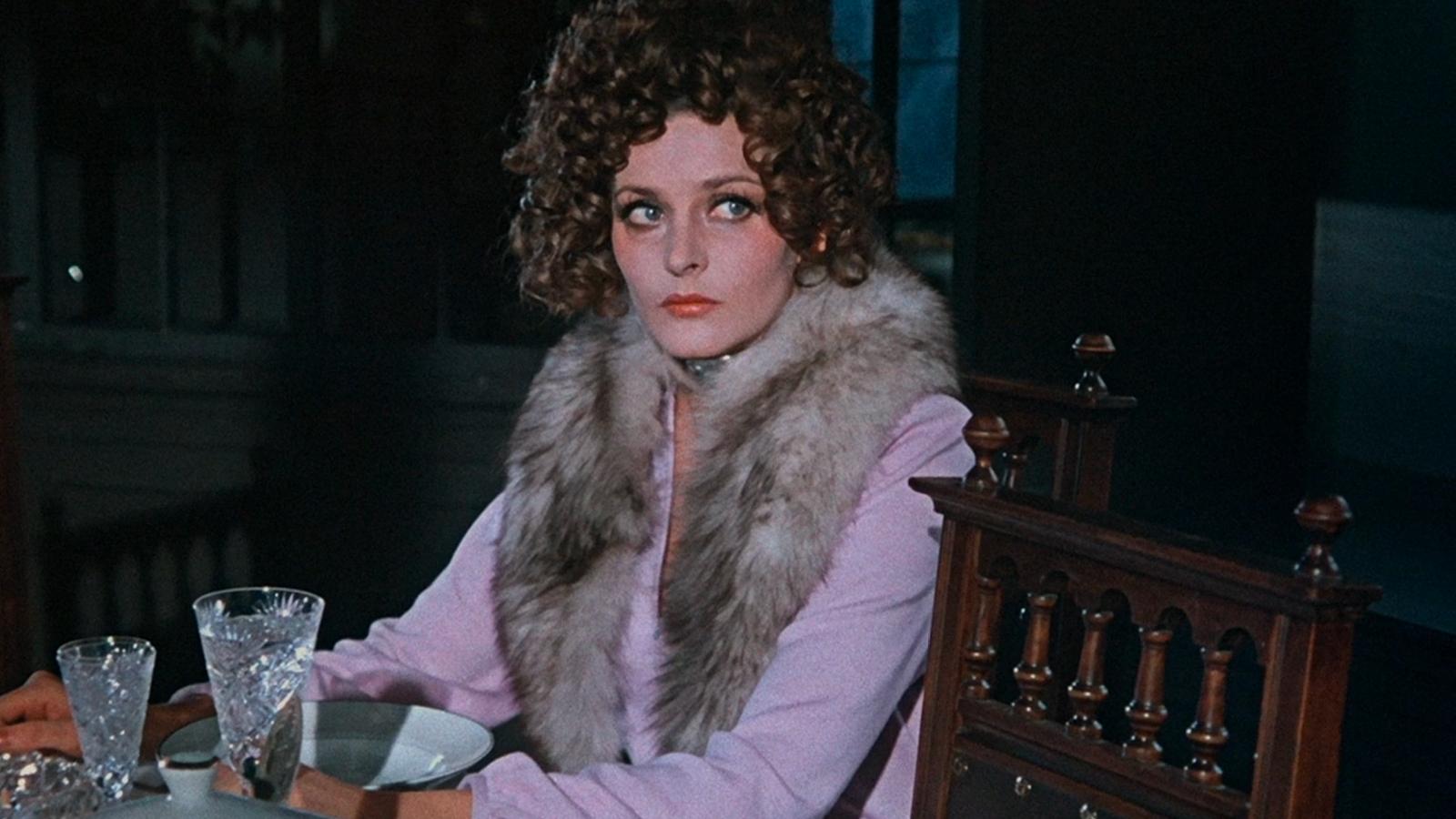
Peculiarities of perception are, it should be said, Dead Mountaineer’s Hotel’s stock in trade; disorienting from the first, it evolves over time into a state of total vertiginous freefall, as our protagonist is fuddled further and further by altitude, alcohol, sleep deprivation, and intimations of the unknown. Summoned to this remote locale by a call requesting police assistance, Glebsky is informed upon arrival at the registration desk by the hotel’s owner (Jüri Järvet, the Dr. Snaut of Tarkovsky’s 1972 Solaris) that no such call was placed. That this is no ordinary alpine chalet ought be immediately apparent from its sleek, ultra-modern decor. A dark stained timber structure bristling with a welter of sharply pitched roofs like black incisors on the outside, the lodge glistens with crystal and chromium within, the sort of place an employee of the Institute for Cybernetics and Futurology in Rainer Werner Fassbinder’s World on a Wire (1973) might go for the weekend to “get away from it all.” Along with modish mood-lighting cylindrical sconces and esoteric wall art by Estonian printmaker Vello Vinn, the unusual features here include a four-foot tall black-and-white portrait of the hotel’s namesake—an avalanche casualty, looking out over the lobby from under a red neon halo—beneath which rests a huge, shaggy, mournful-looking St. Bernard, bosom companion of the departed, now acting as the hotel’s porter. So far, so unusual—but, having trekked all this way, Glebsky resolves to stay the night.
The strangeness of the inn, Glebsky soon learns, is not limited to its appointments and its ever-so-slightly ominous architecture. The guests include Hinckus (Mikk Mikiver), a lung case with a waxen complexion following physician’s instructions to take the mountain air; Simon Simonet (Lembit Peterson), a physicist with a compulsive, Renfield-ish giggle and a penchant for practicing rock climbing techniques in the hotel’s narrow hallways; the Moseses, an odd couple consisting of a stout, stern, silver-haired husband (Kārlis Sebris) and his younger, brazenly flirtatious wife (Irena Kriauzaitė), intriguingly described by the Strugatskys as “between 20 and 40”; Brun (Nijolė Oželytė), a somewhat androgynous young woman who wears sunglasses that hide half of her face; and a bluff and hearty Scandinavian longhair, Olaf (Tiit Härm), who canoodles with Brun at the dinner table.
A creased and weatherbeaten fortysomething with a squarish build and the drably colored wardrobe that attests to a spotless lifelong record of heterosexuality, Glebsky so much looks the part of the supremely competent tough guy you could be forgiven for failing to notice that he never seems to come out on top in any contest of strength, skill, or wit; as Madame Moses simperingly states: “A man of such looks can’t be anything but a daredevil.” This comment precedes Glebsky being humbled at the billiards table by a leering Olaf, a bibulous night of drinks and dancing to reverb-heavy cosmic rock—Glebsky, with the help of some Dutch courage, joins the party, his movements choppy, tentative, and altogether uptight beside the Dionysian revel of the other guests—and, among a host of other mysterious occurrences, the discovery of Olaf’s rigid corpse in his room, locked from the inside. This leaves our Glebsky with a murder on his hands and, thanks to a sudden snowslide that cuts the inn off from the outside world, no hope of backup in sight.
Here we might ask what, exactly, the outside world providing that backup would look like? The international mélange of names entered in the hotel register—Germanic, Scandinavian, French, Hebraic and… Hinckus?—indicates another curious aspect of Kromanov’s film: the ambiguity of its exact setting. (Even the apparently Russian “Glebsky” is difficult to pin down; as Boris Dralyuk writing in the LA Review of Books notes, the name, spelled in Cyrillic, “looks something like a Russian name transliterated into Latin script, and then back again.”) Kromanov’s Glebsky is played by Pūcītis, a Latvian actor, dubbed into Estonian by one Aarne Üksküla. The landscape he drives through is that of Kazakhstan’s Tian Shan range, southeast of Almaty, where production designer Tõnu Virve erected the life-sized exterior of the Dead Mountaineer’s Hotel using imported Estonian wood; interiors were shot back home in Tallinn. More accurately, one might say the exterior of the Hotel Alpiniste Morte; the blue neon signage on the building, like all text seen on-screen, is in French, suggesting an Alpine location—the Swiss liqueur Edelweiss is mentioned—though the exact country where the action occurs is never specified. The very terrain of the place is nigh impossible to pin down; while almost the entirety of the film is set in the building or its immediate surrounds, even the most attentive viewer would be hard-pressed to draw up an accurate floorplan of this gloomy hall of mirrors with tinfoil-shiny summits framed in every window.
Dead Mountaineer’s Hotel (1979)
This ambiguity of place isn’t unique to Dead Mountaineer’s Hotel in the Strugatsky corpus, which has been unusually fortunate in its cinematic interpreters: their 1972 novella Roadside Picnic would be adapted by Andrei Tarkovsky as Stalker, released the same year as Dead Mountaineer’s Hotel, and their 1964 Hard to Be a God would be the basis of Aleksei German’s final film of the same title, released 2013. Roadside Picnic lays its scene in the fictitious Anglophone city of Harmont; Hard to be a God, the planet Arkanar, which bears a distinct resemblance to Earth in the sodden mire of the Middle Ages. The Strugatskys’ frequent recourse to settings outside of the country where they lived and worked was, to some degree, dictated by the pessimistic streak in their later fiction and the strictures of Soviet censorship; as Boris would write in an afterword to Roadside Picnic published years after the fall of the USSR: “The fact that the world [we depicted] was coarse, cruel, and hopeless, well, that was how it had to be—it was the world of ‘decaying capitalism and triumphant bourgeois ideology.’”
Given the Strugatskys’ struggles with said censors, and the reputation they earned as dissident writers, it is often taken as a given that their portrayals of the decadent West were, in fact, coded commentaries on Brezhnev’s repressive USSR. While there’s certainly a measure of truth to this, the jumbled, neither-nor nationality of Dead Mountaineer’s Hotel—novel and film—suggests something more uncertain, equivocal; as Dralyuk writes, “The not-quite-Russian, not-quite-Western Glebsky positions the universe of [Dead Mountaineer’s Hotel]on a precipice between worlds. Whatever the novel implies about the condition of Western man goes for Soviet man as well.”
For two thirds of its runtime, Dead Mountaineer’s Hotel operates, quite entertainingly, as a police procedural and a locked-room mystery; Arkady, per his brother Boris, was “a great connoisseur of Rex Stout, Erle Stanley Gardner, Dashiell Hammett, John le Carré, and other masters who were, in those years, little known to the Russian mass reader,” and the pleasure taken in playing with a verboten set of genre tropes is abundantly evident. (Verboten because the detective story had all but vanished from Soviet bookstalls for several decades, presumably deemed unsuited to a society in which the root causes of crime had been wrenched from the soil. Kromanov’s previous film, 1975’s Diamonds for the Dictatorship of the Proletariat, had incorporated elements of the detective thriller, but set its scene during the Civil War, with White Russian culprits.) There are anonymous poison pen notes, red herring clues, unaccounted for movements, contradictory testimonials, an unexpected visitor in the middle of the night, a baffling piece of futuristic technology in a dead man’s briefcase… and then, shortly after a scene straight out of a Hercule Poirot mystery—Glebsky gathering the dramatis personae around the dining room table with the intention of unmasking the killer—Dead Mountaineer’s Hotel becomes something entirely, for lack of a better word, alien. Things are not what they seem.
The about-face or, per Boris, “sudden somersault” is this: it is put to Glebsky that there has been no murder, because the decedent, Olaf, was never alive, is in fact a humanoid automaton in service to a visiting extraterrestrial observer also stationed at the inn, none other than “travelling businessman” Mr. Moses. In his foreigner’s guilelessness, it’s explained, Moses had been seduced into putting his extraordinary abilities to use as accomplice to a criminal syndicate claiming to “fight for justice”—right-wing reactionary wreckers or left-wing revolutionist terrorists, take your pick—but, after making a decisive break with the group, revealed as nothing more than commonplace cutthroats, he now endeavors to flee to his home planet before his old gangster associates could take their revenge on him for defection. To do so would, Moses claims, require immediate access to that mysterious briefcase, currently being held as evidence by Glebsky.

Dead Mountaineer’s Hotel (1979)
Here Dead Mountaineer’s Hotel throws off the trappings of a whodunnit, and becomes a moral crucible, a test of faith, for if Glebsky accepts what he is told—by Moses, by a foiled syndicate hitman in their midst, and by Simonet, who becomes an ardent advocate for these visitors from the stars—than this case is no longer about solving a murder, but about preventing one by, firstly, accepting the existence of forces beyond human understanding and, secondly, abetting Moses’s hasty escape.
Unfortunately for all parties involved, imagination is not Inspector Glebsky’s strong suit; we see him, sweating over this crucial quandary, staring at the hotel’s telephone and musing, in voiceover: “I wanted the phone to talk and tell me what to do.” Glebsky ultimately fails to keep Moses in custody, but succeeds in delaying him long enough for his would-be assassins to arrive on the scene as he makes his exit in a fashion that seems beyond all question to confirm his outrageous claims of interstellar otherness, mounted on the shoulders of an android servant and hurtling across the landscape as though riding a souped-up ski-doo—fast, but not fast enough to outpace the syndicate helicopter and its fatal missiles. And so ends First Contact: those who came in peace leave in pieces.
It is not much of a stretch to propose that, in the character of Glebsky, the Strugatskys were exorcising some of their own frustration with interfering bureaucrats of the sort whose dearest desire was being told what to do and then doing it unto others. Roadside Picnic and Dead Mountaineer’s Hotel—the latter first published in 1970 in the Soviet magazine Yunost—were intended as entries in an anthologized trilogy rounded out by Space Mowgli, bound together under the title Unintended Meetings, each relating a story of mankind’s first encounter with alien intelligence. The trilogy would only be published as such after more than eight years, in autumn of 1980, and then “disfigured, massacred, and pathetic,” in Boris’s telling, and shorn of Dead Mountaineer’s Hotel. The younger Strugatsky details at some length their arduous battle with the stuffed shirts at publisher Young Guard:
At first, [they] didn’t want to enter into a contract about the anthology at all. Then it did but for some reason revolted against the novel Dead Mountaineer’s Hotel. Then it seemed to agree to replace Dead Mountaineer’s Hotel with the previously approved novel Hard to Be a God, but then it categorically revolted against the Picnic. It’s impossible here to even give a brief account of this battle; it turns out to be too long—it was eight years, after all. There were unexpected repudiations of the publisher’s own demands (suddenly, for no reason at all, down with Hard to Be a God!) and five or six renewals of the contract, and even sudden attempts to break off the relationship entirely (all the way up to court!).
Faced with such a brutalizing editorial process—the case of Unintended Meetings, Boris counts “14 letters to the ‘big’ and ‘little’ Central Committees. Two hundred degrading corrections of the text. An incalculable amount of nervous energy wasted on trivialities”—it is remarkable that they managed to conjure up a Glebsky who, for all his pigheaded stubbornness, is, after all, recognizably human in his limitations and his failings, in his inability to conceive of a situation not covered by protocol, his absence of faith in anything that can’t be tidily summarized in a report.
The world that produced Dead Mountaineer’s Hotel is now long gone, disappeared with the USSR and the satellite Estonian Soviet Socialist Republic, and today, of course, the artist acts with absolute freedom from outside intervention. In the realm of cinema, to take one example, it is only asked that said artists satisfy certain conditions required by the national funding board, or that their test screenings are altogether satisfactory (and, if not, that they be open to notes), or that it be carefully considered how the handling of certain subject matters might be viewed from every angle in the panopticon of social media, or that any little oddity in a film that doesn’t demonstrably serve the story be judiciously pruned away… and couldn’t such-and-such character be made a little more likeable? And, you know, they really are doing incredible things these days with AI…
The Glebskys are still with us. They never left.

Share:
Recommended
- Yuliya Solntseva
 On the actress-turned-filmmaker’s unsung authorship.
 - Futures and Pasts: Socrates
 Rossellini’s one-of-a-kind approach to the costume drama, and his 1970 film on the last years of the Athenian truth-seeker.
 - The Illiac Passion
 On the most elaborate of Gregory Markopolous’s modern myths.