
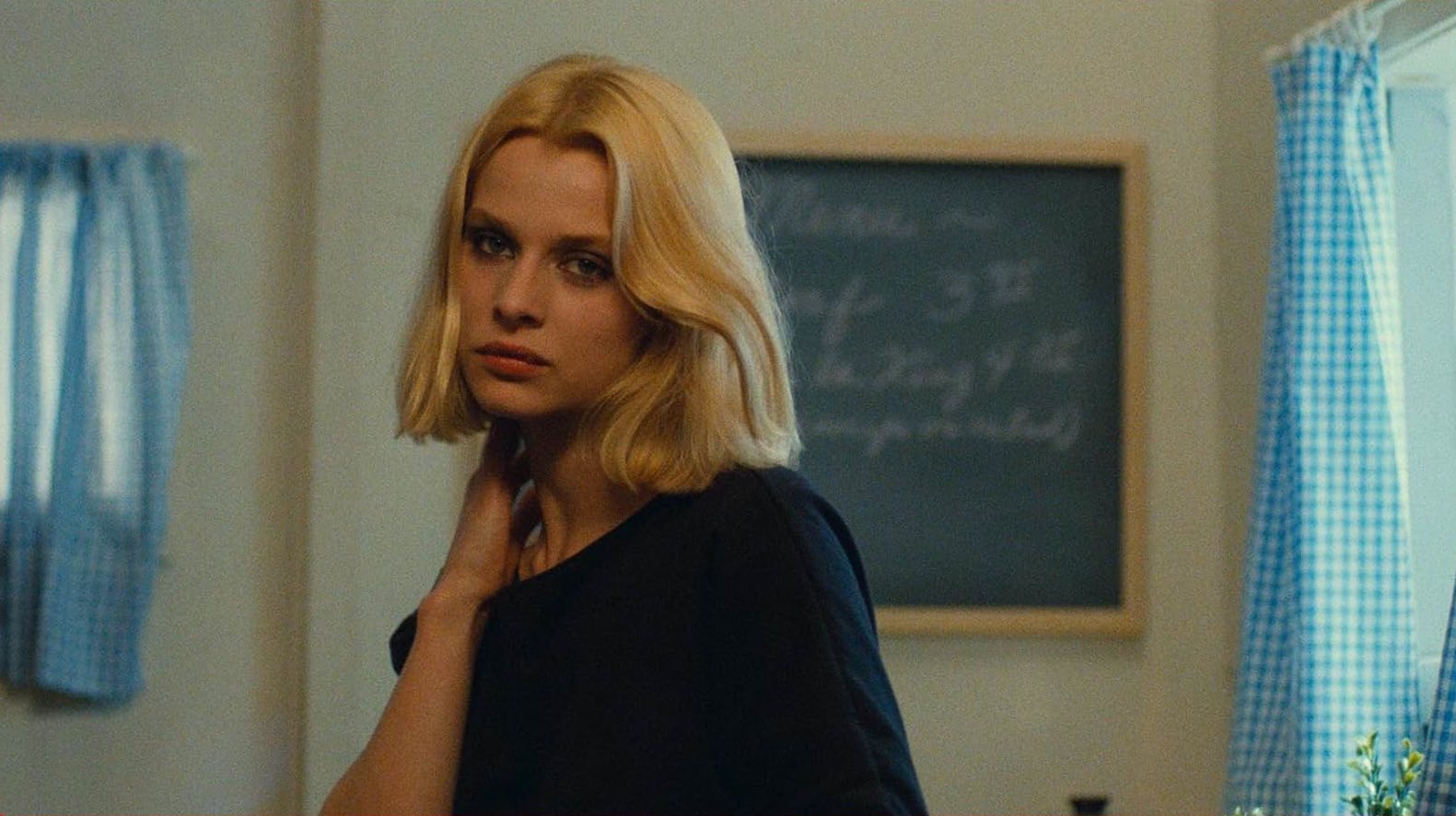
Essay
Forever Searching for Paris, Texas
On watching and re-watching Paris, Texas.
Share:
It’s 1984 in Texas, in LA. Skies are orange; shower curtains are pink. Women are either fancy or plain, and fathers look like fathers, or, at least, they think they should. But underneath these rich colors and the sensitive dialogue that saturates Wim Wenders’s Paris, Texas, underneath the images of a broken family in the American West, lies an intricate story of identity and love unraveled through relationships, a story that continuously leaves me in awe.
It is difficult to resist mentioning co-screenwriter Sam Shepard’s perfect script, Robby Müller’s sublime cinematography, or Ry Cooder’s gorgeously bleak score. However, it is just as difficult not to repeat phrases that already exist. By now Paris, Texas has been written about, talked about, adored, and critiqued too many times to count. It is wildly popular among cinema-lovers. When I first watched the film, I knew nothing about it. I was 19, living alone in Italy, and had texted my mother one night asking for a list of movies that would make me cry. When she replied, Paris, Texas was on that list. Upon first viewing, I did, in fact, cry, although I was not exactly sure of the reason.
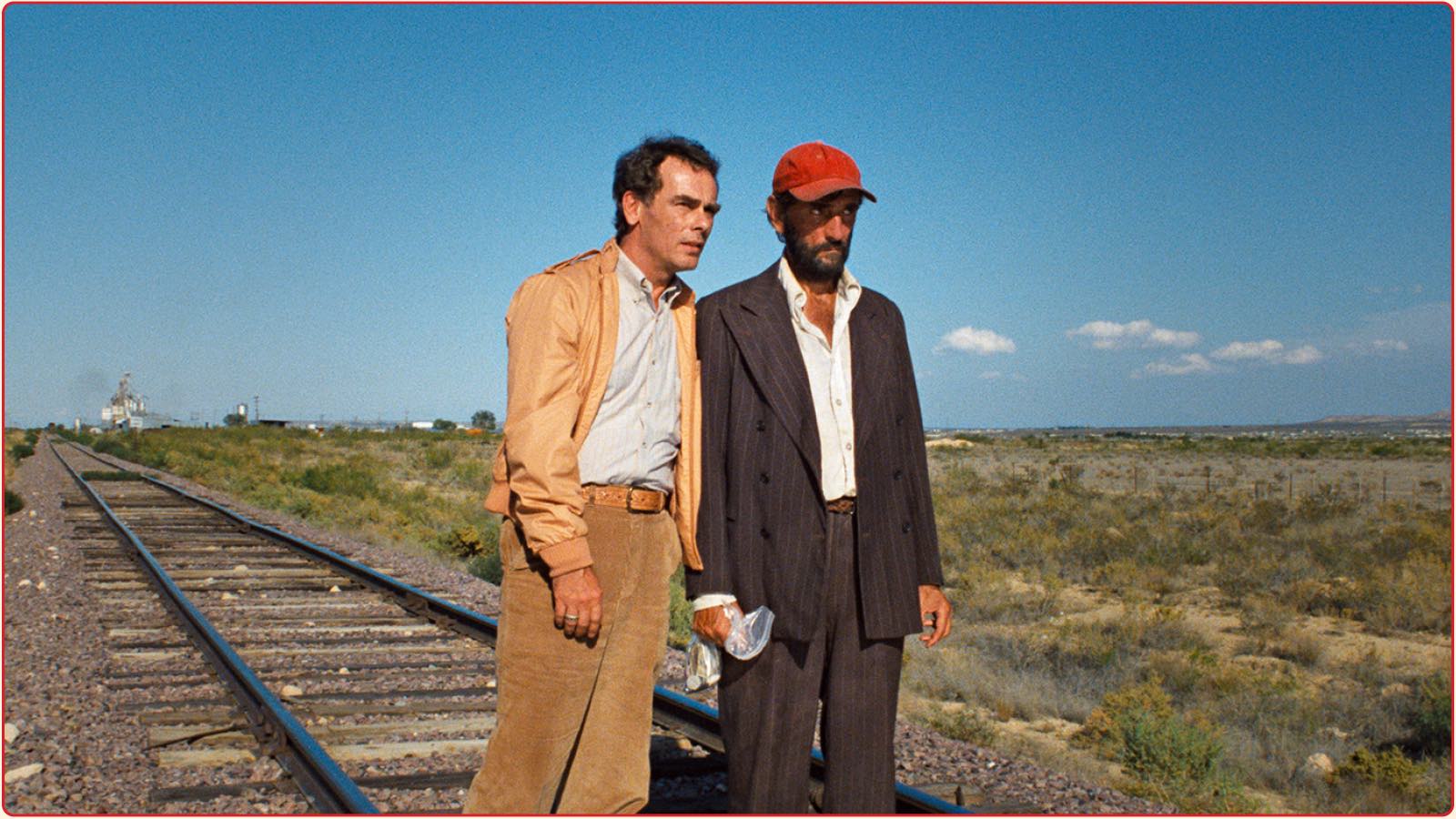
Was the beauty that permeates the film what pulled me in? Or was it something else? Paris, Texas opens with a long pan of the desert. A weathered man (Harry Dean Stanton) walks with a strangely determined, self-assured stride through the desolate landscape, stopping only to drink the last drop of water from his worn plastic bottle. Stumbling upon a small bar, he desperately stuffs a handful of ice cubes into his mouth and falls to the floor. A stranger finds a phone number written on a piece of paper in the man’s wallet and exclaims, “I’m gonna call up this number and see if they can tell me who you are.” Thus begins our discovery of this man’s identity. The number belongs to the man’s younger brother Walt (Dean Stockwell), and it is only through him that we come to learn the name of this mysterious amnesiac wandering through the desert: Travis Henderson.

Paris, Texas (1984)
As Walt drives Travis from Texas to his California home (Travis refuses to fly due to a fear of leaving the ground), he becomes a kind of mirror, reflecting a piece of his brother’s interiority; Travis doesn’t appear to have a sense of himself and relies just as much as the audience does on others to show him who he is. Through Walt’s recollections we get a spoonful of Travis’s backstory: he has been missing for four years, presumed dead; the woman he loved, Jane (Nastassja Kinski), couldn’t be found either; their then three-year-old son, Hunter (Hunter Carson) showed up one day at Walt’s door, so Walt and his wife Anne (Aurore Clément) adopted him, not knowing what else to do. Hunter still lives with Walt and Anne—whom he knows as Dad and Mom—in a house in the suburbs of LA. From the backyard, they watch planes come and go as they look out at the city.
After arriving in LA, Travis sits on his brother’s patio and watches the planes through a pair of binoculars, as if a metaphor for his habit of remotely observing the things he fears. Reintigrating into his life, he begins to confront these fears, endeavoring to fix things; having spent the last four years apparently running away from the past (and future), he begins to see the pain he has caused. Travis tries to “look” like a father: flipping through magazine pictures, standing up straighter, walking Hunter home from school. I have sometimes concluded that my own longing to be someone else is a direct result of being twentysomething, but seeing Travis express such a strong desire to reinvent himself reminds me of the very human nature of this particular kind of longing.
Initially seeming as adrift as Travis himself, the film changes direction, or perhaps finally decides its destination, when Anne confesses to Travis that in four days’ time, Jane will be at a bank in Houston. Just before Travis leaves to look for Jane, he visits Walt at his workplace, where he designs billboards. The two of them stand on the billboard’s scaffolding as thin, gold light colors the horizon. Walt’s coworkers assemble the billboard—an ad for Evian water that depicts a woman wearing a white leotard—their heads almost in the clouds as they construct the image of a fragmented woman piece by piece, putting her on display.
Paris, Texas (1984)
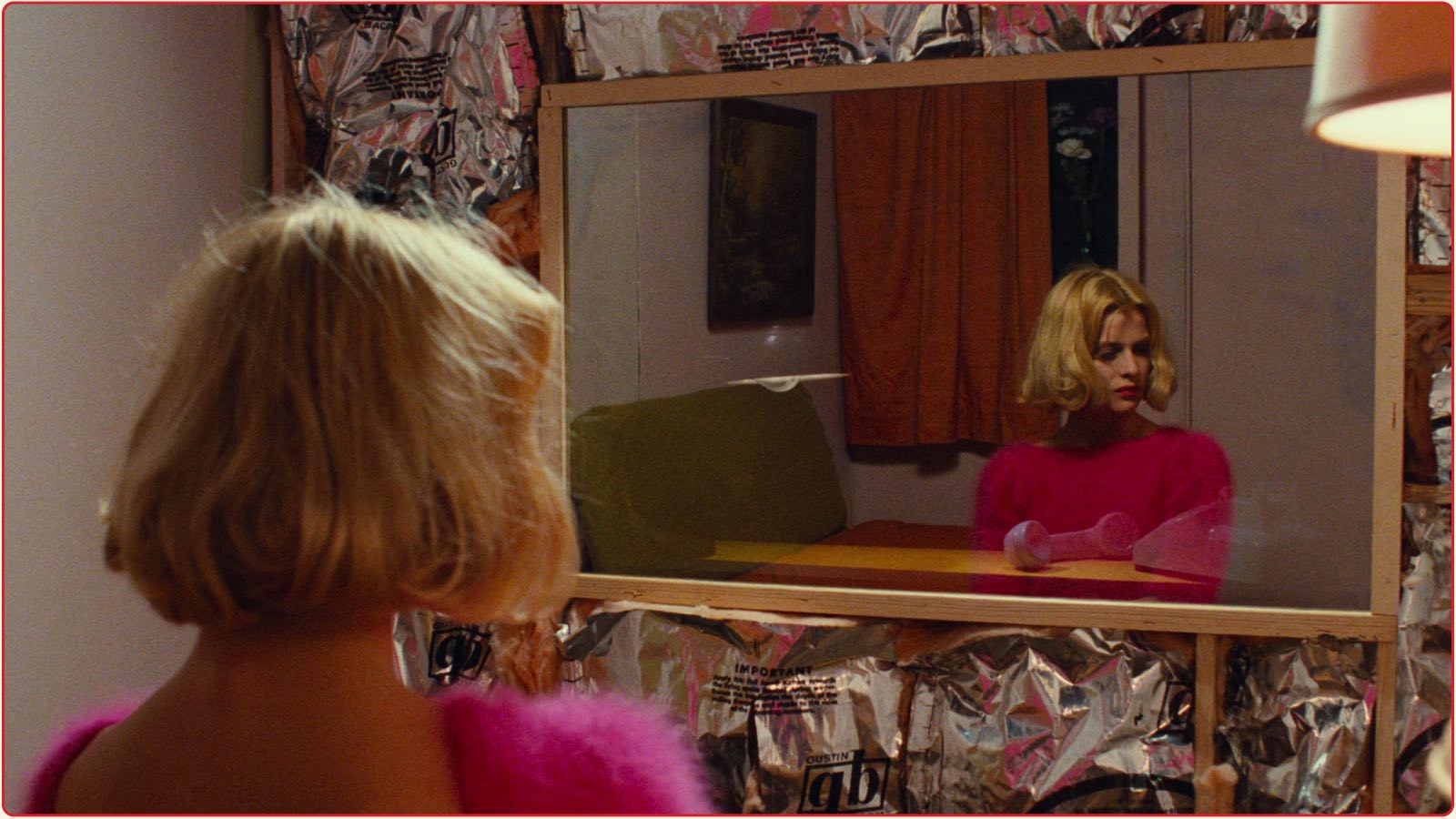
Taking Hunter with him, Travis drives to Houston in search of Jane. After waiting in the bank’s parking lot at which Jane is supposedly depositing money for Hunter, the father and son, both wearing red shirts, finally spot Jane in her red Chevy, and they follow her, ending up at the peep show where she now works. Hunter waits in the car while Travis goes inside and, after some time, finds Jane in booth number four, wearing a hot pink sweater.
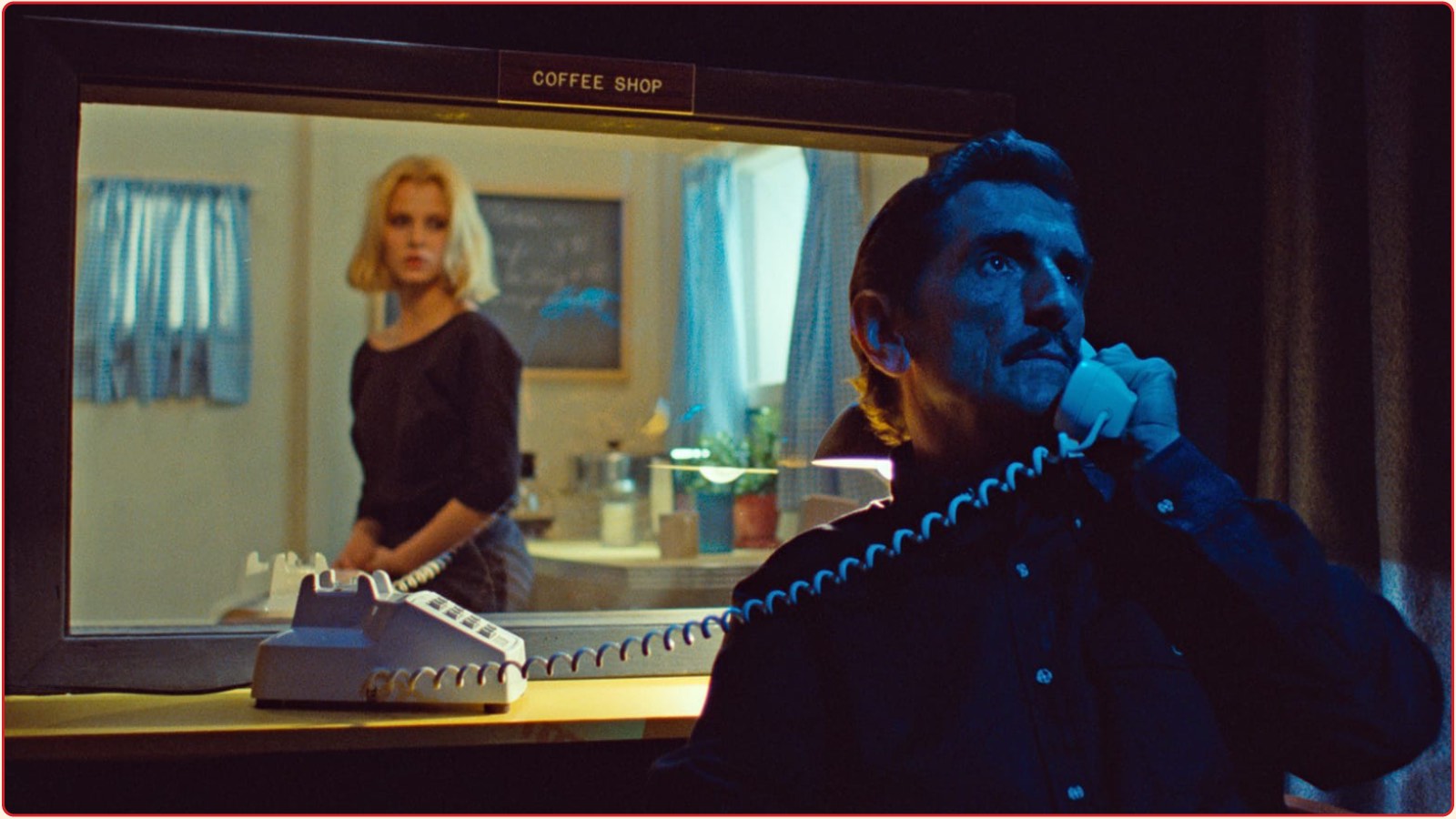
It’s 2020 in Turin. As I watch, I feel the tension in their proximity and simultaneous division, as Travis watches Jane through a one-way mirror while Jane looks back at her reflection, unaware of his identity. Jane sits, restless, in a small hotel-themed booth. In the dimly-lit room opposite her is Travis, who holds a phone up to his ear. In the same way that we can look in a mirror at ourselves, we can look at another person as if they, too, are a mirror. When Travis finally sees Jane, his own image is clarified. He recognizes that his relationship with Jane is not an image on a billboard that can be taken apart and pieced together seamlessly, that his desire to reunite their family cannot be fulfilled.
Travis returns the next day to the peep show to visit Jane again, this time turning away from her as he speaks. As Travis monologues, shifting from a vague story of a man and woman in love to a detailed account of their past, Jane realizes who is speaking, and she transforms—she kneels in front of the mirror, tears falling, hands pressed to the glass—and it is as if the performance she puts on at her job melts like wax until we are left with some visible, visceral extension of her interiority. After a slow and picturesque two hours, we can perceive the shape of Jane, but nothing beyond that. Our one glimpse of her side of their story occurs in this moment, when she gives a monologue of her own, following Travis’s confession (and these monologues do very closely resemble confessionals). As she sits facing away from him, Jane recalls how “it was easier [to talk to Travis] when [she] just imagined [him],” but then says how this imagined Travis eventually began to fade. One can only conjure up so many images of someone else, can only construct so much. That which can physically be seen is only a small portion of what there is to know.
Is it possible to know another person, or only who they are in relation to us? Must we have an absence of self when interacting with others in order to see them completely? Take this seemingly transparent partition in Paris, Texas: on Jane’s side of the booth is a lamp that, due to the nature of the one-sided mirror that separates them, allows her to be visible from Travis’s perspective while he remains hidden from Jane’s view. It is only when Jane turns off the light in her room, eliminating her reflection in the glass, that she is able to fully see Travis. Similarly, Jane is only visible from Travis’s side when he is not directly illuminated.
Paris, Texas (1984)
In one of the final scenes, Travis records himself speaking to Hunter, still too afraid to say what he has to say face to face. “I was hoping to show you that I was your father. You showed me I was,” he says. Just as he only came to understand his own identity with the presence of his brother, Travis remains, to some extent, dependent on his son to prove something about who he is. And despite his hesitancy when it comes to looking reality in the eyes, his ultimate love for Hunter and Jane and his yearning for resolution speaks volumes. Paris, Texas is much more than a road movie; it is a poignant depiction of what it means to live and to love—and are these not just versions of each other?
The film first presents Travis moving toward a destination. Even from the quick and confident way he walks one can assume that he is trying to get somewhere. When Walt asks Travis where he is going, he is met with silence. Travis does not speak or respond, until 25 minutes into the film when he says, “Paris. Have you ever been to Paris?” He asks his brother, “Can we go there now?” We later learn that Travis was likely conceived in Paris, Texas—the small town that gives Wenders’s now legendary film its name—and had been trying to get there, to return to where he began, perhaps to begin again.
It’s 2024 in New York, in wherever. What have I learned of moving backwards and forwards? What have I learned of seeing someone else? Must I be lost in the expanse of a desert until someone saves me? Or must I save myself? Should I dream of an idyllic past? Or should I dream of what could be? Forty years after the film’s release, Wenders’s sunset-seeped finale leaves me in a state of tension: do I cry as I watch Hunter and Jane embrace? Or as Travis watches from the hotel parking lot before driving away? Either way, I cry, simply because it is true. Because heartbreak and longing and reunion and disappointment and sadness and beauty and pain are all true. But then what?
When Walt first finds his brother walking through the desert, he gestures toward the horizon and asks, “What’s out there?” Before Travis has a chance to, he replies, “There’s nothin’ out there.”
Paris, Texas (1984)
Share:
About the Contributor
Recommended
- Re-wind
 On the AV dreams and celluloid nightmares of Hisayasu Satô’s Re-Wind.
 - Listen Up! Mihály Víg & Béla Tarr
 Metrograph’s Listen Up! column, in which we revisit movie scores and soundtracks of note, continues with a look at Mihály Víg’s haunting collaborations with Béla Tarr.
 - Orangey, Revisited
 A video essay ode to the inimitable feline screen star.