
[wpbb post:terms_list taxonomy=’category’ html_list=’no’ separator=’, ‘ linked=’yes’]
[wpbb post:title]

Reynaldo Rivera. Pamela Mendez and Pablo Aguirre Lopez, Echo Park. 1994. Courtesy the artist and Reena Spaulings Fine Art
[wpbb post:terms_list taxonomy=’category’ html_list=’no’ separator=’, ‘ linked=’yes’]
BY
[wpbb archive:acf type=’text’ name=’byline_author’]
On the LA-based photographer’s Reynaldo Rivera’s intimate, debut film.
Fistful of Love plays at Metrograph on Monday, May 20, and streams exclusively on Metrograph At Home from Saturday, June 1. To commemorate Rivera’s solo major exhibition at MoMA PS1, a limited edition print from Rivera is now on sale from Metrograph Editions. Rivera will be in attendance at 7 Ludlow on May 20, signing prints.
“What’s your reason to live?” Reynaldo Rivera asks a performer dressed in drag, the Tejano pop star Selena, while she pins up her hair backstage. Rivera recedes in and out of the mirror, framed by the camera rolling in his hand. Puzzled by such a forthright question, Selena repeats it back to him and, with her hands firmly on hips, responds with talk of community. The camera spins to face her, the shine of her crystal earrings bouncing off the shimmer of her purple halter dress as she replies, “No sé…”
The question of existence, (im)mortality, and the ultimate insufficiency of its expression persists throughout Rivera’s first feature film, Fistful of Love (2024). Rivera was born in Mexicali, Mexico, and spent his early life between California (Stockton, Los Angeles) and Mexico (San Diego de la Unión) before settling in East Los Angeles, where he still lives. He is best known for his photography, which boasts aesthetics similar to the stark drama of noir films and the romance of Silent era productions. The affective melancholy and glamor of his most familiar images often pay tribute to the legacy of his East Los Angeles community: drag performers and trans women of the 1980s and 1990s. Occasionally, he includes himself with a camera in his images, particularly in this film; his practice pressurizes the given and stable position of the photographer “behind” the camera. Shot between 1995 and 1997, Fistful of Love was predominantly filmed in Los Angeles with excursions to Mexico and Nevada. Edited with filmmaker Pablo Bujosa Rodríguez, the film is concurrently showing as an installation in Rey’s solo exhibition that bears the same title, Fistful of Love/También La Belleza, at MoMA PS1.
Fistful of Love, the film, composed of Rivera’s archival Hi8 footage shot on various cameras, follows Rivera with his friends as they return to old haunts, engage in wordplay, party, and attend performances. These selections from his archive are rich with his daily experiences and effectively treat the past both intimately and collectively. Time is counted by breaths and its scissions: car rides, cruising lessons, lovemaking, backstage scenes, drugs, bathroom tête-à-têtes, music gigs, dances with neighbors, house parties, and sidewalk encounters. These histories are archived as resistance against totalizing death drives, essentializing forces and world-destroying mechanisms. In its most discernibly larger historical, archival gesture, the film makes reference to the Rodney King riots in Los Angeles and benefits raising funds against the passing of California’s anti-affirmative action Proposition 209, alongside the violent specter of AIDS. Shortly before cutting to the ruins in the aftermath of the Rodney King riots in Koreatown, Rivera asks his late cousin Trisha what she wants of the world. “World peace?” he teases as he films in the car. Windows rolled down and wind fanning out her brown hair, Trisha quips from the backseat, “What of the world? The world can take care of themselves quite well.”

Reynaldo Rivera. Bianco, Echo Park. 1992. Courtesy the artist and Reena Spaulings Fine Art
While contextualized through these historical markers, the film cannot be reduced as such. The film’s divergent form of storytelling bears entanglements in queer and cultural signifiers along with the politics of class and race. Such resistance and sardonic humor against ‘minoritarian’ categorization also refuses any determining and organizing principle of the film. The lives depicted onscreen-immortalized beyond such space-time markers in moody yet joyous aporia-banter, drink, repeat, flush drugs down the toilet, sing “Como la flor” clutching a Selena Barbie doll while speeding into the balmy Los Angeles night, recite texts on satisfaction and pleasure at philosophical raves, and blow kisses to Rivera’s camera. The filmed scenes of performances at the various bars he frequents are shot without flash to evoke noir’s shadowy and crisp atmosphere: the thickness of the fog and sharpness of the light that accentuates the performers.
These moments take place in the same sites (and with many of the same subjects) as much of the photography Rivera is known for: that is, the art and social milieux of East Los Angeles in the 1980s and ’90s. His camera follows trans and drag artists singing or styling and readying themselves backstage at The Silverlake Lounge, Mugy’s, and La Plaza (enclaves of working-class, predominantly queer Latino and nonwhite patrons). Sequences are intercut with house parties frequented by East LA’s Latino bohemia of artists, writers, musicians, and curators (with appearances from the likes of Michael Queenland, Elia Arce, Cindy Gomez, Rita Gonzalez, scholar C. Ondine Chavoya, and fashion designer Willy Chavarria) and post-punk performances. Rivera includes footage of The Chance Event at Whiskey Pete’s casino, a three-day philosophical rave in 1996 organized by Chris Kraus, and his travels to his father’s village, his grandmother’s grave, and theater and dance performances in Mexico. The creak of these archives beneath the weight of Los Angeles today-an edifice of gentrifying forces and AIDS that has completely destroyed foundational symbolic, mythological and material existences-can be heard in the echoes of Rivera’s artistic practices. To position Rivera’ s work as merely an archival practice in counterpoint to this scaffolding, however, is precarious: the base becomes fragile beneath the burden of all it is asked to support. The image does not pre-exist his camera in the purely ethnographic or documentarian sense. He keeps the image at bay, as in, it escapes the category of document and the suffocating containment of the so-called archive.

Reynaldo Rivera. Martine (Herminia) and Reynaldo Rivera. 1981. Silver gelatin print. Courtesy the artist
The film begins by brutally introducing its central organizing principle: the cut. Friends and strangers spill out from the historic gay bar Akbar, onto Sunset Boulevard where they stop before his camera. Yellow-tinged streetlights and stark neon stop lights make for a noir-like glow against stark darkness as Rivera lowers a suit sleeve to reveal the wound on his arm. When his subjects ask what happened, he proclaims, “I tried to hurt myself and it worked.” He notes that he was not intending to wreak material destruction or death. The wound marks suffering as necessary for existence and the desire and pleasures by which we attempt to live. In this way, the marking of the wound opens the film.
Rivera takes the laceration ever further. Later, at a house party, we see a close-up on a friend’s face as she asks, “Did you get photographs of it?” We cut to the moment of the act, and then back to the party where Rivera attempts to make a cocktail. A friend excitedly names and puns the cocktail he makes “Bloody Rey” after the filmmaker, arm still encased, with nerve endings that have lost feeling due to the violent act of material self-effacement, mistakenly cuts his finger while slicing a lime. And yet, a slapstick moment ensues where Rivera tries to wipe the tequila he has spilled on the counter into the cup, his heavy silver chain bracelet jingling with his movements. There are no further mentions of Rivera’s hand after this scene, but its presence haunts the rest of the film, not in the foreboding sense, but in acknowledgement of the cleavages and precarity of existence.
Suffering-“It’s life,” he asserts-and experience itself in all its agony and joy: distorting time, perception, and reality, much like the reflective screens, windows, backstage mirrors, binoculars, and the uncanny glimpses of Reynaldo’s famed photographs dotting the walls of his apartment that reflect and refract images and perception. It is when Rivera, himself, comes into the mirrored frame while filming that such refractions intensify to their highest point.
Rivera’s scar begins and ends the film: a conclusion with the bedroom scene, the site of the act and its documentation, empty as if to say that the mark itself (wound) and the documented image of it remains insufficient. Psychoanalytic thought exhorts preparation for death and faith in the limits of mortality precisely as an endurance to life; Rivera, in recognition, plays against nostalgic, romanticized inclinations rife in the archive and in memory. The film articulates the inexpressible, the unrepresentable: love, suffering, death in its paradoxical function of both joining and separating, ending and beginning-as perhaps the most articulate expression of desire (unsatisfied satisfaction), de-romanticized. Fistful of Love is inspired by Mary Lambert’s 1987 film Siesta, which follows a woman trying to piece together the last few days of her life after, seemingly, waking up. Intercut with scenes that could be either memories of the past, scenes from the near future, or dreams, Siesta offers a loose structure that Fistful of Love follows in all its ruminative, singular glory and dreamlike beauty.
Mugy’s-recognizable by its checkerboard flooring and oversized fan lettering was owned by Yoshi (Sasaki), a friend and frequent performer documented in many of Rivera’s photographs. While the bar on Hollywood Boulevard no longer exists, Yoshi features twice in the film: first, performing in a long-sleeved floor-length black dress adorned with turquoise taffeta ruffled hems and sleeves, and in a subsequent scene of a decadent hybrid kabuki-flamenco routine, costumed in a maximalist, striped headdress and chiffon, feather-outlined cape that gi pierces through the clouded surroundings. The atmosphere is rendered much like Rivera’s expression of existence, in all its pain, suffering, joy, and ecstasy. As his sister put it outside of Silverlake Lounge, as a glamorous blonde performer approaches the bar, “Las estrellas siempre salen de noche.” “The stars always come out at night.”
Perwana Nazif is a writer and the art director for the Los Angeles Review of Books.
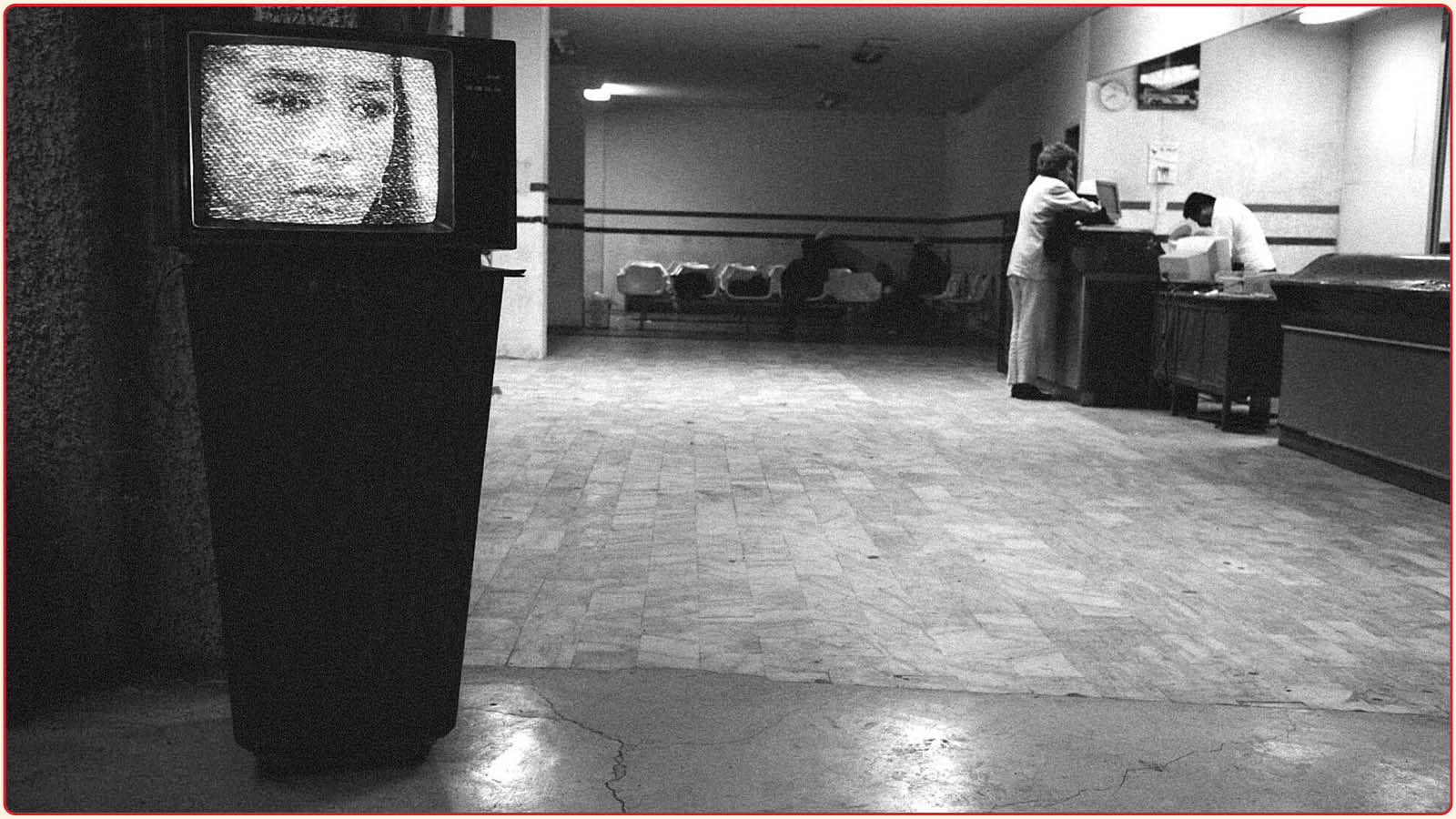
Reynaldo Rivera. Bus Stop, Sonora. 1991. Courtesy the artist