
Column
[wpbb post:title]

Column
BY
The Metrograph Journal
Metrograph’s Double Exposure column, in which two filmmakers interview one another about the craft.
India Donaldson’s debut feature Good One opens in theaters on Friday, August 9, released by Metrograph Pictures. Two Short Films by India Donaldson is now streaming on Metrograph At Home, alongside Eliza Hittman’s debut feature It Felt Like Love (2013).
To accompany the theatrical release of Sundance success Good One, we bring together in conversation the film’s LA-based writer-director India Donaldson and the lauded, Brooklyn-based Eliza Hittman (Never Rarely Sometimes Always, 2020)-two resourceful independent filmmakers who, though at different stages in their respective careers, share that rare ability to craft small stories that resonate, showing great sensitivity to the travails of youth and the intimate textures of place. Over Zoom, the pair discuss their various approaches to making films, their experiences working with young actors, and the often mysterious dynamics of performance. –Metrograph
INDIA DONALDSON: First, I have to call out that I accosted you in front of a café at Sundance this year.
ELIZA HITTMAN: I remember!
ID: I just needed to say that was me, and I’m sorry. [Laughs] I had to tell you how much your films mean to me! But thank you for talking to me now.
EH: I was thinking about the setting of your film, the Catskills, and more generally the woods. For me, it connects back to Shakespeare, presenting a place that can be magical or menacing. It can be a space of freedom or transformation, and the woods can be filled with all kinds of desire-queer desire, transgressive desire…
ID: I love that.
EH: How did you conceive the setting? Were you thinking about it all as being in conversation with this long history of what the woods can represent?
ID: Well, now feels like a good time to say that I went to Shakespeare camp as a kid. So yeah, the question resonates for me for sure! [Laughs]. Before shooting I happened to be showing my son my favorite Miyazaki films. I was thinking a lot about how the natural world in those films is so aligned with the emotional undercurrents of the characters while still being a completely autonomous and powerful entity; it’s scary and unpredictable, but also protective.
My experience of going on trips like [the one seen in Good One] in my childhood and teen years was twofold; there’s the intense claustrophobia of being with the same people for days on end without an escape, and then also the extended periods of silence and quiet, where you can be in the environment and in your own thoughts-and those two feelings can happen concurrently. And especially, when you’re a teenager, there’s so much going on that you’re not vocalizing to the adults around you. I really wanted the natural world to be this space where Lily Collias’s character Sam could sit with that deep well of experience while also juggling and managing the immediate and present needs of the men around her.
Also, something I was thinking about in the writing-but even more so during the shoot and the edit-was just how tiny these characters are within this larger world. For them, it’s a significant moment, but the woods and the waterfalls and everything existed before and will exist after, so it’s sort of neutral, you know? It’s just there to witness.
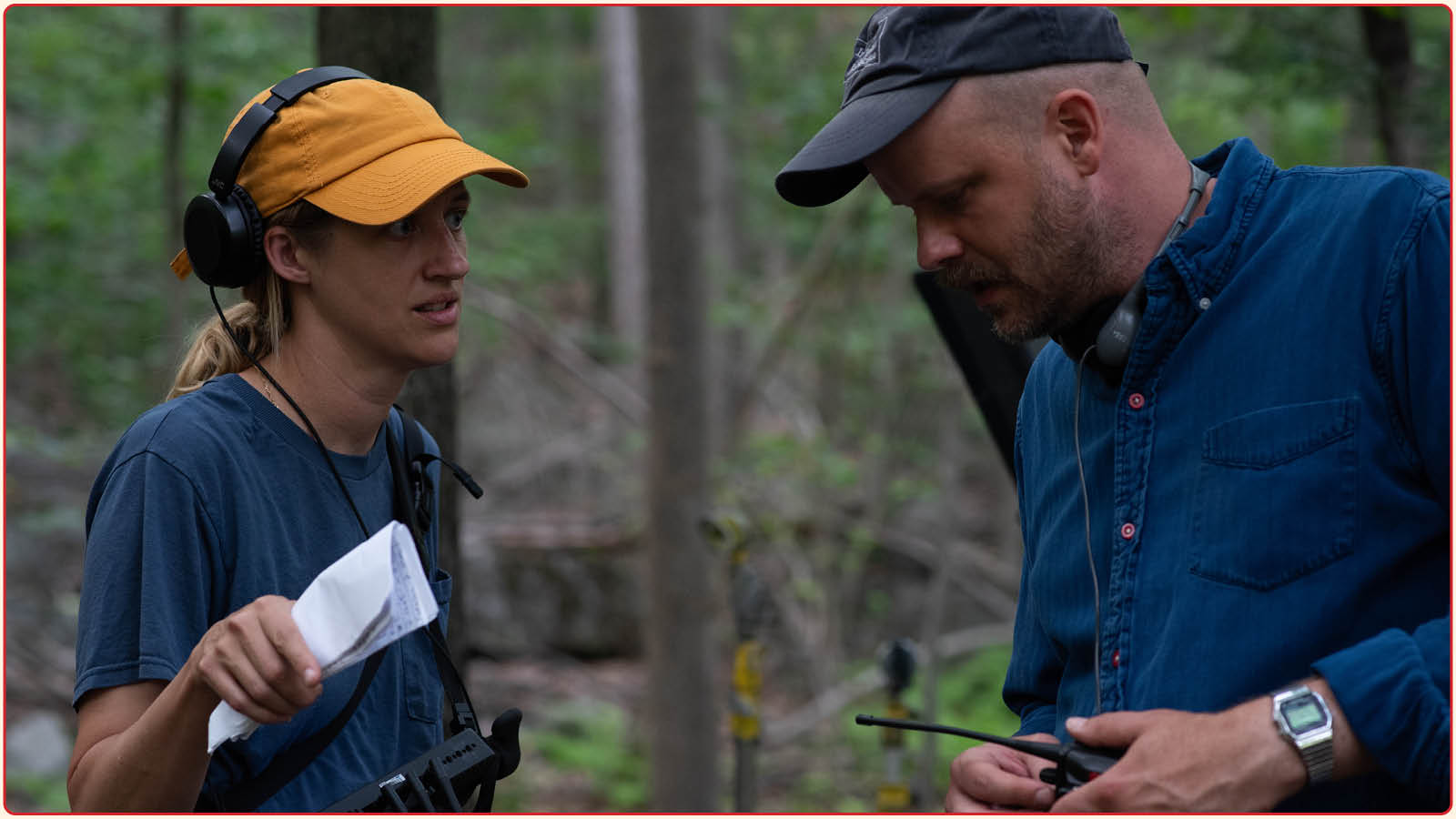
India Donaldson. Photo by Eric Ruby.
EH: I like that. Watching the film, it really resonated as a story of female isolation. For me, there was something so alienating and grating about listening to the men in the film talk, and their conversation. I felt very identified with the main character in having to suffer through their experience of what they wanted this trip to be and where they were in their lives, and particularly the lack of accountability and ownership over their personal stories. I was curious if, while writing, you were hearing them that way, and how you decided to craft that?
ID: Yeah. I have a lot of love and empathy for the male characters, but they also irritate me, and that’s a place where I’m aligned with the main character, her experience of them is similar to my own. But for me, that’s also where, I hope, the humor of it comes in. Sam is conditioned to playing this role and so used to her dad’s eccentricities, and to [his friend] Matt’s too, so if she’d had an ally in this trip, she would have had somebody to laugh about them with-Matt’s kid was supposed to come; if he was there, they’d be laughing about them-but she’s alone. Rather, it’s the accumulation of it all that becomes unbearable to her.
EH: How did you cast this role, and how did you find Lily?
ID: I met Lily through my younger sister who is Lily’s age. We’d been trying to cast in a more traditional way, but having a hard time finding our Sam. On a whim, I asked if she knew any actors, and that’s how we found Lily. It was this immediate feeling when I met her. And her audition was astounding. I was still anxious-we didn’t have the budget for rehearsal time, so it was just really going off of instinct-but after our first day of shooting, I felt incredibly relieved because she was so present, and she had this quiet confidence.
EH: The film culminates in a violation. When you were writing, did you know where the journey would lead? Was it pre-plotted or was it a moment that revealed itself to you?
ID: A little of both. I knew it was going to happen, and I wrote the first draft of the script with an understanding of who the characters were and their dynamics, but just feeling my way through. I had thought it would happen earlier, but it ended up coming out really late in the script. When I went back and read it, though, it felt important that it landed there. Rather than an encounter that happens in the first act that you’re then dealing with, I felt the audience had had so much time to get to know all of them, and so the fallout of the moment would be more disappointing, I hope, but also more complex. To invert it in that way felt more interesting to me.
It’s definitely Sam’s story, but I wanted to provide all the shades of where that moment is coming from for him as well-not to justify it, but to complicate it, and to mirror what she herself is going through. In inappropriate ways, so many layers of his emotional freefall have been exposed to her, and so she has to make this quick pivot from feeling bad for him to feeling violated by him, which is something I’ve experienced a lot throughout my teen and adult life.

Good One (2024)
EH: It’s a very poignant moment. How did you work with Lily to take her through that scene?
ID: We shot that scene last, and I think the process ended up mirroring the way the violation comes about in the story. Lily had the entire shoot to get to know James [Le Gros] and Danny [McCarthy], and to get comfortable with them. Lily told me it felt like a real betrayal-it snuck up on her after 12 days of working and collaborating with them. It was a lucky coincidence that we scheduled the shoot that way.EH: I feel the schedule is often what really unlocks performances.
ID: Is that something you think about a lot when scheduling?
EH: Yeah, to save those scenes for last.
ID: I have to ask: the scene in Never Rarely Sometimes Always (2020) that the title comes from, when did that come in the schedule? That scene is unbelievable.
EH: Thank you. It was shot towards the end.
ID: Interesting. Yeah, when I realized how much Lily, James and Matt were all dreading it, I realized we actually needed all that time leading up to it. So I was grateful for that. And maybe that’s something I’ll carry forward.
To be honest Lily’s performance in those scenes is still a little mysterious to me. She was so just in it that I felt a light touch and a gentle intervention was contributing to the best results for her. We cast her when she was 17, and we couldn’t afford to shoot with a minor so we waited a year. I think she spent that year really getting to know the script, and she had spent so much time with the character that the character popped to me as soon as I saw her in front of the camera. She added depth and nuance and a little edge. With that scene, everyone was so tired, and it was such an uncomfortable moment; I think she was really feeling the things the character was feeling in that moment. We didn’t shoot many times because I could tell she wanted out of it in the way the character wanted out.
EH: In the time you had while waiting for her to turn 18, were you prepping? It feels very prepared, the film.
ID: Yeah. Honestly, I’m so grateful for that year of unofficial prep I had, because we shot the film in 12 days. The only way that was really possible was because Lily, myself, and Wilson [Cameron] who shot it, and Graham [Mason] and Diana [Irvine], our other producers, had spent all our free time prepping, scouting locations multiple times. We put in so much work in that year, it for sure enriched the film.

Good One (2024)
EH: What about you, what did you go in with? Did you have a complete shot list, storyboards?
ID: I went in with a detailed shot list, but I learned something about myself, which was that I do a ton of prep and then I don’t think about it. I don’t think I looked at the shot list once while we were shooting.
EH: You internalize the process?
ID: Yeah, and I think the most important things rise to the surface.
EH: Do you see the narrative as a work of microfiction, this sort of single perspective story focusing on one small transformative moment in a character’s life? How do you contextualize it?
ID: I love short stories, and I love films that, rather than going broader, go deeper; I feel you can do that within a contained setting, and a contained point of view. And there’s possibility for a more emotionally expansive story-especially, when you’re trying to do something on a budget. For me, the way to be ambitious was to go deep with the emotional story rather than, say, gather a large ensemble. I think, in many invisible or more subterranean ways, the micro can be vast, too.
EH: And now, are you working on a film? What’s happening in your world?
ID: I am still soaking it all in, really; processing. The goal with this movie was truly just to make it. I’d been trying to get a different film made for a long time. Then after having a child in 2021 I had this crazy sense of urgency: I can’t keep waiting. That we made Good One, and that it’s now getting released-all these things I didn’t really allow myself to hope for-I am just feeling grateful for all that.
Award-winning director, screenwriter and producer Eliza Hittman is best known for her films Never Rarely Sometimes Always (2020), Beach Rats (2017), and It Felt Like Love (2013).
India Donaldson is a filmmaker based in Los Angeles. Her film Good One will be released by Metrograph Pictures on August 9.
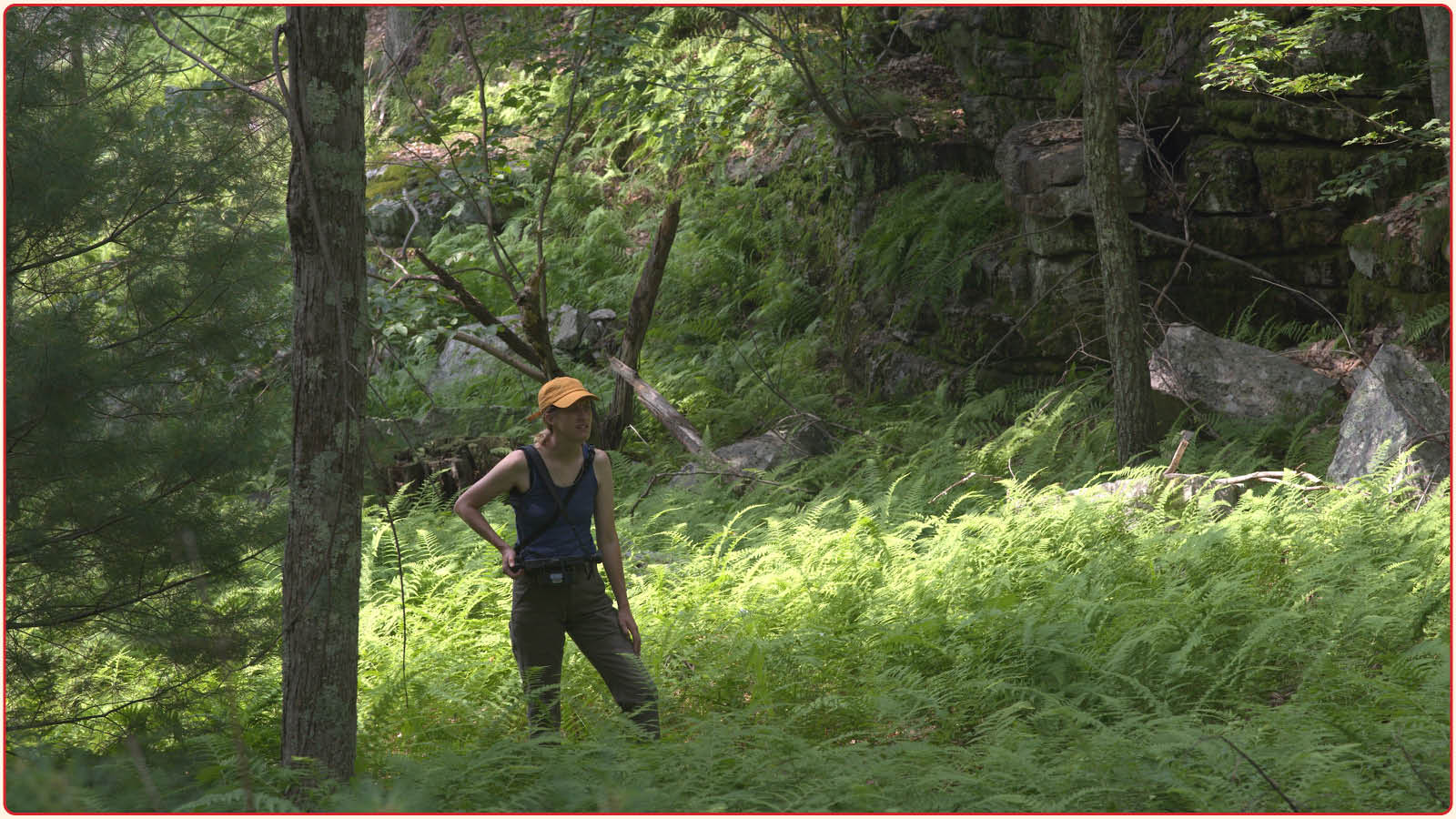
India Donaldson. Photo by Eric Ruby.