
[wpbb post:terms_list taxonomy=’category’ html_list=’no’ separator=’, ‘ linked=’yes’]
[wpbb post:title]
By [wpbb archive:acf type=’text’ name=’byline_author’]
Decoding Michael Mann’s Blackhat.
Blackhat plays as part of Starring Tang Wei at 7 Ludlow from Friday, November 18.
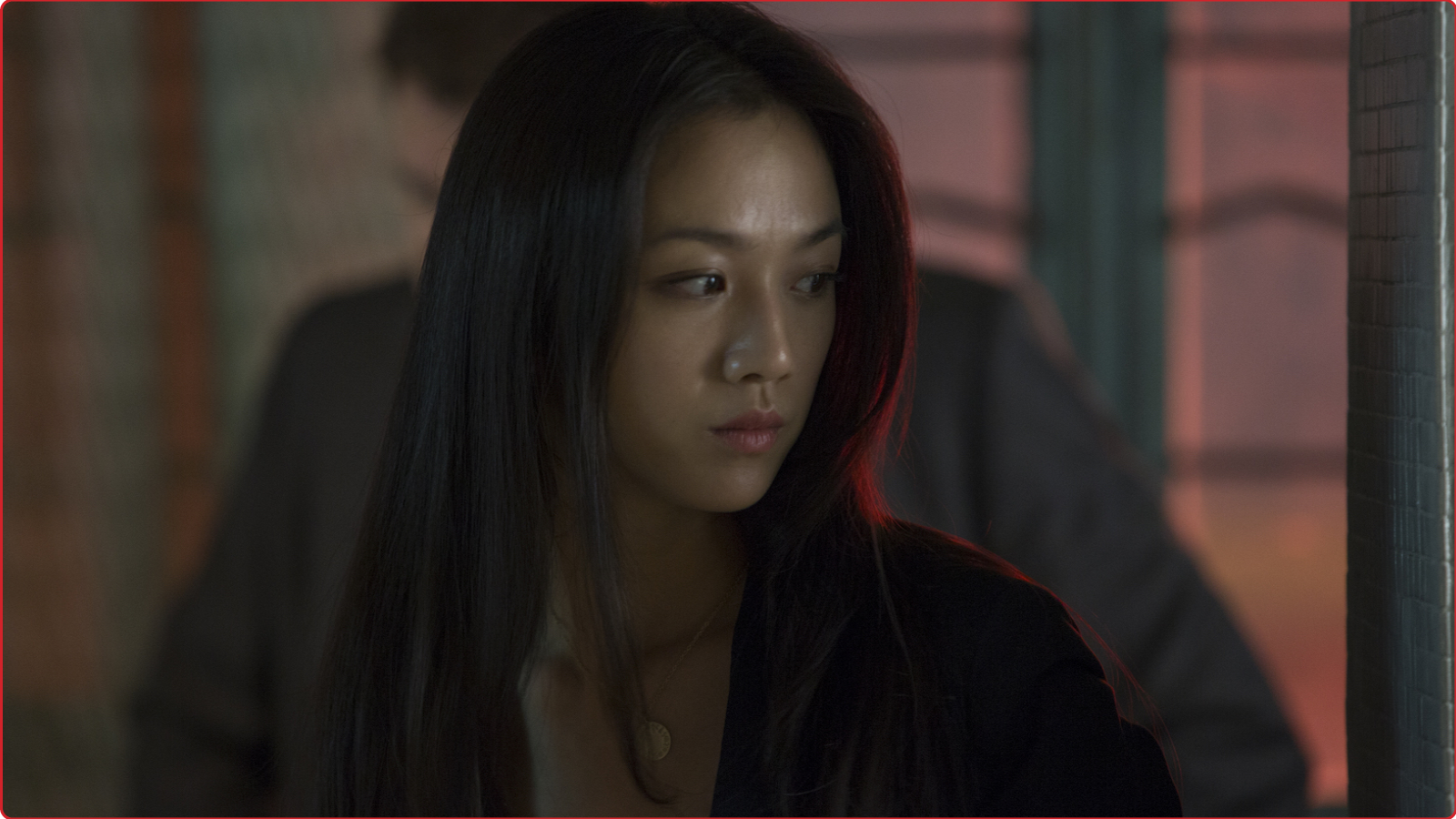
Tang Wei in Blackhat (2015)
“It’s not about zeroes, or ones,” says hacker Nicholas Hathaway (Chris Hemsworth) at the climax of the one theatrical film Michael Mann managed to get made last decade, 2015’s box office bomb Blackhat. Within the narrative of the film, a globetrotting search for an elite cyberterrorist, Hathaway refers to the human cost of attacks on targets such as nuclear power plants. But within the film’s larger context, he could be making a plea for the very idea of a personal digital cinema. “Zeroes or ones,” binary code, already implies in its very name an absence of nuance or negotiation, a limitation of agency-a criticism often lobbed at digital cinema. Mann, who began to shoot digitally with Ali (2001), is the mainstream modern filmmaker who has worked the hardest both with and against the qualities of digital filmmaking, wresting the personal from the impersonal and developing a digitally native yet head-rushingly subjective film language of which Blackhat is, to date, and appropriately, the culmination. Hathaway’s digital pseudonym is “Ghostman,” but the real ghost in the machine is Mann himself.
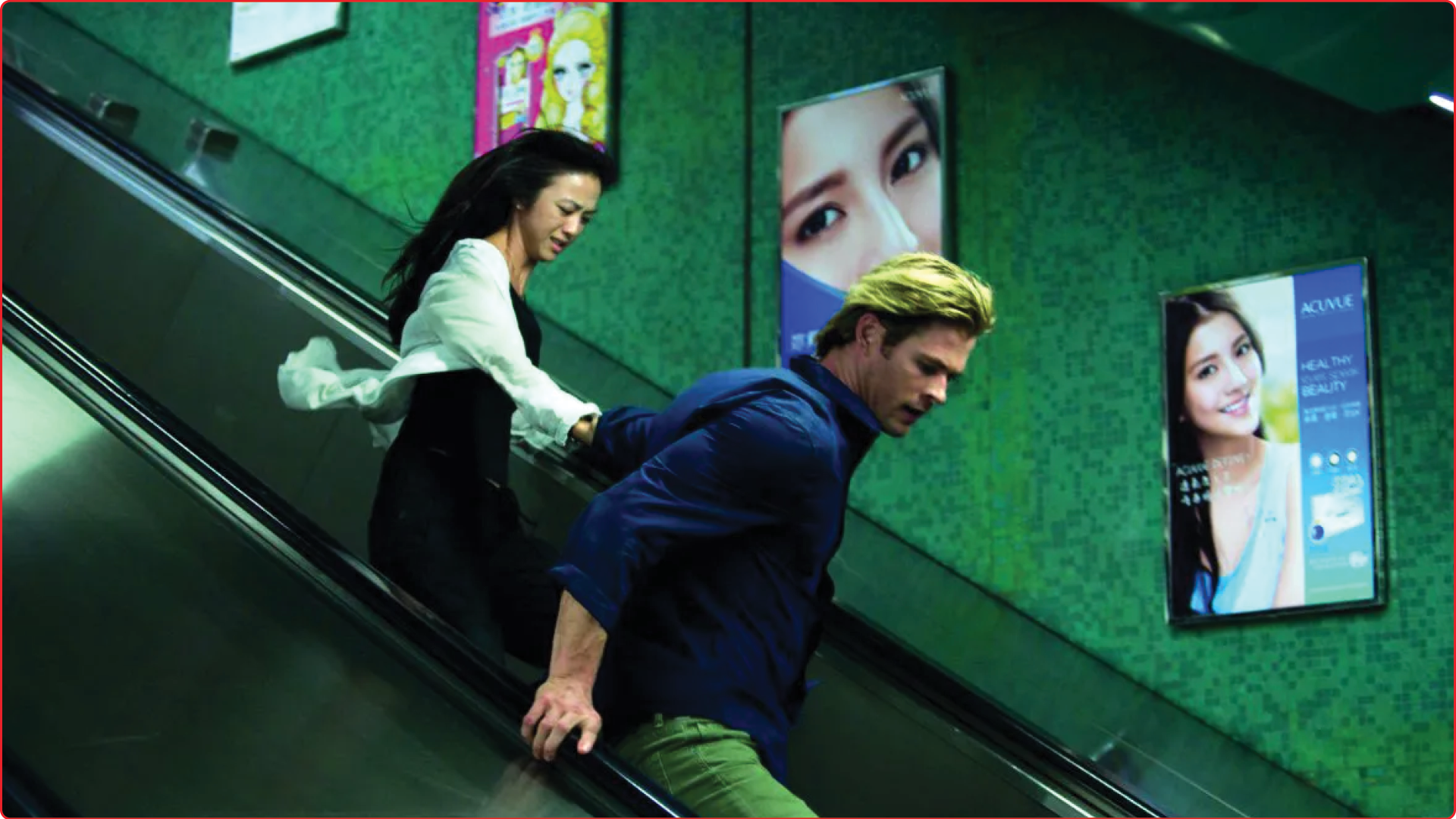
In Blackhat, Mann and cinematographer Stuart Dryburgh employ many of the same techniques Mann honed this century, particularly in Collateral (2004), Miami Vice (2006), and Public Enemies (2009). Digital’s potential for nimbler setups and higher-volume cutting make for unmoored coverage, with dialogue scenes assembled out of an almost random sampling of space. There is still the grammar of classical continuity editing-over-the-shoulder two-shots, the axis of action-but glitchy, with the camera often at an inconsistent eye level, and sometimes finding its way in-between the characters. Even medium shots are compromised with a handheld quaver that complicates our detachment, implicating us within the action rather than anchoring us at a remove from it, and exposition is psychological and intuitive: a surveillance van glimpsed out of the corner of the eye and only ever seen in a partial view; a tracking device affixed to a rear bumper in neurotic looming close-up.
Hathaway’s digital pseudonym is “Ghostman,” but the real ghost in the machine is Mann himself.
In Blackhat, Hathaway must on the one hand concern himself with the hunt for Sadak (Yorick van Wageningen), the hacker whose seemingly unmotivated cyberattacks on critical infrastructure necessitate Hathaway’s release from prison and enlistment into a joint Chinese-American task force. On the other hand, he must also negotiate the mutual distrust between rival governments and territorial pissing between their various security agencies. A pawn in their games and a packet of data in their apparati, he clocks the CCTV camera that is following his movements inside a Korean restaurant and, in a gesture we’re all familiar with, asks not to be tracked (in this case, by adjusting the program linked to his ankle monitor).
Blackhat makes us feel the struggle of the individual to maintain a discrete sense of self within the disorientation of enormously complex digital networks. The camera is sometimes too far away from its subjects, and often too close to see the whole face, with characters reduced to impressions of their ear, their hair, the nape of their neck. The opening sequence, which recalls Charles and Ray Eames’s Powers of Ten (1977), begins with aerial views of networked city lights visible from Earth’s orbit, and then switches from the macro to the micro, showing the conveyance of digital signals flashing across a circuit board, interconnectivity at two scales equally beyond naked-eye comprehension. One moment I love in Blackhat seems to combine the two: a night-time establishing shot of Hong Kong’s towers and the glow of market stalls in the street below, a river of light flowing through a high-tech city.
The darkened city is the quintessential setting for noir, but because digital tends to capture low-light situations with more definition and less diffusion than analog, Blackhat is the opposite of expressionist: sharp-edged, with defined vectors of artificial light set against deep black backgrounds instead of a play of shadows. I don’t think it’s a coincidence that Hathaway and all the other hackers use black Dell laptops with black keyboards rather than sleek, futuristic white or gray MacBooks; Mann fills the frame with light-absorbent surfaces against which sources glow eerie and metallic, a dark web of illumination. He pushes back against the hard-edged objectivity of digital with an amorphous moodiness that, paradoxically, could only be achieved digitally. You feel the heat of CPUs running.
When Mann and cinematographer Emmanuel Lubezki were making Ali, the latter recalled that he used a consumer-grade camera for location scouting, and that he and Mann were equally struck by the ability “to see in this camera things that film could not give us, like seeing the night sky lit by the urban pollution, you know, the light pollution and the clouds.” In Blackhat, the clouds catch and hold the artificial glow of the city below; the skies look like the walls of a room in which someone is watching something on a laptop with the lights out.
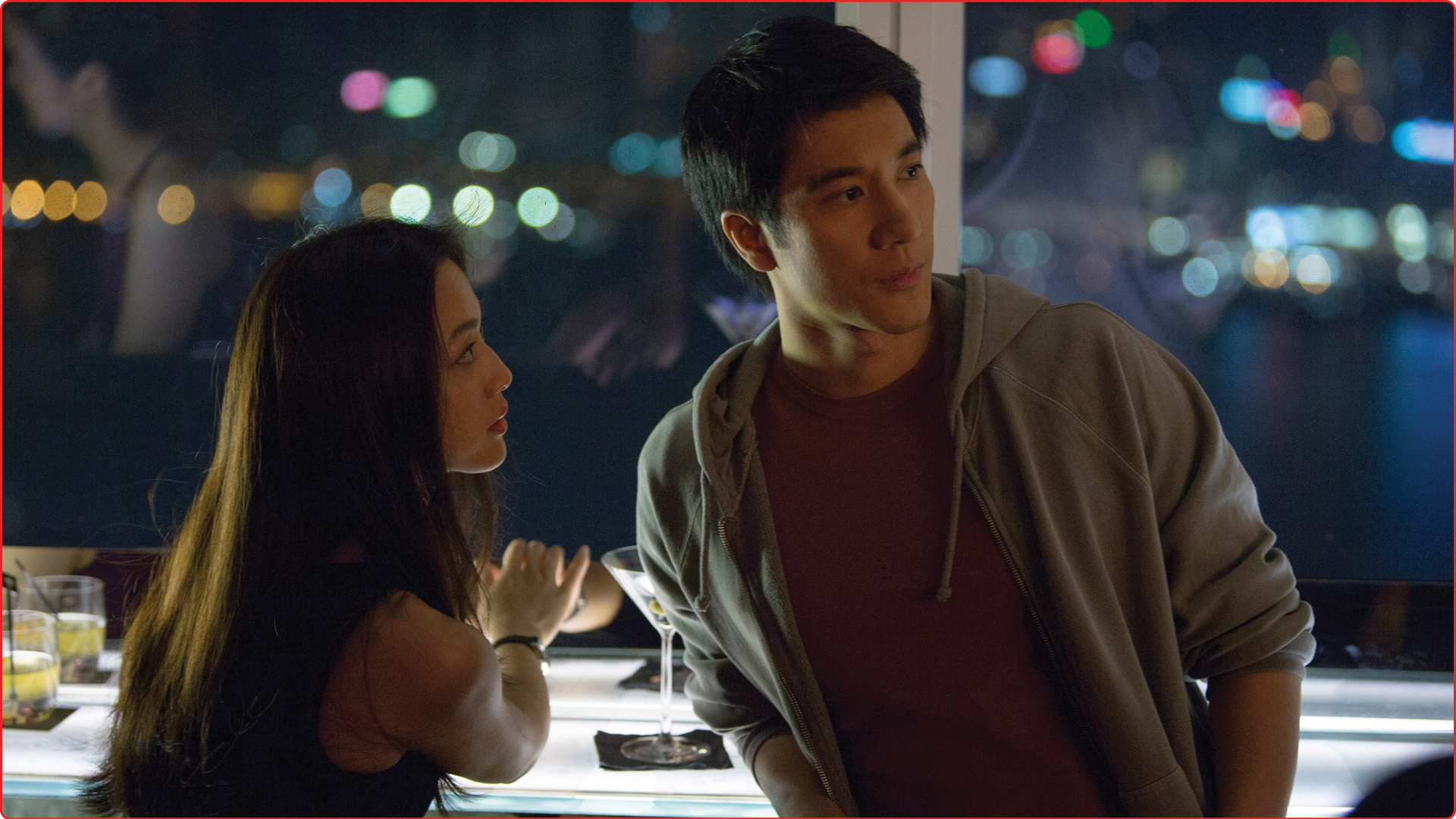
Blackhat (2015)
The daylight in Blackhat is flat, objective. There is shockingly little warmth in the film’s color palette; even hot locations in the South Pacific look bleached and desaturated. The light of day is particularly harsh during a shootout scene in which Hathaway and his team run through a maze of shipping containers like a bank of servers, the sound of gunfire alternately oppressively loud and percussive, or muted or cut out entirely in a reprieve from the brutal clarity. The film has solipsistic headphone vibes, at once overheated and muffled: scenes open or end on characters staring out windows or into the horizon, looking for some Omega Point in the middle distance (like in so many Michael Mann films), or experiencing a premonition of their own death. Throbbing music cues, strings or overwrought butt rock, accompany emotional gestures that come out of nowhere-or maybe out of some unseen roiling interiority-like when Hathaway embraces his old bro (Leehom Wang). Other interactions are suspicious and animalistic.
Against the grain (or lack of grain) of Blackhat‘s streamlined aesthetic, the rugged individualist Hathaway is a Mann Man character if ever there was one, a frankly absurd Übermensch from a filmmaker who, when Miami Vice was on the air in the mid-’80s, would alternate between telling reporters about sneaking into the Golden Triangle to research the Asian drug trade and researching 19th-century painters in London. Hathaway is an MIT-educated computer genius with the body of a Norse god, who occupies himself in federal prison with push-ups and Foucault. “I do my own time, not the institution’s,” Hathaway insists, a proclamation of resistance against the order imposed by the panopticon.
Like Zodiac (2007) and Zero Dark Thirty (2012) but with a plot based around even more up-to-the-minute concerns about information infrastructure and security, Blackhat is a film about sifting through massive mounds of data, and thus implicitly a metaphor for the technology used in its making. It is self-reflexive in an additional, macho-existential sort of way: Hathaway is an auteur. He is pulled out of prison when it is discovered that Sadak has been using a modified version of Hathaway’s old code for his attacks-Hathaway’s authorial thumbprint is visible in the programming language. His code is “lean, graceful” while Sadak’s new code is “frenetic-or overwritten.” This is a none too subtle allegory of creative control; it also establishes the terms of the cat-and-mouse game between co-authors and doubles Hathaway and Sadak. Pursuer and pursued, locked in an unstable binary of self and other, are the source code for Mann’s cinema, most piercingly in Manhunter (1986), from which Mann blatantly lifts the dialogue for Hathaway’s mind-meld with his quarry.
The Blackhat actor who cuts through the fog of Mann’s dissociative milieu is Tang Wei, who, as Hathaway’s love interest, plays off the bruising and bruised Hemsworth with a tart-tongued sense of urgency conveying a restless, sensual intelligence. You can see her thinking-she practically vibrates with thought, in the way she keeps fixing her hair as she talks, or in the twitch of her leg.
When Hemsworth and Tang fall into bed together it’s another of the film’s dizzying plays with scale-his hands are as big as her head. Their wordless, overpowering intimacy is “[their] own time, not the institution’s.” It is pure instinct, desire outside any imposed logic, unresolved. Blackhat ends, in fact, with a nice pun about “resolution”: Mann allows Hemsworth and Tang to escape his camera’s surveilling eye, to go out of focus and end the movie in a pixelated blur.
Mark Asch is the author of Close-Ups: New York Movies and a contributor to Reverse Shot, Screen Slate, Little White Lies, Animus, and elsewhere.

Chris Hemsworth and Michael Mann on the set of Blackhat (2015)