
[wpbb post:terms_list taxonomy=’category’ html_list=’no’ separator=’, ‘ linked=’yes’]
[wpbb post:title]

Charlie’s Angels: Full Throttle (2003)
[wpbb post:terms_list taxonomy=’category’ html_list=’no’ separator=’, ‘ linked=’yes’]
BY
[wpbb archive:acf type=’text’ name=’byline_author’]
On the high-key mysteries of Crispin Glover.
Willard plays 7 Ludlow as part of Animal Farm: Rats.
On the official website of Crispin Glover, charming for how easily its no-frills, red text on black scheme might be mistaken for a GeoCities-era fan page, there can be found an FAQ section headed thusly: “There have been many rumors that have perpetuated about Crispin since the 1980s that are not accurate. This list of frequently asked questions is to clear up some inaccurate claims.”
Sensationalism has cleaved to Glover ever since his turn as Marty McFly’s dweeby dad in Back to the Future (1985) established him as an in-demand character actor, one whose gonzo histrionics easily lent themselves to either fetishization or total non-comprehension. Today, approaching 60, Glover has incarnated a Bedlam’s worth of miscreants, dullards, and irremediable weirdos; characters who get lumped with such sobriquets as “Rat Man” (Willard, 2003), “Wax Man” (Bartleby, 2001), and-one that has proven stickier than Glover’s actual name, at least in the millennial circles I’ve polled-“Creepy Thin Man” (Charlie’s Angels, 2000). Glover himself, the logic goes, must be a pretty twisted character, a notion bolstered by reports of his all-black, Wunderkammer-like penthouse on Hollywood Boulevard, home to his set of anatomical wax eyeballs, amongst other curiosities. (This storied pad is long-gone; these days, he splits his time between a Spanish Revival manse in Silver Lake and a 17th-century chateau in the Czech Republic). And yet there is a touch of reproach-bitterness, even-in the fact that included in his official FAQ is the question, “Is Crispin crazy or on drugs?” His answer: “Many people confuse Crispin the actual person with characters he has played.”
Crispin Hellion Glover-yes, that’s his real name. “Crispin,” for the St. Crispin’s day speech from Shakespeare’s Henry V, and “Hellion,” a 19th-century term for a rabble-rouser. With this endowment, it seems that parents Bruce and Betty Glover-both entertainers themselves, he an actor, she an actor and dancer-quite clearly augured a son of fierce and florid idiosyncrasy.
Like his confrère Nicolas Cage-with whom he shared a screen debut, in the 1981 TV pilot The Best of Times-Glover is known for the full-bodied intensity of his work. But whereas Cage has at times opted to modulate or neutralize his stylistic excesses, all the better to hold down romantic and dramatic leads in Holly-not-so-weird, such compromise is anathema to Glover-one of the key reasons his career forked from that of his fellow Beverly Hills High alum. In commercial fare as in artier endeavors, he delivers performances that constitute a resurrection of the German Expressionist tradition. His Creepy Thin Man, an assassin so dubbed by the Angels, stands as the handiest example: mute but lethal, with jet-black hair and a mime-white face, he is as a modern-day Cesare. Like the somnambulist henchman from The Cabinet of Dr. Caligari (1920), the Thin Man’s knifeish features converge, at the sight of an alluring target, in a kanji of fury.
With Glover, such onscreen fits of apoplexy tend to strike with little warning and dissipate just as fast-see also his poor cousin Dell in David Lynch’s Wild at Heart (1990), one of the film’s less dangerous loons, who writhes in a soiled Santa suit by day and compulsively makes sandwiches by night. His fists clench on being caught bent over a counter strewn with Wonder White: “I’m MAKING my LUNCH!” he exhales. Glover’s outbursts are distinguished by their demonic-neurotic bent; while “Cage rage” runs on machismo, Glover’s are inevitably an expression of impotence-a giving in rather than a letting go. Even in stillness he is spring-loaded, alive to every muscle. In Wild at Heart, Laura Dern’s Lula makes a claim generalizable to maybe all of his screen personae: “My cousin Dell was always fightin’ bad ideas.” A certain nervy vigilance must be maintained.

Willard (2003)
Hence, Glover has infrequently served as a leading man: his turn as the titular Willard in Glen Morgan’s remake of the 1971 horror fable, about a put-upon pencil-pusher who marshals a rodent army in a revenge plot, marks the one occasion a Hollywood studio was brave enough to give him a vehicle. The film does, however, stop definitively short of allowing a romance to blossom with Laura Elena Harring’s solicitous office temp-Glover’s is a case of ‘Always the horned-up swinger (Even Cowgirls Get the Blues, 1993), the lazy-eyed virgin (Fast Sofa, 2001), or the necro-curious gravedigger (Drop Dead Sexy, 2005), never the groom.’ He usually gets sprinkled in sparingly, like chili or cloves or a hallucinogenic of unknown strength. Even in working with as freak-forward a director as Lynch, he’s afforded just two demented minutes of screen time-it’s Cage who gets to wear the cool snakeskin jacket and love up on Dern (though Lynch did put Glover to expanded use in an episode of his 1993 anthology series Hotel Room). Little matter. Glover can steal a scene in seconds flat, with just the narrowing of his beady eyes, or a disarming line delivery. After digesting the narrative in full, one is likely to discover that he is what lingers on the palette; in the brain.
His sui generis strangeness had its blockbuster breakout in Back to the Future, in which Michael J. Fox’s Marty gets sent back in time to his parents’ high school years and, impelled to play matchmaker to his would-be mom and dad, must coach the hapless George McFly in the art of manliness. The 20-year-old Glover, as both the teen- and middle-aged George, gave his character a glottal, nyuk-nyuk laugh and broad, skittish gestures, flinging his limbs about like a marionette; the actor visibly operating on his own, whackadoo wavelength as much as the guy he was playing.
Back to the Future also saw Glover establish a (still lingering) reputation amongst industry folk for being “difficult”-you might frame it as the prophecy of his middle name made manifest, or, if you like, his “density” fulfilled. His Brylcreemed vision of the McFly patriarch brought him into conflict with writer-director Robert Zemeckis (a hatchet buried with 2007’s Beowulf, in which he plays-who else?-the monstrous Grendel): Zemeckis has described getting Glover to cooperate while shooting the final scene, in which Fox’s Marty returns to 1985 and discovers his family’s newfound affluence, as “probably the single hardest thing that we had to do in the movie”-so great was the upstart’s resistance to the country-club-looking costume given him; so vocal his objection to the entire denouement, which he saw as being unconscionably materialistic.
However indecorous, his protests were a matter of principle rather than provocation; of artistic integrity rather than straight obstinacy. The experience of making BTTF left Glover wary of big Hollywood productions-a feeling that, let’s face it, was likely mutual, especially after he sued Universal over the use of his likeness in Back to the Future II (1990), for which he had declined (after a fraught negotiation) to return. Rather than recast the part plain and simple, Zemeckis and Co. contrived to obscure the fact of Glover’s absence, slapping prosthetics on another actor; “Crispin without the trouble,” in the words of cinematographer Dean Cundey. On meeting this knock-off version, Fox presaged, “Crispin ain’t going to like this.” Hoo boy, was he right. The case was settled out of court but became the impetus for a new Screen Actors Guild regulation, and remains a Baudrillardian legal touchstone. It would be 15 years from Glover’s from BTTF before his likeness would consensually return to the multiplexes, in McG’s Charlie’s Angels reboot, at which point he’d decided to make peace with “corporate propaganda” (his words) so as to privately fund directorial pursuits of his own (to date, two thirds of his It trilogy, and a forthcoming, as yet untitled, stand-alone feature).

Back to the Future (1985)
If young Glover were looking to shrug the mantle of Hellion, however, he might’ve chosen a different tack for his Late Night with David Letterman debut. On the evening of July 28, 1987, instead of promoting the release of his then-latest film, River’s Edge-which marked Glover’s first top-billing in a theatrical release-he stumbled onstage in ’70s-style platform heels, tight flares, and a long, higgledy-piggledy wig, setting in motion what Legs McNeil wrote up in Spin as “the best bit of television since Jack Ruby shot Lee Harvey Oswald.”
Once seated, a thoroughly spooked Glover waxed garbled about his discomfort with the side effects of his burgeoning movie stardom-“The press, they can do things, they can twist things around”-before challenging his host to an arm wrestle. “People try to make me sound like I’m a lot… weird, and I’m just, I’m strong!” he sputtered, flexing his bicep. With Letterman all but tapped out, Glover ventured an upping of the ante: “I can kick!” he insisted, launching a very high kick indeed in Letterman’s direction. Under cover of a commercial break, Glover was summarily booted from the show-the only guest to have ever picked up that particular badge of honor. Back in control, a ruffled Letterman defended the expulsion: “You wanna have dinner with the guy?”
This Kaufman-esque gambit, which (unlike Joaquin Phoenix’s half-baked rapper schtick) was executed without the foreknowledge of anyone at Late Night, stoked giddy speculation in living rooms and gossip rags across the United States-that McFly kid is unhinged! An acid freak! If Glover had clearly been courting infamy, he nevertheless seems to have over-estimated his audience’s capacity to clock a piece of performance art. A few years after the Letterman fracas, he would appear in that same outlandish get-up in Trent Harris’s budget buddy comedy Rubin & Ed (1991), playing one of the titular odd couple-“Rubin” was evidently a character, not a bad trip, but the legend had become fact, been printed: Hellion by name, hellion by nature.
The name was in fact a hand-me-down from his father. Bruce “Hellion” Glover had adopted it first, when he was just starting out in the biz. A prolific character actor himself, you might recognize the elder Glover as half of the assassin duo from Diamonds Are Forever (1971) or one of Jack Nicholson’s associates in Chinatown (1974), or, depending on your vintage, as a devilish presence in hundreds of other movies, plays, and TV shows. Interviews with him evidence a showman with a prankster streak. For Crispin, on the other hand, acting is no laughing matter. He eschews the spotlight except for promotional duties-you won’t even catch him clowning in the blooper reels that close out Charlie’s Angels and Epic Movie (2007)-and he has skewed increasingly earnest in interviews, often induced to repeat some variation of his FAQ claim to sanity: “Many people confuse Crispin the actual person with characters he has played.” He is not, in fact, a born exhibitionist, but-often pinstriped, always polite-a professional one.
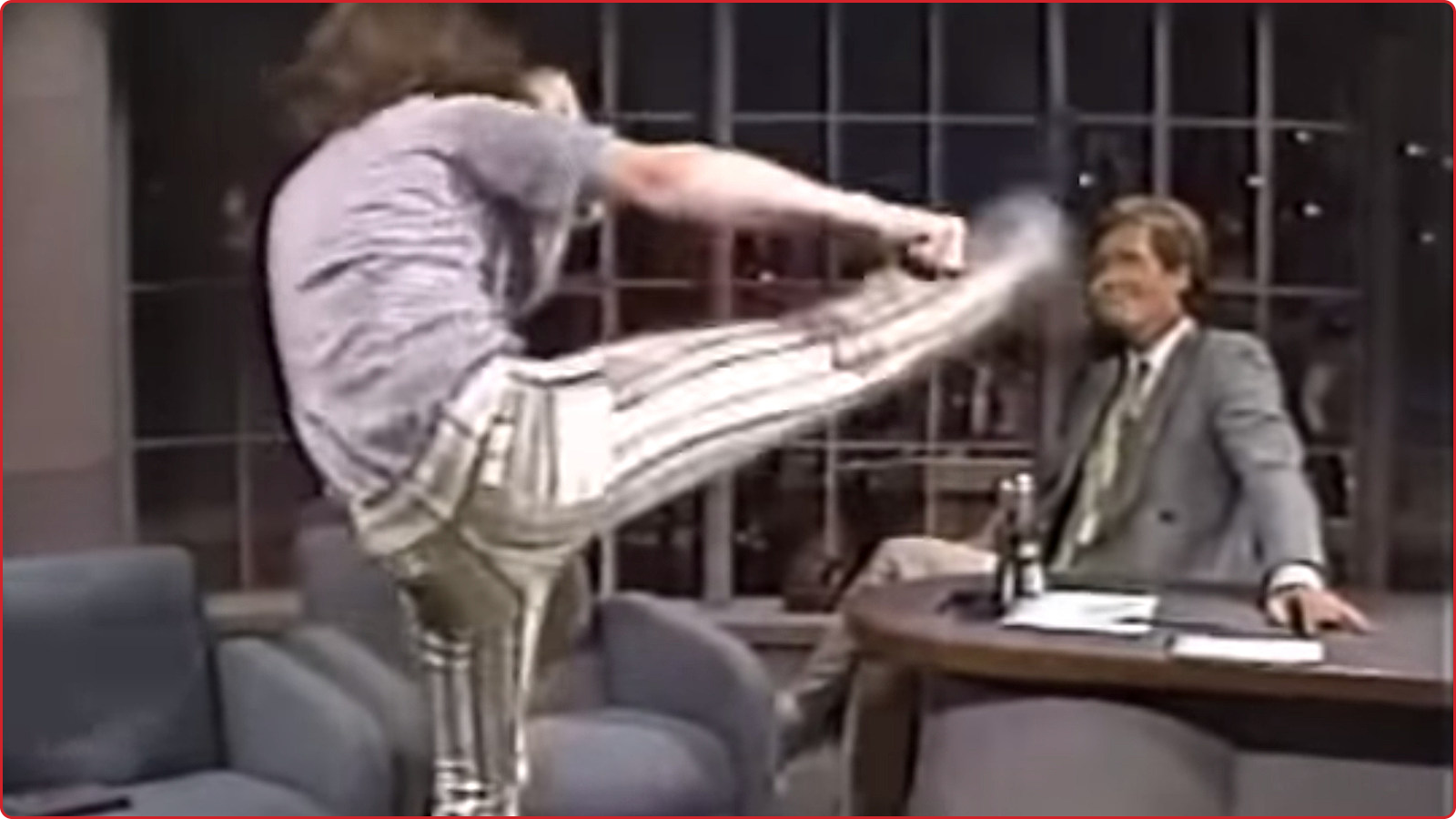
Late Show with David Letterman (1987)
As regards his performance style, however (let alone his physiognomy), Glover seems very much his father’s son. Bruce’s first acting teacher, as he tells it, was a gorilla whose gestures he was studying for his stage debut, in a strip club act. “Think my thoughts and do my moves,” is the instruction Glover Sr. received, without a word passing between man and ape. While big speeches are what tend to scoop up award season statuettes, acting is at its core pantomime-a lesson he no doubt imparted to his offspring.
The younger Glover does have a way with dialogue-he bends his thin, aniseed voice into (as per critic Jonathan Rosenbaum) “goofy rhythms and stresses”-but he doesn’t need it, indeed, sometimes doesn’t even want it, preferring alternative modes of expression. “I wouldn’t trust no words written down on no piece of paper,” his coal-faced seer advises Johnny Depp in the monologue-one of very few in his filmography-that sets the tone for Jim Jarmusch’s acid Western Dead Man (1995).
In Bartleby, Jonathan Parker’s adaptation of the Herman Melville story about an uncooperative clerk, Glover has little more than the one, recurring line, “I would prefer not to.” It is his physicality that makes the performance hypnotic: underscored by noodling theremin, he lurches languidly through the fluoro-lit office space, impervious to the bafflement of his colleagues. As Grendel in Beowulf, Glover contrived to ululate exclusively in Old English; as a spacey Andy Warhol in Oliver Stone’s The Doors (1991), he requested a “line reduction.” Most notable is his reinvention of the Creepy Thin Man, saddled in the Charlie’s Angels script with exposition, as mute. (The hair fixation was also his idea.)
“His command of physical gesture is virtually Egyptian,” remarked River’s Edge director Tim Hunter of his lead-a description that calls to mind Antonin Artaud’s praise for Balinese theater actors as “looking like moving hieroglyphs.” In Hunter’s proto-Twin Peaks tale of teen anomie, Glover plays metalhead ring-leader Layne with slowed-down, stoner intonations and the twitchy physicality of a speed freak. Screenwriter Neal Jimenez thought that he wrecked his movie, but it’s a bravura performance, all the more so for the way in which Glover’s neo-Expressionist stylings clash with the hammy naturalism of his co-stars (Keanu Reeves and Ione Skye amongst them), producing eerie new harmonics-it makes for a film that is, like the actor himself, in a key all its own.
Certain directors have managed to work Glover into their films, not seamlessly, but smoothly: Lynch, Harris, Jarmusch… McG. More often, however-River’s Edge being the finest example-Glover is something like insoluble; add him to the mix and you get, rather than a solution, a suspension. The former scenario, generally speaking, has made for better films in the Gesamtkunstwerk sense, but the latter offers its own, more rarefied thrills. If Glover has now more or less walled himself up in his Czech chateau, preferring to labor in the construction of his own cinematic worlds than visit upon those of others, to keep company with his peacocks rather than studio execs, it is nevertheless true that he has seemed to thrive in (aesthetically, professionally) hostile environments; when he’s had something to push against. Of “Crispin the actual person,” though, perhaps all that can be said with unimpeachable accuracy is that he’s a man of whom questions are frequently asked.
Keva York is a New York-born, Melbourne-based writer and critic. She completed her doctorate on the subject of Crispin Glover’s It trilogy.
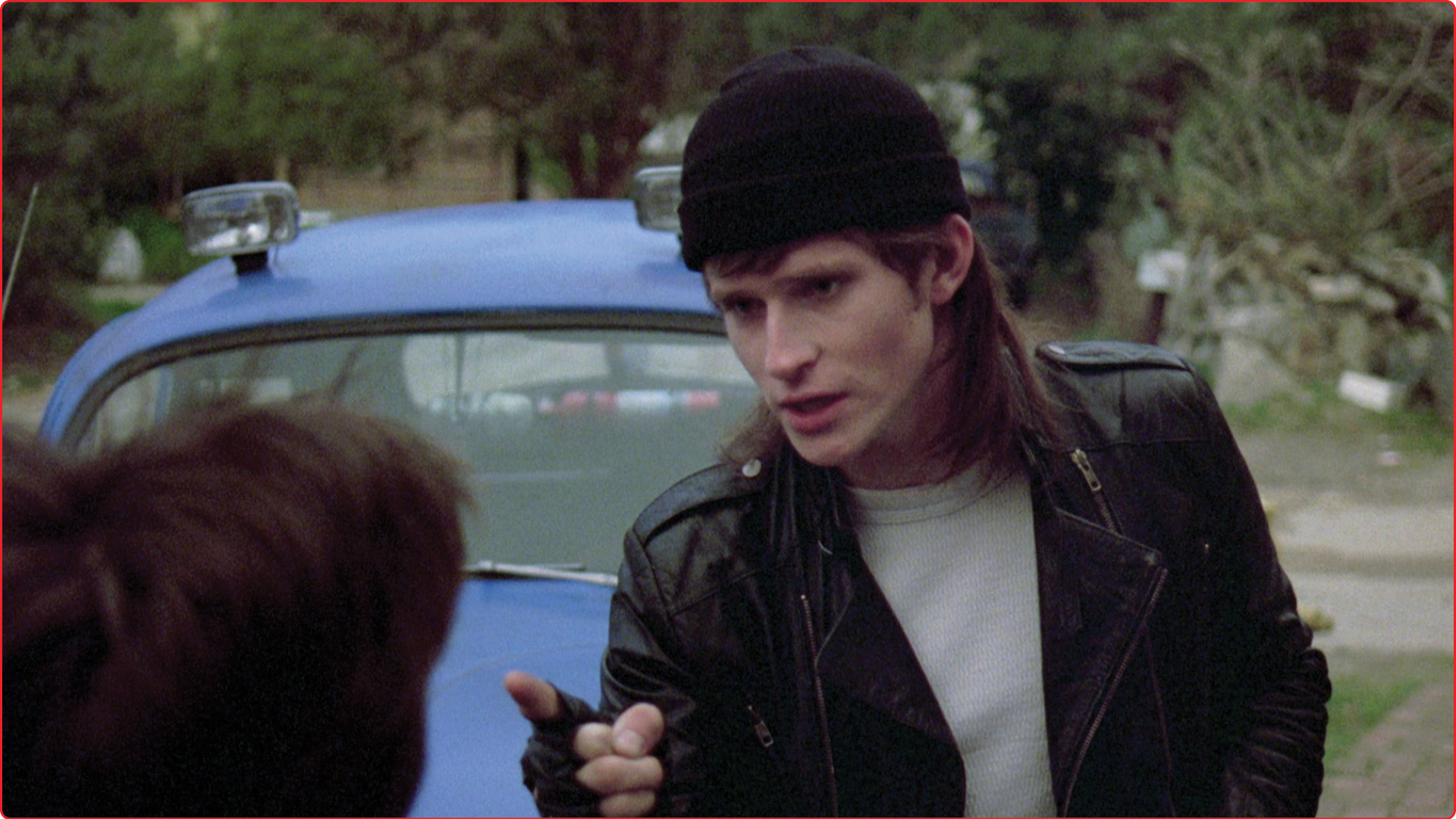
River’s Edge (1986)