
Column
Cracked actor: youn yuh-jung

An Experience to Die For (1995)
Column
BY
KYUNG HYUN KIM
On the actress whose bold performances blazed a defiant trail in Korean cinema.
An Experience to Die For plays at Metrograph in Theater and At Home from Friday, May 17, as part of Kim Ki-Young x 2.
In 1991, South Korean audiences were glued to their television sets every weekend for What is Love (Sarang eui mogilrae), which still holds the record for the highest viewership in Korea’s television history. The series starred a steely Youn Yuh-jung as the affluent, cantankerous mother of the new bride who has just married into a working-class family, faithful to conservative, neo-Confucian principles. Youn’s portrayal of Han Shim-ae, a woman with unapologetically high spending habits, was groundbreaking. The character not only challenged patriarchal norms, but also the nation-building ideology of the military dictatorship that had encouraged financial thriftiness for decades. When her daughter reports that her in-laws are critical of her lavish expenditures, Han stridently defends herself: “What is wrong with getting a new garment at every turn of a season?” Youn’s character must often contend with the disapproval of both her husband and her daughter’s new father-in-law; and she stands in stark contrast to the groom’s mother (played by Kim Hye-ja), who constantly finds herself sewing and mending tattered family clothing in the corner of her traditional ondol-style family room (with neither a chair nor a bed). You couldn’t imagine the defiant Han forced into such a traditional domestic role. If she ever was pressured to perform such menial housework, she definitely wasn’t going to take it.
Youn’s character marked a fresh departure from the days of restricted women’s rights. Her gravelly voice rendered a splendid version of femininity that broke with the conventional voice of Korean actresses at the time: demure, high-pitched, and accented with what Koreans would call aegyo (staging cuteness to please men) tones. It was her unorthodox, raspy voice that dulled the sharp edges of the neo-Confucian values that ruled South Korea and reshaped the perception of Korean femininity for an entire generation of filmgoers and television audiences. It was the kind of voice-not unlike Katharine Hepburn’s quavering tremor-that left an indelible imprint on your memory. When she made her dramatic return to the big screen in Im Sang-soo’s The Good Lawyer’s Wife (2003) as Hong Byung-han, a grandmother who pursues her own pleasure, her first lines in the film make it very clear that women’s lives do not revolve around sacrifices: “You are one hour late…Do you take me for an old lady who has all the time in the world to look after your kid?” She scolds her daughter, whose tardiness has made Hong late for a date with her lover, the man with whom she is having an extramarital affair. Referring to her own grandson as “your kid,” Hong’s line, delivered so fiercely by Youn, shatters an age-old patrilineal arrangement that had bonded extended families for centuries.
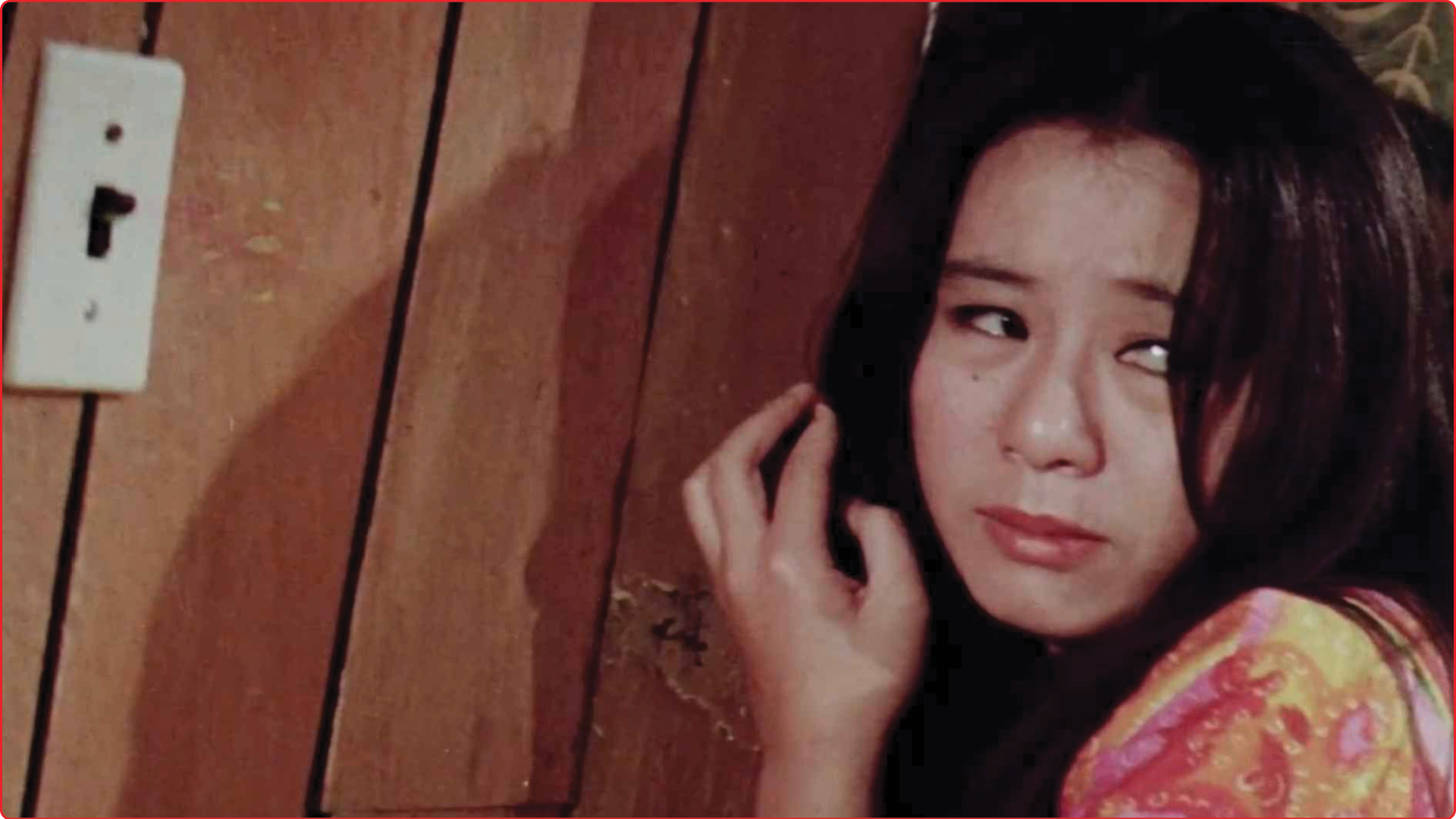
Woman of Fire (1971)
Draped in expensive jewelry and designer handbags and coats, Youn frequently played roles that found her drinking, smoking, and seducing men, splintering the on-screen stereotype of older Korean women, constructed to police the society’s moral values. Previously, the archetypal mother figure in Korean cinema and television was embodied by the aforementioned Kim Hye-ja, who repeatedly played self-sacrificing women, loyal to her husband and children above all else. Always even-keeled and asexual, these characters had neither independence nor sexuality before Youn. The actress cemented her persona as the antithesis of a virtuous woman upholding the values of deference and chastity when she was cast in the popular miniseries Queen Jang Hee-bin (1972) as the titular 17th century royal, who-like Queen Margot of France-boasted a tarnished reputation for her nymphomaniac desires and hunger for power. In Im’s Taste of Money (2012), an explicit portrait-in the vein of Pasolini films-of sex and sadistic violence among aristocratic people, she plays Geum-ok, a greedy patrona. When her mogul husband informs her of his plan to leave Korea and accompany Eva, the Filipina maid, to the Philippines, she silently accepts his decision, only to rise from the breakfast table and slap Eva. Shot in a single long take, this scene reveals Geum-ok to be a figure as poised and shrewd as she is capable of impulsive violence. These performances established Youn’s image as an assertive woman, unafraid of her desires, and a sexual enigma that relies on her erotic prowess to seduce men.
But from her very earliest roles, she had defied the stifling contours of what was expected of women both off-screen and on-screen. When Kim Ki-young, the maverick director of Korean cinema during the so-called Golden Age of the 1960s and 1970s, was casting the infamous femme fatale role in the latter films of The Housemaid trilogy, it is not coincidental that he chased after Youn, a relatively unknown university student-cum-actress, with just a couple of years of experience in television dramas. Youn’s breakthrough performances in Kim’s Woman of Fire (1971) and Insect Woman (1972) echoed the young, fearless vamp role from Kim’s first classic The Housemaid (1960): women who espouse total disrespect for traditionalist order and structure. In Kim’s harrowing films, Youn frequently delivers outrageous, razor-sharp lines that crack open the thin veneer of the patriarchal ideology: for instance, in Insect Woman, when she states, “You are not a 50-year-old anymore. If you sleep with a 19-year old, then you, too, are a 19-year old.” Youn shook the myth of “good girl” until it had been completely torn asunder in South Korean screen culture.

An Experience to Die For (1995)
What is Love had marked a triumphant comeback for Youn, who took a long hiatus for nearly a decade and a half during the peak of her career. She achieved stardom at the tender age of 25, after the success of Woman of Fire and Insect Woman, and married Cho Young-nam, at the time the country’s top singer, who ultimately proved a cruel and unfaithful partner. She spent close to a decade in Florida, raising two children as a single mother, and worked menial jobs as a supermarket cashier at minimum wage, with limited English, before she returned to Korea to start her career anew at nearly age 40. Upon her return, director Kim gave the actress yet another opportunity to star as a murderess who plots revenge against her unfaithful husband in an Experience to Die For (1995). Sadly, this would be the final film directed by Kim, who died in a tragic house fire in 1998.
The two roles Youn is perhaps best known for outside Korea, Soon-ja in Minari (2020)-for which she won an Academy Award for Best Supporting Actress-and Sun-ja in the Apple streaming series Pachinko (2022), embody the turmoil and hardship suffered during the 20th Century in Korea, when millions were forced from their homes due to colonial exploitation, war destruction, and harsh military dictatorships. These roles, two grandmothers-both sympathetic, yet incomprehensible and distant figures-reflect her own life, where transnational migrations entailed extended suffering and abuse. In Minari, the first gift Youn’s character offers her prepubescent grandson is a deck of red plastic cards called hwatu, commonly used for gambling games in Korea. When confronted by her daughter about the cards being inappropriate for a six-year old, she retorts, “Wouldn’t it be better if life lessons were learned earlier so that he can beat up others?” Gambling, just like life’s vicissitudes, perhaps has both merits and demerits. To achieve the career she has had, Youn, much like many of the Koreans of her generation, had to learn from the bitter lessons of gambling; there can be no success without the risk of “going broke,” professionally or otherwise.
Kyung Hyun Kim is author of Hegemonic Mimicry: Korean Popular Culture of the 21st Century and Virtual Hallyu: Korean Cinema of the Global Era.

Minari (2020)