
Cracked Actor
Keanu Reeves
On the mysterious magnetism of the transcendent movie star.
Whoa! Keanu Before The Matrix plays at Metrograph from Friday, November 21.
Johnny Mnemonic (1995)
Share:
KEANU REEVES HAS BEEN COMPARED to a block of wood and a Prada model. He has also been described, over the course of his 40-year career, as a sly Brechtian actor, a mirror, a tabula rasa, and a robot. There was a “Whoa”-ful period in the ’90s when you couldn’t, like, write about the dude without totally festooning your prose with his most excellent Bill & Ted’s deliveries. “He is one of the top three Hamlets I have seen,” the Sunday Times critic Roger Lewis wrote of Reeves’s 1995 turn in a Winnipeg production of Shakespeare’s play, a role Reeves reportedly chose over that of Chris Shiherlis (eventually played by Val Kilmer) in Michael Mann’s Heat. Born in Beirut in 1964 to a British mother and a Chinese Hawaiian father, and raised mostly in Toronto, Reeves has been called “unplaceable,” a word meant to gesture, perhaps, towards his ambiguous ethnicity, and one that doubles as shorthand for the outsider, man-apart aura he can exude at will. He is not a shapeshifter or a chameleon—he is a beautiful mammal—but his reputation among critics and audiences has changed its colors repeatedly over the years. For the last decade, writers have been undertaking a breathless reappraisal of his performances and abilities, as well as analyses of these reappraisals. Where, with notable exceptions, they once saw dull, monotonous acting (and even freely insulted his intelligence), many now see in Reeves’s output a subtly variegated tapestry of feeling and thoughtful physicality. They see light and grace, a kind of pure incarnation of popular cinema and a cherished representative of that endangered species, the transcendent movie star, who operates in the same body-on-the-line, action-hero mode as Tom Cruise minus the baggage. Reeves is, according to a New York Times list, the fourth best actor of the 21st century.
Who’s right? I’m tempted to dismiss the authors of yesterday’s pans for living in a dream world and to tout those of today’s paeans as red-pilled (on the specific matter of Reeves). But none of their takes are The One. Together they express a desire to resolve an uncertainty about the nature of acting—his, anyone’s—that Reeves has spurred in viewers across his 70-plus screen roles. This is a roundabout way of saying that I love Keanu Reeves, that when I received this assignment my first thought was “I love Keanu Reeves” and my second was “What, exactly, do I love about Keanu Reeves?” I love the long dark horseshoe of hair that frames his face these days, sure; I love the gun-nut boy camp of his killing sprees in the John Wick franchise, too. Do I believe he has, on occasion, resembled a block of wood? Yes, but a very expensive variety, with a fine, complex grain, hidden notches, and perhaps alien origins: an intriguing, glimmering block, containing multitudes of wood. Like the Norwegian writer Karl Ove Knausgaard, Reeves has found in the sometimes prosaic, blank style of his art a means of dramatizing miniscule emotional gradations; his mask of reserve, and the cracks and fissures that he etches in it, have enabled Reeves to play a man out of his depth better than almost anyone. And, in some of his earliest films, well before his era-defining turn as Neo in The Matrix (1999), Reeves reflected questions about how an actor should relate to his material—and how a person should assimilate life’s overwhelming violence and inconvenience—back upon his audiences. Call his project a meta-inquiry into the struggle between impassivity and feeling.
Before he was much of anyone, Reeves was a long-haired high-school pothead wrestling with the death of a classmate in both River’s Edge (1986) and Permanent Record (1988). In River’s Edge, directed by Tim Hunter from a script by Neal Jimenez, a group of high schoolers must decide what to do when one of their friends strangles another in cold blood, strips her naked, and then brings them out to see her body by the riverbank. They do not call the police. Mostly, they do nothing, not even mourn. The pitch-black crime drama mines significant comedy from its young characters’ indifference and amorality. A greasy, goblinish Crispin Glover plays Layne, the speedfreak leader of the gang, who wants to cover up the killing and protect its perpetrator. Reeves, clad in a leather jacket and denim vest, plays Matt, who alone among the adolescents wants to feel bad about the femicide. “Even that close, we don’t even feel like we lost anything,” he says of his encounter with the girl’s body. We see in his face then a secret strain pulling at a smooth surface. Already, very near the start of his career, Reeves was expert at expressing a character’s stunted but genuine desire to feel. He embodies a certain obstruction in the flow of sentiment, a postmodern affective agnosia: he is simultaneously assailed by the knowledge of how he should respond to an event, discomfited by his failure to respond in the terms that popular narrative forms and social mores insist he ought, and yet still willing himself forward, toward a blunted but genuine emotional phrasing. In one scene, he mutters and then yells the words “I don’t know” in response to a police officer’s questions about his mental state; in another, he wears a dopey look of wonderment as he contemplates his own apathy, ironically one of the only things that can evoke strong feelings from him.

Bill & Ted’s Excellent Adventure (1989)
River’s Edge debuted the same year as Blue Velvet, and both films feature Dennis Hopper as a wacko with a gun. Both were also photographed by the great Frederick Elmes, and center young Americans confronting sudden eruptions of psychopathy in small towns. They have their share of differences, too. In River’s Edge, there is no fake birdsong or rapturous melodrama to counterbalance the anomie; a fog hangs over the trees and the titular river, trapping the characters in a sodden, deathly otherworld whose only hope of salvation is Matt’s second-order belief that things shouldn’t be this way. Two years later, Elmes photographed Marisa Silver’s sophomore feature Permanent Record. Here again, the kids are not all right; here again, Elmes injects an air of foreboding into the antics of high schoolers. But in Permanent Record, goodness reigns, and Reeves’s character, Chris Townsend, is its bouncy, guitar-shredding avatar.
It looks smart, but Permanent Record has an afterschool-special quality that it never quite shakes. In the film, Chris and his uber-talented, guy-who-has-it-all best friend David (Alan Boyce) thunder around Portland in a Plymouth Barracuda, practice with their rock band, and prepare for the school musical, a presentation of The Pirates of Penzance. Reeves delivers lines like “Everything’s crazy—so what?” with the surfer laxness that would soon catapult him to stardom. Chris throws a house party; David walks out and throws himself off a cliff. Party foul! Afterwards, a fall-prevention chain-link fence is installed at the site. Lesson: memorials are often ugly and dissatisfying. I’m being glib, but Reeves isn’t. When Chris describes his friend’s death to David’s parents, we can hear Reeves collecting spit, struggling to tell them, “There was no sound… He didn’t scream.”
In this movie, high school is not hell but a mostly solid support network. The affable principal wears an expensive suit and has an intimate personal relationship with each of his charges. When, at the film’s climax, a girl interrupts the performance of Penzance to sing a protracted song a cappella—one of David’s, its lyrics finished by Chris in the wake of his friend’s death—the capacity crowd claps and cries, intuiting that it’s an ode to the deceased (and to getting on in his absence). It’s Reeves’s oafish strut, his louche, open mien, and the innocence and youthfulness he swings around like his Stratocaster that survive and thrive after the credits roll. Here we see the flipside of his stunned uncertainty in River’s Edge; instead of reveling in the difficulty of mustering a moral response to life’s depredations, Reeves’s character overcomes crisis with a baffling, constitutional optimism. The world is crazy—so what?
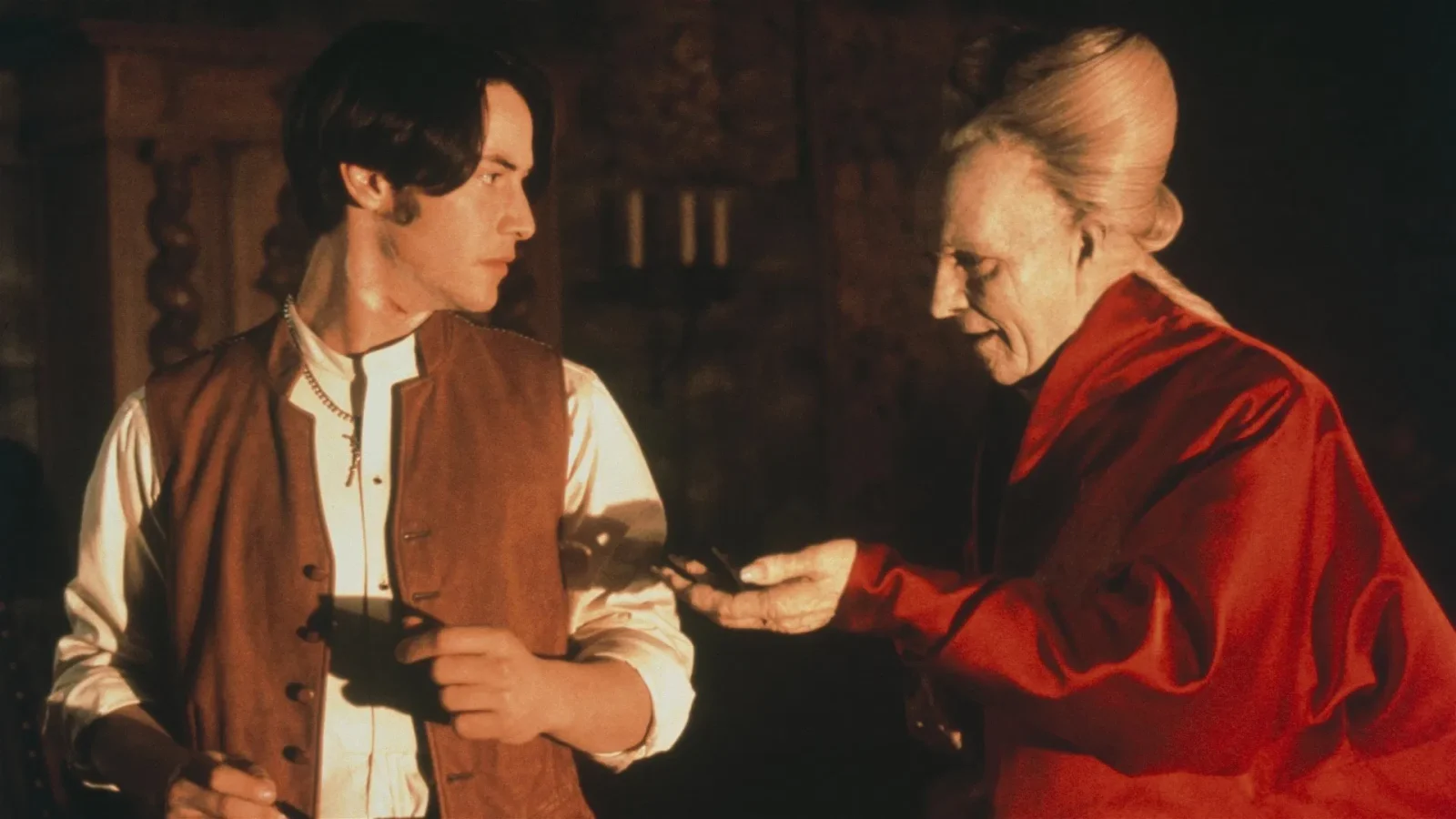
The next year Reeves became Ted in Bill & Ted’s Excellent Adventure (1989) and perfected his stoner congeniality act to such a degree that people believed he was dim. The iconic roles that followed two years later—undercover FBI agent Johnny Utah in Katherine Bigelow’s homoerotic adrenaline-rush frenzy Point Break; the emotionally and perhaps physically impenetrable trust fund kid Scott Favor in Gus Van Sant’s all-timer, Shakespeare-infused gay hustler flick My Own Private Idaho—should have put that rumor to rest. But there is the matter of his stilted English accent in Bram Stoker’s Dracula (1992). “He tried so hard,” director Francis Ford Coppola said later, adding, “To this day he’s a prince in my eyes.” (Accents proved a recurring problem for Reeves: his Indian inflections in 1993’s Little Buddha waver, and his Southern drawl goes in and out during his otherwise strong performance in 1997’s The Devil’s Advocate; he fared better three years on, in Sam Raimi’s The Gift, where he masks any deficiencies in his bayou brogue behind a snarling holler suited to his philandering, wife-beating character.) At the risk of sounding like a partisan hack laying on spin, I’ll propose that Reeves remains affecting in Dracula precisely because of the audible effort he commits to the role while failing: watching in 2025, we follow not a character scrambling to save his beloved so much as an actor confounded and soldiering on anyway. It’s moving, in its way.
Bram Stoker’s Dracula (1992)
Jan de Bont’s megahit Speed (1994) is moving in an altogether different way. You know the setup: if the bus goes under 50 mph, it’ll explode. Reeves packed on muscle to play the LAPD officer Jack Traven opposite Sandra Bullock and Hopper, but he doesn’t bulge like a Schwarzenegger or a Stallone. His rendition of the action hero archetype is pretty, boyish, and sleek rather than out-and-out macho. Nor is he a loose cannon cop on the edge à la Mel Gibson. He’s a controlled, conscientious badass on the make. Squint—squint hard!—at Speed and you’ll see not just a top-grade action spectacle featuring future superstars with serious chemistry trading one-liners over a steering wheel, but also a cautionary tale about the soul-corrupting nature of policing. Hopper plays a retired cop, his spirit twisted and his flesh mangled by a lifetime on the force, who returns to action to redistribute his disaffection to the general population in the form of bombs. Reeves, the young buck designated by fate and his own daring to become Hopper’s chief adversary, balances authoritative calm and restrained excitement. Jack saves the day; he gets the girl; he’s exhilarated; he’s hot; he believes in his work. But where will he be in 30 years? Could Reeves pull off a warped terrorist in a belated reboot who wants to blow up Austin Butler’s Waymo? If any studio execs are reading, I’d watch that movie.
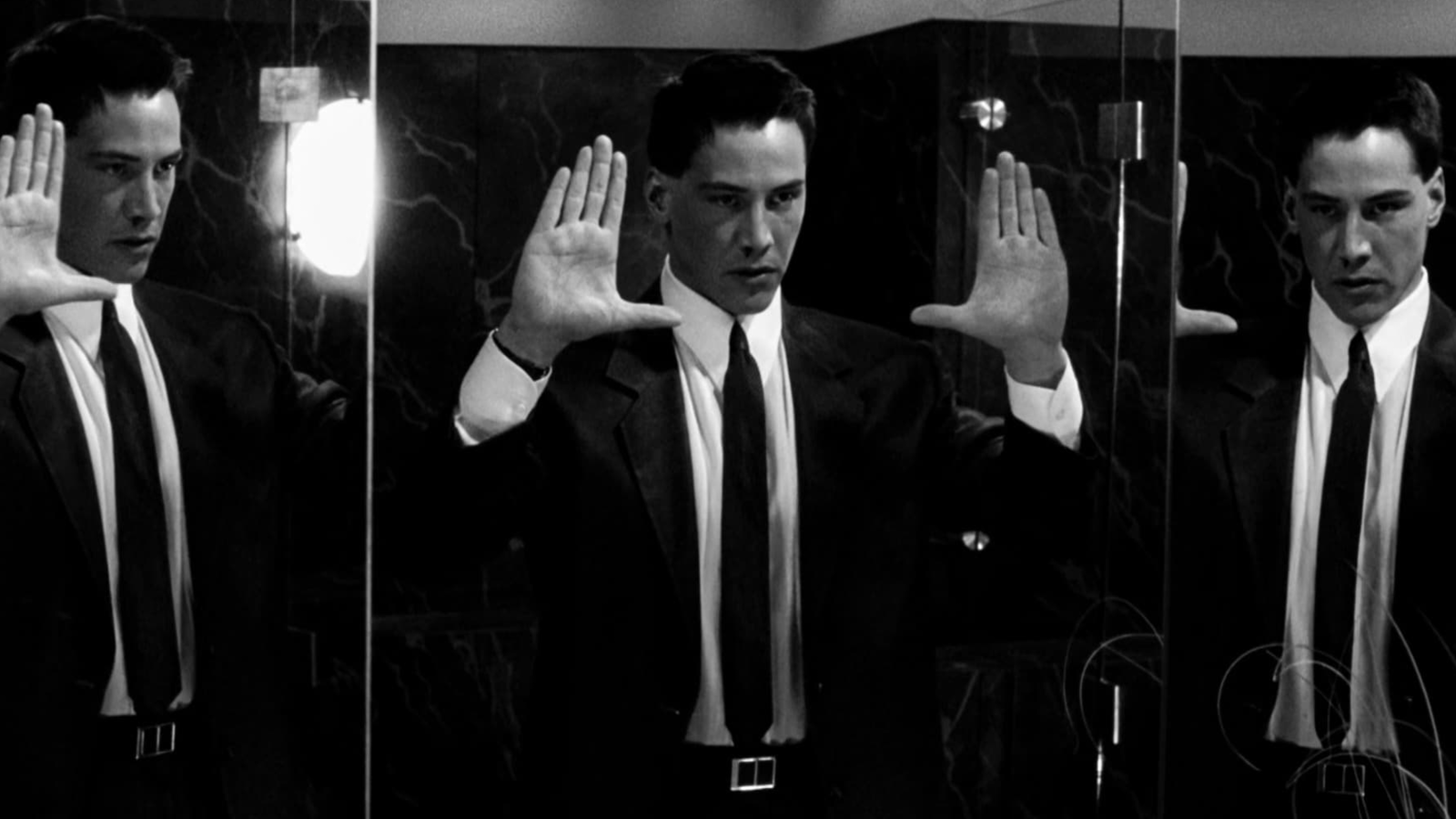
Back to the block of wood: I first saw the descriptor applied to Reeves in a review of 1995’s Johnny Mnemonic. By then, Reeves’s work had asked gently probing questions about the figure of the action star and profound ones about how to respond to inexplicable violence. In Johnny, he turned his attention for the first time to the lifeless, cynical suit-cum-hacker at the edge of the tech sector, one whose apparent blankness conceals hysteria. Reeves is, for stretches, very blank as Johnny Smith, a brain-damaged data courier who carries high-value information through a cyberpunk dystopia via a neural implant. Johnny has lost his memories to technology and lives in a ruined world. Corporations reign. Employers coax and cajole workers on unwanted video calls. Information overload has become a fatal pandemic called Nerve Attenuation Syndrome (NAS). The year is 2021. Haha. Hounded by a Yakuza enforcer wielding a laser whip, he wears a look of repressed agitation at the nonstop interference of corporate-criminal machinations in his life. Unlike Matt in River’s Edge, Reeves’s character isn’t confused about how to emote when confronted with murder or moral dilemmas; he’s convinced, rather, that inhuman vacancy is the correct personal-professional response to an electron-polluted cityscape designed to annoy, inconvenience, and kill him. When Henry Rollins, playing an off-the-grid surgeon, yells at him about the pitfalls of technological civilization, Reeves hardly reacts: he maintains the studied non-expression of a specialized worker numb to everything but his own self-interest and incapable of perceiving how his desires—to get his memory back; to offload the data stuck in his brain before it poisons him—might intersect with those of the people around him.
The picture lacks the transportive sheen that wide audiences expect from high-end science fiction, and its tone is scattershot. In other words, it flopped, critically and commercially, a fact artist and director Robert Longo has attributed to Speed’s success and the studio meddling that followed. But time is kind to cinema’s messy old futures. They open a window onto the era in which they were conceived and inspire us to wonder not what will be or what should be but what might have been and what the hell was going on. I am charmed, anyway, by Johnny’s prognostications for 2021: about the architectural headpieces women would drape in chiffon, about the cybernetic upgrades that every other person would adopt, about AI-enabled sinks that announce unbidden the temperature of the water they dispense. At length, some of the film’s visions have come to seem prescient; others just look cool. I’ve learned, meanwhile, to indulge in its bouts of cheesiness: “Next time knock, baldy,” Reeves deadpans after dispatching a goon in a bathroom. As Johnny, he is a reluctant, comic hero, corralled against his wishes into saving the world, a fact played up at the film’s climax, when Reeves mounts a squat dirt dome and finally snaps. “I want the club sandwich,” he screams, wild-eyed and reaching out toward an invisible sub at the start of a primo monologue mourning the creature comforts he’s been forced to forego during his quest. In later sci-fi features—in The Matrix and A Scanner Darkly (2006), for example—his heroes might enjoy more expansive motivations; they might benefit from more consistent characterization helped along by a seasoned actor; but they’d never be funnier than Johnny.
While revisiting Reeves’s work I found myself imagining other actors in his roles. How would Brad Pitt or Will Smith—both of whom were reportedly considered for Neo—have fared beside that river, on that bus, in that benighted future? I wouldn’t make those trades even if I could. Some actors tell you how to feel. Reeves, at his best and at his worst, makes me wonder: How should a person feel?
Oh, and I realize that I’ve failed to describe the actor’s beauty. It invites and warrants every cliché. But you already know that. We’ve been watching him for years.

Share:
Recommended
- Farley Granger
 On the queer star who defied mid-century Hollywood archetypes.
 - Cracked Actor: David Gulpilil
 Looking back at the inimitable Indigenous icon.
 - Arnold Schwarzenegger
 How the heavyweight star became America’s favorite father figure.