
Cracked Actor
Juliette Binoche
On the eloquent hunger of the iconic French actress.
Juliette Binoche, Emotion in Motion plays at Metrograph from March 6.
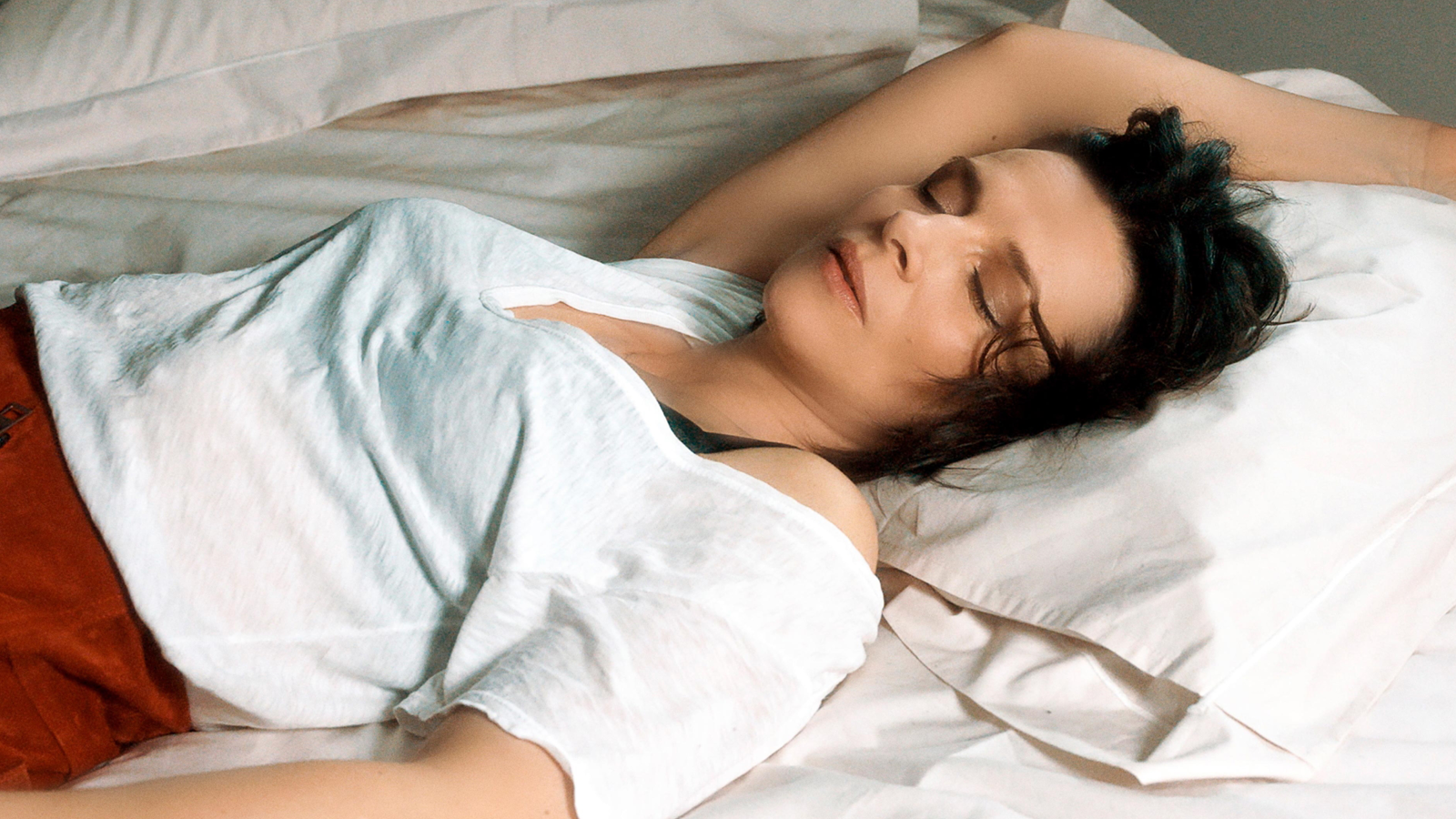
Let the Sunshine In (2017)
Share:
There is a scene midway through The Taste of Things (2023) where Benoit Magimel’s esteemed gourmand Dodin has prepared an elaborate dinner for his live-in cook Eugénie, played by the luminous Juliette Binoche. The meal is a romantic overture: a proposal with a ring hidden in the dessert. Around the third course, Eugénie bites into chicken roasted with truffle slivers under the skin. She pauses, stops short. Her eyes dart around, as if she’s about to cry. Instead, she releases a tremulous “mmm”—a silky purr of orgiastic pleasure. The moment is earnest and earned, not least because of filmmaker Trần Anh Hùng’s keen oversight of the scene, but much credit is owed to the woman inhabiting the self-possessed Eugénie. Binoche (once in a long-term partnership with Magimel, and also the mother to their child) was born to play this role. From the beginning, the French actress’s screen presence has always seemed a study in hunger, whether spiritual, erotic, or existential. Here, that lifelong motif resolves into something more direct: the right to savor.
So much has already been said about Binoche, who recently turned 62-years-old at the time of writing. In 2019, the Museum of Moving Image publication Reverse Shot devoted an entire symposium to establishing her as an authorial force equal to the trailblazing filmmakers for whom she would become something of a muse. Binoche has described a slew of her roles over time as her “sorrow sisters.” Crushing sadness tends to alternate with unbridled joy. An aspiring young actress, a prickly aging one, a mad scientist, a grieving widow—critics and audiences have been astonished by the same thing: her blistering vulnerability. Her face blooms and erupts in a fluttering laugh. Expression tracks in her eyes, which glisten and flare, rather than etch itself across her brow.
Despite her storied career, she has had her share of detractors. Writing about her performance in Harold Pinter’s Betrayal in The New Yorker, Nancy Franklin quipped, “She can do happy, she can do sad, but her palette doesn’t include any shades of gray.” It is a bracing charge—one I don’t abide—that Binoche’s transparency amounts to a vapid and regular alternation of histrionics. Watch Certified Copy (2010) though, and see her face transform, recalibrate in real time, cycling through flirtation, irritation, grief, and everything in between. Binoche’s great gamble has been to play emotions straight, without quotation marks. It works because of her uncanny ability to impart both self-awareness and uninhibitedness, a paradox that scholars like Shonni Enelow have tracedin her performances. There is, too, that cosmopolitan glibness—a light, quick intelligence so often, fairly or not, ascribed to the French, which flickers at the edge of even her most stricken heroines and grounds her more extreme emotions in something unmistakably real.
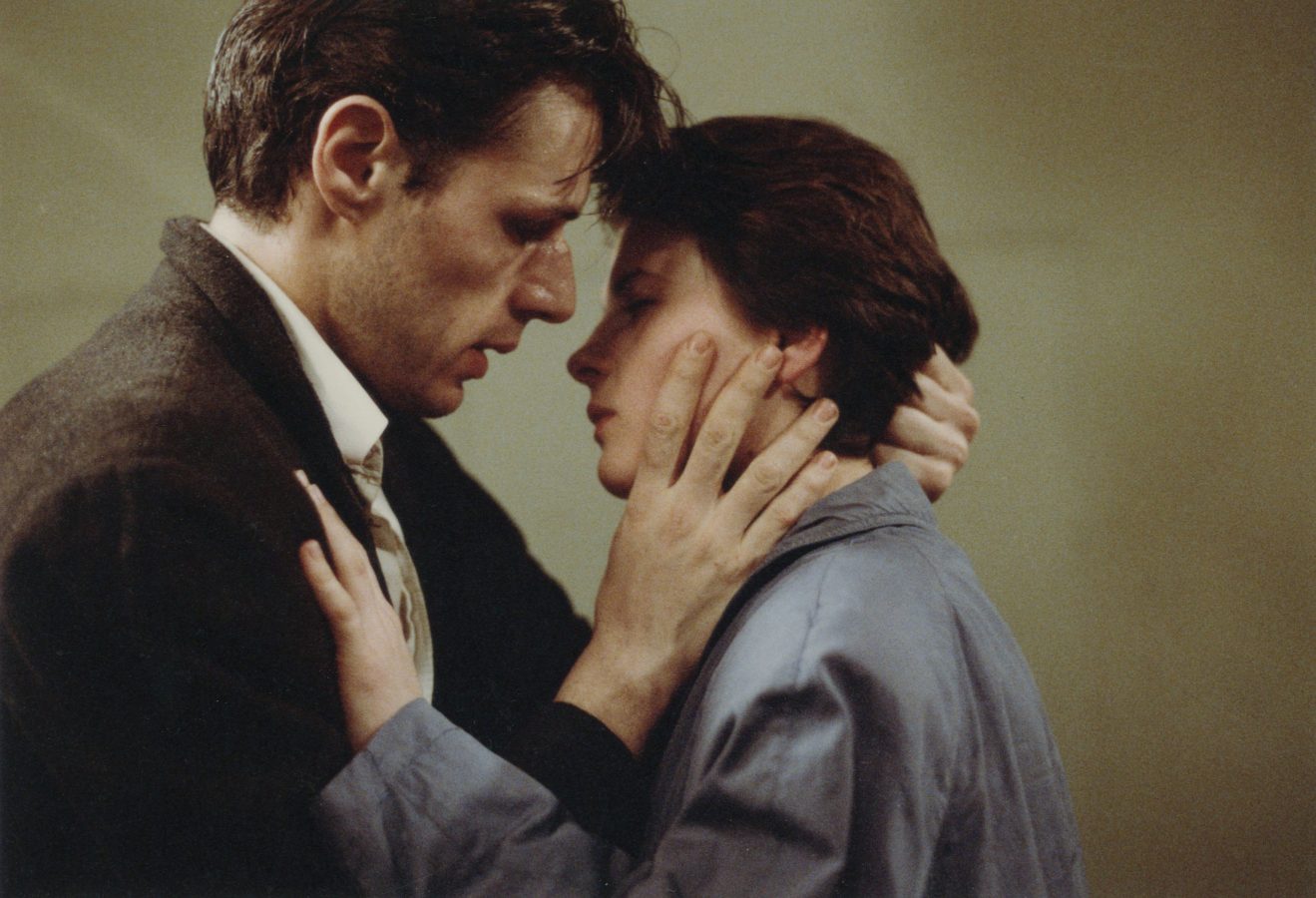
Rendez-vous (1985)
At 21, she slinked onto screen as a slender, bobbed gamine in André Téchiné’s Rendez-vous (1985). Her Nina, an aspiring stage actress newly arrived in Paris, ricochets between suitors, between the ache for belonging and the ferocity of independence. Binoche’s particular look combines bruised innocence (irreproachable alabaster skin, roseate cheeks) with a snarled sensuality, lending a volatility that sets her apart from other French actresses. She wants to be seared into visibility, to dissolve into the city and be remade by it. M. F. K. Fisher famously wrote, “When I write of hunger, I am really writing about love and the hunger for it.” The sentence coils back on itself, binding appetite to affection, sustenance to safety. Appetite, in her telling, is never merely physical; it is braided with the hope of being held and sustained. That entwinement runs like a live wire through Binoche’s work.
In The Unbearable Lightness of Being (1988), directed by Philip Kaufman and adapted from Milan Kundera’s novel set during the Prague Spring, she plays Tereza—her first English-speaking role—as a creature of romantic famine. Her love for the caddish surgeon Tomas (Daniel Day-Lewis) is ravenous and humiliating. Actors are vessels, but some are longing to be used, attempting to overcome some insurmountable part of themselves. Others are blank canvases onto which we project. But Binoche’s face is more like a chalice: the camera studies it as something to be filled or emptied. Emotion arrives, crests, and recedes. In Lovers on the Bridge (1991), directed by Leos Carax, the hunger has transformed into an appetite for obliteration. As Michèle, the painter going blind, Binoche has cracked lips and wild gestures, a romantic heroine dragged through the mud. If the titular bridge is a liminal space, then her body is, too—caught between annihilation and ecstasy. That sense of fatality flickers throughout Louis Malle’s Damage (1992) in which she plays the sphinx-like Anna, having an affair with her fiancé’s father, portrayed by Jeremy Irons. The young woman has an urge toward self-erasure as depicted in her heady, furious love scenes with Irons. Her stereotypically French character—dark and moody, and seemingly poised to homewreck—disrupts the lives of his proper upper-crust English family.
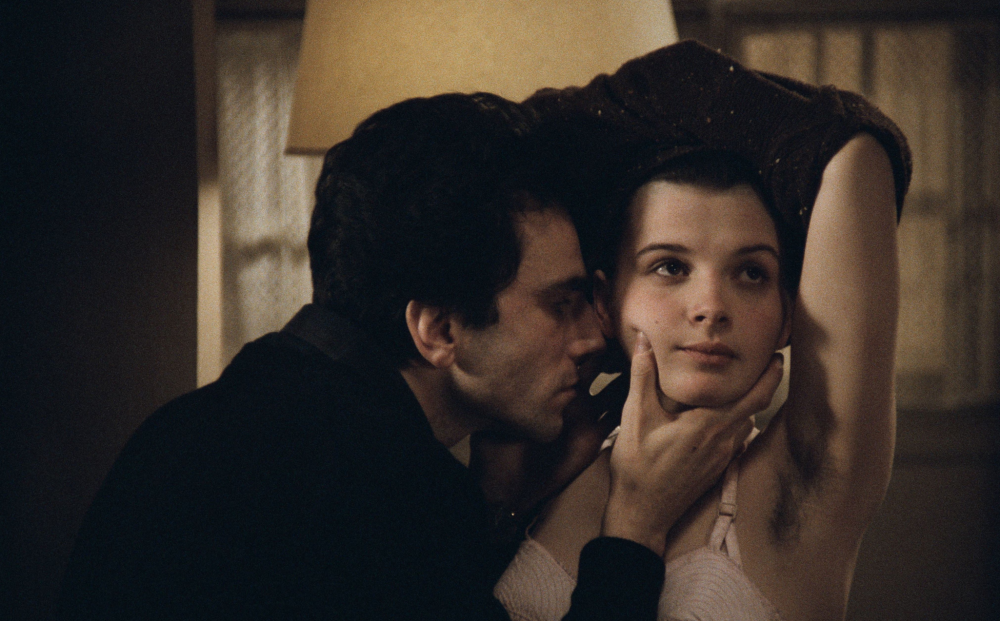
The Unbearable Lightness of Being (1988)
If Binoche’s early career is a study in erotic appetite, the middle period reveals a curious softening, as sensuality is routed into service and eventually transmuted into gastronomy.Binoche is still best known in the United States for The English Patient (1996) and Chocolat (2000); they remain her only two performances noted by the Academy: she was nominated for Chocolat and The English Patient won her, to this day, her only Oscar. Both are Miramax prestige pictures and twin studies in how to saw the edges off her spiky persona for American audiences. It is easy to fashion Binoche into a symbol of maternal warmth or a tasteful French woman. Her role as the beatific nurse Hana in Anthony Minghella’s adaptation of The English Patient does not make the best use of her talents. In Michael Ondaatje’s novel, Hana is the center that binds the narrative together; in the film, she is on the sidelines, caring for and bathing Ralph Fiennes’s ghoulish burn victim with a whimsical generosity. For the most part, her sexual yearnings are rechanneled into emotional (and physical) labor, as she tends to his wounds as opposed to embodying her own. She is given a paramour in Naveen Andrews’s Sikh soldier, but their assignations are more romantic than carnal.
The same can be said of her outsider Vianne in Lasse Hallström’s Chocolat. Her romance with the Romani wanderer (Johnny Depp) has been calibrated for mainstream appeal so parents can watch with their children without squirming. Binoche’s mysterious chocolatier, who drifts into the town like a benevolent witch, presents in many ways a brighter iteration of the same containment the actress endured in Minghella’s period piece. Rightly dismissed as a frothy fable, Chocolat finds Vianne liberating the provincial townspeople from their self-denial with pralines. Its politics are soft; the film is too sweet, and risks crystallizing into a cliché. Notably, Vianne rarely samples her own confections. While the camera luxuriates in melting ganache, Binoche herself remains composed, almost ascetic. Her goal is to awaken others’ appetite, not to indulge her own. (Instead, we get a lascivious close-up of the tongue of Alfred Molina, the stodgy mayor who is finally undone by cocoa.)
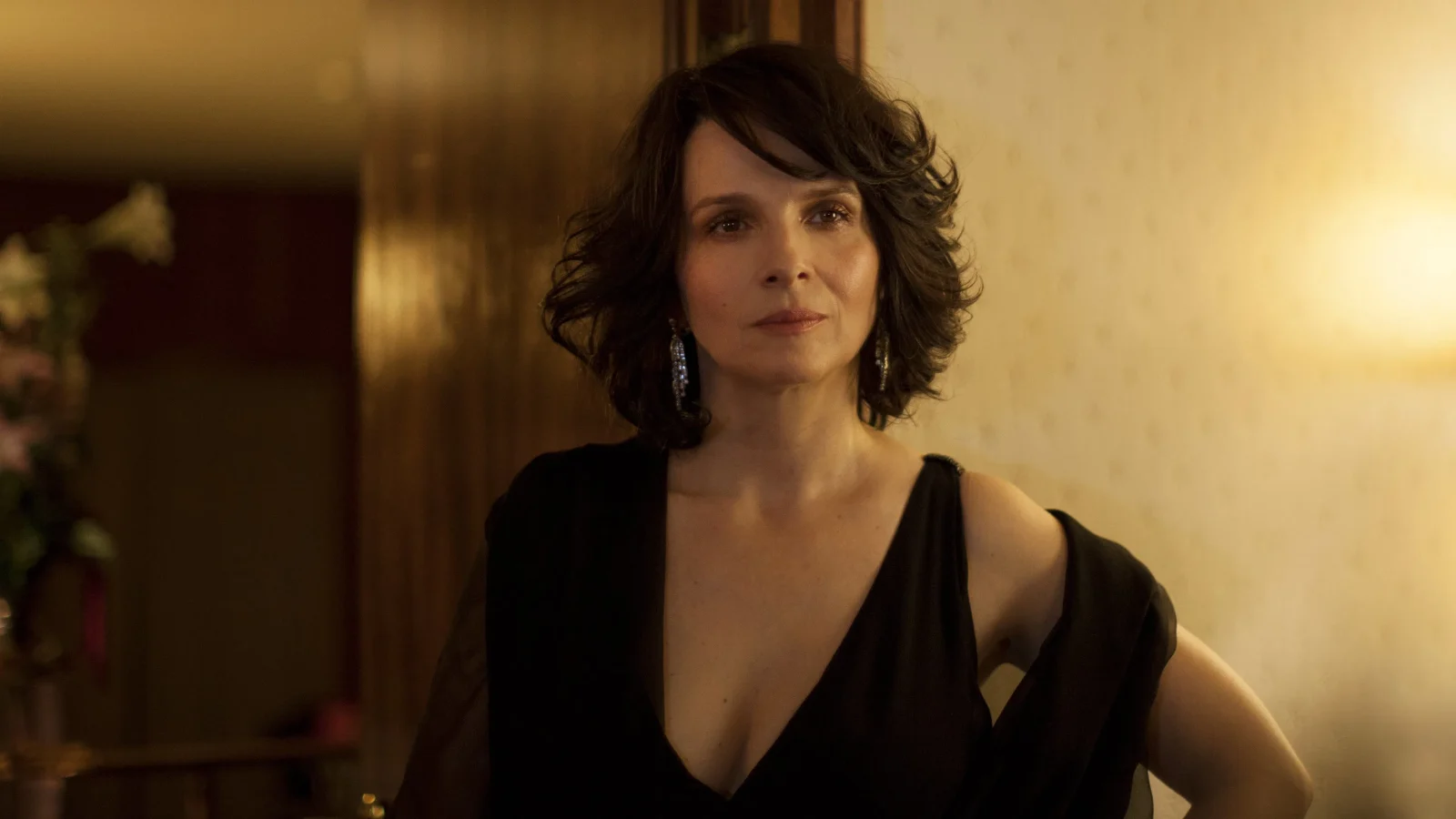
Clouds of Sils Maria (2014)
Released two decades later, The Taste of Things feels like a rejoinder to Chocolat as well as Binoche’s own screen history. Eugénie cooks as an act of authorship, building flavors the way a painter configures light. She refuses marriage at first, not out of coyness, but out of a fierce insistence on autonomy, and the resistance rhymes with Binoche’s own persona and career: her dogged refusal to settle into ornamental stardom and allegiance to established international auteurs. (In addition to Téchiné, Carax, and Claire Denis, she has starred in films by Krzysztof Kieślowski, Michael Haneke, Bruno Dumont, and Olivier Assayas.)
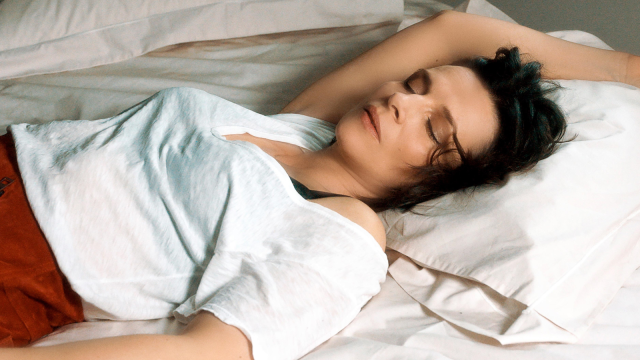
Binoche’s evolution from erotic ingénue to on-screen gourmand is a refinement of and second life for her sensuality. Hunger moves from the romantic to the elemental.Crucially, Eugénie eats. She tastes and adjusts and savors. Let the Sunshine In (2017), in which she is a middle-aged divorcee looking for love, is an ironic counterpoint to Hung’s films. In Denis’s film, inspired by Roland Barthes’s 1977 text A Lovers Discourse: Fragments, Binoche’s character goes on dates but seldom eats. Her romantic disappointments and setbacks—“vexations of amorous existence,” as Barthes refers to them—accrue alongside a series of increasingly fraught visits to the fishmonger, as if her stalled appetite for love had migrated into these anxious transactions. To cook and eat in The Taste of Things, is to declare existence and to insist that desire can be plated and shared. Pleasure is one of our most underrated sources and kinds of knowledge, one that Binoche has understood all along.
Share:
Recommended
- Juliette Binoche
 On the eloquent hunger of the iconic French actress.
 - I’m Not Everything I Want to Be
 On Libuše Jarcovjáková, the queer photographer drawn to the social fringes of Soviet Prague.
 - Letters to His Wife
 Translated into English for the first time, a selection of the esteemed Soviet filmmaker’s devastatingly honest and bittersweet letters.