
Columns
Cracked Actor: Cary Grant
Unraveling the coded queerness that animates the exuberant actor’s performances.
Share:
Everyone is invited to want Cary Grant—to admire him, to laugh with him (or at him), to bed him, or to long for his approval. He feels like a celluloid “Adam” brought to life for the new era of talking pictures, inaugurated five years before his film debut, in This is the Night, followed by his breakthrough, Blonde Venus, in 1932. He was enormously seductive to watch: a perfectly handsome, unusually charming figure who could induce romance with the lift of an eyebrow, or draw howls of laughter by flinging himself into collision with an armchair, to say nothing of his pitch-perfect comedic timing. He would influence generations of modern leading men, including the likes of George Clooney and Channing Tatum. He belongs to everybody who loves movies, but I love him for all the ways the idealized quality of his screen persona is subverted through a latent queerness.
Grant’s appearance was manicured, and he felt glamorous and alluring like an actress, because he often played characters who were sought after like a prize. Grant’s sexuality has long been the subject of rumor, but he was never beholden to the macho constraints of his contemporaries such as John Wayne, Humphrey Bogart, or James Stewart. His characters were more likely to throw a verbal catty barb than a punch, but he didn’t come off as either passive or soft because he was just as adept at playing schemers who exerted patriarchal control. For queer viewers like myself, he’s an especially intoxicating actor because he doesn’t exactly adhere to any specific idea of traditional masculinity or femininity. He is most comfortable residing somewhere in between, which is why his best acting partner was Katherine Hepburn, who contained that same evasiveness. They are lovely alongside one another as freewheeling spirits who would rather engage in tomfoolery than rub elbows with the upper-class in George Cukor’s Holiday (1938), and again, as anarchic comedic foils in Bringing Up Baby (1938). Grant, especially alongside Hepburn, seems to transcend simple concepts of sexuality and gender identity—both of which are so important for the appeal of audience identification—and this natural adroitness collapses into the palette of his performance.
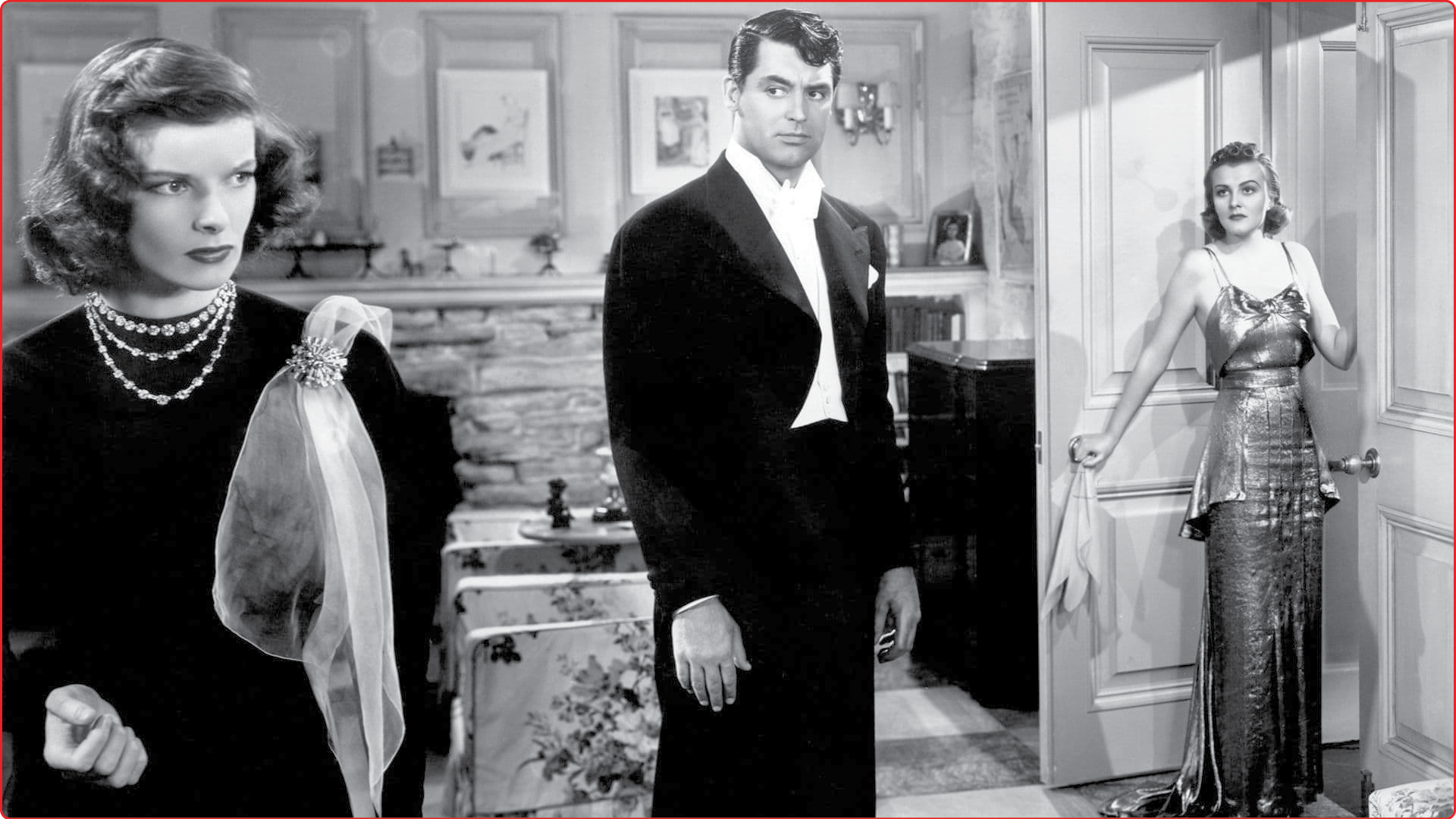
Holiday (1938)
Looking into those possibilities of queering in his screen presence can also reveal stranger enigmatic qualities. Grant himself, later in life, summed up his own translucent persona with an astute analysis: “Everybody wants to be Cary Grant. Even I want to be Cary Grant. I have spent the greater part of my life fluctuating between Archie Leach and Cary Grant, unsure of either, suspecting each.” There is something displaced about the actor, even when considering his own legacy. Although considered a prototypical American movie star, Grant was born to an impoverished family in England in 1904 and given the name Archibald Leach. His Englishness doesn’t really show on film, with his classic Transatlantic accent being another ingredient of his blended appeal. There’s a mannered charm to his voice that contrasts wonderfully with his elastic, rambunctious body language. He joined the circus as a teenager and made a name for himself in vaudeville in the 1920s, and these elements of performance are visible in the type of outwardly expressive actor he became. Grant would often tumble and mug for the camera, performing standing acrobatics as the free spirit Johnny Case in Holiday, or stretch his face into cartoon dimensions of absurd comedy as Mortimer Brewster learning strange new details about his homicidal family in Frank Capra’s Arsenic and Old Lace (1943). Late in Grant’s career, he primarily played weary, sarcastic romantic leads, nonetheless idealized in the eyes of women (Deborah Kerr, Audrey Hepburn) who saw him as a great fling or an unmissable opportunity for life-changing romance, as in Leo McCarey’s An Affair to Remember (1957) or Stanley Donen’s campy Hitchcock-lite farce, Charade (1963).
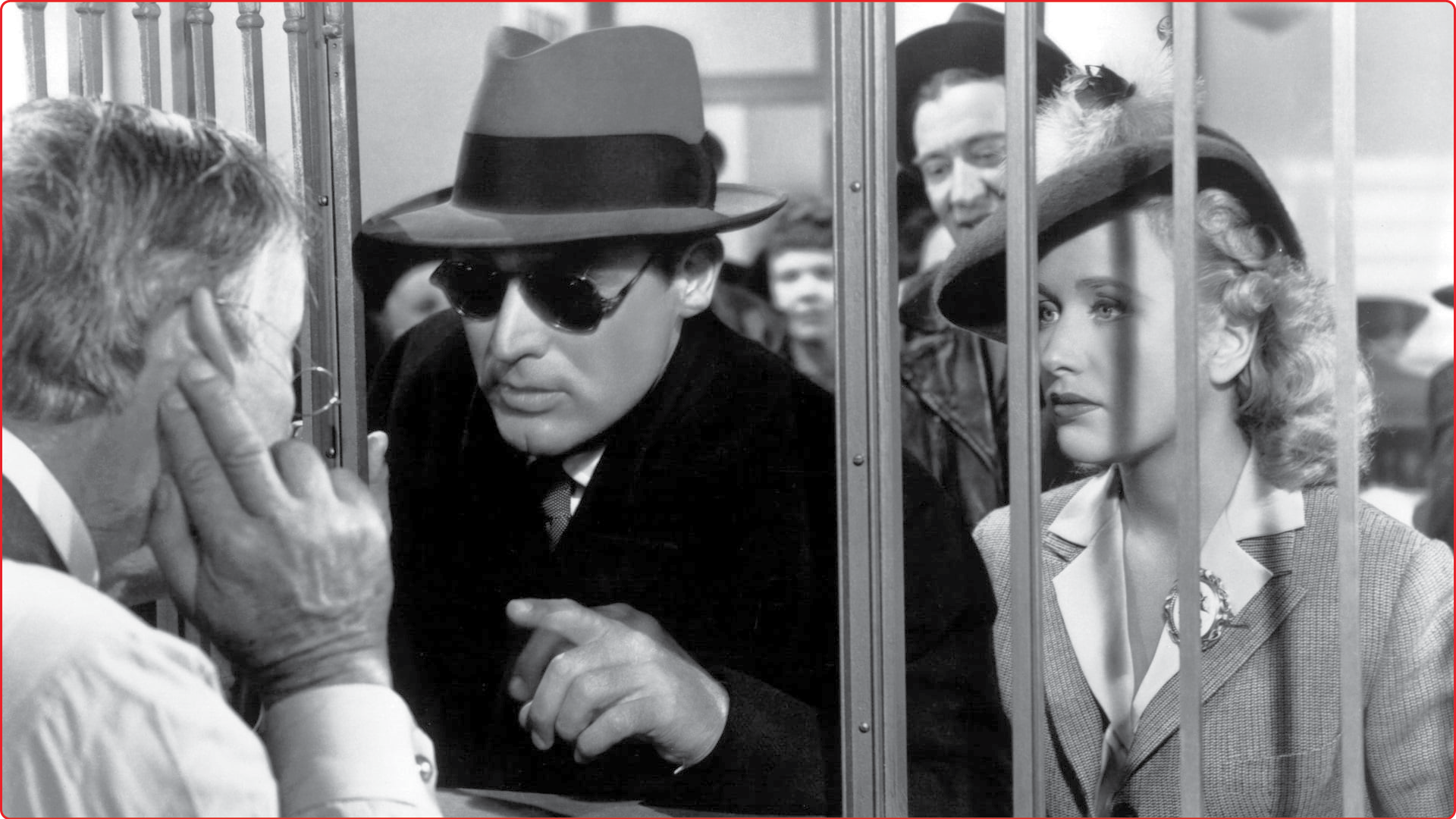
Arsenic and Old Lace (1944)
Grant was wonderful at embodying characters who are liars, either by their nature or due to life’s circumstances. This can sometimes make it seem as if he’s hiding in plain sight, given the highly stylized nature of his acting, and there’s a Cheshire cat-like ambiguity that surfaces in some of his darker roles. For instance, in Hitchcock’s Suspicion (1941), Grant is Johnnie Aysgarth, a suave, penniless crook with a gambling problem who has seduced the wealthy, straight-laced Lina McLadlaw (Joan Fontaine. Grant is comically sinister as coincidences begin to pile up that paint him as a potential murderer. He employs all the classical pillars of his performances and garners more than a few laughs by playing things exactly as he would for Cukor or Howard Hawks, but underneath the laughter there is a boiling tension that Aysgarth’s confidence is nefarious in nature. At a dinner party late in the film, Johnnie, Lina, and a few other guests (two of whom are queer-coded lesbians in a traditional butch/femme relationship) discuss untraceable poisons and whether or not each guest could potentially be a murderer. In close-up, Grant’s reaction is beguiling, teetering on a razor’s edge of charm and wickedness, a complex, gleefully macabre concoction twinkling in those perfect, chestnut eyes of his. Maybe he could kill, and yet, he still feels like Cary Grant.
Grant has another revealing, career-best close-up near the end of Holiday, which perhaps feels so invigorating to queer viewers because it is legible as metaphor for coming out of the closet. As Case, Grant plays a blue collar man who has recently become engaged to the wealthy Julia Selton (Doris Nolan). Initially, Case is excited to enter into the lap of luxury with Julia, whom he seems to love very much, but he quickly finds that way of life demoralizing. He longs to escape the stifling pressures of class before he even marries into the family. He finds the parties celebrating their engagement and the itineraries dictating every moment of their life suffocating. Case would rather flee to a secluded room of the Selton home and practice acrobatics with kindred spirit and soon-to-be sister-in-law Linda (Hepburn). Later, in a touching monologue, Johnny says he needs to figure out who he is and live his life how he sees fit. If he doesn’t take the chance now he’ll regret it forever. Grant shines in the climax of this emotionally charged scene. He conjures a direct, liberated emotion by excavating a precise desire through Johnny’s need for self-expression. There’s longing in the way his eyes seem to be searching as he carefully seeks his words in real time, unlike his usual acerbic timing and precision. His corkscrew body language, usually wound tight in his comedies, unwinds with his shoulders noticeably unclenching the further he gets into his proclamation of selfhood. It feels revelatory and shockingly honest for an actor who frequently played characters with something always hidden up their sleeve. Everything which is relevant to queer viewers about this scene is bundled up in code, and it conveys something beautiful without saying it directly. It mirrors Grant’s own effect as an elusive but crucial figure of queer cinephile imagination.

An Affair to Remember (1957)
Share:
About the Contributor
Recommended
- Gong Li
 On the enduring eloquence of the timeless actress.
 - Allegro non troppo
 On Italy’s lurid riposte to Fantasia.
 - Juliette Binoche
 An interview with the icon of French cinema, La Binoche.