
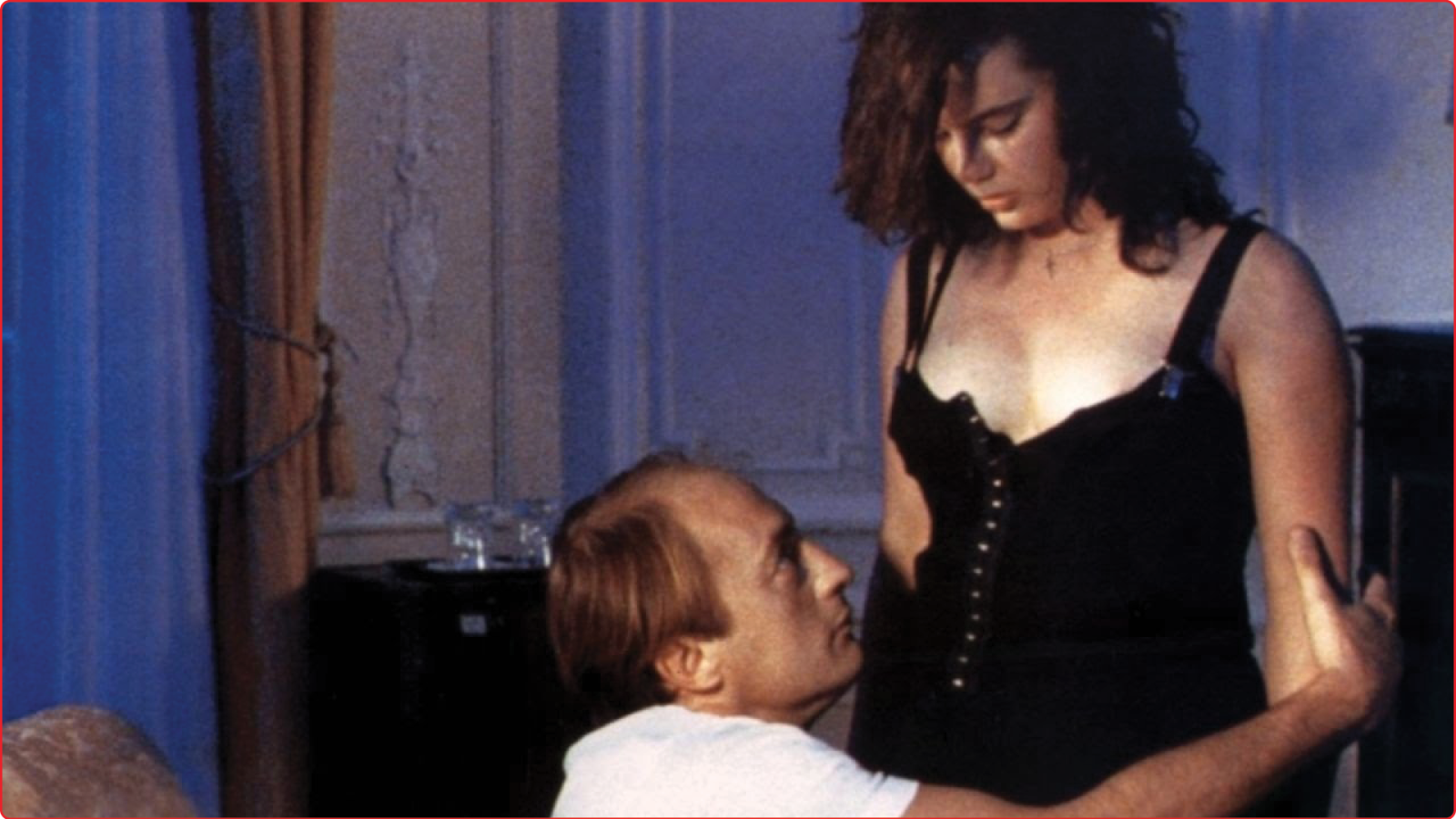
36 Fillette (1988)
WHEN IT WAS RELEASED IN the United States in 1988, Catherine Breillat’s 36 Fillette was billed as “The French Lolita,” with Breillat’s fillette the continental echo of Nabokov’s nymphet. Played by Delphine Zentout, the film’s young protagonist is Lili—not Lolo, or as Humbert Humbert famously pronounced the name of his desire, “Lo. Lee. Ta.” Lili is also 14, not 12. Already too old for Humbert’s deviant taste, she is a minor by French law, but not prepubescent. Breillat locates Lili’s age by her dress size—36 fillette, junior size 36—even though, as Lili will tell the 40-something-year-old man whom she ambivalently courts, “feelings have nothing to do with chest measurements.” Although they are not small, Lili’s feelings are, in fact, very young. Lustful, fearful, arrogant, furious: her enormous feelings appear to surprise even her. On vacation with her parents and brother in Biarritz, southeast France, she is hopelessly bored and regretfully a virgin. “You don’t have to work or go to school,” her father berates her. “What more do you want?”
In an interview with Cineaste, Breillat said of her films’ sexually impatient young protagonists, “Their first desire is to be.” It seems that to be, for these characters, is to be not-a-virgin—to have sexual knowledge and its attendant power. 36 Fillette follows Lili’s emergence into being, as it were, but losing her “horrible” virginity proves a challenge. En route to a nearby disco with her older-but-hapless brother as a chaperone, she meets Maurice, a balding would-be playboy (he has no paunch, he assures her), with whom she has three tortured encounters that leave her variously bruised, tearful, and frustrated. She is still a virgin. She still isn’t.

36 Fillette (1988)
Where Lolita is narrated by an admittedly guilty protagonist—Humbert Humbert wrote from prison, his conscience and his rap sheet teeming with criminality—Breillat isn’t particularly interested in guilt, Maurice’s or Lili’s, psychological or legal. She focuses instead on that other antonym of innocence: knowledge. How do girls gain it? And at what cost?
Femininity convolutes Lili’s path to knowledge. She can’t simply lose her virginity as a boy would. After all, she isn’t looking to fuck; she’s looking to get fucked, and as a result, she draws Maurice into a clumsy tango—a game of cat and mouse, in which she rebuffs him and he calls her bluff. She needs to get him to “take her” without being taken for a fool, without losing the upper hand. This is the familiar dance of the willful submissive—sometimes called a “bratty” bottom—but its familiarly doesn’t diminish the anxiety of watching a 14-year-old girl assume its steps. Lili looks her age (uncombed hair, unpainted face, donning adolescent overalls), but her look (chin down, eyes up, slight smirk) projects the studied faux-naiveté of the sexually mature coquette. Her naiveté, however, is not “faux.” With the three men she encounters over the film’s 48 hours—a concert pianist, played with debonaire swagger by Jean-Pierre Léaud; Maurice; and a red-haired teenager, whom she first dismisses as an “egghead”—Lili insists that she wants “just to talk.” She knows, as these men do, that wanting “just to talk” is as much a truth as it is an alibi. She is using her innocence as a shield for her desire to no longer be innocent.
“Okay, I’m listening. Talk, talk, talk,” Maurice says to her in his hotel room. For the nth time that evening, he challenges her posture, revealing her to be a phony representative of her own desire. She says she wants to leave; he lets her go; she stays. She says she wants to talk; he lets her talk; she says nothing. Lili’s ambivalence is not—or not only—the result of mixed messages, of a culture that tells girls to be both good and bad, both virginal and “cool.” Instead, Lili is following in the more direct footsteps of the French feminist second wave—the footsteps of Breillat—which, in aiming to strip virginity of its invidious ties to virtue, presented sexual liberation as a valid response to patriarchy and the infantilization of women. The risk of sexual violence and the fear of sexual vulnerability, in these terms, are the cost of freedom.

36 Fillette (1988)
“Maybe I thought I’d feel like it,” Lili finally says, “that something might make it possible. Have you looked at yourself. You’re too old. You make me sick. I can’t.” Is this an honest expression of Lili’s displeasure or an extension of her ruse? Is she expressing disgust or speaking the anti-sentimental lover’s discourse of the French sexual revolution? (The steady stream of “t’es dégueulasse”—you make me sick—that runs from Jean-Luc Godard’s Breathless in 1960 to Maurice Pialat’s A nos amours in 1983 turned the ugly phrase into the cupid’s arrow of New Wave heterosexuality.)
Lili’s insults continue—“You make me sick. You really do”—until Maurice interrupts them with the sexual aggression that they were maybe meant to incite. She turns her back, which also shows him her ass; she moves his hand from her leg, which also allows her to hold it. “Stop talking. I knew you were lying. Lying your head off,” Maurice says as he reaches into her pants. She cries out that she doesn’t want to have sex, after all—“I said I don’t and I mean it. Isn’t that enough?” Is this where Lili’s ruse ends? Was it ever a ruse at all? “There,” Maurice says, pointing to Lili’s head, “there you don’t want. But down there, you’re dripping with desire.” The viewer is likely wise enough to know that this is a false dichotomy, but is Lili? Does she know that her body cannot consent without her? Having shifted the terms of Lili’s drama from ethics to epistemology, Breillat compels us to ask not who is legally innocent in this disturbing scene but who is innocent of the other’s desire? Who is innocent of their own desire?
These are Breillat’s perennial questions, and underage girls are the frequent medium for their negotiation in her novels and films. Whether in 2001’s Fat Girl or in her retellings of Bluebeard (2009) and Sleeping Beauty (2010), sex—even coerced, violent sex—is the vehicle for girls’ entrance into womanhood. These girls, she implies, cannot know their desire, or themselves, until their sexual fantasies have been reality tested.

36 Fillette (1988)
Submitting to Maurice’s forcefulness, Lili begins to caress Maurice under his pants only to injure him, to grab too hard. Was this a mark of retribution or a sign of her ignorance? He furiously presses her collarbones deep into the rug, leaving her with two dark bruises and her virginity intact. Lest we turn Lili into the victim—and sexual innocent—that she does not want to be, the next scene presents her championing her injuries. She returns to Maurice’s hotel room, where she brandishes them as new tools in her arsenal of seduction: “I’m covered in bruises. You’re lucky I didn’t file charges. Want to see them? … I just wanted to scare you.” Victimhood, it seems, is something Lili knows can be exploited—and not only (or not even especially) by Maurice, but by her.
After two more similarly frightening, similarly interrupted, trysts with Maurice, Lili is told by Anne-Marie, Maurice’s ex-girlfriend, that he is only using Lili to get back at her. Anne-Marie is about to be married to a younger man, and whether out of concern for Lili or for her own retaliatory pleasure, she encourages Lili to go to the police. Lili flees back to the camp where her parents are vacationing, and we no longer hear from Maurice again. Just as Lolita revealed more about Humbert’s solipsism than about its titular protagonist, 36 Fillette sidelines Maurice’s psyche, giving Lili’s center stage. (Maurice may not be exonerated as a result, but he is certainly not on trial.)
“I thought about you all day,” she lies, “Why should I lie?”
Lili finds the red-headed teen she had earlier rebuffed and convinces him—easily—to have sex: “I thought about you all day,” she lies, “Why should I lie?” Her high-risk dance with Maurice seems to have primed her for this apparently low-risk conquest. The boy has been spending his vacation reading Dostoyevksy’s The Idiot—a symptom, to Lili, of his passivity and naivete. He is, as she earlier insisted, not her type. After their lusterless shag, Lili tells the boy that it was her first time. “You mean… you love me?” he asks, with the guilelessness of Dostoyevsky’s protagonist. She replies, before breaking into a defiant grin, “Espèce du con”—you idiot!
The phrase is sometimes translated as “you asshole!” and the distinction might matter: is the boy deficient in brains or ethics? Has he been dumb or bad? We might ask the same of Maurice and Lili herself. But to consider knowledge when assessing guilt is to contend with the thorns of consent: can a 14-year-old meaningfully consent? Can she know enough to do it? This line of thinking strips Lili of the sexual agency she claims at her own risk. It is, per Breillat, her claim to being. Directed to the camera, Lili’s broad smile signals the catharsis of her anticlimactic sex. She won: she did it. But she is not just not-a-virgin. She is also an idiot, an asshole, the master of her own desire, and a minor.
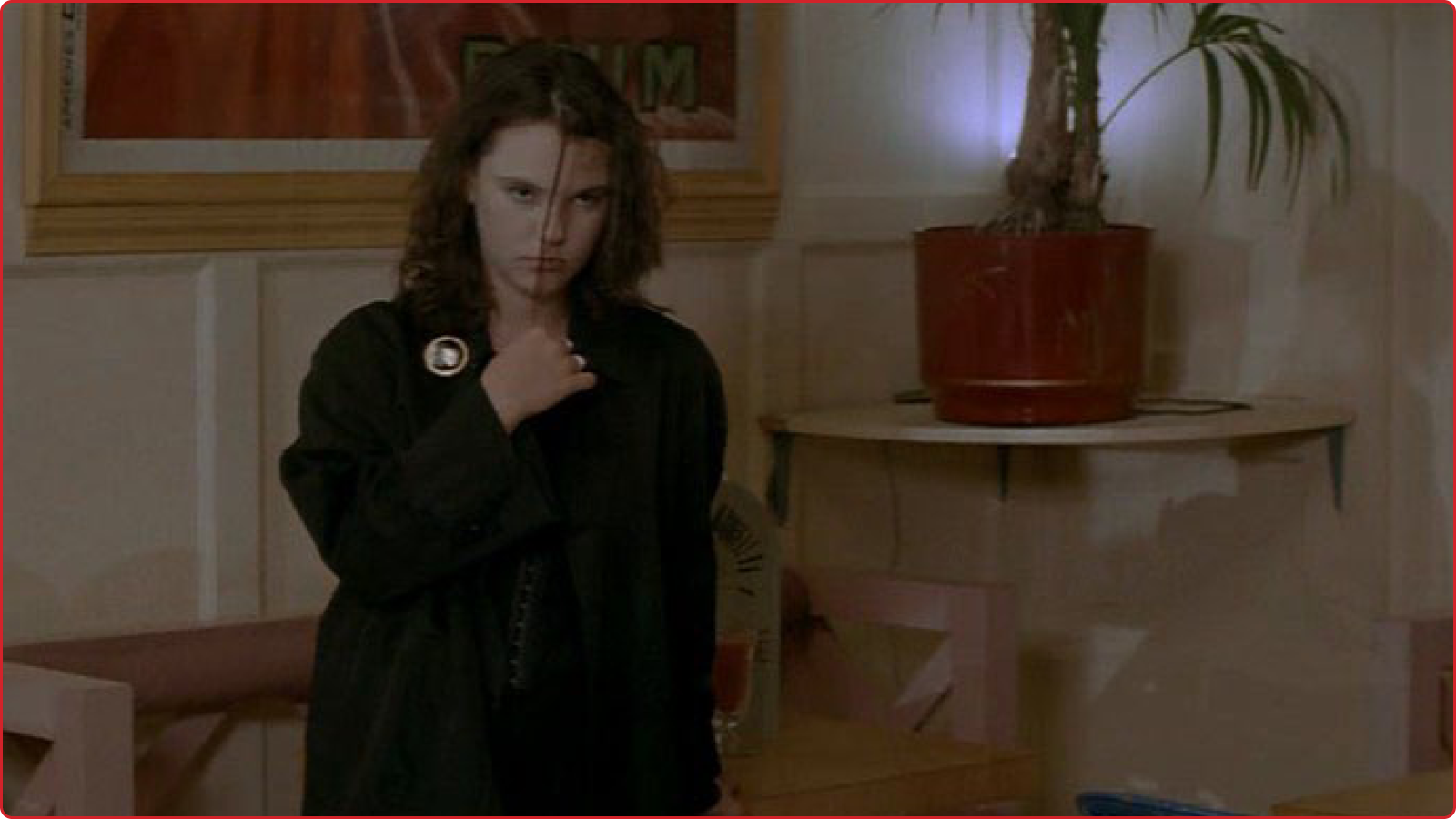
36 Fillette (1988)

Share:
Recommended
-
Susan Seidelman
 An intimate conversation with the trailblazing American filmmaker.
 -
Carol Kane
 Fifty years in 50 minutes with the irrepressible screen icon.
 -
Mark Lee Ping-bing
 The legendary cinematographer reveals his three core beliefs.
- Yuliya Solntseva
 On the actress-turned-filmmaker’s unsung authorship.
 - Futures and Pasts: Socrates
 Rossellini’s one-of-a-kind approach to the costume drama, and his 1970 film on the last years of the Athenian truth-seeker.
 - The Illiac Passion
 On the most elaborate of Gregory Markopolous’s modern myths.