

Journey (1972)
Essay
Travel Companions: Bahram Beyzaie & Amir Naderi
On two defining Iranian filmmakers, and two of their most enduring works.
Travel Companions, our 10-film retrospective honoring the films of Bahram Beyzaie and Amir Naderi, opens at Metrograph on Saturday, January 31.
Share:
IN AMIR NADERI’S THE RUNNER (1984), a boy sprints toward a melting block of ice as time turns thirst into a race. In Bahram Beyzaie’s Bashu, the Little Stranger (1985), another boy runs—barefoot through green fields, bearing the gaze of an entire village, as if the land itself were asking whether he should be allowed to remain. Modern Iranian cinema has many signatures, but few are as immediate as these: childhood not as innocence, but as exposure—body against heat, language, hunger, suspicion.
To place Beyzaie (1938–2025) and Naderi (b. 1946) side by side is not to pose a rivalry, but to honor two esteemed auteurs and two orientations about what cinema can do. Beyzaie—who died on December 26, 2025, from cancer-related complications—was never only a filmmaker. In Iran, he is considered a defining modern playwright and theater director as much as a director of features: a scholar of performance traditions, myth, and ritual whose films often feel like staged debates with cultural memory. He made landmark films across the 1970s–2000s, with Downpour (1972), The Stranger and the Fog (1974), Ballad of Tara (1979), Death of Yazdgerd (1982), and Killing Mad Dogs (2001) among the most enduring.
Naderi’s formation is almost the inverse: less institutional, more feral; a filmmaker shaped by the southern port cities where he grew up, raised by his aunt; by movie theaters; by watching and laboring; by learning cinema as craft and hunger. After working at the Institute for the Intellectual Development of Children and Young Adults, alongside Abbas Kiarostami, Naderi emerged from the Iranian New Wave, and became known internationally for his autobiographical drama The Runner. He later made films restlessly across borders and languages. His last Iranian production, Water, Wind, Dust (1989) was followed by five films made in the US (including Manhattan by Numbers, 1993) as well as productions in Japan (Cut, 2011) and Italy (Monte, 2016). He is currently working on his first Australian-set feature, titled Moon.
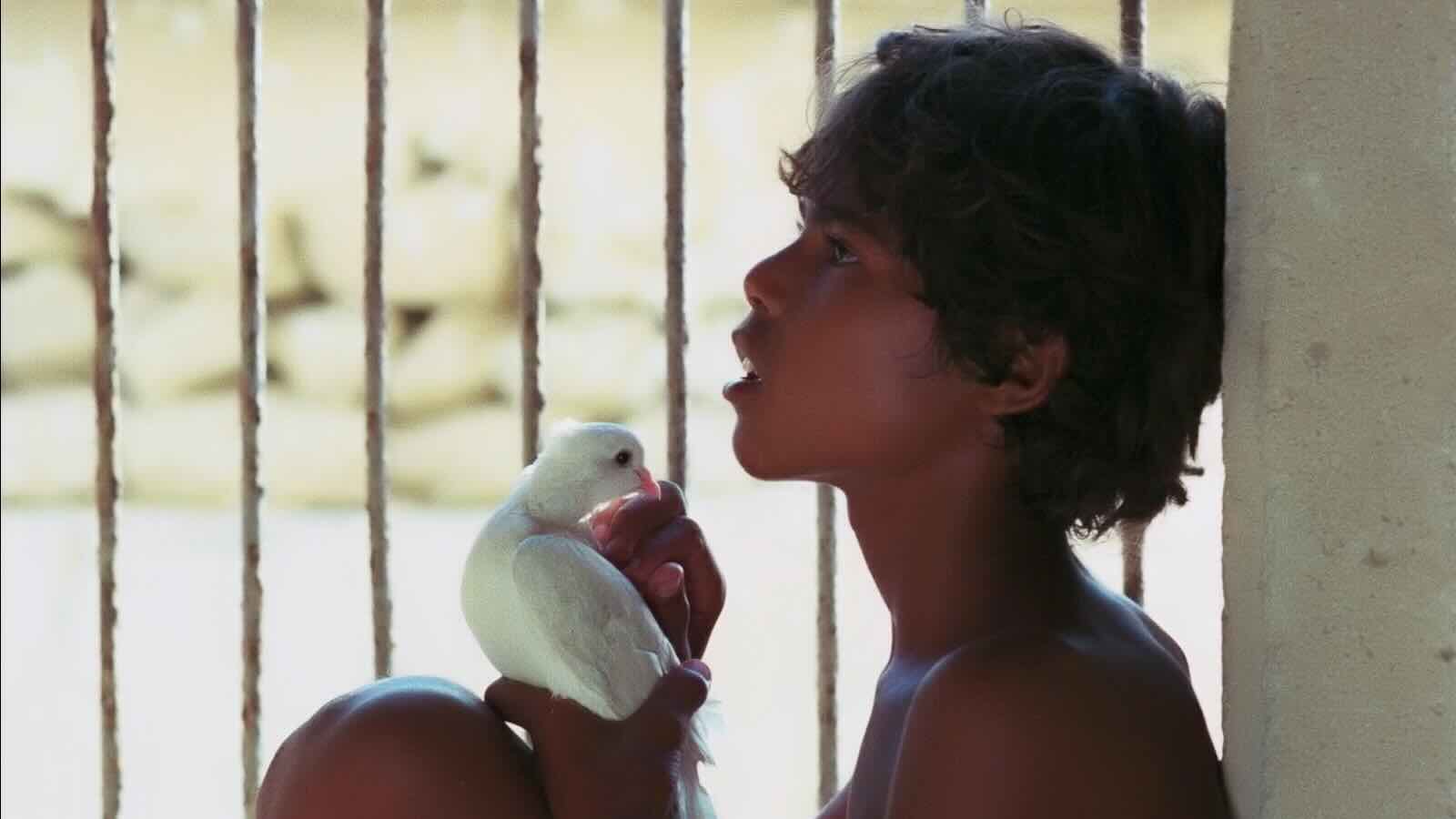
Waiting (1974)
Their experiences of leaving Iran sharpen the contrast further without explaining it away. Naderi left by choice in the mid-’80s and settled in New York, treating displacement as another condition of production: difficult, yes, but willingly embraced. Beyzaie left much later, moving to California in 2010 to teach at Stanford; outside Iran he continued to write, teach, and stage work, but feature filmmaking largely dropped away. Naderi, who even tried to help Beyzaie make a feature in the US before the pandemic arrived, once described his friend as an artist who was “rooted in the soil of Iran,” and who, abroad, reminded him of “a fish fallen out of its pond”; tender phrases that point to the two artists’ different relationships to place, language, and home.
You can glimpse these orientations early in two short films shot before the Revolution. Beyzaie’s Journey (1972) turns a poor child’s errand—a trek from Tehran’s shanty outskirts toward the city’s center, searching for his parents with only an address on a scrap of paper to guide him—into a map of permissions: who gets refused, who gets policed, and how quickly hunger is criminalized. Naderi’s Waiting (1974), shot in Bushehr, is built from the daily ritual of a boy taking a glass bowl to be filled with ice from a home where, at the doorway, only a girl’s hennaed hands are ever visible—desire shaped out of routine, requiring no further explanation. In miniature, these two shorts point toward what the later features make unmistakable: Beyzaie’s cinema is drawn to questions of belonging, how it is performed and contested, how a community recognizes and misrecognizes its own. By contrast, Naderi’s cinema is more overtly elemental: he is drawn to endurance and repetition—what a body can and will do under pressure—motion as contest with the world.
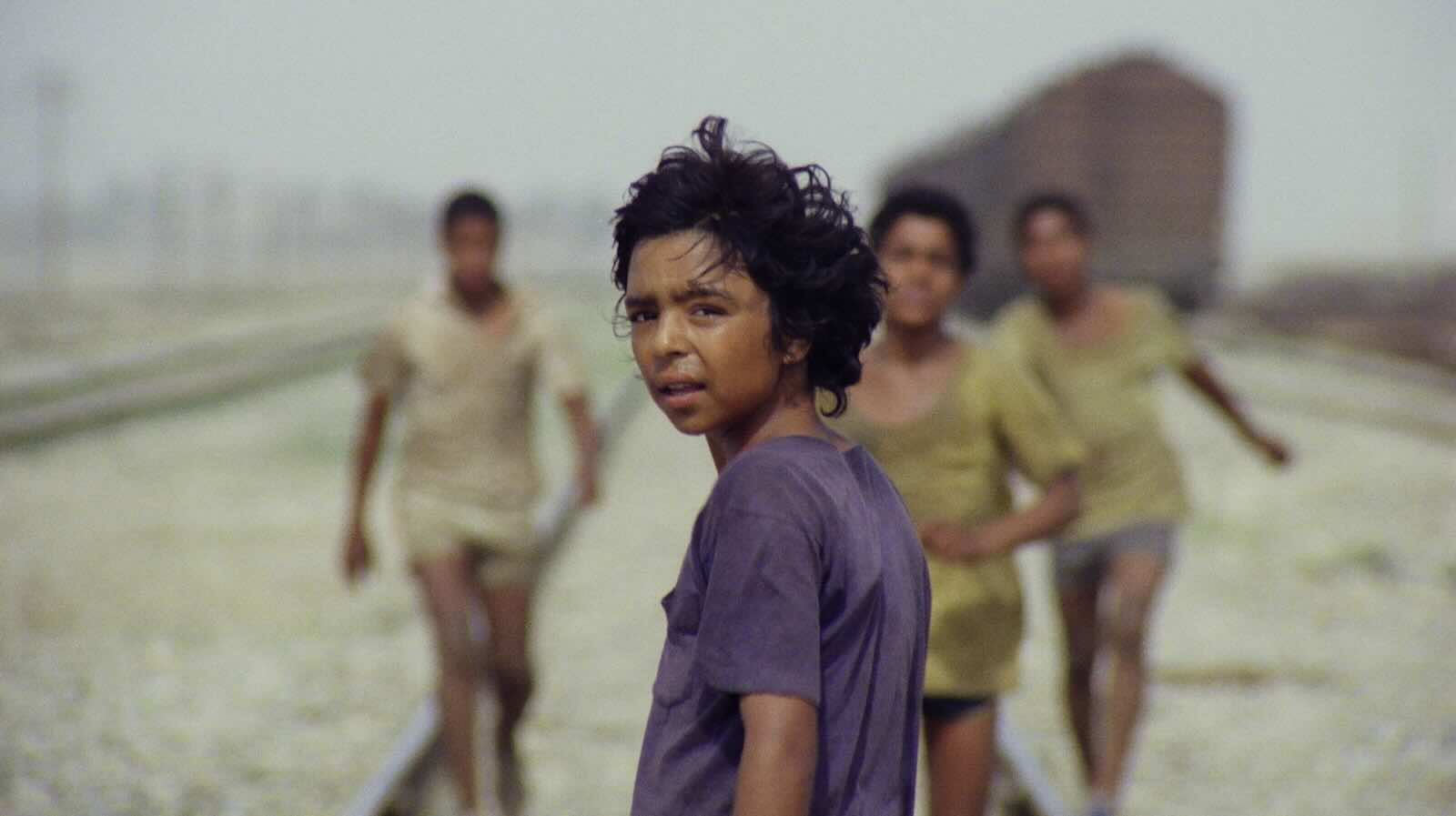
The Runner (1984)
A decade later, during the Iran–Iraq War, both directors returned to childhood in now-revered feature films that show how each found his unique road: Naderi’s The Runner and Beyzaie’s Bashu, the Little Stranger. Neither is organized around battles nor frontlines. Rather, war registers as a hardening of conditions inThe Runner, and as recurring echo in Bashu. In both films, it is through the figure of a child that the weight of the world is most deeply felt.
In Bashu, the title character (Adnan Afravian) is a war-displaced orphan from the south who arrives, almost as if washed ashore, in the lush north. Nothing fits: the climate, the crops, the language. Bashu is silent, and the community senses disrespect. When he finally speaks, pleading in Arabic, the Gilaki-speaking villagers hear only trouble and threat. Beyzaie is unsentimental about how quickly “not understanding” can become a moral verdict. Suspicion here isn’t just a matter of personal prejudice, it’s a way of policing a boundary. Bashu must be marked as a stranger by the villagers so that everyone else can remain coherent.
The film turns on Naii (Susan Taslimi), the woman who eventually shelters him. She is no saintly abstraction. She is labor, fatigue, anger, humor—someone with her own battles, left caring for her land and children while her husband is absent. She works the fields, argues back to the men, refuses to be cowed. When Bashu appears at her door—dirty, terrified, persistent—her compassion is more than a stubborn act of defiance against the village’s authority. Feeding him, translating him—these are not mere gestures, but choices that are made repeatedly, and under duress. Beyzaie understands hospitality is work, which is why, without ever pretending that it is easy or pure, Bashu offers one of cinema’s most moving arguments for care as a social act.
Beyzaie also allows two registers to coexist without one cancelling out the other. Bashu’s needs are practical—food, warmth, a place to sleep—and the film never prettifies them. Yet the child is also haunted: memories of the war from which he has fled return as sound and image, breaking into the present, including of his dead mother. Beyzaie’s cinema can thicken an image quickly with cultural resonance—ritual, myth, collective memory—and in Bashu that density often deepens the film’s emotional impact.
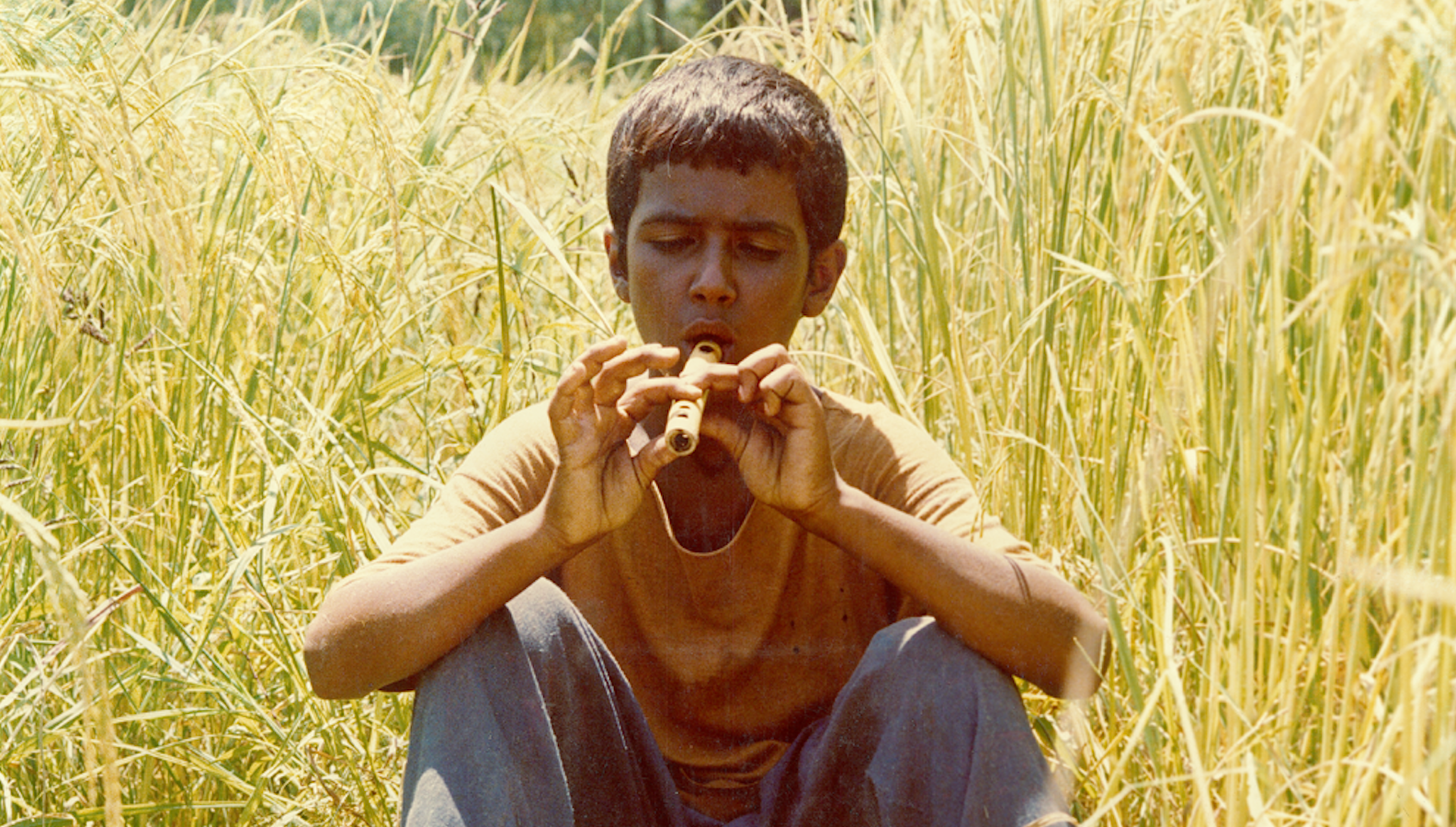
Bashu, the Little Stranger (1985)
In The Runner—which, incidentally, was edited by Beyzaie—the 11-year-old Amiru (Majid Niroumand) is already alone. There is no “before” to return to, no family to mourn; solitude is his given condition. He lives in the southern port city of Abadan, hustling to survive: collecting bottles, running errands, sleeping where he can. Surrounding him are constant images of elsewhere—cargo ships moving across the water, planes flying overhead—promises of a life beyond the oil-stained horizon.
Drawing from his own childhood, Naderi builds the film out of repeated trials. Amiru runs races against the other boys again and again. He keeps testing himself against heat, hunger, and time; later, he even teaches himself to read. The celebrated final scene of the sprint toward the giant melting ice block distills the movie into one physical problem. The camera holds; space compresses; the ice functions as both material object and an image of great longing. It doesn’t so much “symbolize” in a literary sense. Rather, it insists. It melts. It burns. The image lands because you can feel time in the body and scarcity in the hands.
The two filmmakers’ stylistic contrast go beyond differences in taste. Even Beyzaie’s cuts can feel like a community thinking: attention shifting, judgments forming, positions hardening or softening. Naderi often does the opposite. He holds the shot longer. His style can look “simpler” on paper—fewer camera moves, fewer overt compositional flourishes—but the effect is frequently more intense, concentrated. Meaning arrives through process and repetition. His images don’t ask you to decode but to stay with them. For viewers meeting these filmmakers now—especially in the wake of Beyzaie’s passing—what may be most bracing is how much their work expands what “Iranian cinema” can sound and feel like beyond the internationally familiar image of poetic realism so often circulated through festivals. This is true whether they’re turning a daily chore into a portrait of desire, or making one of cinema’s most distilled portraits of endurance. A boy running toward melting ice; a boy running through a landscape that won’t yet name him. Between them is a reminder that cinema can build a world in more ways than one.

Share:
Recommended
- Yuliya Solntseva
 On the actress-turned-filmmaker’s unsung authorship.
 - Futures and Pasts: Socrates
 Rossellini’s one-of-a-kind approach to the costume drama, and his 1970 film on the last years of the Athenian truth-seeker.
 - The Illiac Passion
 On the most elaborate of Gregory Markopolous’s modern myths.