

Interview
Athina Rachel Tsangari, Caleb Landry Jones, & Sean Price Williams
An interview with the holy trinity of director, star, and cinematographer of Harvest.
Share:
Athina Rachel Tsangari’s Harvest (2024) is, in at least two senses, a film out of time. In the first: like the 2013 novel by the English author Jim Crace on which it is based, Harvest takes place in a small agrarian community somewhere in the British Isles at a deliberately indeterminate point in a previous century, maybe the 17th, maybe the early 20th—the act of forced enclosure that will eventually drive the peasantry from their land, to be subjected to efficiency-minded “improvements” by its new stewards, was common practice for over 300 years. In the second: in an era when relentlessly literal and message-minded films routinely come in for praise and even filmmakers who really ought to know better spit up the same hoary platitudes about “storytelling,” it prioritizes the tactile and the sensorial above schoolmasterly instruction in abstract themes. This is not to say that it is a film bereft of ideas, but that its ideas are fully embodied: in gesture, in landscape, in the rhythms of life as once they were determined by the changing seasons and the earth’s revolution. Watching it, I was variously put in mind of the mounting communal mania of Norman Mailer’s Maidstone (1970), various pastoral paeans from far-flung corners of the former USSR, and the kinetic cinema of Philippe Grandrieux. Not once did I worry that it might be greeted with a BAFTA or face some still grimmer mark of prestige.
Caleb Landry Jones, putting on a woolly Scotch burr, plays the nearest thing to the film’s protagonist, Walter Thirsk, something of a lone wolf in the village, an intimate since boyhood of its landlord, Master Kent (Harry Melling), who begins to feel the winds of change stirring with the arrival of a mapmaker, Quill (Arinzé Kene), charged with charting the land. Ahead of the film’s US theatrical release, I spoke via Zoom to Tsangari about her film and her community of collaborators, in the course of which, to her great delight, two of them, Jones and cinematographer Sean Price Williams, joined our conversation. —Nick Pinkerton
NICK PINKERTON: Hello. It’s so nice to see you; how are you?
ATHINA RACHEL TSANGARI: I’m fine, I’m in Edinburgh. We are doing the tour for the UK release. I’m at The Filmhouse. It was shut down five years ago and just re-opened, so we’re here in a historic week.
NP: You’re bringing it back to life.
ART: They revived it through fundraising, and it’s back! It looks amazing. Harvest is playing downstairs right now, so we’re talking before I do the Q&A. I thought Sean [Price Williams] was going to join, but I guess he’s shooting?
NP: Sean’s in Kansas City, shooting a movie.
ART: No way!… I didn’t know they started…What about Caleb [Landry Jones], he’s not joining?
NP: It was proving a little difficult to get all the ducks in a row. Anyhow, I only want to talk to you, Athina.
ART: Okay! Alright!
NP: Now, I know you’re a great bibliophile, but Harvest is your first literary adaptation. As somebody who has such great respect for literary fiction, I wonder if you could speak a little to the particular challenges presented in trying to distill Jim Crace’s novel into a film.
ART: You begin with the beginning, which is really nice, and also the toughest question. [Laughs] Yes, it was terrifying, exactly because I had never done it before. But there was a great first draft by Jocelyn Barnes, who was also the originating producer of the film. I was approached by her, Rebecca O’Brien, and Michael Weber—all three of them got together with the idea of co-producing the film, and they were looking for a director. I don’t do commissioned films. So that was also a first. I was in Syros, right before the pandemic, finishing Trigonometry—which, as you know, Sean shot. It took me some time—to read and study the book, to understand… how I was going to approach it—the novel is all an interior monologue, but I liked that, that there’s a single point of view, which belongs to someone who is largely absent.
I realized Jim [Crace], he loves subtly throwing wrenches in the engine, so I got excited about that, and about what wrenches of my own I was going to throw in. And there is definitely a punk tone to the book. But, basically, he gave Joslyn and I carte blanche. He didn’t want to be involved, didn’t want to read our screenplay. One of the films that was inspiring for Harvest is McCabe & Mrs. Miller (1971), Altman is notoriously a director who discredited and ravaged his writers—Joslyn and I felt liberated by Jim letting us loose, but the responsibility was strong to not lose his voice along the way.
Harvest (2024)
NP: Talking of the problems of adapting interior monologue, I think of John Huston’s 1984 film from Malcolm Lowry’s Under the Volcano. Knowing this isn’t something cinema lends itself to, exactly, it becomes a question of: “Okay, since we can’t have that interior monologue, what can we extrapolate is actually happening around the character from what we glean through the blinkered POV of the text?”
ART: To tell you the truth, that was the biggest dilemma: how do you make a film about doing nothing? And with a principal character who’s not your classic ’70s anti-hero, but more like a void, who slowly gains a sense of his own, very mild urgency. How do you make a film about this kind of fever dream, about someone absent and abject from his own world? And an unreliable narrator, too—how do you translate that into filmic language? In this era of superheroes, action and franchise films, how do you work against that—and at the same time finance the film? [Laughs]
NP: I don’t know; you tell me.
ART: I mean, it’s a miracle. Warrior producers—nothing could stop them. And also what’s called “European public funding,” that had something to do with it. And Rebecca O’ Brien, and Marie-Elena Dyche, our uncompromising generals on the ground. And the decision that the process of making the film would be the film. That was so important to me. From the get-go, I imagined the film itself as building a community of outsiders, of vagabonds. We knew that we were going to be in mud, that we were going to live as a commune, and that we’d have to be there for months until we finished the film, which is a commitment that rarely happens with cast these days. Everyone was there, from rehearsal up ’til the bitter end. This was my big ask from production and from our cast and crew.
NP: Caleb’s character, as you suggest, is almost a structuring absence: a central character who in many ways stays on the fringes of things. Which is a conceit I adore: the passive, or only subtly active, protagonist.
ART: [Laughs] Oh, that’s the best way anyone has put it—including us.
NP: He’s very much present throughout, but it’s really only in—I’m not going to say the last act because it’s not really an act-structured film—it’s only in the back half of the film that he emerges as anything like a “proper” lead. It’s here you come to understand this is someone who has an almost pathological dedication to this place, this ramshackle village, which nobody else seems to share to the same extent. What sort of conversations did you have with Caleb about the character?
ART: Uh, we had no such conversations. I don’t have conversations about characters. Nor does he. We talked about music and cinema. There was a playlist everyone on the cast and crew had to listen to and watch; these were my notes so to speak, that and my extensive mood board. I tend to work nonverbally, corporeally, sensorially. He understood that immediately. We met in his kitchen in LA and just started talking about everything but the script. I mean, I asked if he had read it, and he said, “Yes,” and that was it. He was auditioning me, and I was auditioning him to make sure we were right for each other, and I was patiently waiting for him [to say if he would do the film]. He did say one thing, something like: “Hm. Walt doesn’t really do much, does he?” I was like: “No he doesn’t.” And that was it. It was a strange kind of slow dance, from both sides. The fourth time we met, he said, “Who is my dialect coach? Can I meet him tomorrow?” And that was when I knew. And then in Scotland, Caleb arrived way earlier than anyone else. He walked to his cottage—it’s like an hour and a half from Oban, the port where we were based. He helped the builders, he built the fire, he met all the shearers of the sheep and started shearing. He disappeared. For a couple of days, we didn’t know where he was.
NP: Sean’s version of events is that Caleb holed up for a week in a hotel room, watched Scottish reality television, and that’s how he found his accent.
ART: [Laughs] He probably did that, but he also had a great dialect coach, Conor Fenton. Though, yes, I’m sure the first thing he did was to start watching every single thing where people are speaking Scottish from Argyllshire. When he arrived, he hung out with the farmers and the barman in the pub around the corner. He would chat with them, and he would check the progress of his accent through his barman pal, who verified it became pretty damn good for someone who worked on it for four weeks.
SEAN PRICE WILLIAMS: [Appears on Zoom, roaming around craft services somewhere in the greater Kansas City area] Are you guys wrapping up or still going?
ART: We’re still going.
NP: We’re in the heat of it. I was just getting around to another aspect of preparing the film that fascinates me, because it’s a period film… but we have no idea what the period is. It’s ambiguous, to say the least. Normally, when one is preparing a period film, you’re working from specifics: “Okay, this is 1950, let’s look at all these reference materials with our production designers, then they’ll know exactly what to do…” And clearly you didn’t, or perhaps couldn’t, do that…
SPW: It’s about how deliberate you want to go with that stuff, right? Like, is one guy going to show up wearing Converse sneakers? But there was a lot of serious research going on, questions like, “When did this kind of metal start being used on roofs?”
ART: The red roofs! Which immediately we wanted to keep, we all loved them. There’s no way we were not going to keep them. So we said, “Screw it.” But then Nathan (Parker) our production designer announced that they actually were introduced in that part of the world, in the late 1700s. But still, we didn’t really discuss the film that way because it was never going to be a period film. We discussed in terms of what was available to us, and how to lightly bend it. The barn was the only thing we built from scratch. Or say, the costumes. There was no way we were going to do historical costumes.
NP: For internal reference, just for yourself, Athina, did you have a specific year that you thought the film took place in?
ART: No. Locating it in a specific time and space would have really shut down the entire process for me… The land was the only essential element that we were there to worship, to record… it was everything that was going to be lost. It’s being lost, stolen, ravaged, disrespected, bordered up. We used the blooming plants to dye the cloth for the costumes, we harvested forgotten seeds that we’d sown in fields that hadn’t been cultivated for ages… It was a sort of cinematic biofeedback. The same way Sean was with the light, using what each day and night was giving him.

Harvest (2024)
SPW: Yeah, we let what we had determine things. For example, when we make movies today, we still might put a desk phone in a scene because we like how it looks, even though no one’s using them. This was kind of the reverse. Here, we were taking away things that we don’t like to look at, and that way we… I mean, I don’t know what number of people can tell, on sight, if a film is set in 1480 or 1560?
ART: I come from a rural part of Greece, from a long lineage of farmers, small landowners. And there, you can’t tell whether it’s the 1950s or 1850s or 2020s because so little has changed. Take away the cars and the bulldozers, and it’s all exactly the same.
NP: A trap a lot of period films fall into is relentless now-ness. So often you’ll see a film, say, set in the Eisenhower era, and every car on the road is a brand-new Pontiac Catalina or whatever, whereas in 1950 you would realistically have bits of the 1920s and ’30s and ’40s still around… you would have that sense of the sediment of previous decades.
ART: That’s a good observation. Basically, the thing that we did with Sean and Nathan [Parker, production designer] and Kirsty [Halliday, costume designer] is build tactility. It was about colors and textures and evoking smells. Everything else could go to hell.
SPW: I saw 28 Years Later (2025) last night, which is set in the Scottish Highlands, and, you know, it’s the future, but they’ve lost all of the technology so they’re operating like we were in making Harvest, without electricity and everything like that. It was kind of funny. The future’s going to end up looking like Harvest.
NP: I also recently watched this movie, Sean, and I can’t figure out if it’s incredibly stupid or kind of funny: the premise is that the UK has fallen to this zombie outbreak while the rest of mainland Europe is, apparently, doing just fine; there’s a Swedish naval officer who washes up on shore who has a normal life and a collagen-lipped fiancée waiting for him back home. The survivors in the UK though, have been reduced to defending themselves with bows and arrows, which makes no sense whatsoever… unless you accept the implicit premise that continental Europeans hate the Brits so much that they won’t send them a so much as a single machine gun.
ART: [Laughs]
SPW: Yeah, I think that’s accurate. I liked it. I thought what he was doing with the camera and editing was just really wild. Very experimental. I like Danny Boyle ultimately. Anyway, what else? I have to go in a minute…
NP: Alright, let’s get something better from you, we don’t want “I like Danny Boyle” to be your one contribution here…. I caught your Parajanov shot.
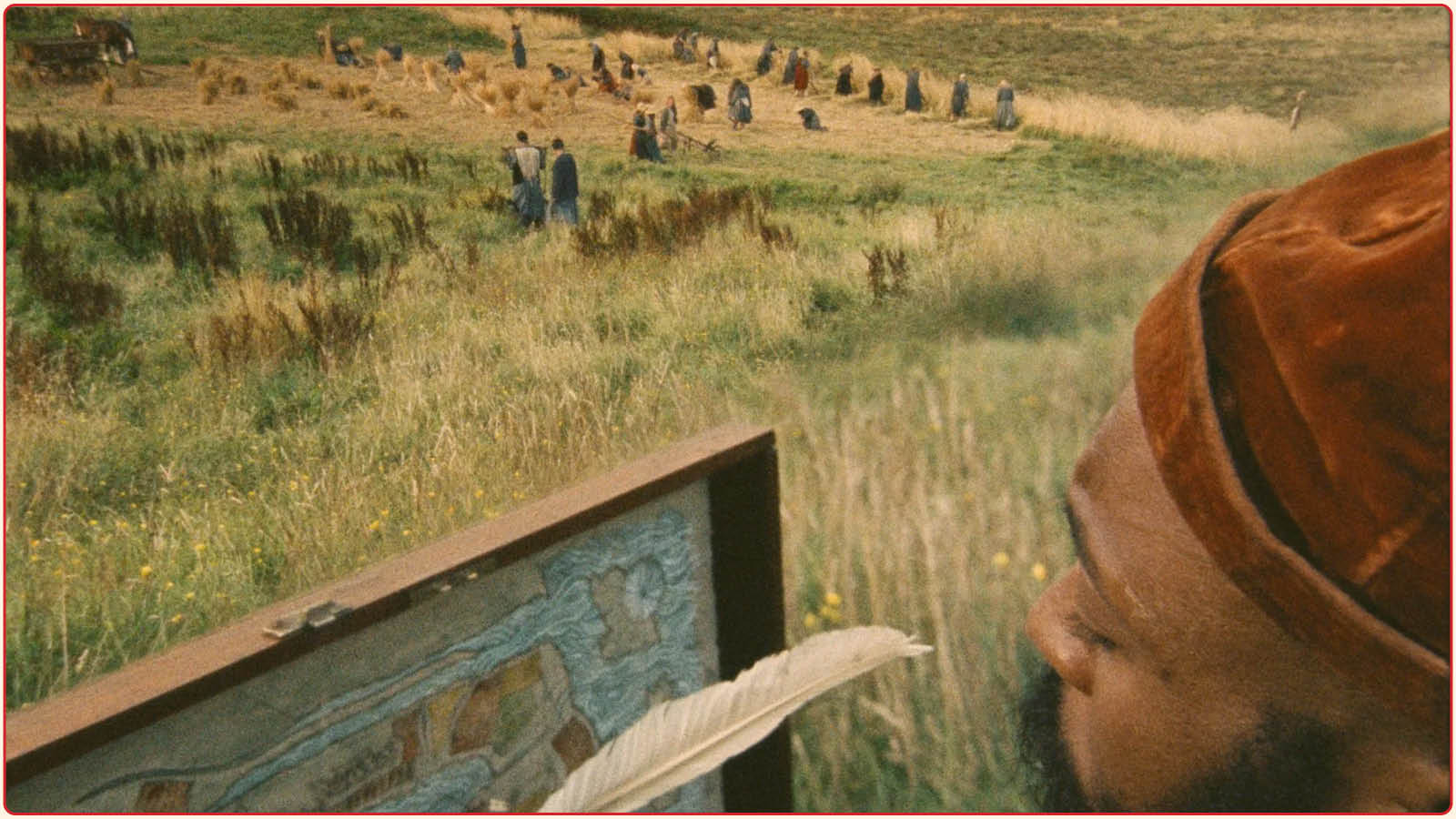
SPW: There’s only one? Oh, with the musicians? That was actually one of [second camera] Ben [Rivers]’s shots. My Parajanov shots were all the really athletic ones. We did talk about him, though. We wanted it to be handheld, because we feel like that’s not really the way period pieces are done, you know, very kinetic. A lot of historic movies just feel like one painting after another. Whereas we’re on the move, and we’re getting close to the dirty fingernails, which Caleb was really showing off. We have this beautiful landscape, but also the people—that’s what it’s about.
NP: Athina, from what you were speaking to before, it feels like a lot of this was an organic outgrowth from the environment: you get there and the setting, the people, inform how they be shot, rather than making them conform to a shot list that you have ready to go.
ART: I don’t work with shot lists. That’s putting the film to death before it is even born. The great thing about working with Sean is that there isn’t this pressure of prep. Sean doesn’t do prep. He just comes to location, and then in his body he knows; we don’t have to talk, I don’t ask questions. Of course, we talk about the format and the ratio and the stock and the palette, but that’s it. I shared my mood board and my music, we talked about movies that inspired us, but it’s not this geeky thing, because we don’t want to replicate. He comes to my rehearsals and watches. At rehearsals we build the film. Then we execute. Silently.
It’s all an accumulation, like this hard drive that we all carry as our autobiography, which is basically cinema. Most of my life is cinema I’ve watched, so, we’re just hoping that there is this transfer between our respective hard drives. And Sean is that for me. We know we’re going to do three or four takes maximum, and he’s going to keep moving until I say cut. And that’s so wonderful and so anti-the industrial complex of making cinema, because everyone is moving with us. His grips were like dancers and absolutely dedicated to the process. It’s like grips who are actors, and actors carrying the equipment between takes. Everyone on set—Caleb, Harry [Melling, who plays landowner Master Kent] and Thalissa [Teixeira, who plays peripatetic traveler and suspected witch Mistress Beldam] and Rosy [McEwan, who plays village coquette Kitty Gosse]—if you showed up on set, you wouldn’t immediately know who’s cast and who’s crew.
SPW: When there is a mood board and images that are there to inspire, we were never trying to imitate them. That’s the important thing. That’s where I think a lot of movies fail. I’d rather think we’re making a movie that will be on the next mood board, you know?
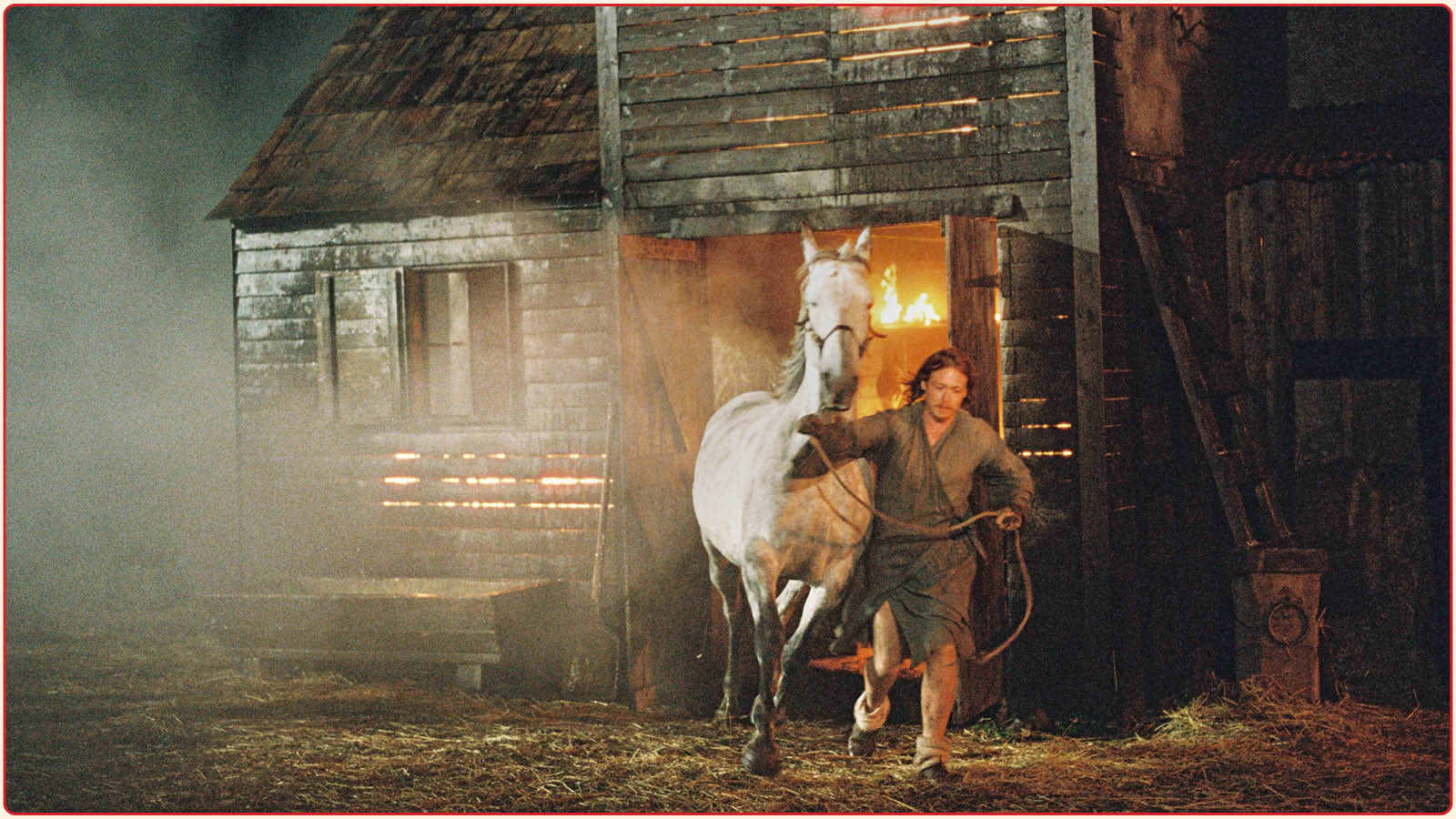
ART: We had small means. But we had this incredible landscape that kept on giving. I mean, the fire—which is the big set piece, right?—a “proper” production would have taken three or four days to do, and we had half a night. We shot it last, and by that time we’re basically like one body, one soul. It sounds like one of those sweetie things to say, but it was fucking fun to make this film.
SPW: Yeah, and partly because we didn’t have much money so we could only have fun.
ART: Mm-hm. And because we lived all together, we ate all together…
SPW: We watched Spinal Tap (1984) together. We watched Predator (1987) together. Predator was the first movie we watched as a crew.
ART: All of the films actually were not Harvest-y.
NP: Now that you say that I can really see the Predator in it.
SPW: Yeah, it makes sense right? The dirt, the mud, the physicality of it all.
NP: Athina was being very coy earlier, talking about McCabe & Mrs. Miller, but I knew there was a missing ingredient
ART: Predator. [Laughs] Oh my God, who is that?
SPW: Is Caleb here?
ART: I can’t believe this!
CALEB LANDRY JONES: [Appears wearing a large cowboy hat and pushing a stroller down the sidewalk] Sorry, I just saw what time it was. [Laughs]
ART: Wow. Hey! Where are you? Why are you wearing this hat?

Harvest (2024)
CLJ: I’m in Los Angeles walking Agnes.
ART: Where is Agnes? Can we see? Oh my God, she’s huge!
CLJ: I know, she’s gigantic.
ART: We had our big homecoming screening yesterday. At the Rockville center, in Oban, [the town that was Harvest’s base camp]. I’m going to send photos. Of course I was crying, and absolutely everyone came.
SPW: The kids were there, they watched the movie?
ART: Maya [Boniwell, who plays Lizzie, one of the village children who gets captured by the villains] was allowed to see the film. In the UK, it starts with a warning, saying “over 18 for sexualized violence,” but this was a private screening. She came out, and I asked, “Maya. What do you think?” “It’s pretty weird.” She said it with a sense of excitement. She was very matter of fact, like, “I understand why there is this warning for kids, because Mrs. Beldam suffocated Mr. Earl with her pee. I can imagine this is pretty controversial, but I understand why she did it. That was her revenge, and that was her only tool to kill him!”
SPW: Did she use the word tool? That’s pretty cool.
NP: Athina, Sean, someone needs to ask Caleb a question.
ART: Nick, you are the one who’s doing this!
NP: I’m 50 minutes in, Athina, I’m out of fresh observations!
SPW: Caleb, which environment was more difficult for an actor, the streets of New York City for Heaven Knows What (2014), or the Scottish Highlands?
CLJ: What’s more difficult? I don’t know, it’s like “heroin or ticks”?
SPW: Or whiskey.
CLJ: But we were all safe on Harvest.
SPW: That’s true. Until the floods came.
NP: You have a great escape story, Sean.
ART: This has never been talked about in any interview: our last day of shooting.
SPW: Yeah, which we missed. We didn’t get our last day.
CLJ: I was thinking about that hotel a few days ago. I was just reminiscing over that hotel. It was dainty but I miss it, I miss it!
ART: We were shooting the day before last, and it was pouring rain, so miserable. At that point, Caleb had given it his all, and then he got really sick, he had a nasty cold and probably Covid… We had one more day to shoot and there was an extreme weather warning of the sort that hadn’t happened in Scotland for 40 years. And the epicenter of the flooding was where we were shooting. Which is fitting because nature is the most important character in the film, it’s all about exile from nature, the loss of Eden. But the US premiere of The Sweet East (2023) was in two days’ time at the New York Film Festival, and so Sean was freaking out because there was no way for him to leave. Everything was flooded, and we were all living in separate towns, completely disconnected.
CLJ: And then Sean, you got out.
ART: Because we got him the fucking speedboat!
SPW: I had to get a fishing boat out.
ART: And that was after he tried to escape on a freaking sedan, and got stuck in the mud, this is how desperate he was to get to his premiere—
NP: Sean described his first attempt to escape by car as being like Sorcerer (1977).
ART: Okay, so Harvest, bookended between Predator and Sorcerer.
CLJ: What was the budget of Sorcerer?
NP: Similar to that of Harvest, I think. Adjusted for inflation.
ART: Just one question for Caleb, because this [is] the first time that we’re on Zoom together and everyone is asking me, “Why did an actor decide to make a film about someone who does nothing?” And actually, why did you decide to make this film? I’ve never asked you, we never actually talked about the film.
CLJ: Oh, gosh. I mean, it started with Sean really being supportive of your work. I remember reading the script and getting to the end and… I wasn’t really sure, but I knew it was something fucking serious. It sounds, I don’t know…It’s like a real reason to work, you know? The character… the film you were wanting to make—that you did make—it was something fucking serious.
ART: You never told me this. You never used that word.
CLJ: I know! Because I don’t want to be too serious.
ART: This is like a confession, two and a half years after we met.
CLJ: Listen, there’s a lot of people making a lot of stupid shit, and people seem to be loving it. And I don’t quite get it. I don’t mean to sound arrogant or anything, but your script, and you as a filmmaker, and Sean, you guys mean serious business.
NP: I told you this after the New York Film Festival screening, Athina, but after Harvest premiered and there was a one-star review in The Guardian, that was the moment I knew, “Ooh, Athina’s got a hot little movie on her hands.”
ART: [Laughs] I’m glad you thought that, Nick, because let me tell you…
NP: Any moderately intelligent person knows if you’ve made something that nobody really despises, you’ve not made anything interesting.
ART: Well, thanks. I’m doing the UK tour right now and everyone is going to go to The Guardian and read this one-star review.
NP: To me that’s better than a five-star review!
CLJ: I agree!
ART: And this was the first review that came out. We premiered the film in Venice and according to tradition you go up on the roof and have champagne. The producers, I see them all going completely white, turning and looking at Caleb and me. We’re like, “What’s going on?”
SPW: I read The Guardian but the entertainment stuff is horrible across the board. Everything they love—Frozen (2013), they probably think that’s the greatest movie ever made. Also, Caleb, you knew that making this movie everything was going to be real. We’re not doing CGI stuff. We’re going to have real fire and smoke and somebody’s probably going to get hurt, which no one did thank God…
CLJ: Holly [Blakey, who choreographed the film and plays villager Cecily in it] got stung a lot.
SPW: Holly got stung, yeah.
ART: Thalissa too!
CLJ: But that’s bees! That’s working with bees, from what I hear.
SPW: Yeah. We just knew it was going to be a real adventure. But I’d work on anything with Athina, even if we were going to be in a box all day.
CLJ: Hear, hear!
ART: I’ll remember this on the next one, guys, when we make a film in a box. Okay. I have to go do the Q&A.
SPW: Love to see you guys.
NP: Ciao. Thank you.
CLJ: See you guys! Love you all!
SPW: Bye guys, I hope I see you soon. Good luck with the screening.
Harvest (2024)
Share:
About the Contributor
Recommended
- The Given Word
 An essay from the newly released compendium Ken Jacobs: I Walked Into My Shortcomings.
 - An Introduction to Jan Švankmajer
 A primer on the work of the visionary Czech artist.
 - A Few Musings on Specific Films
 The visionary Czech filmmaker shares his unique reflections on several of his legendary films.