
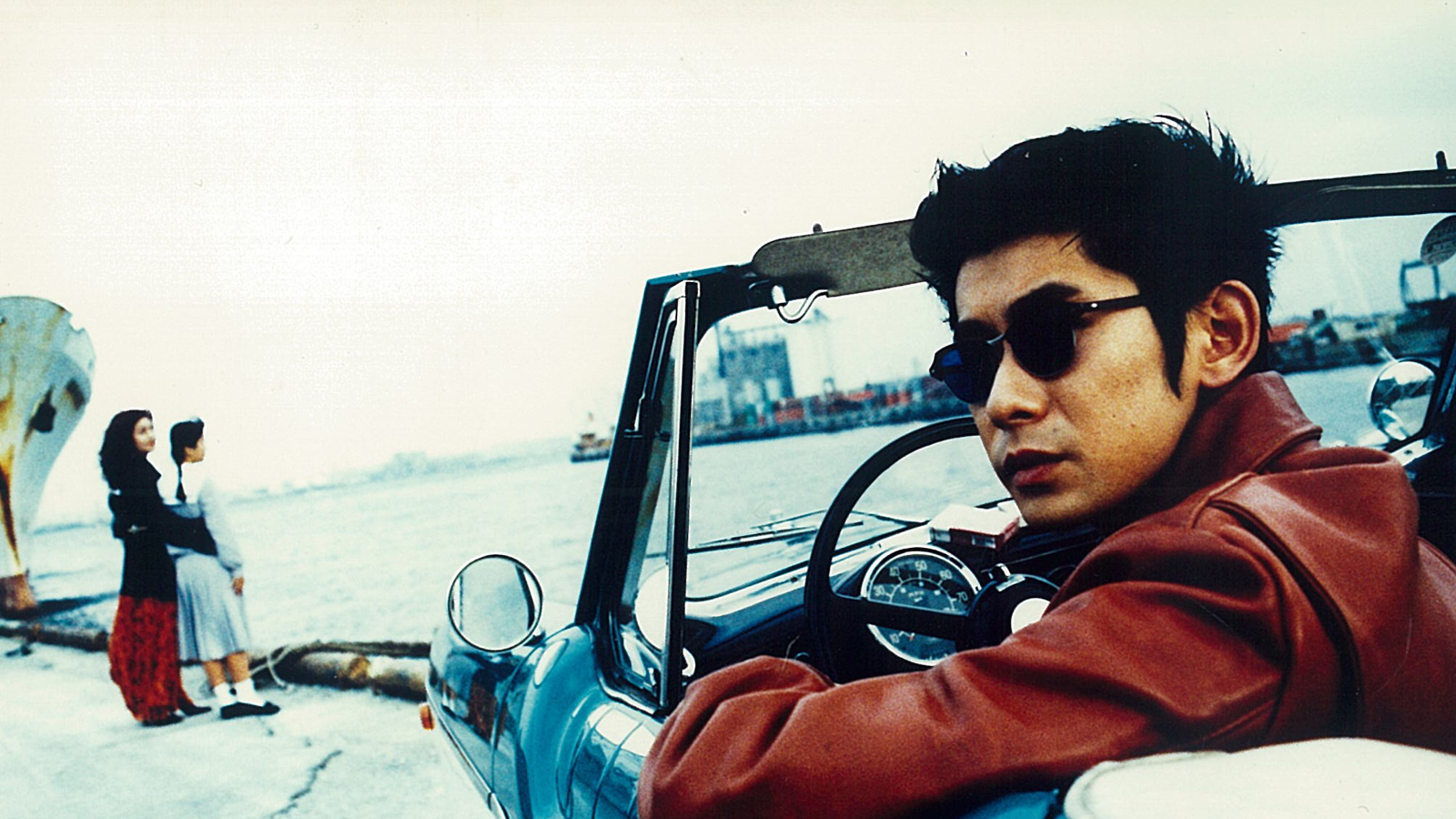
The Stairway to the Distant Past (1995)
Essay
The Maiku Hama Trilogy
On the retro riffs and magnetic lead of Kaizo Hayashi’s cult trilogy.
Newly restored for its 30th anniversary, the Maiku Hama Trilogy opens at Metrograph on Friday, March 20, as part of After the Case.
Share:
Cult phenoms since the ’90s but now primed for wider rediscovery, the cross-genre “Maiku Hama” movies are that rare find—a trilogy that not only brings characters and narrative arcs to a satisfying conclusion, but also introduces new tones and aesthetics with each offering while cohering as a connected work. Best viewed in sequence, and so called for their parboiled private investigator protagonist, whose name is the Japanese phonetic equivalent of crime novelist Mickey Spillane’s pugilistic hero Mike Hammer, the largely black-and-white The Most Terrible Time of My Life (1994) and its voluptuously color-saturated sequels The Stairway to the Distant Past (1995) and The Trap (1996) are at the same time deliriously entertaining mystery-driven mashups of nostalgic cinephilia as well as clear-eyed sociocultural examinations of mid-’90s Japan, dreamed up by one of cinema’s most singular creative voices, Kaizo Hayashi.
Self-taught by making 8mm movies in his teens and, by his own account, watching Akira Kurosawa’s Stray Dog (1949) five times to understand the finer points of editing, the Kyoto-raised, movie-obsessed Hayashi dropped out of his university economics studies after two years and hightailed it to Tokyo to establish himself as a director. Crucial in many ways was his involvement there with Tenjo Sajiki, multi-hyphenate artist Shuji Terayama’s radical, underground theater company. Hayashi was drawn to the company primarily because Terayama made films—the bold visual language, artifice, experimentalism, and provocation of the latter’s work echo within Hayashi’s own storytelling—and it was through his association with the troupe that Hayashi connected with two collaborators who would become indispensable: art director Takeo Kimura and cinematographer Yuichi Nagata.
The pair have repeatedly teamed with the director since his first film, the silent cinema homage To Sleep So as to Dream (1986). When Hayashi arrived in Tokyo, the studio system in Japan was in its death throes because of changing audience tastes, economic shifts, and the dominance of television, and there was zero chance a fledgling filmmaker could apprentice and hone his craft in a traditional training hierarchy. Without the support of these two highly experienced talents—Kimura began working at Daiei in the early ’40s, but is perhaps best known for his flamboyant, show-stopping work with director Seijun Suzuki at Nikkatsu (e.g., 1966’s Tokyo Drifter) while Nagata worked extensively in the softcore Pink Film industry, perfecting techniques for atmospheric lighting and bold compositions under tight production constraints—it’s likely the many pleasures of the very indie Maiku Hama movies, such as their studio-grade technical excellence and pop art bricolage, would be far less in number.
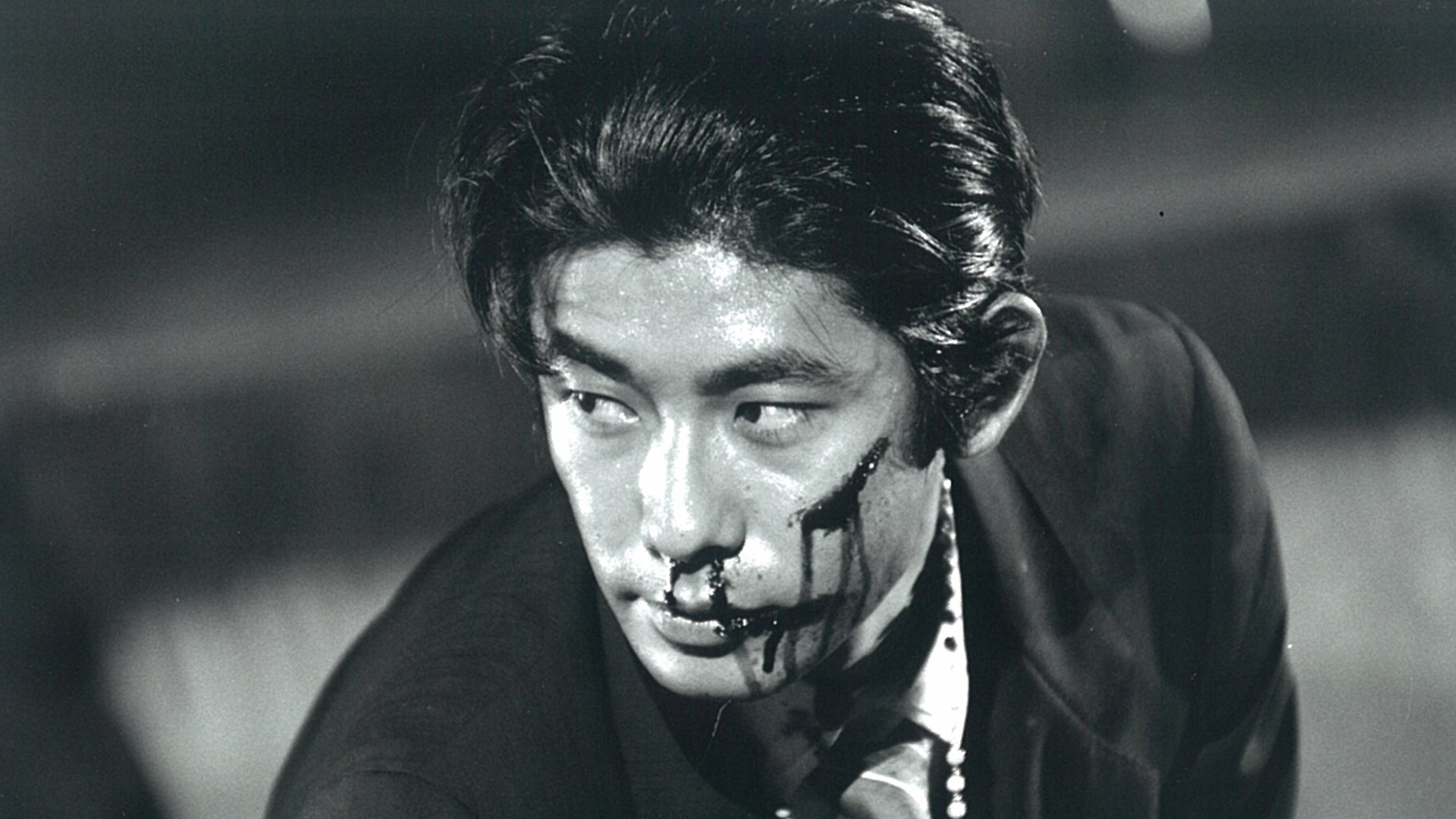
The Most Terrible Time of My Life (1994)
And make no mistake, Hayashi has entertainment under his magnifying glass across the trilogy, exploiting chiaroscuro-centric cinematography for film noir vibes; fabulous and sometimes hilariously clever costumes courtesy of Masae Miyamoto (bubble wrap has never been utilized more imaginatively); an energetic, jazzy score by Meina Co. (Yoko Kumagai and Hidehiko Urayama); and a surfeit of self-conscious metaness. From the location of Hama’s office in the projection booth of a cinema, Yokohama’s real-life Nichigeki Theater, which closed in 2005, to each film’s prologue kicking off with a fourth-wall-shattering direct address to the audience from the P.I., it’s clear that the director wants the audience grinning right along with him.
The highly versatile actor Masatoshi Nagase anchors the series and is irreplaceable as Hama. With his slicked-back hair, stellar wardrobe, stylish wheels (a 1954 Nash Metropolitan belonging to the director), tough guy affectations, puppy-dog earnestness and fuck-you attitude, Nagase exudes the effortless cool one would expect of a top-notch silver-screen detective, like Bogie’s Sam Spade, whose painted likeness adorns the wall of Hama’s office. After debuting in Shinji Somai’s exuberant teen adventure P. P. Rider (1983), Nagase scored wider attention with his road movie turns in Jim Jarmusch’s Mystery Train (1989) and, later, Friðrik Þór Friðriksson’s Cold Fever (1995). But it was through Nagase’s role in the transnational six-film Asian Beat series (1991-1992), for which Hayashi served as executive producer, that the duo first linked up. Each film in the genre-hopping series, such as Clara Law’s Golden Leopard–winning Hong Kong entry Autumn Moon (1992), was helmed by a different young director, and stars Nagase as the Asia-trotting Tokio, a drifter (unkillable, per production mandate) who experiences a new culture with each picture—arguably a trial run for Nagase’s magnetic turn as the lead in the trilogy.

The Stairway to the Distant Past (1995)
A rather unusual aspect of the Maiku Hama films is that Hayashi studied and received his own private investigator license as research, so all three begin with an endorsement from the “Association of Detectives, Japan.” It’s a wry opener because Hama isn’t particularly successful at sleuthing, and, despite his confident braggadocio, more often than not has his ass (or, on occasion, a different body part) handed back to him in a tussle. He’s joined in his misadventures by a recurring line-up who deliver their own quirky charms: his kawaii 16-year-old sister Akane (Mika Ohmine), whom he intends to send to college with his earnings; taxi-driving informant/sidekick Hoshino (Kiyotaka Nanbara), the source of much of the trilogy’s comedy; menacing Kanno, a scarred gangster played by frequent Hayashi collaborator Shiro Sano, whose debut role was in To Sleep So as to Dream; fellow filmmaker Shinya Tsukamoto (1989’s Tetsuo: The Iron Man) as a nail-nibbling hood; and chipmunk-cheeked Joe Shishido as Joe Shishido, a fellow P.I. who not only mentors Hama but harkens back, for those who recognize his iconic visage, to his ’60s crime classics such as Suzuki’s Branded to Kill (1967) that defined the genre.
But while Shishido’s presence, or, say, the anachronistically whimsical set dressing featuring items such as a rotary phone or reel-to-reel tape recorder in the detective’s office, may charm with breezy nostalgia, any easy comforts are complicated when juxtaposed with the very contemporary 1990s Japan world in which the films are set. In The Most Terrible Time of My Life, for example—the movie that basks in classic noir stylings the most of the three—Hama’s main case embroils him in the tragic relationship between a Taiwanese waiter and his missing gangland-affiliated brother. Through this investigation, Hayashi, a naturalized Japanese citizen of Korean heritage, draws our attention to the callous treatment of immigrants in the country, and his razor-sharp social concern slices through the film’s sleek monochromatic surface.
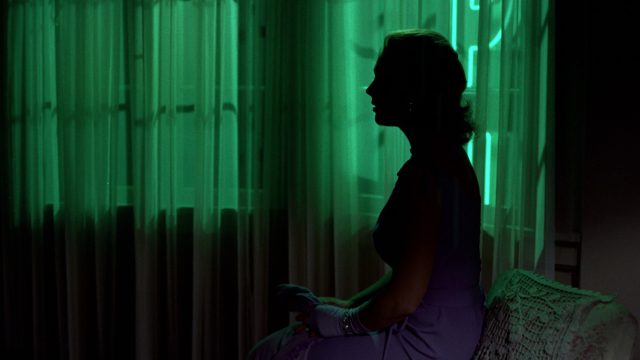
The robust pink and white of sakura blossoms in The Stairway to the Distant Past highlight the cinematographic shift from black and white to color, and a transient beauty flourishes. But the reality of the film’s post-economic crash cityscape, where everyone on both sides of the law is scrambling to make ends meet, emerges as a decrepit (and sometimes ostentatiously theatrical) industrial hellscape where a mythic postwar criminal mastermind, with a possible connection to our hero, maintains a tenuous grasp on power. The postwar past, as lawless as it may have been, is losing to something more hideous: total amorality and widespread political corruption.
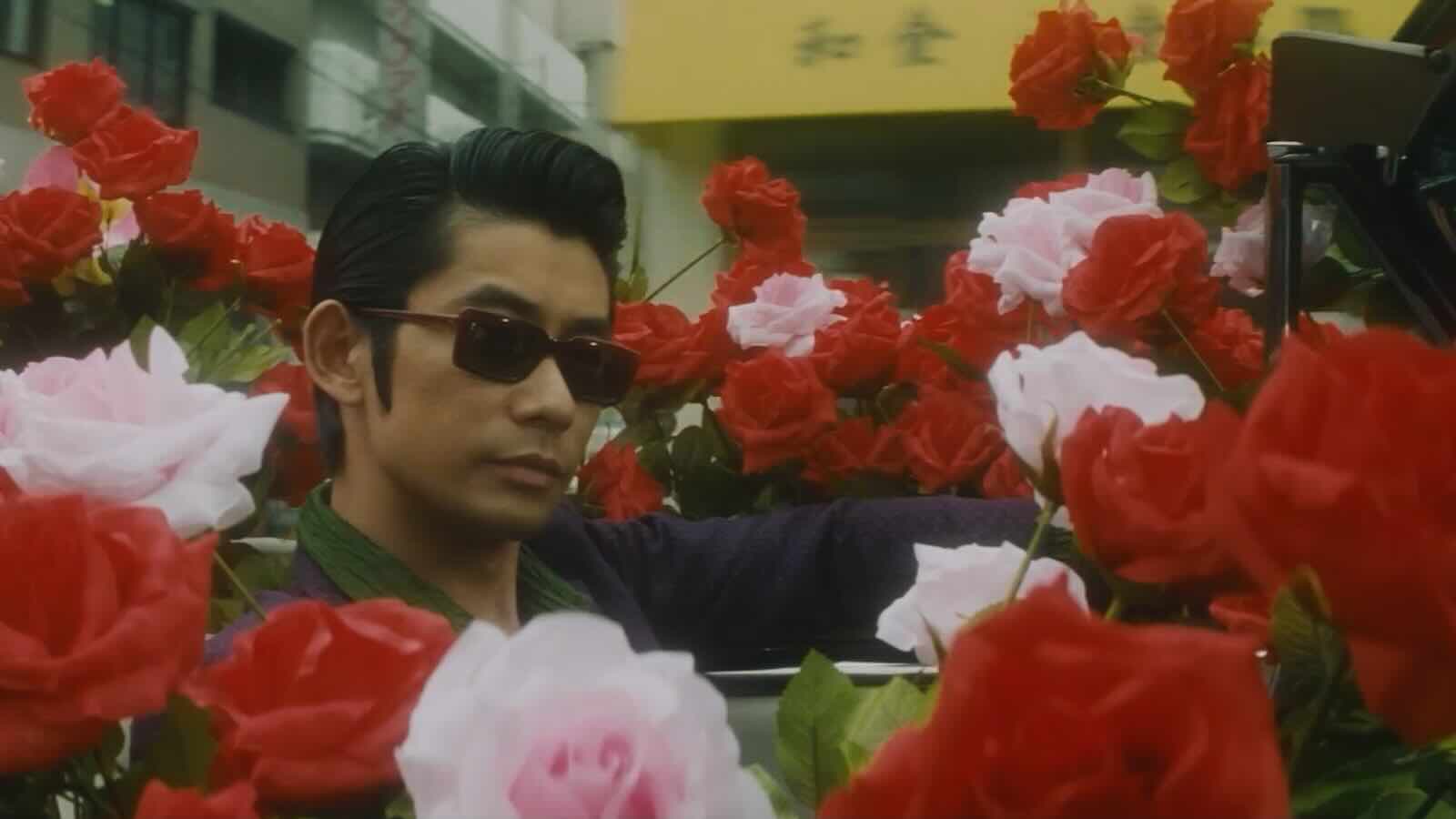
The Trap (1996)
However, it’s The Trap that fully shifts the trilogy from largely buoyant romp into something far more unsettling. Wildly colorful but almost bleakly nihilistic, Hayazaki trains the jaundiced gaze of his third entry squarely on identity. With the Aum Shinrikyo cult’s March 20, 1995, sarin gas attack on Tokyo’s subway system—the largest ever domestic terrorism attack in Japan, which claimed at least 13 lives—the country’s self-image of social cohesion and security was shattered. The palpable paranoia and dread in The Trap are a likely reflection, pitting Hama against a mysterious killer targeting young women and a mute doppelgänger named Mikki (also played by Nagase, showcasing his astonishing range), and the debonair detective’s heroism masks a potentially sinister side.
Closing a series on a largely dark and semi-oblique note might not be the most obviously “crowd-pleasing” move, which is perhaps why, without Hayashi’s direct involvement, Nagase returned as a rebooted, more punk-rock Hama in 2002’s The Private Detective Mike, a 12-episode TV run helmed by directors such as Shinji Aoyama, Gakuryu (né Sogo) Ishii, and Alex Cox. And yet, for all its dark moments, the trilogy’s conclusion is tempered with a glimmer of hope, and the sincerity of the original three movies—for all their pastiche, they are decidedly unironic—guide us on a surprisingly emotional journey. And as the elderly ticket-taker at the detective’s home-base theater says early in the first work, “If you can’t take time out for a movie once in a while… What kind of life is that?”
Share:
Recommended
- India Donaldson and Eliza Hittmann
 Metrograph’s Double Exposure column, in which two filmmakers interview one another about the craft.
 - Meeting Otar Iosseliani
 A newly translated interview with the titan of Georgian cinema.
 - In Her Shadow
 On women who haunt women.