

Can She Bake a Cherry Pie? (1983)
Essay
Can She Bake a Cherry Pie?
On the sexy warts of Henry Jaglom’s anti-rom-com.
The new 4K restoration of Can She Bake a Cherry Pie? (1983) plays at Metrograph from Friday, February 20, and Films by Henry Jaglom, our five-film spotlight, is streaming now At Home.
Share:
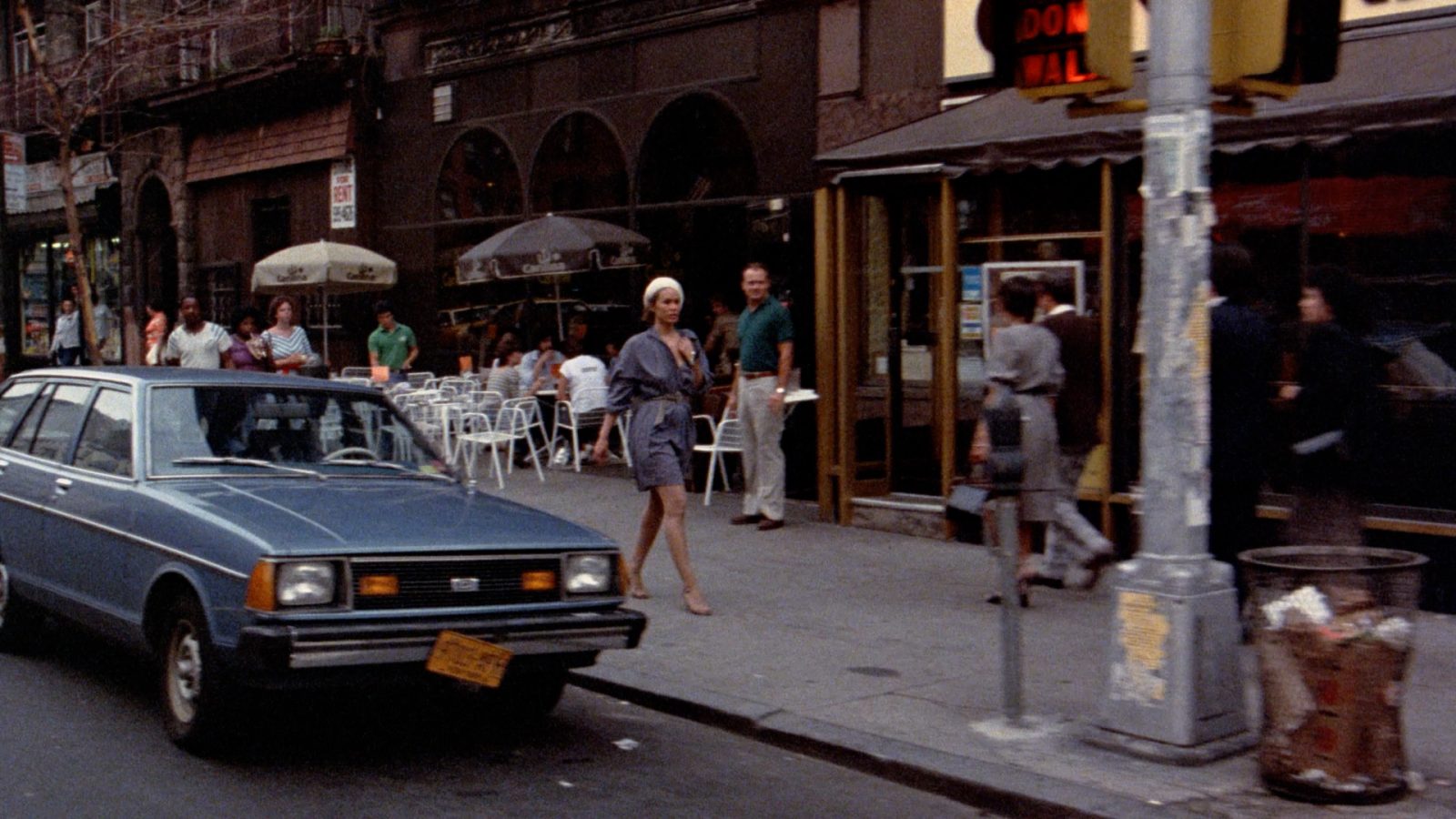
SHORTLY AFTER HIS DIVORCE, HENRY JAGLOM was found muttering to himself, sulking around the streets of New York City by none other than his old friend, the New Hollywood habituée Karen Black. She was fresh off of both the Broadway and the film versions of the Robert Altman–directed Come Back to the 5 & Dime, Jimmy Dean, Jimmy Dean (1982), but this decade saw her prolificity, once so explosive, beginning to wane. It was her suggestion that Jaglom turn the pain of his separation into a film, which is how his fourth feature as a director, Can She Bake a Cherry Pie? (1983), came to fruition, with Black playing a version of Jaglom, whom she had briefly dated herself. In the early minutes of this anti-rom-com, it is Black’s eccentric Zee who is doing the muttering and sulking, dragging her strappy heels along the 70s on Columbus Avenue, a once-countercultural stretch of blocks that is perhaps unrecognizable even to longtime New Yorkers today. On this stroll, Zee voices her regrets and rage about her newly disintegrated marriage out loud. Should she have cooked more? Complained less? Let him talk more? Taken more interest in his work? Her ramblings never come to a resolution.
She eventually plops down on an outdoor seat at Café Central—the bygone bistro and actual location where Jaglom wrote the film (on paper tablecloths). Visibly depleted, she manically changes her order multiple times between staccato sobs before landing on a diabolical, diabetes-inducing combination of chocolate ice cream with chocolate sauce and whipped cream, a chocolate donut, and a coffee—at the height of 1980s diet culture, surely a telltale sign of a damsel in distress. Zee’s histrionics attract the attention of two men sitting next to her, notably Eli, played by Jaglom’s older brother Michael Emil, who appears in several of the director’s films as a loquacious, atypical lothario, often yapping about sex and the opposite sex. Eli operates with that same timbre, and his chattiness earns him an invite to Zee’s table, though this immediately leads to a spat. And so begins, with a barbed-tongued tête-à-tête, this imperfect love story: not so much a match made in heaven as a match made in mutual wallowing. He’s a social worker, she’s an aspiring musician, and both are divorcées. The next hour or so is a footloose exercise of a couple courting and bickering—punctuated by scenes of Zee singing in a club called Improvisation—that doubles as a documentary-style time capsule of the Upper West Side and its residents.

Can She Bake a Cherry Pie? (1983)
Whether hired or in background—featuring real pedestrian traffic—everyone in the film embodies the spontaneous, serendipitous spirit of the city that feels aligned with Jaglom’s ethos of candor. Quirky characters come and go, including a pigeon-wielding pick-up artist (played by Michael Margotta), and Larry David, in a 30-second scene talking about the meaning of true happiness. Jaglom’s vision of bizarre love in the city is especially animated by his inspired casting choices for his leads. Emil—with wisps of hair combed over his quinquagenarian head, hooking himself up to a pulse checker during intercourse—is country miles away from the image of a romantic leading man, but his almost repellent aura feels refreshingly authentic, a true embodiment of odd in this deeply odd couple. Black’s brilliance always lay in her unconventional sexiness: she was leggy with bright eyes, big lips, and wild hair, but she was all the more fascinating because she was a little wobbly, slightly cross-eyed, exaggeratedly pouty, and at times, donning a nest-like ’do just a spray away from attracting cartoon birds. Black, above all, was an immensely talented actress. Each of her roles speak for themselves, but her sole Oscar-nominated turn, as Jack Nicholson’s love interest in Five Easy Pieces (1970), is a standout example of her ability to be the devastating, palpitating heart of a film even in a supporting part. She was a true one-of-a-kind, and yet remains criminally under-discussed among her peers (and Hollywood has yet to see her spiritual progeny). She turned in what is possibly her best work in this underseen film.
Both leads convey a high level of neurosis that has earned the film’s frequent comparison to the works of Woody Allen. Funnily enough, Orson Welles—whose appearance as a park magician in his friend Jaglom’s 1971 debut, A Safe Place, is used as footage during one such neurotic scene in which Eli and Zee watch the film while arguing in bed—was famously repulsed by Allen. Recorded in My Lunches With Orson, Jaglom’s book documenting his standing weekly lunches with his mentor and business partner, is this eviscerating Welles quote from 1983: “I hate Woody Allen physically, I dislike that kind of man. I can hardly bear to talk to him. He has the Chaplin disease. That particular combination of arrogance and timidity sets my teeth on edge.” Though Welles doesn’t explicitly distinguish Jaglom’s filmmaking style from Allen’s, we might assume that he felt it was distinct. Like Welles’s “character” tells Jaglom’s “character” in the latter’s pseudo-documentary Someone to Love (1987): “You have a different way of making movies than almost anybody else.”

Can She Bake a Cherry Pie? (1983)
Jaglom, who passed away last September, was a real independent cinema iconoclast. He came up with the BBS Productions crowd—the trailblazing New Hollywood group that produced Easy Rider (1969), Five Easy Pieces, The Last Picture Show (1971), and Jaglom’s own A Safe Place, among others—and befriended the likes of Nicholson and Dennis Hopper (both of whom star in his films). Throughout his career, Jaglom made movies totally outside the studio system—including Tracks (1976) and New Year’s Day (1989)—and seemed unconcerned with box office success. He maintained the spirit of the New Hollywood revolt into the ’80s and beyond, even as studio-dominated, franchisable blockbusters, like Ghostbusters and the Indiana Jones series, were on the rise and indie auteurs being cast aside. Opinions on the filmmaker were expectedly polarizing. A description for the 1997 documentary Who Is Henry Jaglom? states that some considered him a “cinematic genius” while others dismissed him as “the world’s worst director.” Reviewing Cherry Pie on their show, Gene Siskel and Roger Ebert were also of split minds; Siskel called it a “real bore” with an “amateurish feel” while Ebert found it full of spontaneity: “I felt it kind of got under my skin and I enjoyed it.” Whereas Siskel thought Black was overemoting, Ebert countered that if you walked down the street in New York, you would come across people just like her. (I’m inclined to agree with Ebert—because Jaglom captured New York’s essence and all its high-strung allure so well, the film has that unmanufactured spark about it.)
However you feel about Jaglom, it’s difficult to deny that his filmmaking was all his own, even if that meant the results were sometimes alienating. Jaglom made movies with a carefree realism that often blurred the line between fiction and nonfiction (and in the case of his 1990 ensemble comedy Eating, in which a coterie of women talk about their food habits, a documentarian character obtains talking-head footage as part of the plot). Jaglom also let his personal hangups mold his movies, to a degree that straddles the line between brave and psychotic. He followed up Cherry Pie, already a movie about his divorce starring his ex-girlfriend, with 1985’s Always…But Not Forever, a startlingly meta reenactment of that very same divorce starring his actual ex-wife, actress Patrice Townsend. Jaglom thrived on the thorns of his interpersonal relationships; in many of his movies, he seems to put a magnifying glass on these wounds until wry revelations and comedic ironies reveal themselves. (And more often than not, that would mean a lot, a lot, a lot of talking to get there.)
Can She Bake a Cherry Pie? (1983)
Can She Bake a Cherry Pie? wields many such displeasures into an unforeseen weapon of charm. Jaglom gives us a warts-and-all depiction of romance, where its central couple seems repulsed or perplexed by each other at every turn. At one point, Zee voices a desire to have a baby, but not with Eli, the man she’s literally in bed with. Yet it’s an entertaining ride to spend time with them, perhaps because through all the “ugliness” and “undesirableness,” there is a sex appeal to the film that seemingly accidentally, though likely intentionally, slips through.
Jaglom deftly thwarts audience expectations at every turn. Zee spends much of the film paranoid about someone tailing her; she suspects that her ex-husband is keeping tabs on her dalliances to get out of paying divorce fees. This later leads to a fourth-wall-breaking confrontation during a session of interrupted copulation with Black looking right at what she believes is the “hidden camera” that her husband has planted—and thus directly at the viewer—while making deliberately offputting facial expressions, screaming about how there’s nothing erotic to see here. “You didn’t get anything sexy, did you?” she yells at the camera in a state of borderline delusion. It’s a question Jaglom playfully puts to us, the audience, about the movie itself.
Share:
Recommended
- Gong Li
 On the enduring eloquence of the timeless actress.
 - Allegro non troppo
 On Italy’s lurid riposte to Fantasia.
 - Juliette Binoche
 An interview with the icon of French cinema, La Binoche.