
Excerpt
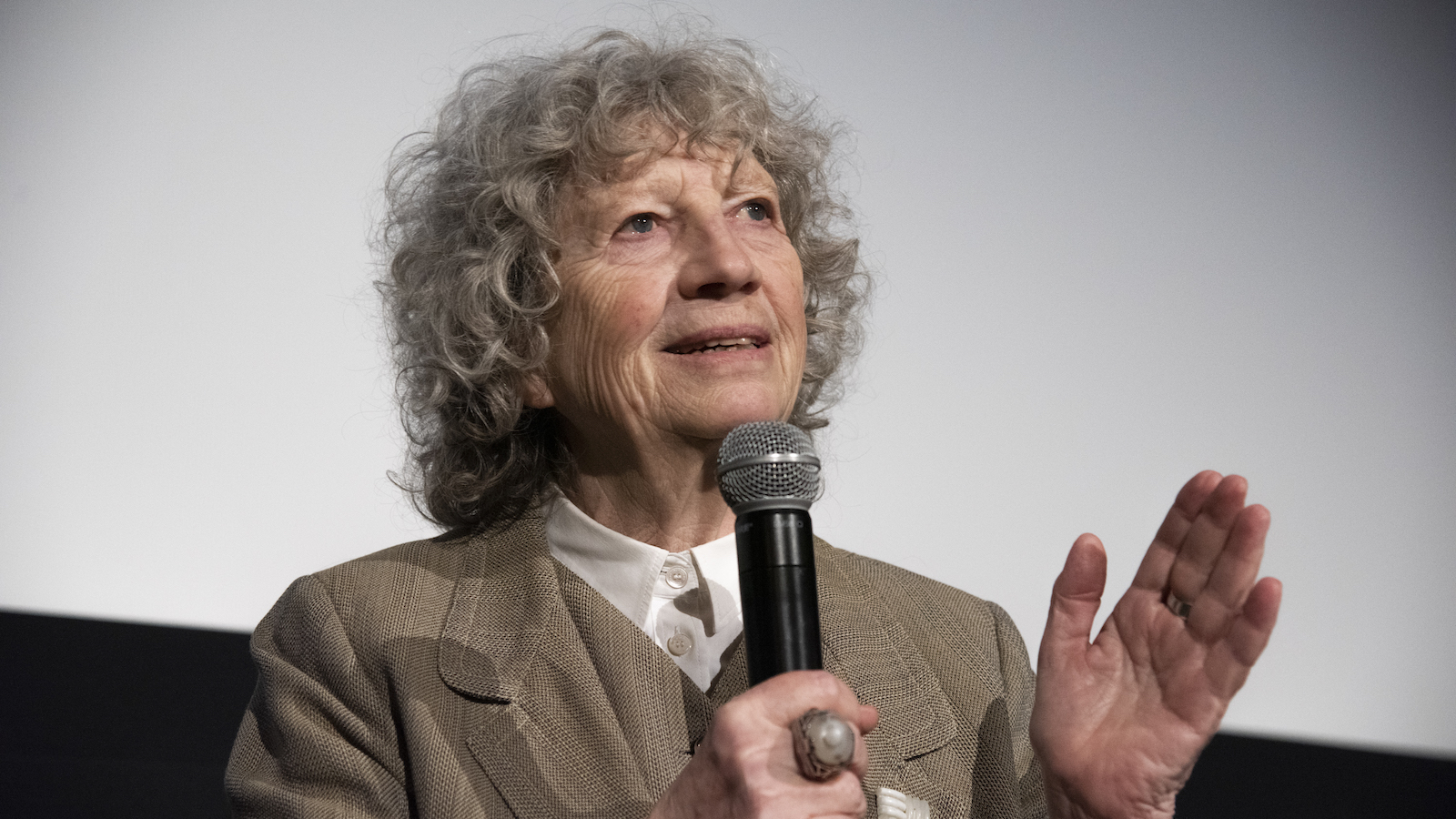
Ulrike Ottinger in the Mirror of Her Movies
The figure of the artist in Ulrike Ottinger’s Paris Calligrammes (2020).
Ulrike Ottinger: From Paris to Berlin plays at Metrograph from Friday, October 3 and is now streaming on Metrograph At Home.
Share:
This is an excerpt from Ulrike Ottinger: Film, Art, and the Ethnographic Imagination, a new critical study of Ottinger’s work, edited by Angela McRobbie. The book is available for purchase from the Metrograph Bookstore.
WE LEARN ABOUT ULRIKE OTTINGER’S interest in the figure of the artist in Paris Calligrammes (2020), a chronicle of the influences and impressions Ottinger received as a young painter in Paris in the years leading up to the events of May ’68. The film is a rich invocation of the period, carrying all the weight of Ottinger’s decision to make an autobiographical film at this stage of her long career. But the film is also a very deliberate telling, retrospective and redacted, which refuses extensive biographical access. Instead, Paris Calligrammes is a portrait of a city at a moment in time: a title card tells us it is an homage to Paris as Wunderkammer. The Wunderkammer (cabinet of curiosities, literally “wonder room”), the technique of displaying collections of marvelous and exotic objects that arose during the Renaissance, is a favorite conceit of the filmmaker and a useful way of approaching her practices of collecting, collage, and display. Here Ottinger, who narrates the film’s German version, is our host, and only more obliquely our subject.
The film opens with rich stories of the expatriate community centered around Franz Picard, whose German-language bookstore gives the film its title (“caligramme” was derived from a work by André Breton). Ottinger pages through the guest book signed by the interwar luminaries who frequented the bookstore: Tristan Tzara, Joan Miró, the poet and Berlin Dada figure Walter Mehring. Subsequent chapters of the documentary recount the impact of the Algerian war and the anti-imperial activism of her friends, and introduce significant influences on the young artist, almost all of them male. Jean Genet’s production of The Screens, the lectures of Claude Lévi-Strauss, and the films of Jean Rouch are intertwined with Ottinger’s tale of how she develops the skills and conceptual frame for her own confident contributions to Narrative Figuration, a French painting style developing in dialogue with Pop Art. Throughout the film, Ottinger, her camera, and her editing of archival footage take up the position of flâneur, that figure of urban enchantment theorized by Walter Benjamin in his reflections on Paris as the capital of the 19th century: a wanderer and a witness, also implicitly male, as feminist commentators have explored.
In his astute review of the film, Michael Sicinski argues persuasively that Paris Calligrammes bridges the apparent contradiction between the filmmaker’s fictional works and her documentaries through its stress on the key role of surrealist principles of disruption. “Part of the intellectual inheritance from the Surrealists was the sense of continuity between the aesthetic and the anthropological study of non-Western cultures,” he explains, suggesting that surrealist primitivism underpins some of the filmmaker’s more outrageous acts of cultural appropriation. Paris Calligrammes recounts how the architecture and collections memorializing France’s colonial pillaging affected Ottinger’s personal image bank. Tracing the frieze depicting the colonies’ homage to the capital on the facade of the Palais de la Porte Dorée, now the National Museum of the History of Immigration, the camera betrays the fascination with ethnographic kitsch that Ottinger’s voiceover deconstructs. Subtitled a “landscape of memory,” the exhibition accompanying the release of Paris Calligrammes at Berlin’s own Haus der Kulturen der Welt registers the felt forces of decolonization, Maoist sloganeering, anthropological inquiry, and art-making that swirled around the young painter.

Paris Calligrammes (2020)
Yet Sicisnki doesn’t trace the link between racial/cultural difference and sexuality and desire in Ottinger’s work to Dada and surrealism, perhaps because of Paris Calligrammes’ own reticence about such matters. The film is about the origins of the Kunstlerin—without dwelling on gender. Yet the gender rebellion that is missing in the narration is tantalizingly suggested in the visual evidence of Ottinger’s self-fashioning in her early twenties. Black-and-white images used in the film, and to promote contemporary exhibitions of her paintings and objects from the period, feature the androgynous director with close-cropped, curly, dark hair, interacting with her artwork: she stands in front of a painting of Allen Ginsberg (dressed incongruously as Uncle Sam) wearing a dark turtleneck and round sunglasses, with her deadpan face encircled by the painting’s speech bubble. Ottinger wears a bowler hat and stands behind a dressmaker’s dummy painted with pop motifs (reminiscent of Sophie Taeuber’s “Dada Head” from 1920). With the photos as evidence, one can infer that one of the faces in the narrative painting showcased in the film—a riotously colored, Warhol-style grid of pop images—is her own. A section of Paris Calligrammes on the Cinémathqèue Française, which played such a role in the events and mythologies of ’68, opens on a black-and-white photo of young Ottinger posed in front of a poster of the Marx brothers as if she were the fourth sibling. Arms folded, her image gazes out through round glasses, prompting speculation about what her shtick in the act might look like.
Compared to Paris Caligrammes’ footage of women wearing mini-skirts, and even the striking chanteuse Barbara, who is profiled with a hint of fannish obsession, Ottinger’s presentation is notably gender nonconforming. Queerness is thus inscribed but not referenced, leaving the viewer to calculate the working of desire in the film’s equation of art, history, memory, and cultural encounter. McRobbie, in speaking of “Ottinger’s erudite obsessions,” implies that it is the collision of modes, of collecting and erotics, of desire bound up with cultural othering, that many find disconcerting in the filmmaker’s work.
This excerpt from Ulrike Ottinger: Film, Art, and the Ethnographic Imagination, edited by Angela McRobbie, is reproduced here with the permission of the author and publisher, Intellect. The book (add link) is available for purchase from the Metrograph Bookstore.
Share:
Recommended
-
Susan Seidelman
 An intimate conversation with the trailblazing American filmmaker.
 -
Carol Kane
 Fifty years in 50 minutes with the irrepressible screen icon.
 -
Mark Lee Ping-bing
 The legendary cinematographer reveals his three core beliefs.
- The Holy Girl
 On Lucrecia Martel’s transfixing portrait of adolescent fervor.
 - Somersault
 On Cate Shortland’s assured directorial debut on sexual awakening.
 - Can She Bake a Cherry Pie?
 On Henry Jaglom’s effervescent anti-rom-com.