
Essay
Love Hotel
On the generation-defining Shinji Sōmai’s singular foray into Roman Porno.
Love Hotel plays from Friday, April 4 at Metrograph Theater.
Share:
By the time director Shinji Sōmai made his feature debut Tonda Couple (1980), he was among the handful of emerging Japanese directors to have trained under the studio system. The 1980s in Japanese cinema—sandwiched between the twilight years during which five major film companies dominated its theatrical landscape and the ascendance of a new generation of auteurs such as Kiyoshi Kurosawa and Shinji Aoyama—was a transitional period marked by uncertainties. In 1971, Nikkatsu, a once-great movie studio now in financial turmoil, had observed the continued popularity of the independently produced softcore exploitation genre of Japanese Pink films, and begun producing a series of their own sexploitation films by the name of Roman Porno, as a last-ditch effort to stay afloat. Throughout the ’70s, Sōmai apprenticed at Nikkatstu, often working as an assistant director. He knew very well that the filmmaking tradition he had been accustomed to was rapidly losing cultural relevance. Still determined to preserve some of its facets, according to critic Jinshi Fujii, the director recruited the highly skilled, maverick technicians he met at Nikkatsu and gave them the space to work outside the confines of the studio in his independent productions.
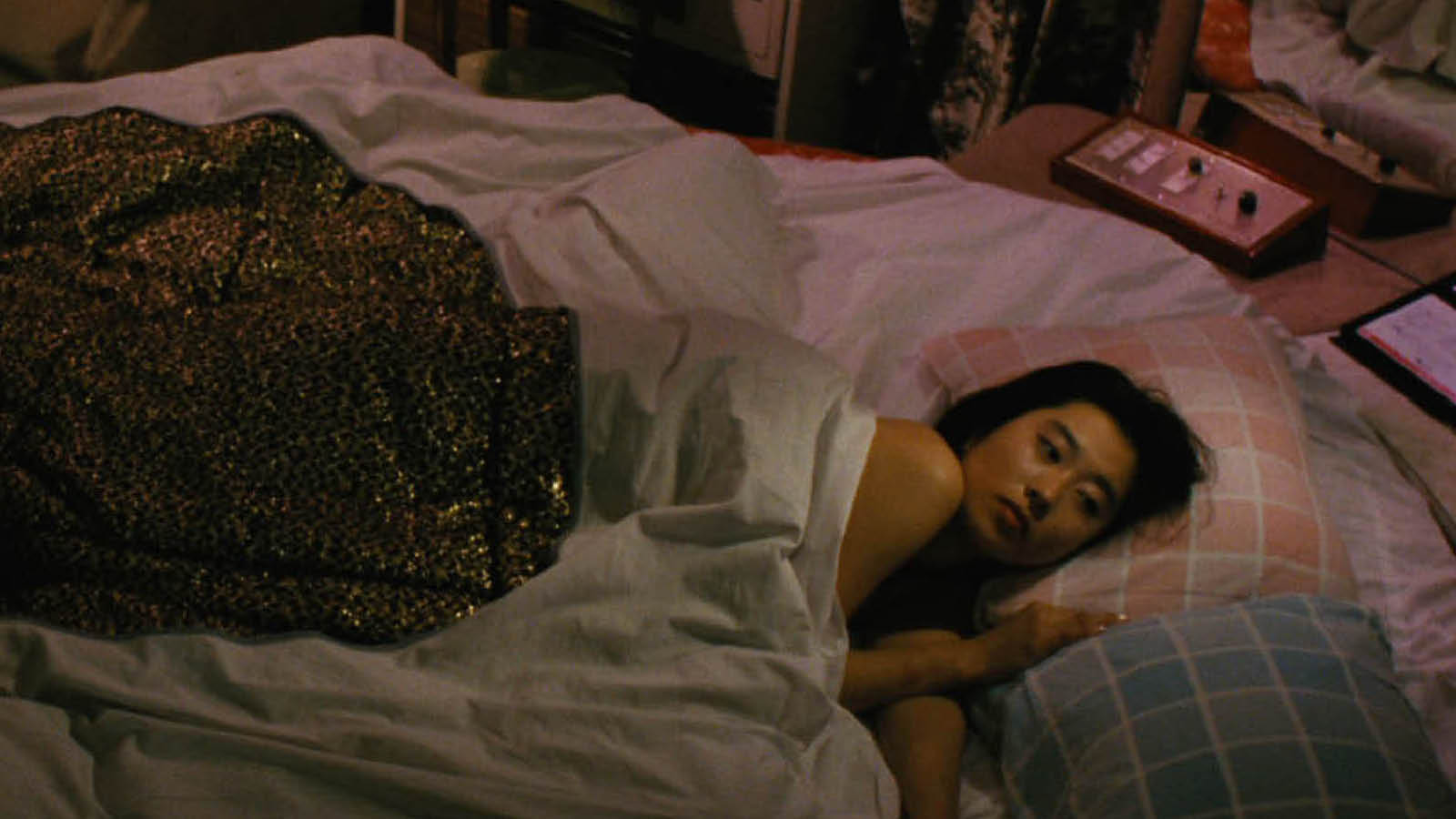
Now a classic of the Roman Porno genre, Love Hotel (1985) was shot in Tokyo over just 10 days: a remarkable fact considering the sophisticated shot design and the polished camerawork and lighting of the film. It begins with two startling sequences of sexual assault. Tetsuro (Minori Terada), the owner of a publishing company on the verge of bankruptcy, comes to his office to find yakuza debt collectors sexually violating his wife Ryoko (Kiriko Shimizu). He checks himself into a love hotel, for discreet short-stay lodging, and meets a call girl named “Yumi” (Noriko Hayami). He handcuffs her and unleashes his anger on the poor girl at knifepoint, eventually tying her to the bed with a vibrator placed between her legs. He originally intends to take the girl’s life before committing suicide but ultimately kills neither.

Love Hotel (1985 )
Two years later, now divorced (to ensure his wife’s safety from the yakuza) and working as a cab driver, Tetsuro encounters “Yumi” again by pure chance. It turns out her real name is Nami, and she holds an office job at a respectable company where she is having an affair with her married boss Kiyoshi (Nobutaka Masutomi). When asked why Testuro did not carry out his plan two years ago, he tells her, “The expression on your face was like a mirror.” In stark opposition to the unrelenting sexual violence that dominates the film’s early scenes, the rest of Love Hotel proceeds with a surprising amount of tenderness and melancholy. There is plenty more sex—after all, this is a Roman Porno film—but physical intimacy feels both desolate and titillating in equal measure. When Ryoko visits him in his new shoebox apartment with a bag of groceries, they have passionless sex, concluded by him pulling out: he does not want to risk pregnancy, he tells her. He cannot bear to release himself from his self-imposed emotional austerity, driven by shame over the consequences of his reckless financial decisions. Sex in Love Hotel exists only as a temporary respite from the crushing reality of living with the self, never as a generative act through which human connections deepen and sustain themselves.
Understandably, some might consider Love Hotel, Sōmai’s only directorial foray into Roman Porno, to be an outlier in his filmography. At a quick glance, it seems to lack many of the aesthetic trademarks found in his best-known works such as P. P. Rider (1983), Typhoon Club (1985), and Moving (1993). There are no adolescent protagonists here, and Sōmai’s signature long takes feel rather subdued here next to, for example, the anarchic opening of P. P. Rider.
Often executed with elaborate camera movements on cranes, Sōmai’s kinetic long takes have come to be regarded as one of the defining features of his cinema. However, the director himself was skeptical of the tendency to uphold it as a skeleton key to unlock his filmography. At a masterclass event following the release of Tokyo Heaven (1990), he opined that the importance of the technique in his practice is “exaggerated,” and that instead, it should be understood in the context of what was happening in the Japanese film industry when he began making works of his own in the ’80s. Long takes were at once a formal expression of Sōmai’s artistic vision and a bridge to the old tradition, a testament to the well-funded studios and their in-house master craftsmen. We could argue that Sōmai inherited the technical prowess of the studio and chose the long take as a means to explore human bodies in motion and unpredictable ruptures in relationships, even at the risk of compromising the “quality.” Although impressive formal feats, his long takes are rough and freewheeling compared to his Nikkatsu senior Kenji Mizoguchi’s technically impeccable long takes. The mutated long takes born out of this liminal period, much like Yasujiro Ozu’s low-angle shots, went on to be one of the cornerstones of Japanese cinema. And Sōmai’s films have since beget a cinematic lineage of their own, inspiring both his contemporaries and—since his death in 2001—coming generations of Japanese filmmakers. The ending of Kurosawa’s Bright Future (2003) pays direct homage to the credits sequence of Moving; the opening of Mitsuo Yanagimachi’s Who’s Camus Anyway (2005) not only visually mimics P. P. Rider’s, but also namedrops its source material.
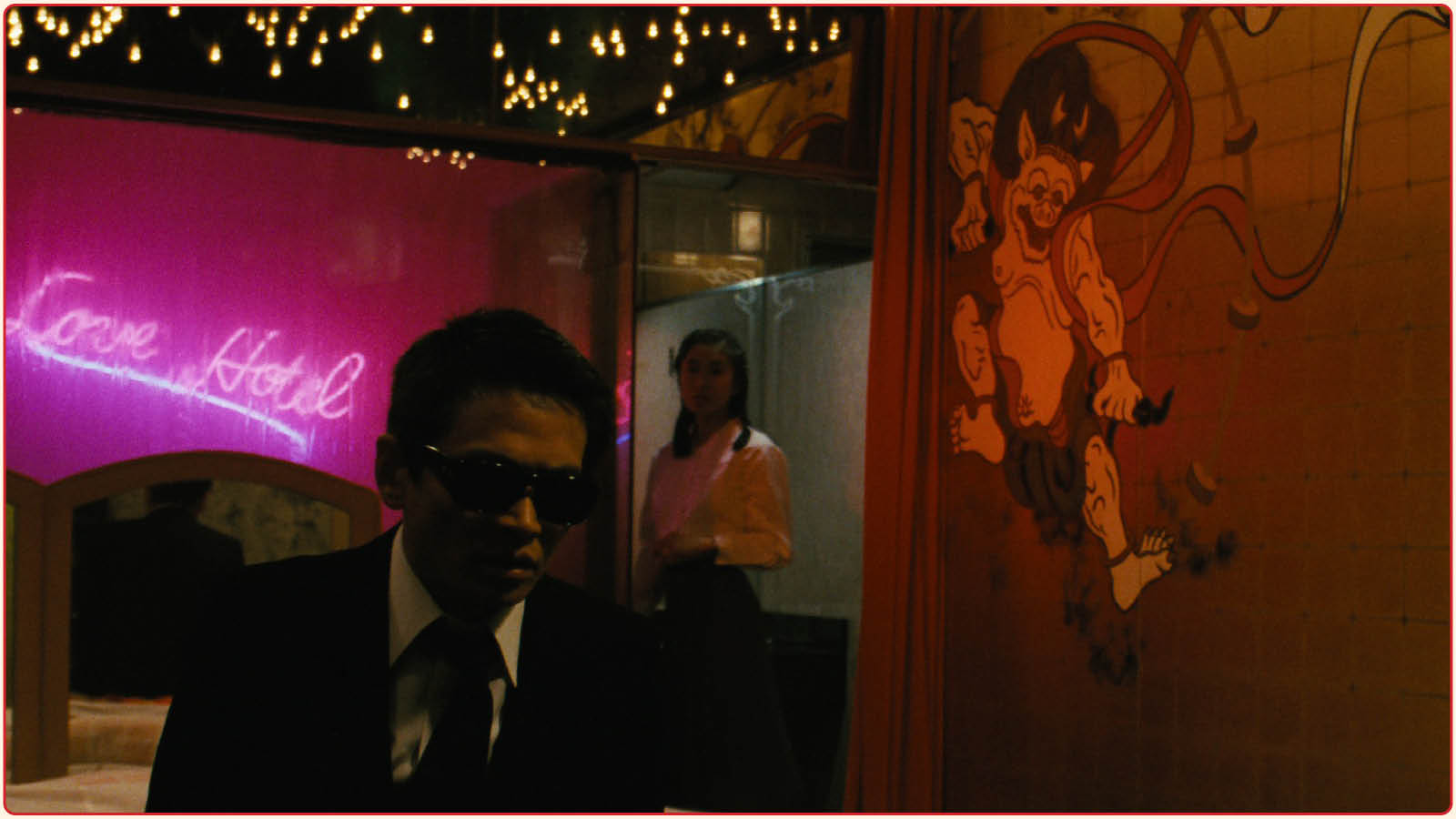
Love Hotel (1985)
There is undeniably a parallel between Roman Porno, the lifeblood of a studio struggling to keep up with the changing times, and Sōmai, whom critic Shiguehiko Hasumi calls “the missing link” between the two distinct models of filmmaking that precede and succeed this transitional period. But what makes Love Hotel unmistakably a “Sōmai” picture is his keen interest in roleplaying. Yoon Un-seong, one of the most insightful Korean critics working today, points to the prevalence of mimetic performances throughout Sōmai’s filmography. His characters often engage in diegetic roleplaying, and acting in Sōmai’s films is both an instrument of makeshift social reproduction and an act of transgression against rigid social customs and structures. In Sailor Suit and Machine Gun (1981), Izumi, a high school girl, is forced to step into the role of a yakuza boss—previously occupied by her deceased father—to guide a leaderless clan. In Typhoon Club, a group of unsupervised teenagers dance on a stage inside a school auditorium; earlier in the same film, a lonely teenage boy repeatedly murmurs “I’m home” and “welcome home” to himself in the absence of any family members to greet him. In the end, his characters succeed at neither conformity nor revolution, but what Sōmai is after is the transient space of fiction where, although temporarily, everything becomes possible for the duration of the performance. Again, we find traces of Sōmai’s influence: decades later, Ryusuke Hamaguchi takes up Sōmai’s interest in diegetic “acting” as an avenue for self-discovery and spiritual epiphanies, perhaps most beautifully in the third segment of Wheel of Fortune and Fantasy (2021), where two strangers attain long-awaited emotional closure through roleplaying.
Love Hotel, too, is driven by Nami’s desire for a reenactment of the night she first encountered Tetsuro. She wears the same yellow cardigan she did last time, and brings handcuffs to make it all feel “real.” Tetsuro follows along and they make love. But the mimesis collapses in on itself when Nami steps out of her role as “Yumi” and asks him to call her by her real name. Tetsuro can no longer pretend that this is play-acting, and has to grapple with the reality of her genuine feelings—and ultimately his own reflection in the mirror attached to the headboard. An actor must take his exit once his role on stage comes to an end. So Tetsuro leaves her in the room yet again, faithfully sticking to the script.
Sōmai shot all this in a single long take with minimal movement, save for one instance of tracking and a slow pan that captures the room’s interiors: the sex scene feels as much like a drawn-out dirge as a genre requirement. Strangely, this elegy seems addressed to both the couple’s roleplay and Roman Porno itself, which would shut down in 1988. Here, the diegetic acting extends to Sōmai’s part as a director working on this studio assignment. Just three weeks after the release of Love Hotel, Typhoon Club came out through Sōmai’s independent production unit Director’s Company, leaving behind a towering filmography that, in the words of Hamaguchi, “no Japanese filmmaker makes a film without being conscious of.”
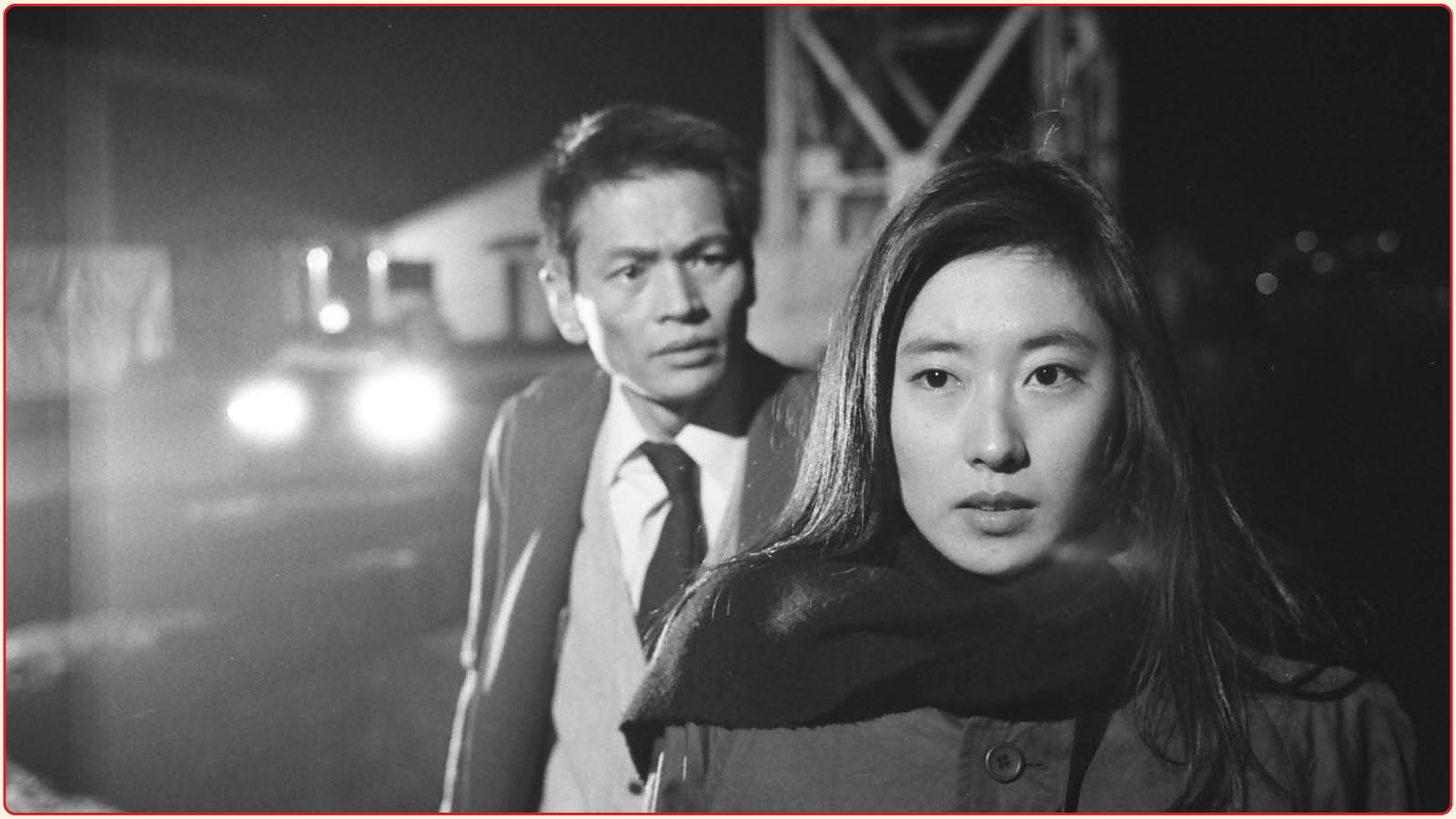
Love Hotel (1985)
Share:
About the Contributor
Recommended
- Mississippi Mermaid
 On Yves Saint Laurent’s striking costumes in François Truffaut’s subversive neo-noir.
 - Lady in the Water
 On the death of the critic in M. Night Shyamalan’s watery fairy tale.
 - Der Fan
 Eckhart Schmidt’s chilling cult fable and the all-consuming side of pop fandom.