
[wpbb post:terms_list taxonomy=’category’ html_list=’no’ separator=’, ‘ linked=’yes’]
[wpbb post:title]
Sister (2012)
[wpbb post:terms_list taxonomy=’category’ html_list=’no’ separator=’, ‘ linked=’yes’]
BY
[wpbb archive:acf type=’text’ name=’byline_author’]
Mapping the films of Ursula Meier.
Permeable Boundaries: The Films of Ursula Meier opens In Theater and At Home from March 31.
Ursula Meier makes movies about borders. Well, kind of. Her focus is not on political borders or divisions between countries, though certainly there is some inspiration taken from there; the filmmaker was born in 1971 to a Swiss German father and a French mother. She was raised in Besançon, in an area known as France Voisine (“neighboring France”) which she describes as a kind of no man’s land. Growing up, she crossed the border four times a day, and has acknowledged that this “had a clear impact” on her movies. She went to film school in Belgium, in an attempt to distance herself from the countries of her parents while still preferring to study in her native French tongue. Traces of Belgian surrealism can be seen in her otherwise deceptively realistic films; the film critic Thierry Méranger once said her features are “ground in reality and, at the same time, can have a fairly symbolic way of looking at things.”
These tensions that arise from existing between (sometimes contradictory) spaces have not only shaped the direction of Meier’s work behind the scenes, but are also often the subjects of her films. She focuses on the borders of domestic life, of public and private spheres, the separation between parent and child, and the ways that these distinctions can be muddled, permeable, and otherwise flipped on their head. The borders are metaphors, except when they’re not: Meier’s films are filled with physical barriers.

Home (2008)
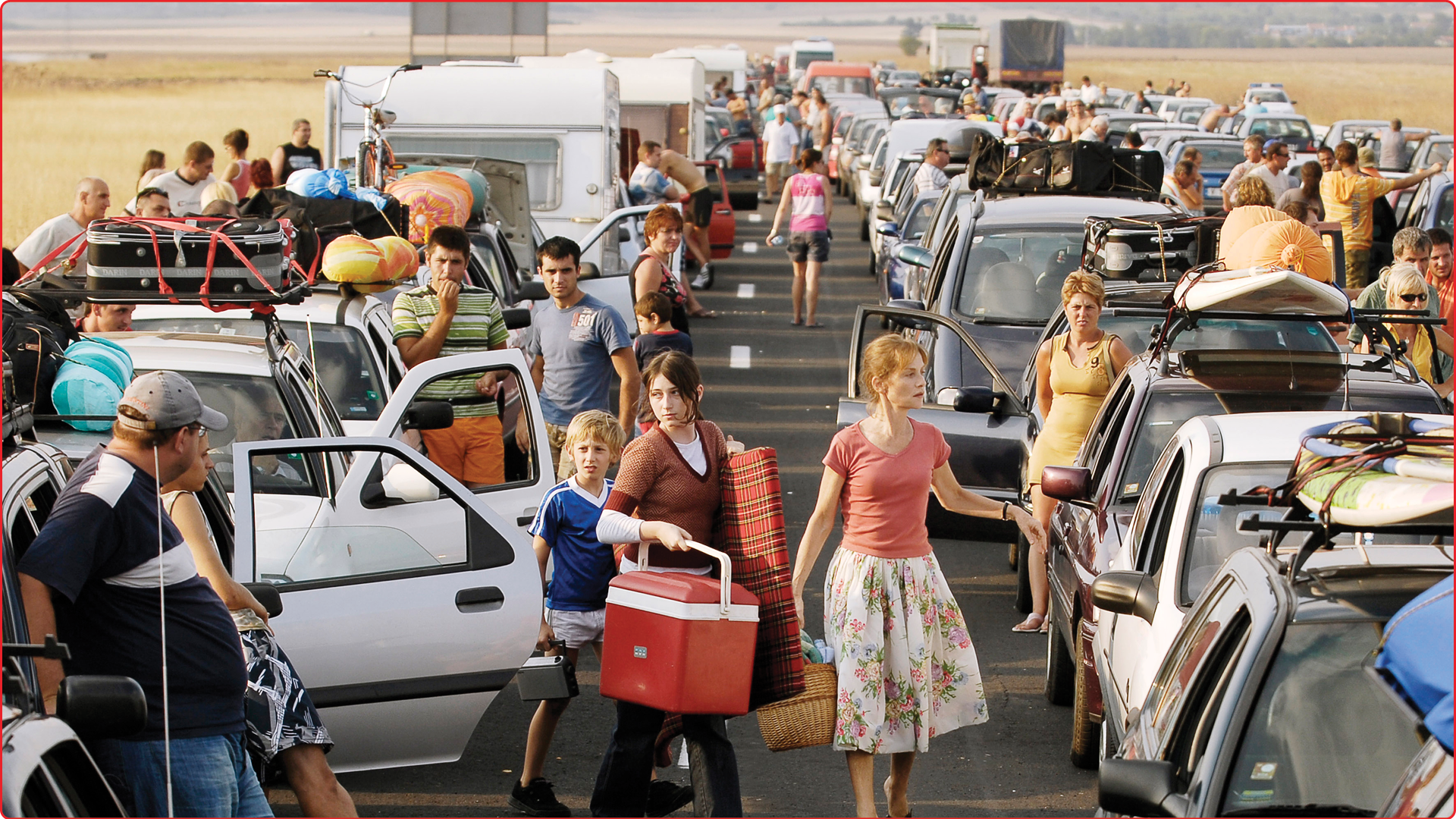
Her darkly funny debut feature, 2008’s Home (which followed a documentary, a made-for-TV movie, and several shorts), concerns a family who live in a personably rustic house by an unfinished rural highway. The movie was filmed in Bulgaria, but the location is never disclosed within the film; the family is portrayed by French, Swiss, and Belgian performers, led by veterans Isabelle Huppert and Olivier Gourmet as mother Marthe and her partner Michel. The family lead an idyllic life, enjoying a closeness not generally depicted in North American cinema covering similar topics. They play street hockey and sunbathe on the desolate stretch of land outside their house, which they treat as an extended backyard. They share cigarettes and bathwater. There are few boundaries between them, just as there are few boundaries between their home and the rest of the world.
Then one day, after a decade of sitting dormant, the highway by their home is completed. Agnès Godard’s camera moves from handheld to static. Within a week, an endless barrage of noisy polluting cars interrupt the family’s quiet existence. Their world shrinks. They lose their privacy and, eventually, their sanity. They are unable to cross the street to go to school or work without jaywalking through four lanes of heavy traffic. A perfect foil to the family’s communal living and reclamation of outdoor space, personal vehicles serve here as the ultimate grim markers of individualism, two tons of steel that grant drivers a sense of unfettered mobility at the expense of that of pedestrians. Watching Home becomes an increasingly claustrophobic experience.
Home (2008)
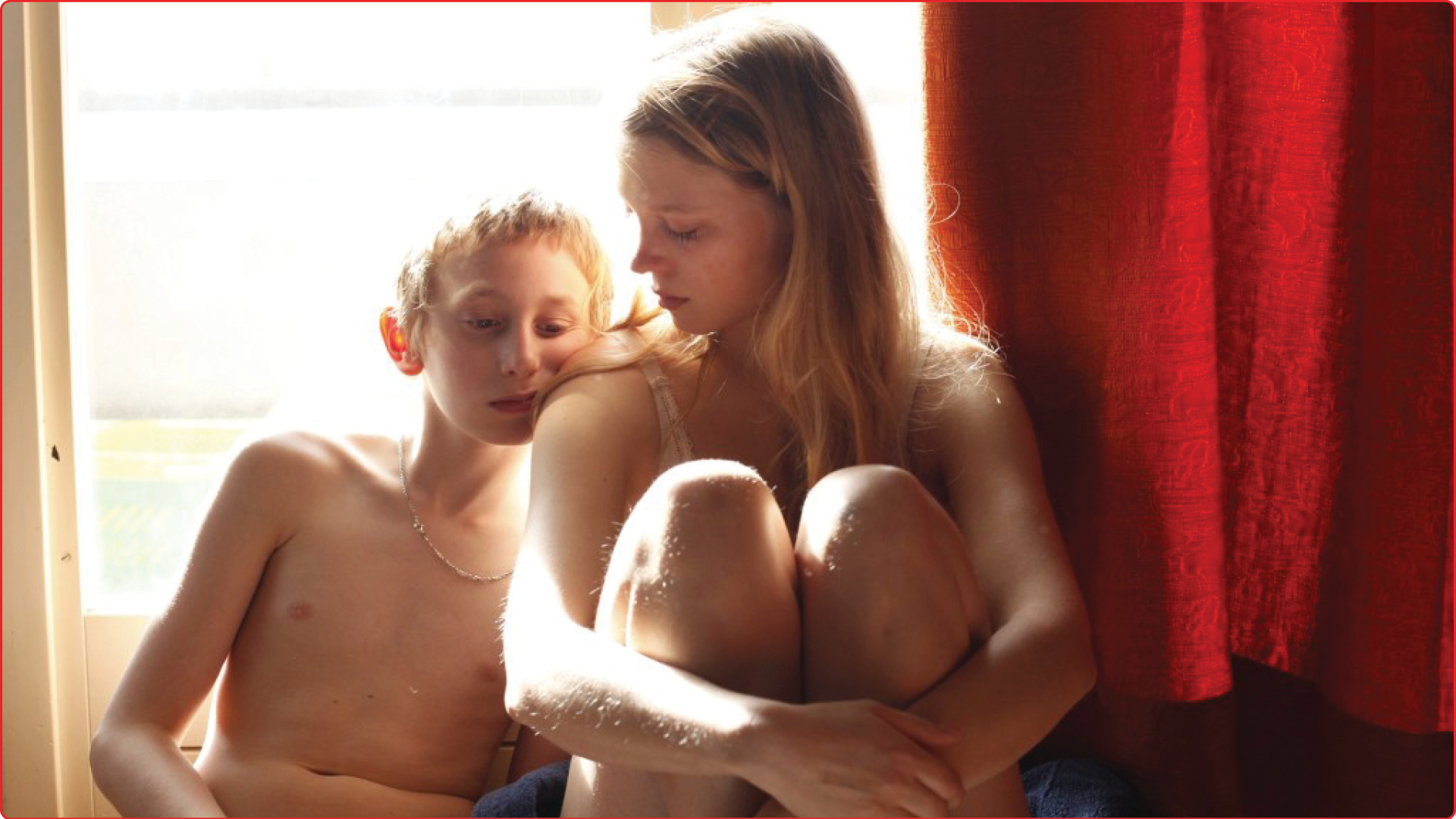
Meier called Home a “completely horizontal film,” and has stated she wanted to follow it up with what she “can only describe as a vertical film.” The result was 2012’s Sister, called L’enfant d’en haut in France, which translates roughly to “the child above.” It follows 12-year-old Simon (Kacey Mottet Klein, following up his role as the youngest member of the family at the center of Home), who lives in a housing complex at the bottom of a Swiss ski resort. Every day Simon takes the cable car up the mountain, ascending from his scrappy working-class enclave to the luxurious mountain playground of wealthy tourists. He steals skis and other equipment from the unsuspecting patrons, which he transports back down the hill to refurbish and resell.
What first appears to be childlike mischief is quickly divulged to be an act of survival. Simon is the primary breadwinner for his family, which consists of him and his flaky older sister Louise (played by a post-Tarantino, pre-Bond Girl Léa Seydoux). Louise’s position in life is certainly sympathetic; the absence of the rest of their family indicates that she herself has likely been forced to be a kind of survivor, particularly during the years in which Simon was too young to play Robin Hood. But as she remains trapped in an extended adolescence, it’s Simon who is left to take up the role of caretaker, devastatingly at the expense of his own childhood. Like François Truffaut’s The 400 Blows (1959) or Abbas Kiarostami’s Where Is the Friend’s House? (1987), Sister is a masterful portrayal of boyhood-particularly, a boy trying to carve out agency in a world that seems to have designs against him.

Sister (2012)
Meier’s latest film, 2022’s The Line, takes this exploration of the divisions between family members to perhaps its most literal end. The movie opens with a sequence of cozy household items in Crayola colors: a green vase, a bunch of golden flowers, a box of teabags each encased in candy apple-red envelopes, records in lemon yellow sleeves, sheet music. The viewer only has the chance to see them for a couple of seconds as they arc across the screen before hurtling against a stark white wall, smashing to bits and fluttering in slow motion, set to an operatic score. The camera cuts and the audience is introduced to 35-year-old Margaret (Stéphanie Blanchoud), her face contorted in rage as two men attempt to restrain her. The scene expands to reveal a house in chaos. Furniture is overturned, a tween girl tries to intervene, a mother (Valeria Bruni Tedeschi) cowers in fear.
The Line starts off as a character study of Margaret, a woman with untreated anger issues, covered in visible scars, whose relationships with those around her are strained. Her reasons for attacking her mother Christina are never all that clear (Margaret claims she was defending her kid sister, Marion, from an insult). Christina retaliates by enforcing a restraining order, prohibiting Margaret from coming within 100 meters of the family home in Port-Valais, Switzerland, for three months. Margaret doesn’t take this seriously; she plays fast and loose with the boundary in order to try and see the other members of her family. The youngest, Marion (Elli Spagnolo), desperate to keep some version of peace and to protect both her mother and sister, takes it upon herself to measure out a 100-meter circumference around the home, and paints on the ground the blue line of the movie’s title. Marion and Margaret continue to meet at the border each day, where Margaret gives her little sister singing lessons.
The humor and heart in Meier’s movies comes from playing at the tensions between the stoic and the absurd
The adult women in the film drive the conflict. Margaret seems stubbornly unwilling to learn from her actions, while the diva-like Christina sees herself as the ultimate victim, going so far as to throw out her beloved piano, despite the fact that young Marion also has musical aspirations. Like Simon in Sister, it’s Marion who has to absorb all the chaos of her environment. She’s the one who enforces the boundaries, while simultaneously keeping the lines of communication open. It’s not that the pain experienced by Margaret and Christina isn’t real-both are excruciatingly believable: Margaret, a woman filled with rage with nowhere to put it; and Christina, a young mother forced to cede her own ambitions to play a role she clearly never wanted. But it’s Marion who ends up with the least amount of agency. She’s able to cross freely over the painted line that separates her sister and mother, yet is increasingly trapped between the confines imposed by the two women’s wounded pride.
The humor and heart in Meier’s movies comes from playing at the tensions between the stoic and the absurd, an amalgam of French, Swiss, and Belgian influences, standing equally on the shoulders of cinema verité and surrealism. Meier resolves the borders that appear in each of her films differently, taking aim at all the manners in which physical barriers can reify emotional ones, or perhaps how emotional barriers can reify physical ones. Either way, once they’re in place, it is difficult to tell the difference.
Anna Fitzpatrick is a Toronto based writer. She is the author of the novel Good Girl and the children’s book Margot and the Moon Landing.

The Line (2022)